


Career Articles
Capgemini Exceller Technical Assessment 2026: AI + Technical - Best Guide
Cognizant GenC Elevate Exam Pattern & Syllabus for Freshers 2026 - Best Guide
Capgemini Exceller Placement Papers and Solutions 2026 - Best Guide
How to Pass the Accenture Recruitment Process 2026/27: The Complete Guide


Get In Touch For Details! Request More Information
Can You Become a Software Engineer Without a Degree in India? (2026 Reality)
Jul 30, 2026 9 Min Read 9080 Views
(Last Updated)
Have you ever looked at a job posting for a software engineer and thought, “I could do this… if only I had a degree”? If so, you’re not alone. In today’s world, more people are asking a powerful question: Do I need a computer science degree to become a software engineer, or can I build the skills myself and become a software engineer without a degree?
The answer is a resounding yes, especially in India’s rapidly evolving tech ecosystem, where companies are increasingly valuing skills over formal education. According to a recent report, about 30% of Indian companies plan to adopt skills-based hiring by dropping degree requirements (compared to 19% globally).
If you’re an aspiring engineer, this article will show you how you can build a software development career through self-learning. Let’s dive into your journey step by step.
Table of contents
- TL;DR Summary
- Can You Become a Software Engineer Without a Degree?
- Who is a Software Engineer?
- Types of Software Engineers- Choose Your Path
- Roadmap To Becoming a Software Engineer Without a Degree
- Core Programming Skills
- Computer Science Fundamentals
- Tools of the Trade
- Pick a Specialization (But Not Too Soon)
- Leveraging Online Resources and Learning Platforms
- Working on Projects and Building a Portfolio
- Software Engineer Salary Without a Degree in India (2026)
- How Long Does It Take to Become a Software Engineer Without a Degree?
- Companies in India That Hire Software Engineers Without a CS Degree
- Company Hiring Requirements at a Glance
- Bootcamp vs Self-Taught vs Online Course: Which Works in India?
- Self-Taught Route
- Online Course Route
- Coding Bootcamp Route
- Which Option Works Best?
- What Self-Taught Developers Earn vs Degree Holders in India
- Indicative Salary Comparison
- Quick Quiz: Test Your Software Engineering Basics
- What Skills Do You Actually Need? (Complete Checklist)
- Technical Skills - Must Have
- Technical Skills - Strong Plus
- Soft Skills - Often Underrated
- How to Choose Your First Software Engineering Job
- How to Handle Rejection Without Losing Momentum
- Conclusion
- FAQs
- Is it possible to become a software engineer without a degree?
- What skills are essential for self-taught software engineers?
- How can I gain experience without a formal job?
- Are coding bootcamps a good alternative to a degree?
- What challenges might I face without a degree, and how can I overcome them?
TL;DR Summary
- A computer science degree is not mandatory to become a software engineer in 2026.
- Build strong skills in programming, data structures, algorithms, Git, databases, APIs, and debugging.
- Choose a specialization after learning the fundamentals, such as frontend, backend, mobile, DevOps, data, or AI.
- Create practical projects, publish them on GitHub, and use your portfolio to prove job-ready skills.
- Consistent learners can become job-ready within 6–18 months through courses, coding practice, projects, and interview preparation.
Can You Become a Software Engineer Without a Degree?
Yes, and it’s more achievable than ever. In 2026, approximately 30% of Indian companies have moved to skills-based hiring, dropping degree requirements entirely (vs. 19% globally). Globally, major tech firms like Google, Apple, and IBM have removed the CS degree mandate for software engineering roles, prioritising what you can build over where you studied.
- The median JavaScript payload reached 558 KB on mobile and 613 KB on desktop in 2024, according to the HTTP Archive Web Almanac.
- Median JavaScript payloads increased by 14% compared with the previous year, highlighting the growing complexity of modern web applications.
Who is a Software Engineer?
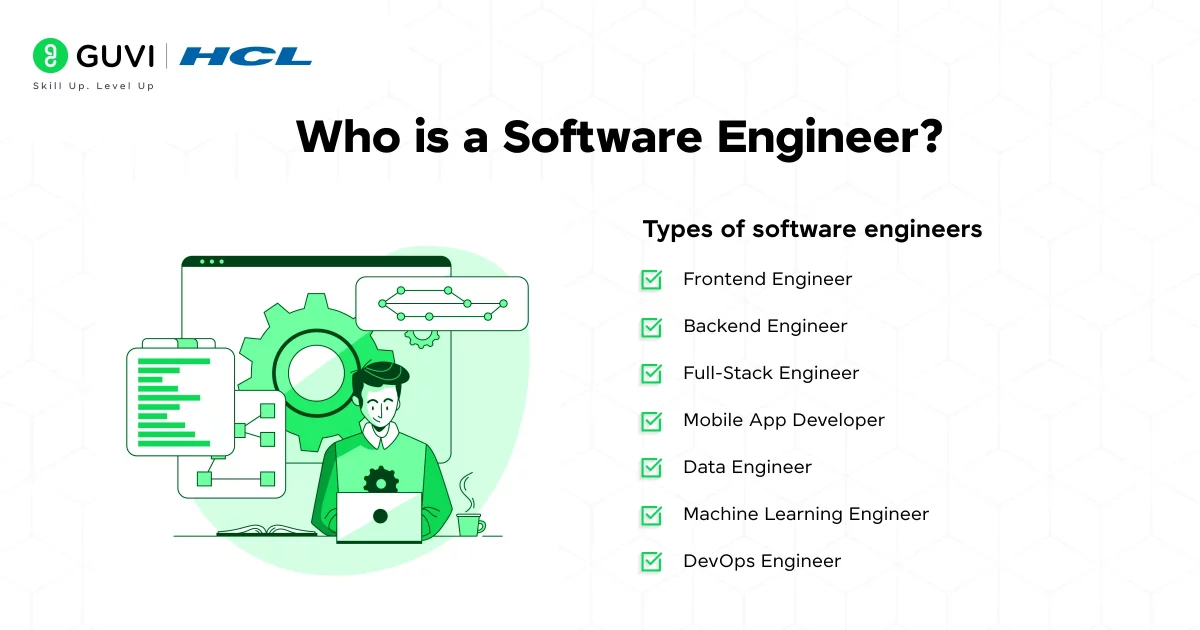
A software engineer is a professional who designs, develops, tests, and maintains software systems and applications. They use programming languages, engineering principles, and computer science concepts to build reliable, scalable, and efficient software that solves real-world problems or meets user needs.
In simple terms, a software engineer is someone who writes code and thinks structurally about how to build an entire software system, much like how an architect designs a building. Their work can range from developing mobile or web apps to creating embedded software for devices, or even working on complex backend systems that support large-scale services like banking or e-commerce platforms.
Types of Software Engineers- Choose Your Path
| Role | What You Build | Key Skills |
| Frontend Engineer | User interfaces, web pages | HTML, CSS, JavaScript, React |
| Backend Engineer | Servers, APIs, databases | Python, Node.js, SQL, Java |
| Full-Stack Engineer | Both frontend and backend | All of the above |
| Mobile App Developer | iOS/Android apps | Swift, Kotlin, Flutter |
| Data Engineer | Data pipelines, warehouses | Python, SQL, Spark |
| ML/AI Engineer | Machine learning models | Python, TensorFlow, PyTorch |
| DevOps Engineer | Deployment, infrastructure | Docker, Kubernetes, AWS |
Roadmap To Becoming a Software Engineer Without a Degree
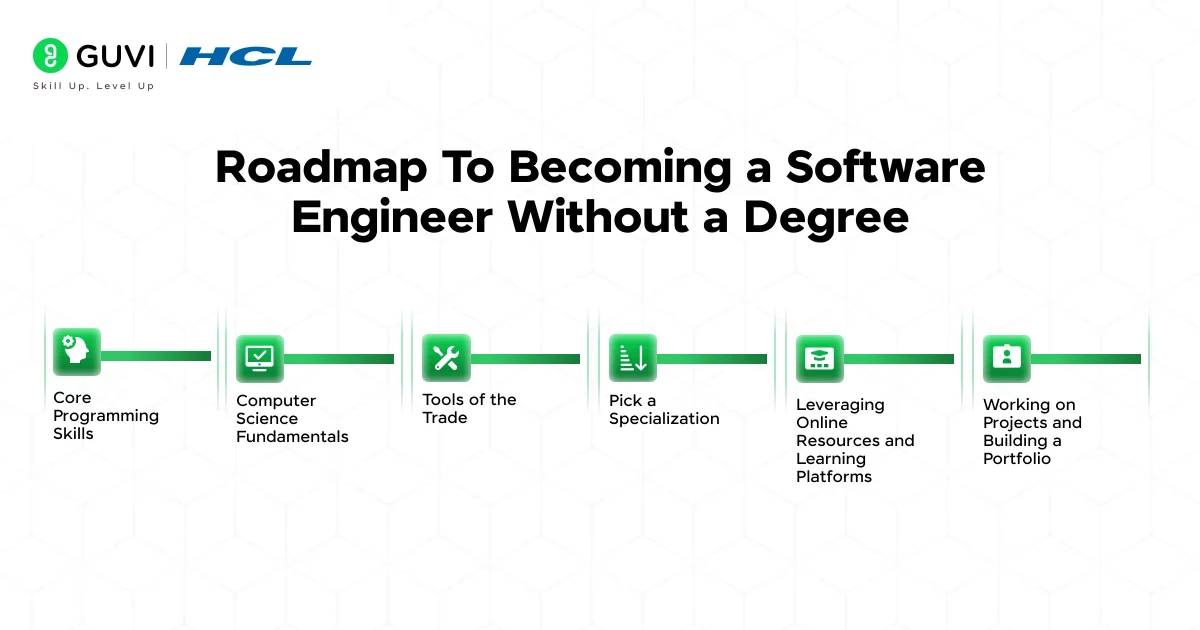
Embarking on a self-taught path requires a clear roadmap. Since you already know programming basics, you’ll need to plan out what to learn next and how to learn it. Think of this as designing your curriculum. Here are the main components of a solid self-taught roadmap:
1. Core Programming Skills
Deepen your knowledge of at least one or two programming languages. Pick languages that align with the jobs you want.
For example, Python (great for web development, automation, and data science), JavaScript (essential for web development, both front-end and back-end with Node.js), or Java (widely used in enterprise applications and Android development).
2. Computer Science Fundamentals
A degree program would cover fundamentals like data structures, algorithms, and operating system basics, and so should your self-learning plan.
Strengthen your understanding of structures like arrays, linked lists, stacks, queues, trees, and algorithms for sorting, searching, etc. Practice analyzing the time and space complexity of your code.
3. Tools of the Trade
Professional software engineers use a variety of tools. Make sure you learn:
- Version Control: Git is a must-know. Learn how to use Git and platforms like GitHub or GitLab to track code changes. This not only helps in collaboration but is also often expected by employers.
- Development Environment & OS: Get comfortable with the operating system you’ll develop on (many prefer Linux for back-end development or use Linux/WSL on Windows).
- Databases: Understand the basics of databases and SQL. Even if you aim to be a front-end developer, knowing how data is stored and queried is valuable.
- Cloud and Other Technologies (Optional): Modern software engineering often involves cloud platforms and containers. You don’t need to be an expert from day one, but being aware of technologies like Docker (containers) or cloud services (AWS, Azure, GCP) can be a plus.
4. Pick a Specialization (But Not Too Soon)
Software development is a broad field, there’s web development, mobile app development, data science, machine learning, cloud computing, and more. It’s good to explore and find what excites you, but also ensure you build a strong general foundation first.
Once you have core skills, you might choose to specialize. For example, if you love building websites, focus on full-stack web development; if algorithms and analysis interest you, maybe explore data science or AI. Specializing can make you stand out in that area, but even as a specialist, a well-rounded knowledge base will help you adapt to different roles.
Build a job-ready software engineering path without depending only on a degree with HCL GUVI’s Full Stack Development Course. Learn HTML, CSS, JavaScript, React, backend development, databases, APIs, Git, and real-world project building through structured training designed for aspiring software engineers in India.
5. Leveraging Online Resources and Learning Platforms
One huge advantage of being a self-taught programmer today is the wealth of online resources available. You have thousands of courses, tutorials, and practice platforms at your fingertips. The trick is choosing quality resources and using them effectively. Let’s break down some of the best ways to learn online:
Massive Open Online Courses (MOOCs) and tutorial sites can give you structured learning like a classroom. Many are free or low-cost. Popular platforms and resources include:
- HCL GUVI: (Grab Ur Vernacular Imprint) is an Indian edtech platform powered by IIT-Madras and IIM-A alumni. It stands out by offering tech courses in multiple Indian languages such as Tamil, Telugu, Hindi, and English, making it easier for beginners from regional backgrounds to learn in their comfort language. They offer:
- Structured Courses on Full Stack Development, Python, Java, Data Science, Machine Learning, and more.
- Zen Class: HCL GUVI’s flagship career program, which includes mentor-led sessions, mock interviews, coding challenges, and placement support.
- Codekata & Webkata: Practice platforms for coding and web development challenges, similar to HackerRank or LeetCode, tailored for Indian learners.
- Real-World Projects: Students build deployable apps as part of the curriculum — great for your portfolio.
- Certification: Verified certificates and GitHub-linked progress, which recruiters in India recognize.
- Job Board & Placement Drives: Access to tech jobs through HCL GUVI’s hiring partners.
- Udemy: Udemy has countless programming courses (often inexpensive during sales). You can find a course on just about any technology – e.g., a Python bootcamp, web development masterclass, etc. Just check the reviews and instructor reputation before you pick one.
- freeCodeCamp: This is a fantastic free resource, especially for web development. It provides a structured curriculum for full-stack web development (HTML, CSS, JS, front-end libraries, APIs, etc.), and you build projects along the way. Many self-taught developers in India have used freeCodeCamp to jumpstart their careers.
When using these resources, try to follow along actively. Don’t just watch videos—code with them, pause and experiment, take notes, and do the exercises. The goal is to retain skills, not just consume content.
6. Working on Projects and Building a Portfolio
Projects are your proof of skill. When you don’t have a degree to show, a portfolio of projects becomes your resume in many ways. Employers in India (and everywhere) want to see that you can build something real. Here’s how to go about it:
Start Building, Start Small
Begin with small, achievable projects that reinforce what you’ve learned. For example:
- If you learned web development, build a personal blog site or a simple portfolio website using HTML/CSS/JS.
- If you learned Python, maybe create a script that automates a simple task (like scraping some data from the web or a command-line to-do list app).
- If you are into mobile development, create a basic to-do app or a simple game.
The project doesn’t have to be novel; the goal is to apply your knowledge and learn practical development skills (like debugging, using APIs, etc.). With each project, try to incorporate a new concept.
Software Engineer Salary Without a Degree in India (2026)
| Experience Level | Salary Range (LPA) | Notes |
| Entry-Level (0–1 year) | ₹3–7 LPA | Varies by city and company size |
| Junior Engineer (1–3 years) | ₹6–14 LPA | Skill-dependent |
| Mid-Level (3–6 years) | ₹14–28 LPA | Strong portfolio accelerates growth |
| Senior Engineer (6+ years) | ₹28–60+ LPA | Skills > degree at this level |
How Long Does It Take to Become a Software Engineer Without a Degree?
| Commitment Level | Realistic Timeline |
| 2–3 hours/day | 12–18 months |
| 4–6 hours/day | 8–12 months |
| Full-time (8+ hours/day) | 4–6 months |
| Structured bootcamp (e.g., GUVI Zen Class) | 6–9 months with placement support |
Companies in India That Hire Software Engineers Without a CS Degree
Not having a Computer Science degree is different from having no degree at all.
Some employers accept graduates from other academic backgrounds. A smaller number consider candidates without a conventional bachelor’s degree when they have equivalent practical experience.
Google job listings in India commonly mention a bachelor’s degree or equivalent practical experience. Microsoft also uses equivalent experience in selected technical job requirements. These policies do not guarantee that every role will accept a candidate without a degree. Each job description must be checked separately.
IBM offers apprenticeship pathways for candidates who do not have a four-year degree in their chosen field. Zoho Schools of Learning also focuses on practical ability rather than conventional paper credentials.
Company Hiring Requirements at a Glance
| Company or Hiring Pathway | Degree Required? | Alternative Accepted | Portfolio Needed? |
|---|---|---|---|
| Google India | Not always | Equivalent practical experience may be accepted for selected roles | Strongly recommended |
| Microsoft India | Depends on the role | Equivalent technical experience may be accepted | Strongly recommended |
| IBM Apprenticeship | No four-year degree in the selected field required | Domain knowledge and apprenticeship assessment | Helpful |
| Zoho Schools of Learning | Conventional college degree not required for the learning pathway | Skills-based training and practical assessments | Helpful |
| TCS iON NQT Hiring Ecosystem | A degree or diploma is usually required by participating employers | Candidates from different degree streams can prove skills through NQT | Helpful |
| Wipro WILP | Yes, but a B.Tech CS degree is not required | Selected BCA and B.Sc graduates can enter through the work-study pathway | Usually not mandatory |
| Indian Startups | Depends on the company | Projects, freelance work, internships, or coding assessments | Often important |
TCS iON allows students pursuing any degree to take its IT-focused NQT pathway. However, the final eligibility conditions are decided by the company posting the job. Wipro WILP provides a technology-career pathway for eligible BCA and B.Sc graduates rather than candidates with no degree.
A company appearing in this table does not mean that every software engineering vacancy is degree-free. Candidates should always check the minimum qualifications listed for the exact role.
Bootcamp vs Self-Taught vs Online Course: Which Works in India?
All three learning routes can lead to a software development career. The right choice depends on the learner’s budget and need for guidance.
| Learning Route | Best Suited For | Main Benefit | Main Limitation | Typical Timeline |
| Self-taught learning | Independent learners with strong discipline | Lowest cost and complete flexibility | No fixed roadmap or placement support | 9 to 18 months |
| Online course | Learners who need structured lessons | Flexible and easier to follow | Feedback may be limited | 6 to 12 months |
| Coding bootcamp | Learners seeking faster career preparation | Mentorship and project-based learning | Costs more than self-learning | 6 to 9 months |

Self-Taught Route
The self-taught path works well for learners who can plan their own curriculum. Free documentation and coding platforms can cover nearly every technical topic.
However, many learners struggle to decide what to study next. They may also keep watching tutorials without building complete applications.
A self-taught developer should create a clear roadmap and follow weekly targets. Regular coding practice should be supported by portfolio projects.
Online Course Route
An online course gives learners an organised curriculum. It is suitable for students or working professionals who need flexibility.
The course should include coding exercises and practical assignments. A certificate alone will not prove job readiness.
Learners must use the course to build independent projects. These projects should be published on GitHub and deployed online.
Coding Bootcamp Route
A bootcamp provides a faster and more structured learning environment. It can include live mentoring and mock interviews.
This pathway works best for learners who need accountability. It can also help career switchers who are unsure about the Indian hiring process.
Bootcamps vary considerably in quality. Check the curriculum and mentor access before paying. Placement assistance should not be treated as a guaranteed job.
Which Option Works Best?
Self-learning is suitable for highly disciplined learners. An online course offers more structure without requiring a full-time commitment.
A bootcamp can reduce confusion for complete beginners. However, the final result still depends on coding practice and project quality.
The strongest route is often a combination. A learner can follow a structured course while independently building projects and practising interview questions.
Build a job-ready software engineering path without depending only on a degree with HCL GUVI’s AI Software Development Course. Learn AI-powered coding, software development fundamentals, frontend and backend workflows, automation, APIs, and real-world project building through structured training designed for aspiring software engineers in India.
What Self-Taught Developers Earn vs Degree Holders in India
No reliable Indian salary database provides a direct national comparison between self-taught software engineers and degree holders.
Most salary platforms report earnings according to the role, company, location, and experience. They do not consistently record how a developer learned programming.
Public salary data from 2025 shows wide variation across employers. Software developer pay at large Indian IT companies often ranged between approximately ₹4 LPA and ₹10 LPA. Product companies and specialised engineering roles could offer considerably more.
Indicative Salary Comparison
| Career Stage | Self-Taught or No CS Degree | CS Degree Holder | India Hiring Reality |
| Entry level | Around ₹3–7 LPA | Around ₹4–10 LPA | Degree holders usually have better campus access |
| 1–3 years | Around ₹6–14 LPA | Around ₹6–16 LPA | The ranges begin to overlap significantly |
| 3–6 years | Around ₹12–28 LPA | Around ₹12–30 LPA | Production experience becomes more important |
| Senior level | Can exceed ₹25 LPA | Can exceed ₹25 LPA | Company and engineering depth matter more than the learning route |
These figures are broad market estimates. They should not be treated as guaranteed salary bands.
A self-taught developer may accept a lower first salary to gain commercial experience. Degree holders may enter through campus placements with a more structured starting package.
The difference can narrow after the developer gains two or three years of relevant experience. Shipped products and system-design knowledge can then carry more weight.
The degree may still matter for government roles or companies with fixed education policies. It may also affect eligibility for certain postgraduate programs or international visas.
Quick Quiz: Test Your Software Engineering Basics

Let’s take a short break for a quick quiz! This mini-quiz will let you gauge your understanding of some essential software engineering concepts. Ready? Grab a pen and paper (or just your brain) and give these questions a shot:
- Time Complexity: You have an array of n numbers that is already sorted. You want to check if a number x is present in this array. Which algorithmic approach is more efficient?
- a) Scanning through each element one by one (linear search), or
- b) Using a binary search algorithm?
- a) Scanning through each element one by one (linear search), or
- What is the time complexity of the more efficient approach?
- Data Structures: Imagine you need to manage a waiting line of people for a ticket counter. People join at the back of the line, and the person at the front gets served and leaves. Which data structure does this scenario represent? Why?
Code Output: Consider the following snippet of Python code:
numbers = [1, 2, 3, 4]

for i in range(len(numbers)):

    numbers[i] *= 2

print(numbers)- What will be the output of this code? (If you’re not familiar with Python, the logic is: take a list of numbers 1,2,3,4 and multiply each element by 2).
Take a moment to think about your answers before reading on. No peeking!
Quiz Answers:
- Binary search is a more efficient approach for a sorted array. Linear search would check elements one by one, taking O(n) in the worst case. Binary search, on the other hand, repeatedly divides the search range in half, which runs in O(log n) time. So (b) is correct, with time complexity O(log n). In other words, binary search is much faster on large sorted arrays because it eliminates half of the remaining elements in each step.
- The scenario describes a queue. A queue data structure works on a FIFO (First-In-First-Out) principle – just like a real queue, the first person in line is the first served, and new people join at the end. We use a queue because it enforces that order: no one can bypass the line. (By contrast, a stack is LIFO, which wouldn’t fit a waiting line scenario.)
- The code will output [2, 4, 6, 8]. The loop goes through each index of the list of numbers and multiplies the element at that index by 2. So the list [1, 2, 3, 4] becomes [2, 4, 6, 8]. (This was a straightforward one – if you got this, you understand basic loops and array/list manipulation!)
How did you do? If you found these easy, great! If you missed one, you’ve identified a topic to review. Quizzing yourself regularly is a good habit to reinforce your learning.
What Skills Do You Actually Need? (Complete Checklist)
Technical Skills – Must Have
- Proficiency in at least one programming language (Python or JavaScript recommended)
- Data Structures & Algorithms (LeetCode Easy → Medium)
- Version control with Git and GitHub
- SQL and basic database design
- Understanding of REST APIs and HTTP
- Basic command line / terminal usage
Technical Skills – Strong Plus
- A frontend framework (React, Vue, or Angular)
- A backend framework (Django, Flask, Express, Spring)
- Basic cloud knowledge (AWS free tier, Netlify, Vercel)
- Docker basics
- Testing fundamentals (unit tests, integration tests)
Soft Skills – Often Underrated
- Clear written communication (essential for remote teams and code reviews)
- Ability to read and understand documentation
- Debugging mindset – knowing how to search for answers, not just memorise them
- Consistency and self-discipline
How to Choose Your First Software Engineering Job
Your first role should provide learning opportunities, code reviews, real projects, and experienced team members. Salary matters, but early career growth often depends more on the quality of technical exposure.
Look for roles that offer:
- Structured onboarding
- Regular code reviews
- Access to senior developers
- Production-level projects
- Clear performance expectations
- Opportunities to work across the development cycle
Avoid roles that advertise software engineering but mainly involve repetitive data entry, technical support, or unrelated operational work.
How to Handle Rejection Without Losing Momentum
Self-taught candidates may face more initial rejections because some companies still use strict education filters. Rejection does not always reflect technical ability.
Track every application and record:
- Skills mentioned repeatedly in job descriptions
- Questions asked during interviews
- Technical topics you struggled to explain
- Projects that attracted recruiter interest
- Resume versions that received responses
Use this information to improve your resume, portfolio, and interview preparation instead of applying randomly.
Conclusion
In conclusion, choosing to become a software engineer without a degree is a brave and exciting path. It’s rewarding – you have the freedom to craft your education, but it also demands persistence and self-motivation.
As you’ve seen, you’re not alone on this journey. The tech industry is increasingly welcoming to self-taught talent, in India and globally. Companies care about what you can build and how you can think through problems.
If you ever doubt that, remember that skills-first hiring is on the rise, even in traditionally degree-obsessed India, and many top companies (Google, Apple, etc.) have dropped strict degree requirements, focusing on practical skills instead.
FAQs
1. Is it possible to become a software engineer without a degree?
Absolutely. Many tech companies prioritize practical skills and experience over formal education. By learning programming languages, building a strong portfolio, and gaining real-world experience, you can pursue a successful career in software engineering without a traditional degree.
2. What skills are essential for self-taught software engineers?
Key skills include proficiency in programming languages like Python, JavaScript, or Java, understanding of data structures and algorithms, and familiarity with version control systems like Git. Additionally, problem-solving abilities and effective communication are crucial for collaborating with teams and stakeholders.
3. How can I gain experience without a formal job?
You can start by working on personal projects, contributing to open-source software, or participating in coding challenges and hackathons. These activities not only enhance your skills but also help build a portfolio that showcases your capabilities to potential employers.
4. Are coding bootcamps a good alternative to a degree?
Yes, coding bootcamps offer intensive, short-term training programs that focus on practical skills needed in the industry. They can be a cost-effective and time-efficient alternative to traditional degrees, often including career support services to assist with job placement.
5. What challenges might I face without a degree, and how can I overcome them?
Without a degree, you might encounter skepticism from some employers. To overcome this, focus on building a strong portfolio, obtaining relevant certifications, and networking within the industry. Demonstrating your skills and commitment can help mitigate concerns about formal education credentials.
Success Stories

About the Author
Vaishali
I'm a seasoned writer with four years of experience across technical, non-technical, and just about every genre or niche you can imagine. Adaptable and curious, I enjoy exploring new topics and making information engaging and easy to understand. Fueled by a steady stream of tea, I approach each project with creativity, reliability, and genuine enthusiasm for storytelling.
View all posts by Vaishali
Connect with me @










Did you enjoy this article?