


Data Science Articles
Accountant vs Data Analyst Salary in India After Switching Careers - Best Guide
Finance Managers: Could Data Science Be Your Next Career Move?
Insurance Claims Executive to Data Analyst: Is It a Good Switch?
Banking Executive (Loans, KYC) to Data Analyst: Skills and Career Path


Get In Touch For Details! Request More Information
Top 10 Benefits of Data Science for Businesses and Careers in 2026
Sep 07, 2026 7 Min Read 11682 Views
(Last Updated)
Every click, payment, search, delivery, sensor and customer interaction creates data. The challenge for businesses is no longer collecting information. It is deciding what that information actually means and what to do with it.
Approximately 402.74 million terabytes of data are created every day, according to current estimates. Yet raw data on its own has very little business value. It becomes useful only when organisations can analyse it, identify patterns and turn those patterns into decisions.
That is where data science becomes important. Data science combines statistics, programming, machine learning and business knowledge to answer practical questions. Which customers are likely to leave? How much inventory will be needed next month? Which transaction looks suspicious? Which product feature is actually improving engagement?
The benefits of data science extend far beyond reporting. It can help organisations predict outcomes, automate decisions, reduce costs and uncover opportunities that would otherwise remain hidden. This guide explores the major advantages of data science for businesses, industries and professionals in 2026.
Quick Answer: Data science is the process of using statistics, programming, machine learning and domain knowledge to turn raw data into useful insights. Its biggest benefits include better decisions, accurate forecasting, lower operational costs, personalised customer experiences, fraud detection and faster product development.
- For businesses: Data science improves revenue forecasting, efficiency, customer understanding and risk management.
- For professionals: It creates career opportunities across technology, finance, healthcare, retail and other data-driven industries.
- For decision-making: Predictive models and real-time analytics help organisations act on evidence instead of assumptions.
- For growth: Data science helps businesses identify opportunities, optimise resources and scale operations more intelligently.
Table of contents
- What Is Data Science?
- Benefits of Data Science at a Glance
- Why Is Data Science Important in 2026?
- Top 10 Benefits of Data Science
- Better and Faster Decision-Making
- Revenue Growth Through Predictive Analytics
- Operational Efficiency and Cost Reduction
- More Personalised Customer Experiences
- Improved Risk Management and Fraud Detection
- Smarter Product Development
- Better Marketing Performance
- Stronger Competitive Advantage
- Easier Business Scaling and Automation
- Better Forecasting and Long-Term Planning
- Benefits of Data Science for Businesses vs Professionals
- Benefits of Data Science Across Different Industries
- Career Benefits of Learning Data Science in 2026
- Key Components That Make Data Science Valuable
- What Are the Limitations of Data Science?
- How Can Businesses Get the Most Value From Data Science?
- Conclusion
- FAQs
- What are the main benefits of data science?
- How does data science benefit businesses?
- Why is data science important for the future?
- What are the benefits of data science as a career?
- What is a real-life example of data science?
What Is Data Science?
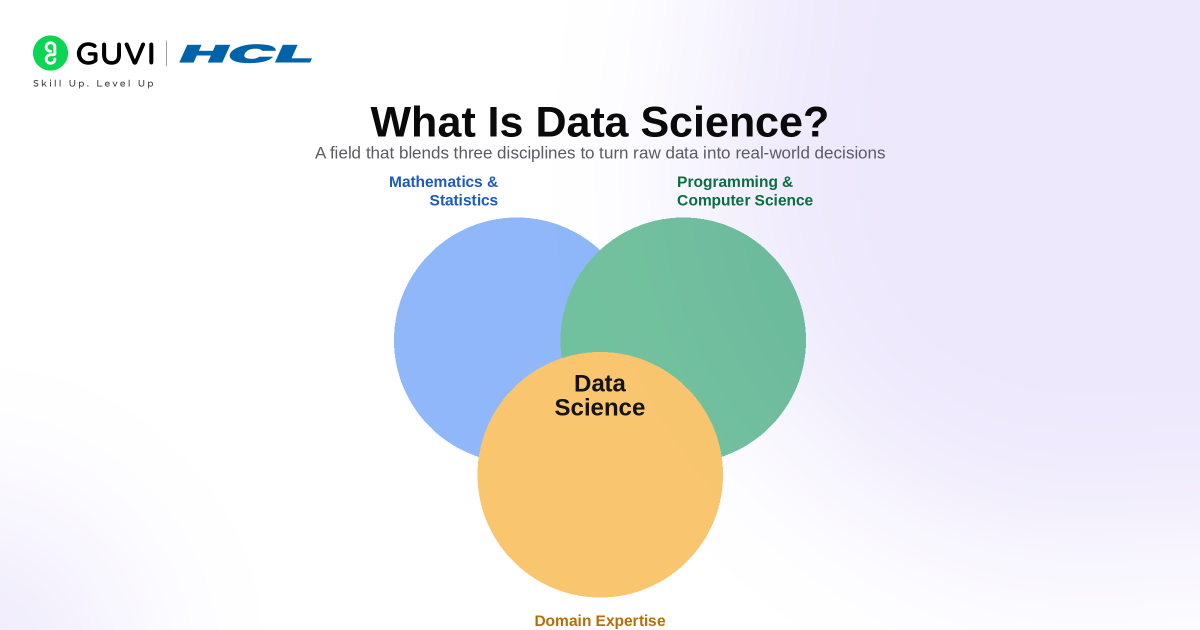
Data science is an interdisciplinary field that uses statistical analysis, programming, machine learning and domain expertise to extract useful information from structured and unstructured data.
A modern data science workflow can include:
- Collecting information from databases, APIs, applications, IoT devices and other sources
- Cleaning and preparing raw data
- Exploring patterns and relationships
- Applying supervised and unsupervised learning techniques
- Building predictive or analytical models
- Evaluating model performance
- Deploying models into real applications
- Monitoring performance over time
- Communicating findings through data visualisation
Data science therefore covers much more than building machine learning models. It connects the entire journey from raw information to a business decision.
Benefits of Data Science at a Glance
| Benefit | How Data Science Helps | Example |
| Better decision-making | Uses evidence and predictive models instead of assumptions | Forecasting future demand |
| Revenue growth | Identifies profitable customers, products and pricing opportunities | Customer lifetime value prediction |
| Cost optimisation | Finds inefficient processes and resource usage | Delivery route optimisation |
| Personalisation | Analyses individual customer behaviour | Product recommendations |
| Risk reduction | Detects abnormal patterns and potential threats | Fraud detection |
| Product improvement | Measures how customers use features | Feature prioritisation |
| Marketing efficiency | Identifies effective audiences and channels | Campaign attribution |
| Automation | Automates repeatable analytical decisions | Automated risk scoring |
| Forecasting | Models possible future outcomes | Sales and capacity forecasts |
| Competitive advantage | Identifies trends and opportunities earlier | Market and sentiment analysis |
Why Is Data Science Important in 2026?
Businesses now generate information from more sources than traditional spreadsheets and databases.
Modern data can come from:
- Mobile applications
- Digital payments
- E-commerce platforms
- Customer-support conversations
- Cloud applications
- Website behaviour
- Connected devices
- Supply-chain systems
- Social platforms
- AI applications
The challenge is connecting these data points and extracting something useful from them.
Data science helps organisations move through three increasingly valuable levels of analysis:
- Descriptive analytics explains what happened.
- Predictive analytics estimates what could happen next.
- Prescriptive analytics helps determine what action should be taken.
This shift from reporting the past to anticipating future outcomes is one of the biggest reasons data science has become central to modern business strategy.
Top 10 Benefits of Data Science
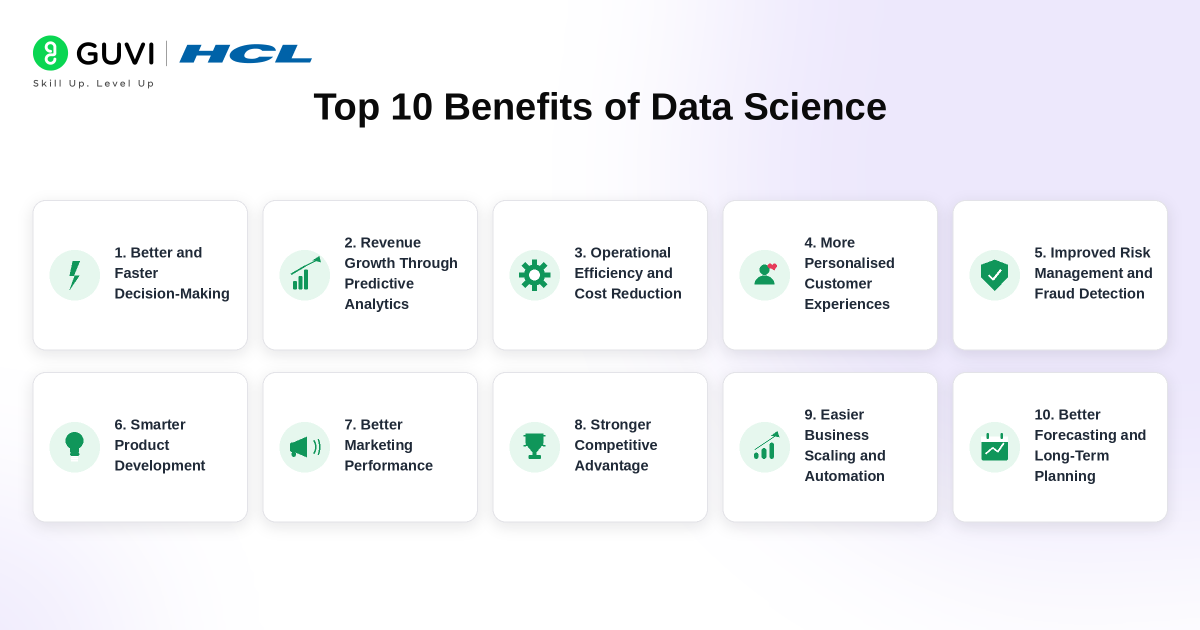
1. Better and Faster Decision-Making
One of the most important benefits of data science is its ability to improve decisions.
Traditional decisions may depend on intuition, past experience or reports created several days after an event. Data science allows teams to combine larger datasets and analyse patterns more systematically.
For example, a retailer can analyse:
- Previous sales
- Seasonality
- Customer behaviour
- Inventory
- Pricing
- Promotions
The business can then estimate how much demand a product may receive instead of ordering inventory based mainly on assumptions.
Data science supports better decisions through:
- Real-time dashboards
- Predictive modelling
- Scenario analysis
- Anomaly detection
- Data-driven KPIs
- Automated alerts
The goal is not to remove human judgement. It is to give decision-makers stronger evidence before they act.
2. Revenue Growth Through Predictive Analytics
Data science can help businesses identify where future revenue is most likely to come from.
Predictive models can analyse customer behaviour, product demand and historical transactions to estimate future outcomes.
Common applications include:
- Demand forecasting: Predicting how much of a product customers may purchase
- Customer lifetime value: Estimating the long-term value of different customer groups
- Churn prediction: Identifying customers who may stop using a service
- Pricing optimisation: Analysing demand and customer behaviour to improve pricing decisions
- Cross-selling: Identifying products customers are likely to purchase together
Instead of treating every customer or product equally, organisations can concentrate resources where they are likely to create the greatest value.
3. Operational Efficiency and Cost Reduction
Data science can uncover inefficiencies that may be difficult to identify manually. Imagine a delivery company managing thousands of orders every day. Fuel use, vehicle capacity, traffic conditions and delivery locations all affect operating costs.
Analytical models can examine these variables together and recommend more efficient decisions. Examples include:
- Optimising delivery routes
- Matching workforce levels with expected demand
- Detecting workflow bottlenecks
- Forecasting inventory requirements
- Reducing unnecessary energy use
- Predicting equipment failures
Predictive maintenance is particularly useful in industries where unexpected equipment failure can interrupt production. Instead of waiting for a machine to fail, organisations can analyse sensor and maintenance data to identify warning signs earlier.
4. More Personalised Customer Experiences
Customers rarely behave exactly the same way. One person may purchase based on price. Another may care about convenience. Some customers visit frequently but buy occasionally, while others make fewer but much larger purchases.
Data science helps businesses understand these differences.
Companies can analyse:
- Browsing behaviour
- Purchase history
- Product preferences
- Location
- Search behaviour
- Previous interactions
- Engagement patterns
This information can support:
- Recommendation engines
- Personalised offers
- Customer segmentation
- Relevant notifications
- Dynamic product suggestions
- Customised content
The purpose is not simply to collect more customer information. It is to use relevant data to make interactions more useful.
5. Improved Risk Management and Fraud Detection
Data science is especially valuable when businesses need to identify unusual behaviour.
A fraudulent transaction may look normal when examined alone. However, when compared against thousands of previous transactions, unusual patterns may become visible.
Data science can support:
- Fraud detection
- Credit-risk assessment
- Insurance risk modelling
- Compliance monitoring
- Cybersecurity analytics
- Transaction monitoring
In cybersecurity, anomaly-detection systems can identify activities that differ from normal network behaviour. Financial institutions can similarly analyse transaction patterns to identify potentially suspicious activity. The advantage is speed. Models can evaluate very large volumes of information much faster than manual review alone.
Build job-ready data science skills to understand how data science benefits businesses and career growth in 2026 with HCL GUVI’s Data Science Course. Learn Python, SQL, statistics, machine learning, data visualization, analytics workflows, and real-world projects through structured training designed for aspiring data professionals.
6. Smarter Product Development
Product teams often have many ideas but limited time and resources. Data science can help determine which problems deserve attention. For example, usage data can reveal:
- Which features customers use regularly
- Where users abandon a process
- Which features receive little engagement
- Which customer groups use a product differently
- Whether a new feature improves a key metric
Teams can then use A/B testing to compare alternative versions before rolling out changes to everyone. Data science can therefore reduce guesswork in product development and help teams prioritise improvements based on actual behaviour.
7. Better Marketing Performance
Marketing generates large amounts of data across advertisements, email, websites, search, social platforms and customer databases.
Data science helps connect these interactions.
Businesses can use it for:
- Audience segmentation
- Lead scoring
- Campaign performance analysis
- Customer acquisition analysis
- Conversion prediction
- Marketing attribution
- Budget optimisation
For example, instead of evaluating campaigns only by clicks, a company can analyse which channels lead to actual purchases or high-value customers.
This helps marketing teams move budgets towards activities that produce stronger business outcomes.
8. Stronger Competitive Advantage
Historical reports tell a business what has already happened.
Data science can help identify changes while they are still developing.
Organisations can analyse:
- Search behaviour
- Customer sentiment
- Market demand
- Pricing patterns
- Product adoption
- Competitor performance
- Emerging customer segments
This allows businesses to identify opportunities earlier.
For example, sentiment analysis may reveal growing dissatisfaction with a particular product feature. Market analysis may show demand shifting towards a new product category.
Businesses that identify these signals early have more time to respond.
9. Easier Business Scaling and Automation
Growth often creates operational complexity.
A process that works for 500 customers may become difficult to manage with five million.
Data science helps businesses automate decisions that would be impossible to perform manually at scale.
Examples include:
- Recommendation systems
- Automated fraud scoring
- Customer-support routing
- Demand forecasting
- Inventory allocation
- Risk scoring
- Content moderation prioritisation
Cloud infrastructure and automated CI/CD pipelines can also help organisations deploy and update analytical models more reliably.
The result is not simply automation for its own sake. The goal is to allow growing operations to make consistent decisions without requiring manual effort to increase at the same rate.

10. Better Forecasting and Long-Term Planning
Businesses constantly make decisions about the future.
- How much inventory will be needed?
- How many employees should be scheduled?
- Will demand increase next quarter?
- How much infrastructure capacity will be required?
Data science uses historical information and relevant variables to build forecasts around these questions. Common applications include:
- Revenue forecasting
- Demand forecasting
- Capacity planning
- Inventory forecasting
- Financial modelling
- Workforce planning
- Scenario analysis
Forecasts will never remove uncertainty completely. However, they allow organisations to make assumptions explicit and test different possibilities before committing resources.
Benefits of Data Science for Businesses vs Professionals
Data science creates value for both organisations and people building careers in the field, but the benefits are different.
| For Businesses | For Professionals |
| Better forecasting and decision-making | Opportunities across multiple industries |
| Lower operational costs | Transferable analytical skills |
| More personalised customer experiences | Exposure to AI and machine learning |
| Improved fraud and risk detection | Ability to work with real business problems |
| Stronger marketing performance | Career paths in analytics, ML and data engineering |
| Better product decisions | Competitive earning potential |
| Scalable automation | Skills applicable to emerging technologies |
Benefits of Data Science Across Different Industries
The value of data science becomes clearer when viewed through real-world applications.
- E-commerce and Retail
E-commerce platforms can use data science for recommendation systems, demand forecasting, pricing, inventory management and delivery optimisation.
For example, delivery-slot availability can be adjusted based on:
- Current orders
- Warehouse capacity
- Delivery staff
- Traffic
- Geographic demand
This can improve resource utilisation while reducing delivery delays.
- Banking and Fintech
Financial organisations use analytical models to assess:
- Transaction risk
- Creditworthiness
- Fraud patterns
- Customer behaviour
- Loan repayment probability
Fintech platforms can also use updated behavioural data instead of relying entirely on static customer profiles.
- Healthcare and Insurance
Data science can analyse large volumes of clinical, operational and claims information.
Applications include:
- Claims anomaly detection
- Patient-risk analysis
- Resource planning
- Medical-image analysis
- Hospital operations
- Healthcare forecasting
The usefulness of any model depends heavily on data quality, clinical validation and responsible implementation.
- Manufacturing
Sensor and equipment data can help manufacturers predict failures and improve maintenance scheduling.
Data science can also support:
- Quality control
- Supply-chain forecasting
- Production optimisation
- Energy management
- Inventory planning
- Social and Digital Platforms
Platforms handling large amounts of user-generated content can use data science models to prioritise potentially harmful content for review.
Models may consider factors such as:
- Predicted severity
- Virality
- User impact
- Previous patterns
This helps moderation teams focus first on higher-risk content.
Career Benefits of Learning Data Science in 2026
Data science is valuable as a career skill because it sits at the intersection of several growing technology areas.
Learning data science can develop expertise in:
- Python
- SQL
- Statistics
- Data visualisation
- Machine learning
- Data preparation
- Model evaluation
- Business analytics
- AI
- MLOps
These skills can lead towards roles such as:
- Data Scientist
- Data Analyst
- Machine Learning Engineer
- Business Intelligence Analyst
- Data Engineer
- Product Analyst
- Decision Scientist
- Analytics Consultant
Glassdoor India data reports an average base salary of approximately ₹15 lakh per year for Data Scientists, with a typical base-pay range around ₹8-21 lakh per year. Salary varies significantly with experience, company, location and technical expertise. The broader benefit is flexibility. Data professionals are not limited to technology companies because finance, healthcare, retail, manufacturing, consulting and other sectors increasingly rely on analytical decision-making.
Key Components That Make Data Science Valuable
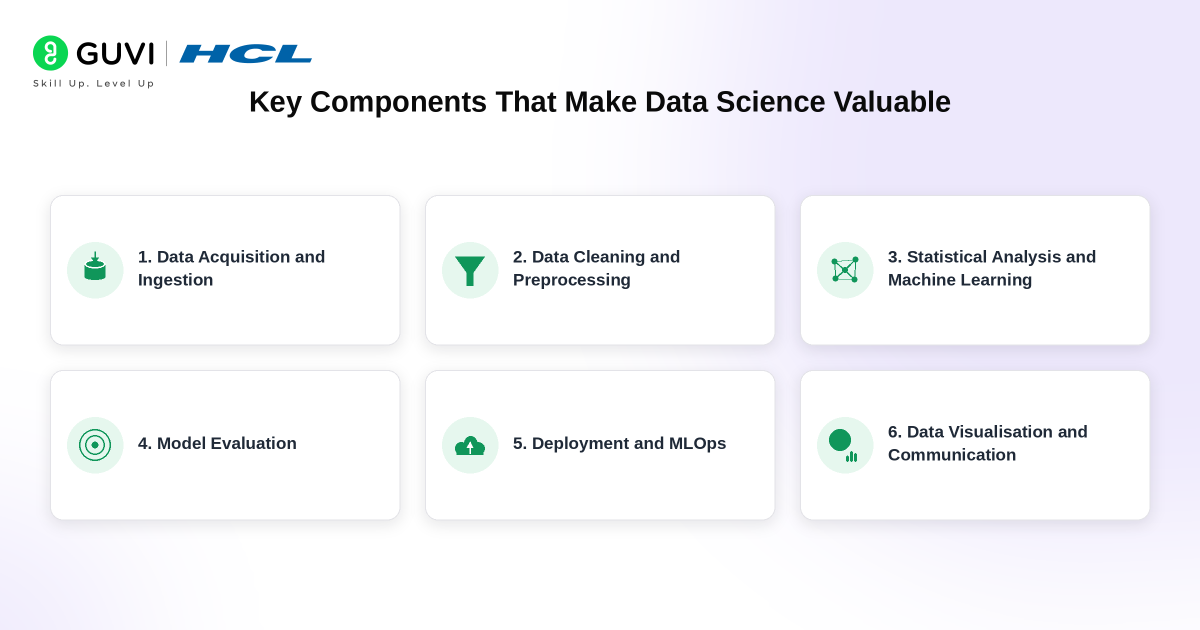
The benefits of data science come from combining several technical disciplines rather than relying on one tool.
- Data Acquisition and Ingestion
Data may come from APIs, databases, applications, logs, sensors and other systems.
Reliable pipelines ensure that useful information reaches analytical systems in a consistent format.
- Data Cleaning and Preprocessing
Raw data frequently contains:
- Missing information
- Duplicate records
- Outliers
- Incorrect formats
- Inconsistent categories
Cleaning and data normalisation improve the quality of the information used for analysis.
- Statistical Analysis and Machine Learning
Statistical techniques help identify relationships and uncertainty.
Machine learning can extend this into:
- Classification
- Regression
- Clustering
- Forecasting
- Recommendations
- Anomaly detection
- Model Evaluation
A model must be tested before its predictions can be trusted.
Depending on the task, evaluation may involve:
- Accuracy
- Precision
- Recall
- F1 score
- ROC-AUC
- Error metrics
- Cross-validation
- Deployment and MLOps
A model sitting inside a notebook does not create business value by itself.
Production systems need deployment, monitoring, version control and retraining processes.
- Data Visualisation and Communication
The final result must be understandable to the people making decisions.
Dashboards, charts and reports translate technical findings into information stakeholders can use.
What Are the Limitations of Data Science?
Data science has significant benefits, but it is not automatically useful simply because a business has large amounts of data.
Several limitations need to be considered.
- Poor Data Quality
Incorrect, incomplete or biased data can produce misleading results.
- Privacy and Security
Organisations must handle personal and sensitive information responsibly and comply with applicable data-protection requirements.
- Model Bias
Models learn from historical data. Existing biases in that information may influence future predictions.
- Lack of Business Context
A technically accurate model may still solve the wrong problem if the team does not understand the business objective.
- Model Drift
Real-world behaviour changes over time. A model that performs well today may become less accurate later.
For this reason, successful data science requires ongoing monitoring, governance and collaboration between technical and business teams.
How Can Businesses Get the Most Value From Data Science?
The biggest mistake is starting with technology rather than a business problem.
A more useful process is:
- Identify a measurable problem.
- Determine whether suitable data exists.
- Clean and validate the data.
- Choose an appropriate analytical method.
- Test the result against a clear metric.
- Deploy the solution where people can use it.
- Monitor its impact over time.
For example, “use AI in customer service” is vague. “Reduce the number of repeat support requests by identifying the most common unresolved issues” is measurable.Data science creates the most value when analytical work is connected directly to a business outcome.
Conclusion
The real benefit of data science is not simply having more information. It is being able to make better decisions from that information.
Businesses use data science to understand customers, forecast demand, detect risk, improve products, optimise operations and identify new opportunities. At the same time, professionals who understand data science gain skills that apply across some of the most important areas of modern technology, including machine learning and AI.
However, useful data science starts with a clear problem rather than a complex model. When organisations combine reliable data, appropriate analytical methods and strong business understanding, data can move from being something they store to something that actively improves how they operate.
FAQs
What are the main benefits of data science?
The main benefits of data science include better decision-making, revenue forecasting, cost optimisation, personalised customer experiences, fraud detection, product improvement and more accurate long-term planning. It helps organisations turn large volumes of raw information into insights that can guide practical actions.
How does data science benefit businesses?
Data science helps businesses understand customers, forecast demand, identify inefficient processes and detect risks. It can also support marketing optimisation, product development and automated decision-making. The exact benefit depends on the quality of the data and the business problem being solved.
Why is data science important for the future?
Businesses are generating information from an increasing number of digital systems, while AI applications depend heavily on reliable and well-organised data. Data science provides methods for analysing this information, building predictive systems and turning data into evidence that supports decisions.
What are the benefits of data science as a career?
A data science career develops skills in programming, statistics, machine learning, data analysis and problem-solving. These skills are applicable across technology, finance, healthcare, retail, manufacturing and consulting. Data professionals can also progress into specialised areas such as machine learning, data engineering, MLOps and AI.
What is a real-life example of data science?
An e-commerce company predicting how much inventory it will need is a common example. The company can analyse historical purchases, seasonal trends, promotions and customer behaviour to forecast future demand. The resulting prediction can help reduce both stock shortages and excess inventory.
Success Stories

About the Author
Vaishali
I'm a seasoned writer with four years of experience across technical, non-technical, and just about every genre or niche you can imagine. Adaptable and curious, I enjoy exploring new topics and making information engaging and easy to understand. Fueled by a steady stream of tea, I approach each project with creativity, reliability, and genuine enthusiasm for storytelling.
View all posts by Vaishali
Connect with me @











Did you enjoy this article?