


Academics Articles
Is the HCL GUVI AI/ML Program Right for You? A Quick Self-Assessment
Inside the HCL GUVI AI/ML Curriculum: What You’ll Actually Build
Wipro Elite NTH Eligibility Criteria 2026: CGPA, Branch & Backlog Rules Explained
What is Wipro Elite NTH? Complete Overview for 2026 Graduates


Get In Touch For Details! Request More Information

What is Leetcode? A Beginner’s Guide (2026)
Jul 27, 2026 4 Min Read 10488 Views
(Last Updated)
Have you ever felt lost choosing the right platform to practice coding? With so many names like LeetCode, HackerRank, Codewars, and CodeKata competing for attention, it becomes difficult to know which one will actually help you prepare for technical interviews.
LeetCode has become the most recognized choice because it focuses on the type of questions that top companies ask in their hiring process. This blog explains what makes LeetCode valuable, where it falls short, and how you can prepare beyond it to strengthen your chances in interviews.
Table of contents
- TL;DR Summary
- What is LeetCode?
- How to Start LeetCode: Beginner First Week Plan
- LeetCode Tiers Explained
- LeetCode Free vs Premium: Is Premium Worth It?
- LeetCode vs HackerRank vs Codeforces: Which for What Goal
- Top LeetCode Problems Asked at Google, Microsoft, Amazon India
- LeetCode Streak Strategy
- Common Mistakes Beginners Make
- Conclusion
- FAQs
- Can a complete beginner start with LeetCode?
- Is LeetCode Premium necessary for placements in India?
- How many LeetCode problems should I solve before interviews?
- Is LeetCode better than HackerRank for interview prep?
- Does solving LeetCode problems teach you programming from scratch?
- How long does it take to get interview-ready on LeetCode?
TL;DR Summary
- LeetCode is an online coding platform with 3,000+ problems used to practice data structures and algorithms for technical interviews.
- Beginners should start with Easy problems in arrays and strings before moving to Medium-level patterns like sliding window and two pointers.
- The free tier covers most of what you need. Premium ($35/month or roughly ₹13,000/year) mainly adds company-tagged questions.
- Google, Microsoft, and Amazon India commonly reuse patterns around arrays, linked lists, trees, and dynamic programming.
- Consistency matters more than problem count. A steady streak of 3 to 5 problems a week beats a weekend binge.
What is LeetCode?
LeetCode is an online coding platform that focuses on teaching learners data structures and algorithms. It is widely used as an interview preparation tool by developers and has become the industry standard for coding interview questions.
It is trusted by top companies like Google, Facebook, Microsoft, and Amazon to assess the skills of their interviewees.
With over 2,500 interview questions and the continuous addition of new problems, it offers a comprehensive collection of coding challenges.
Also Read: HackerRank vs LeetCode vs WebKata & CodeKata: Best Coding Practice Platform?
How to Start LeetCode: Beginner First Week Plan
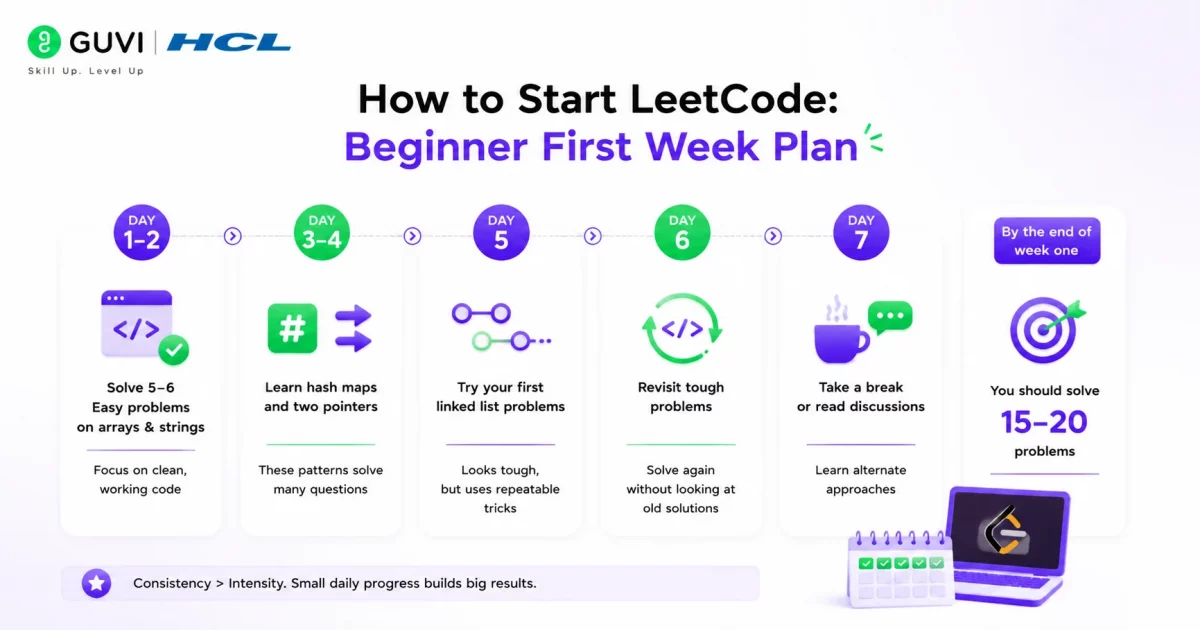
You don’t need to jump into Medium or Hard problems on day one. Here’s a realistic plan for your first week if you’re starting from scratch.
- Day 1 to 2: Solve 5 to 6 Easy problems on arrays and strings. Focus on writing clean, working code before worrying about optimal time complexity.
- Day 3 to 4: Move into hash maps and two pointers. These two patterns alone solve a surprising share of interview questions.
- Day 5: Attempt your first linked list problems. They look intimidating at first but follow a small set of repeatable tricks.
- Day 6: Revisit any problem you struggled with earlier in the week and solve it again without looking at your old solution.
- Day 7: Take a short break or read discussion threads on problems you’ve already solved. You’ll pick up alternate approaches this way.
By the end of week one, you should have 15 to 20 problems solved and a working sense of how LeetCode’s editor and judge behave.
LeetCode Tiers Explained
LeetCode doesn’t officially label problems as “beginner” or “advanced” tiers, but based on difficulty and topic depth, most learners progress through three practical stages:
| LeetCode Tier | Problem Count | Topics | Recommended For |
|---|---|---|---|
| Foundation | 50 to 75 problems | Arrays, strings, hashing, two pointers | Absolute beginners, students |
| Core Patterns | 100 to 150 problems | Trees, graphs, recursion, sliding window, DP basics | Placement prep, service-based companies |
| Advanced | 150+ problems | Advanced DP, backtracking, tries, system-design-adjacent problems | Product-based companies, FAANG-style interviews |
You don’t need to finish one tier before glancing at the next. Overlapping practice, especially between Foundation and Core Patterns, actually helps you retain concepts better.
Curated lists like Blind 75 and its updated version, Grind 75, were built by engineers who reverse-engineered which LeetCode patterns show up most often in real interviews, not just the hardest or newest problems.
LeetCode Free vs Premium: Is Premium Worth It?
The free tier gives you access to a large majority of LeetCode’s problem bank, a working code editor, and discussion boards. For most beginners, that’s genuinely enough.
Premium costs around $35 a month or $159 a year (roughly ₹13,000 in India), and its biggest draw is company-tagged questions, meaning you can filter problems by exactly what Google or Amazon has asked recently.
Premium is worth it if:
- You already solve unfamiliar Medium problems comfortably and just need company-specific practice before an onsite round.
- You want access to official video editorials for problems you’re stuck on.
Premium is not necessary if:
- You’re still building fundamentals. No amount of company tagging fixes gaps in basic pattern recognition.
- You’re a student on a budget. The free tier plus a structured list like Grind 75 covers most placement-level prep.
LeetCode vs HackerRank vs Codeforces: Which for What Goal
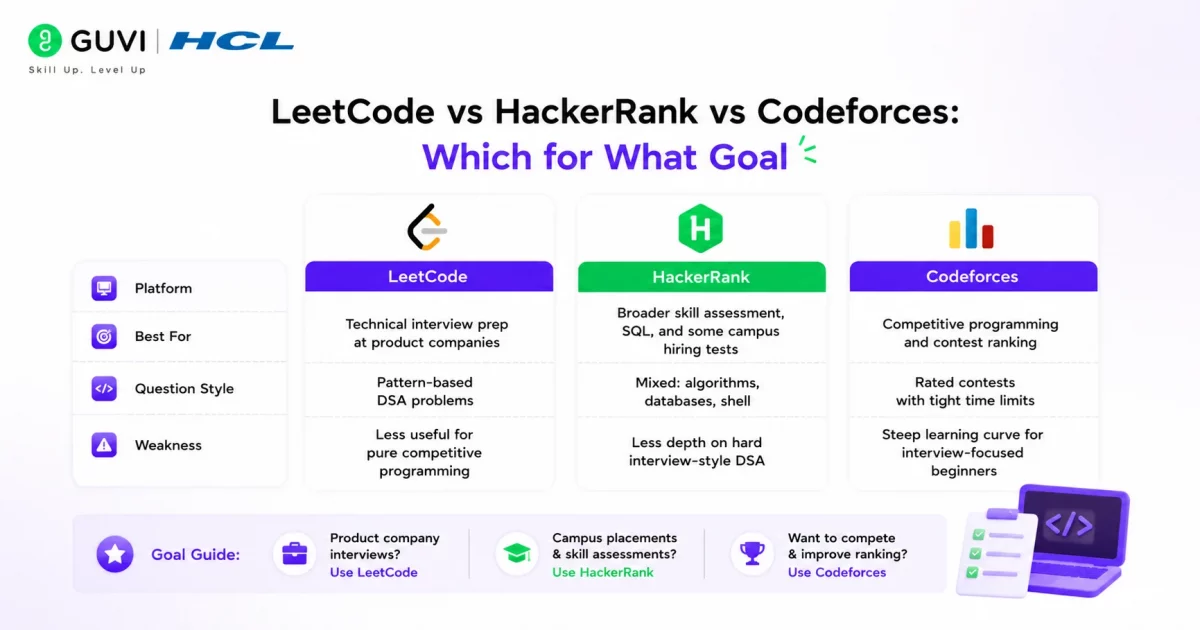
Each platform serves a different purpose, and picking the wrong one can waste weeks of prep time.
| Platform | Best For | Question Style | Weakness |
|---|---|---|---|
| LeetCode | Technical interview prep at product companies | Pattern-based DSA problems | Less useful for pure competitive programming |
| HackerRank | Broader skill assessment, SQL, and some campus hiring tests | Mixed: algorithms, databases, shell | Less depth on hard interview-style DSA |
| Codeforces | Competitive programming and contest ranking | Rated contests with tight time limits | Steep learning curve for interview-focused beginners |
If your goal is cracking a product-based company interview, LeetCode should be your primary platform. If you’re prepping for a campus placement test that includes SQL or general aptitude, HackerRank fills that gap. Codeforces is worth exploring only if you enjoy competitive programming as a skill in itself, not strictly for interviews.

Top LeetCode Problems Asked at Google, Microsoft, Amazon India
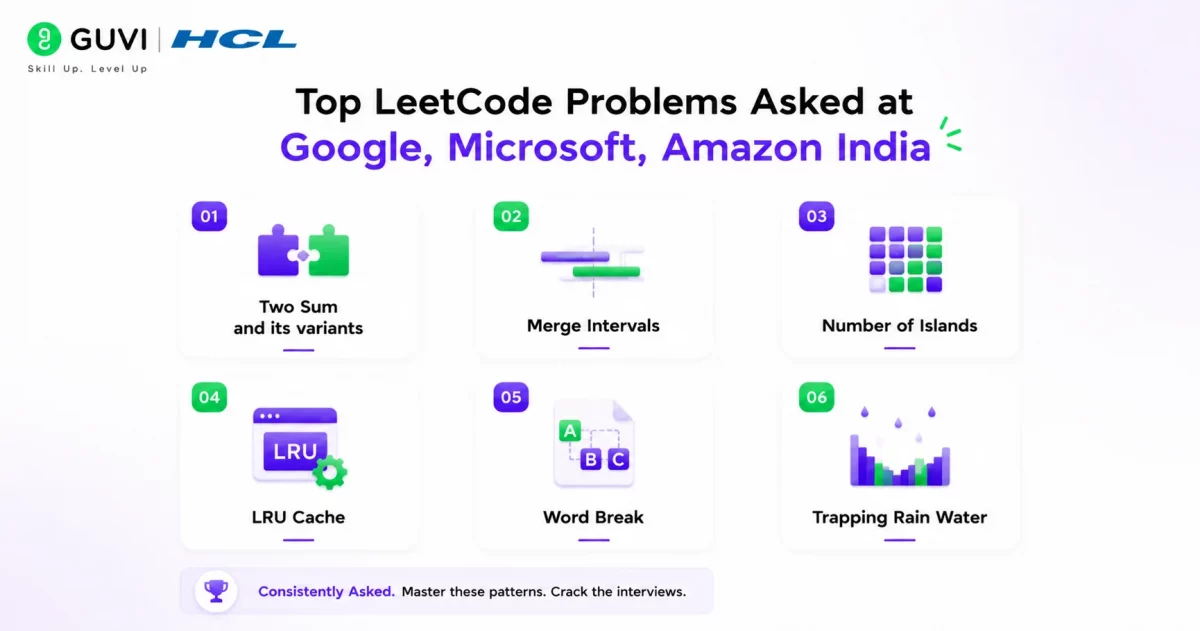
While exact interview questions rotate constantly, certain patterns show up again and again across product-based companies hiring in India.
- Two Sum and its variants: Tests basic hashing, almost always an opening question.
- Merge Intervals: A recurring Amazon favorite, testing sorting and interval logic.
- Number of Islands: Common at Google and Microsoft to test graph traversal (BFS/DFS).
- LRU Cache: Frequently asked at Amazon to test design thinking alongside data structures.
- Word Break: A dynamic programming staple that trips up candidates who skip DP fundamentals.
- Trapping Rain Water: A harder pattern question often used to filter senior-level candidates.
Practicing these problems isn’t about memorizing solutions. It’s about understanding why a particular data structure fits a particular problem, since interviewers often tweak the constraints on the spot.
LeetCode Streak Strategy
LeetCode’s daily streak feature gets a lot of attention, but consistency matters more than the streak number itself.
- Solving 1 problem daily for 3 months builds far stronger pattern recognition than solving 20 problems in a single weekend.
- A short daily habit keeps concepts fresh, so you’re not relearning binary search every time you sit down.
- If daily practice isn’t realistic, aim for 3 to 5 focused sessions a week instead of chasing an unbroken streak.
The goal isn’t the streak badge. It’s the habit of returning to problem-solving regularly enough that patterns start feeling familiar instead of new each time.
Common Mistakes Beginners Make
- Jumping to Hard problems too early: This usually kills motivation faster than it builds skill.
- Copying solutions without understanding them: You’ll recognize the problem later but won’t be able to adapt it to a variation.
- Ignoring time and space complexity: Interviewers care about your reasoning here as much as a working solution.
- Skipping revision: Solving a problem once doesn’t mean you’ll remember the approach a month later.
While LeetCode sharpens your problem-solving for interviews, building real-world web development skills requires hands-on coding beyond algorithms. That’s where HCL GUVI’s WebKata comes in, an interactive platform to practice HTML, CSS, JavaScript, and full-stack challenges in a gamified environment. With instant feedback, progressive difficulty, and project-based learning, WebKata helps you create a portfolio that recruiters value. Start coding on WebKata today and bridge the gap between theory and practice!
Conclusion
LeetCode remains one of the most reliable ways to prepare for technical interviews, but it works best when you approach it with a plan instead of random problem-solving. Start with fundamentals, build a consistent habit, and use premium only if you’re already solid on the basics and need company-specific practice. Pair your LeetCode prep with real projects, since recruiters look for both.
FAQs
Can a complete beginner start with LeetCode?
Yes. Start with Easy problems in arrays and strings before moving to more complex patterns.
Is LeetCode Premium necessary for placements in India?
Not usually. Most campus and service-based company prep is covered by the free tier and structured lists like Grind 75.
How many LeetCode problems should I solve before interviews?
Quality matters more than quantity. 100 to 150 well-understood problems across core patterns beat 300 problems solved without real understanding.
Is LeetCode better than HackerRank for interview prep?
For product-based company interviews, yes. For campus tests involving SQL or general aptitude, HackerRank is often a better fit.
Does solving LeetCode problems teach you programming from scratch?
No. LeetCode assumes you already know basic syntax. It sharpens problem-solving, not language fundamentals.
How long does it take to get interview-ready on LeetCode?
Most learners need 2 to 4 months of consistent practice to feel comfortable with Medium-level problems.
Success Stories

About the Author
Jaishree Tomar
A recent CS Graduate with a quirk for writing and coding, a Data Science and Machine Learning enthusiast trying to pave my own way with tech. I have worked as a freelancer with a UK-based Digital Marketing firm writing various tech blogs, articles, and code snippets. Now, working as a Technical Writer at GUVI writing to my heart’s content!
View all posts by Jaishree Tomar
Connect with me @















Did you enjoy this article?