


Data Science Articles
SQL for customer support executives: What to Learn and How to Practice
Accounting Team Lead to Data Analytics Skills and Roadmap
Can an Insurance Professional Become a Data Analyst Early in Their Career?
Can a Banker Become a Data Scientist? What It Takes After 4+ Years


Get In Touch For Details! Request More Information
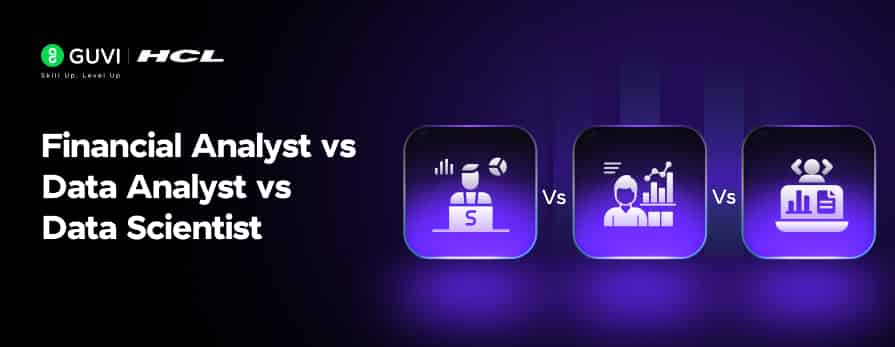
Financial Analyst vs Data Analyst vs Data Scientist: Which Career Path Fits You?
Nov 03, 2026 5 Min Read 57 Views
(Last Updated)
Three careers. All centred around data. But three very different career paths. So, how do you decide which one deserves your time and effort?
If you’re an early-career professional considering a switch, Financial Analysis, Data Analytics, and Data Science might all seem equally promising. However, each demands a different mix of business knowledge, technical skills, and analytical thinking.
Our Financial Analyst vs Data Analyst vs Data Scientist comparison explores these differences before you invest months in learning new skills.
In this guide, we’ll compare their responsibilities, salaries, career opportunities, and entry requirements to help you make an informed decision.
Let’s get started!
Table of contents
- TL;DR
- Financial Analyst vs Data Analyst vs Data Scientist: At a Glance
- What Are the Key Differences Between These Three Careers?
- Financial Analyst: Is the Business Performing Well?
- Data Analyst: Why Are Sales Declining?
- Data Scientist: What Might Happen Next?
- So, What's the Real Difference?
- Which Career Path Fits Your Background and Interests?
- Commerce, Finance, and Economics Graduates
- Graduates From Non-Technical Backgrounds
- Early-Career Professionals Working With Reports and Business Data
- Professionals Interested in Coding and Advanced Analytics
- How Should You Decide?
- Financial Analyst vs Data Analyst vs Data Scientist: Salary Comparison in India
- What Should Career Switchers Keep in Mind?
- How Can You Switch to Financial Analysis, Data Analytics, or Data Science?
- 1) Identify Your Skill Gaps
- 2) Build Practical Skills Through Projects
- 3) Gain Relevant Experience
- 4) Apply for Suitable Entry-Level Roles
- Wrapping Up
- Frequently Asked Questions
- Can a Financial Analyst become a Data Scientist?
- Is SQL enough to get a Data Analyst job?
- Which career offers better international job opportunities?
- Can AI replace Financial Analysts, Data Analysts, or Data Scientists?
- Can you switch between Data Analyst and Data Scientist roles later?
TL;DR
- Financial Analysts focus on financial performance, budgeting, forecasting, and investment decisions.
- Data Analysts examine business data, identify trends, and turn findings into actionable insights.
- Data Scientists use statistics, programming, and Machine Learning to build predictive models and solve complex problems.
- For non-IT career switchers, Financial Analysis or Data Analytics may offer a more accessible starting point, depending on existing skills.
- Your best career choice depends on your background, technical interests, salary expectations, and long-term goals.
Financial Analyst vs Data Analyst vs Data Scientist: At a Glance
Before choosing a career path, it helps to understand what each role involves. Here’s a quick comparison of their responsibilities, skills, and entry requirements.
| Comparison Factor | Financial Analyst | Data Analyst | Data Scientist |
| Primary Focus | Financial performance and business decisions | Data analysis and business insights | Predictive modelling and advanced analytics |
| Key Responsibilities | Budgeting, financial forecasting, profitability analysis | Data cleaning, reporting, trend analysis | Building predictive models, statistical analysis, Machine Learning |
| Core Skills | Financial modelling, accounting, Excel | SQL, Excel, statistics, data visualisation | Python, statistics, Machine Learning |
| Common Tools | Excel, financial modelling software, Power BI | Excel, SQL, Power BI, Tableau, Python | Python, SQL, scikit-learn, Jupyter Notebook |
| Coding Requirements | Usually minimal | Basic to moderate | Moderate to advanced |
| Educational Background | Finance, commerce, accounting, economics | Flexible; graduates from various disciplines | Often technical or quantitative, although other backgrounds are possible |
| Entry Barrier for Non-IT Professionals | Moderate; finance knowledge is important | Relatively accessible with practical skills | Higher due to programming and mathematical requirements |
| Typical Entry-Level Roles | Junior Financial Analyst, Finance Associate | Junior Data Analyst, Reporting Analyst | Junior Data Scientist, Associate Data Scientist |
| Best Suited For | Those interested in finance and business performance | Those who enjoy analysing data and solving business problems | Those interested in programming, statistics, and predictive analytics |
Key takeaway: For an early-career non-IT professional, Data Analytics may offer the broadest range of transition opportunities. Financial Analysis is particularly relevant for those with commerce or finance experience, while Data Science generally requires more intensive technical preparation.
What Are the Key Differences Between These Three Careers?
The biggest difference lies in the problems each professional solves. Let’s understand this with a simple example of an e-commerce company experiencing declining sales.
1. Financial Analyst: Is the Business Performing Well?
A Financial Analyst examines how declining sales affect revenue, profitability, and future financial performance.
They might investigate:
- Revenue trends: Which products or business units are generating less revenue?
- Profit margins: Are rising costs affecting profitability?
- Financial forecasts: How might declining sales affect next quarter’s financial targets?
Their findings help management make decisions about budgets, investments, and financial planning.
2. Data Analyst: Why Are Sales Declining?
A Data Analyst examines customer behaviour, transactions, and operational data to identify possible reasons behind the decline.
They might investigate:
- Customer behaviour: Are fewer customers completing purchases?
- Sales patterns: Which products, regions, or customer segments are underperforming?
- Business dashboards: What trends can SQL queries and Power BI reports reveal?
Their analysis helps teams understand what’s happening and identify areas requiring attention.
3. Data Scientist: What Might Happen Next?
A Data Scientist takes the analysis further by using statistical methods and Machine Learning to predict future outcomes.
They might work on:
- Demand forecasting: Predicting future product demand using historical data.
- Customer churn: Identifying customers likely to stop purchasing.
- Predictive models: Estimating how different factors could influence future sales.
Their work helps businesses anticipate potential problems and make more informed decisions.
So, What’s the Real Difference?
A Financial Analyst evaluates the financial implications of business performance. A Data Analyst investigates patterns and possible causes, while a Data Scientist may develop predictive models to support future decisions.
These responsibilities can overlap, especially in smaller organisations. However, understanding their primary focus can help you decide which role aligns better with your interests.
In 1947, engineers working on the Harvard Mark II computer found a moth trapped in a relay and recorded it in their logbook. The incident became a famous piece of computing history, although the term computer bug was already in use.
Which Career Path Fits Your Background and Interests?
Choosing between Financial Analysis, Data Analytics, and Data Science depends on your educational background, existing skills, and career interests. If you’re in the first few years of your career, understanding your strengths can help you make a more practical decision.
1. Commerce, Finance, and Economics Graduates
If you’ve studied commerce, accounting, finance, or economics, Financial Analysis could be a natural starting point. Your understanding of financial concepts can help you develop skills in :
- Budgeting: Planning and managing financial resources
- Forecasting: Estimating future revenue and expenses
- Financial Modelling: Evaluating financial performance and scenarios
However, Data Analytics could be your choice if you enjoy working with :
- Datasets: Working with structured business information
- Identifying Trends: Spotting patterns in business data
- Creating Dashboards: Presenting insights through visual reports
2. Graduates From Non-Technical Backgrounds
Coming from humanities, arts, management, or another non-technical discipline? Data Analytics could be a practical option, as many entry-level roles value the following skills:
- Business Understanding: Connecting data with business objectives.
- Analytical Thinking: Breaking down problems using evidence.
- Tools like Excel, SQL, and Power BI: Analysing, querying, and visualising data.
You don’t necessarily need a Computer Science degree, but you’ll need to demonstrate your skills through practical projects.
3. Early-Career Professionals Working With Reports and Business Data
If your current job involves Excel reports, performance tracking, customer data, or operational metrics, you may already have some relevant experience, therefore Data Analyst or Business Intelligence Analyst roles could be worth exploring.
You can build on your reporting experience by learning:
- SQL: Extracting and analysing database records
- Data Visualisation: Communicating insights through charts and dashboards
- Basic Statistics: Understanding averages, distributions, and relationships
For professionals already handling financial reports, Financial Analysis may also be a suitable direction.
4. Professionals Interested in Coding and Advanced Analytics
If you enjoy programming, mathematics, and solving complex analytical problems, Data Science might be a better long-term choice.
However, compared with the other two careers, Data Science generally demands deeper knowledge of the following:
- Python: Writing code for data analysis
- Statistics: Understanding patterns, relationships, and uncertainty
- Machine Learning: Training models to recognise patterns
- Predictive Modelling: Estimating outcomes using historical data
Be prepared for a longer learning curve, especially without a technical background.

How Should You Decide?
Ask yourself these three questions:
- Interested in financial planning, budgeting, and profitability? Consider Financial Analysis.
- Enjoy working with data, identifying trends, and solving business problems? Explore Data Analytics.
- Interested in programming, statistics, and predictive modelling? Data Science could be a good fit.
Key Takeaway:
A Financial Analyst evaluates the financial implications of business performance. A Data Analyst investigates patterns and possible causes, while a Data Scientist may develop predictive models to support future decisions.
The distinction between Data Science and Data Analytics becomes particularly relevant when comparing their technical requirements and day-to-day responsibilities.
You can begin by exploring some key data science skills and data analytics skills to understand what employers commonly expect.
Financial Analyst vs Data Analyst vs Data Scientist: Salary Comparison in India
Salary is an important factor when considering a career switch. Here’s how the three roles compare:
| Career Role | Average Annual Salary |
| Financial Analyst | ₹5.4–5.9 LPA |
| Data Analyst | ₹3.5–5.7 LPA |
| Data Scientist | ₹11.3–12.5 LPA |
What Should Career Switchers Keep in Mind?
- Financial Analysts: Finance knowledge and financial modelling skills can influence your starting package.
- Data Analysts: SQL, Excel, Power BI, and a strong project portfolio can improve your competitiveness.
- Data Scientists: Salaries can be higher, but technical expectations and entry barriers are generally greater.
If you’re comparing data analyst salary vs financial analyst earnings, the figures suggest that neither career automatically guarantees better pay.
Also, remember that having two years of experience in an unrelated role doesn’t necessarily mean you’ll receive a two-year-experience salary in your new profession.
The takeaway? Consider salary alongside your existing skills, learning requirements, and chances of securing your first role. A realistic entry point can be more valuable than chasing the highest advertised package.
How Can You Switch to Financial Analysis, Data Analytics, or Data Science?
Once you’ve identified the career that interests you, the next step is building the right skills and gaining practical experience.
Here’s a simple approach for early-career professionals planning a switch.
1) Identify Your Skill Gaps
Start by comparing your existing skills with the requirements of your preferred role.
- Financial Analyst: Financial statements, budgeting, Excel, and financial modelling.
- Data Analyst: Excel, SQL, Power BI, and basic statistics.
- Data Scientist: Python, statistics, Machine Learning, and predictive modelling.
You don’t need to learn everything at once. Focus on the skills relevant to your chosen career.
2) Build Practical Skills Through Projects
Employers want to see how well you can apply your knowledge. Create projects that demonstrate your problem-solving abilities.
- Financial Analyst: Develop a financial forecasting model or analyse a company’s profitability.
- Data Analyst: Build a sales dashboard or analyse customer purchasing patterns.
- Data Scientist: Develop a customer churn prediction or demand forecasting model.
For inspiration, try exploring some data science projects and data analytics project ideas to start building your portfolio.
3) Gain Relevant Experience
Your existing professional experience can also be valuable. For instance, a BPO professional transitioning to Data Analytics may already have experience with performance metrics, customer data, and operational reporting.
Look for opportunities to apply your skills before making a complete career switch.
- Internal Projects: Volunteer for reporting, forecasting, or analytical assignments.
- Internships: Explore opportunities that provide practical exposure.
- Freelance Projects: Work with suitable public or client datasets to demonstrate your capabilities.
Even small projects can help you build confidence and strengthen your resume.
4) Apply for Suitable Entry-Level Roles
Target positions that match your current capabilities rather than applying only for higher-paying designations.
| Career Path | Roles to Explore |
| Financial Analysis | Junior Financial Analyst, Finance Associate, FP&A Analyst |
| Data Analytics | Junior Data Analyst, Reporting Analyst, BI Analyst |
| Data Science | Junior Data Scientist, Associate Data Scientist, ML Intern |
Remember, a successful finance career switch or transition into analytics takes preparation. Your existing experience can be useful, but employers will also evaluate your technical skills and ability to solve practical problems.
Wrapping Up
Choosing between Financial Analyst vs Data Analyst vs Data Scientist ultimately comes down to your interests, existing skills, and career goals. Each offers promising opportunities, but the right choice is one that matches your strengths and the skills you’re willing to develop.
If you’re interested in building analytics skills, HCL GUVI offers a self-paced Data Science and Analytics course and a Data Analysis Project course for practical learning. For more structured upskilling, our mentor-led, premium Advanced Data Science and Generative AI Program offers expert guidance, hands-on projects, and placement support.
You don’t need to have your entire career figured out today. Start by identifying the skills you already have, choose a direction that genuinely interests you, and take the first step towards building your next career opportunity!
Frequently Asked Questions
1. Can a Financial Analyst become a Data Scientist?
Yes. Financial Analysts can transition into Data Science by developing Python, statistics, and Machine Learning skills. Experience with financial data can be particularly useful in fintech and risk analytics.
2. Is SQL enough to get a Data Analyst job?
SQL is important, but employers typically expect Excel, data cleaning, visualisation, and problem-solving skills too. A portfolio can strengthen your application.
3. Which career offers better international job opportunities?
All three have international opportunities. Data Analytics and Data Science skills are transferable across industries, although overseas hiring also depends on experience, qualifications, and visa requirements.
4. Can AI replace Financial Analysts, Data Analysts, or Data Scientists?
AI can automate reporting, coding, and routine analysis, but business judgement, data interpretation, and validating AI-generated results remain valuable across all three roles.
5. Can you switch between Data Analyst and Data Scientist roles later?
Yes. The data analyst vs data scientist distinction mainly involves technical depth and responsibilities. Data Analysts can transition by gaining experience in programming, statistics, and Machine Learning.
Success Stories











Did you enjoy this article?