


Data Science Articles
Data Analyst or Data Scientist: Which Has Better Demand for Mid-Career BPO Professionals?
BPO Workforce Management Analyst to Data Analyst: What Skills Transfer?
CFA Charterholders: Are You Missing Out on Data Science Opportunities?


Get In Touch For Details! Request More Information
BPO Team Leader to Analytics Manager: Skills, Roadmap and Salary
Oct 22, 2026 6 Min Read 29 Views
(Last Updated)
An analytics manager in India earns close to five times what a BPO team leader does. Yet the team leader usually knows why AHT spiked or CSAT dropped long before any analyst does. The only real gap between the two roles is the ability to prove it with data.
Closing that gap is the BPO team leader to analytics manager path. It adds SQL, Power BI, and analytical depth to your experience running people and metrics, so you own the numbers instead of reporting on them.
Since you already manage teams and KPIs, this guide skips beginner material and covers what changes: transferable skills, the tools to learn, bridge roles, a roadmap, analytics manager jobs in India, and salary.
Table of contents
- TL;DR Summary
- What is the BPO Team Leader to Analytics Manager Transition?
- Analytics Manager Roles and Responsibilities
- BPO Team Leader Career Growth: Where the Ladder Narrows
- BPO Operations to Analytics: Why the Shift Makes Sense
- BPO Team Leader Skills That Transfer
- KPI Ownership
- Root Cause Analysis
- People Leadership
- Client Communication
- Data Analytics for Managers: What You Actually Need
- SQL for Analytics: Start With Your Own Metrics
- Power BI for Managers: Own the Dashboard
- Operations Analytics Career: The Bridge Roles
- MIS or Reporting Analyst
- Workforce Management Analyst
- Operations or Business Analyst
- Roadmap for a BPO Team Leader to Analytics Manager Move
- Months 1 to 3: Excel and SQL
- Months 4 to 6: Power BI and Statistics
- Months 7 to 9: Bridge Role
- Months 10 to 18: Analyst to Lead
- Months 18 to 30: Analytics Manager
- Data Analytics Course for Working Professionals
- Analytics Manager Jobs in India
- Analytics Manager Salary in India
- Salary by Role
- Salary Range by Path
- 💡 Did You Know?
- Common BPO Team Leader to Analytics Manager Mistakes
- Conclusion
- FAQs
- Can a BPO team leader become an analytics manager?
- How long does the BPO team leader to analytics manager move take?
- Is coding required for a BPO team leader to analytics manager switch?
- Which roles bridge a BPO team leader to analytics manager move best?
- Should a BPO team leader to analytics manager learner pick Power BI or Tableau?
TL;DR Summary
- What it is: The BPO team leader to analytics manager move shifts you from managing agents against metrics to designing, analysing, and owning those metrics.
- What transfers: KPI ownership, people management, client reporting, root cause analysis, and process improvement.
- What to learn: SQL, Power BI with DAX, Excel modelling, and basic statistics.
- Smart route: Move through an MIS, WFM, or operations analyst role before stepping into analytics management.
- Salary reality: BPO team leaders in India average about ₹4.9 LPA, while analytics managers average about ₹23.8 LPA.
- Next step: Rebuild your team’s weekly KPI report in SQL and Power BI as your first BPO team leader to analytics manager project.
What is the BPO Team Leader to Analytics Manager Transition?
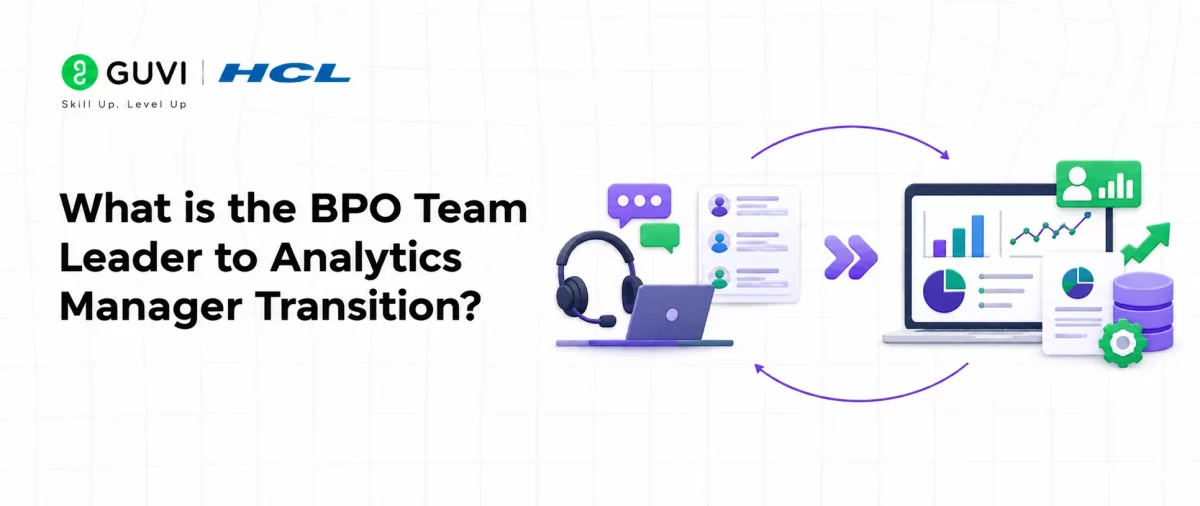
The BPO team leader to analytics manager transition is a career move in which a team leader in customer service, collections, or back-office operations shifts into a role that leads data analysis, reporting, and insight generation for the business.
A BPO team leader to analytics manager switch is not a fresh start. You already manage people, track performance, and explain results to clients. The BPO team leader to analytics manager shift adds the technical layer, so you can pull the data yourself, find the drivers, and recommend changes backed by evidence.
If you want a structured path with mentors and placement support, HCL GUVI’s Data Science Program, offered with IITM Pravartak, covers SQL, Python, Power BI, and statistics in weekday and weekend batches built for working professionals.
Analytics Manager Roles and Responsibilities
Before planning a BPO team leader to analytics manager move, it helps to know what the job involves day to day. An analytics manager leads a small team of analysts and owns how the business measures and improves performance.
| Responsibility | What It Looks Like in Practice |
|---|---|
| KPI ownership | Defining metrics and keeping them consistent across teams |
| Team leadership | Assigning work, reviewing analysis, and coaching analysts |
| Stakeholder management | Turning business questions into analysis requests |
| Reporting and dashboards | Owning the BI layer leadership relies on |
| Insight generation | Finding drivers behind trends and recommending actions |
| Data quality | Making sure numbers are accurate before they reach clients |
Most of these responsibilities already appear in a team leader’s week, only at a smaller scale. That overlap is what makes the BPO team leader to analytics manager path shorter than it looks.
BPO Team Leader Career Growth: Where the Ladder Narrows
BPO team leader career growth usually moves from team leader to assistant manager, then operations manager and senior operations manager. Each step adds more teams but rarely changes the nature of the work: headcount, schedules, escalations, and client reviews.
That narrowing ladder is why many leaders consider the BPO team leader to analytics manager route. Analytics roles grow with data skills rather than headcount, and they move across industries instead of staying tied to one process.
| Factor | BPO Team Leader | Analytics Manager |
|---|---|---|
| Core focus | Agent performance and SLAs | Business insight and decisions |
| Main tools | Dialer reports, Excel | SQL, Power BI, Python |
| Output | Daily huddles, client MIS | Dashboards, analyses, models |
| Team | 10 to 20 agents | 3 to 10 analysts |
| Growth driver | Headcount managed | Business impact of insights |
| Industry mobility | Mostly BPO and CX | Any data-driven industry |
BPO Operations to Analytics: Why the Shift Makes Sense
The move from BPO operations to analytics makes sense because operations already generates rich data: call logs, ticket timestamps, QA scores, and roster data. Analytics teams use exactly this to forecast volume, reduce handle time, and predict attrition.
Many agents and leads begin with a BPO to data analyst career switch, but team leaders can aim higher because they already manage people.
You also know the context behind that data. A pure analyst might see AHT rise and suspect agent performance. You know it could be a new process change, a tool outage, or a client policy update. That context is the biggest advantage in a BPO team leader to analytics manager move.
| BPO Operations Task | Analytics Equivalent |
|---|---|
| Tracking AHT and CSAT | KPI design and trend analysis |
| Root cause on SLA misses | Diagnostic analytics |
| Roster and shift planning | Workforce forecasting |
| QA audits | Sampling and quality analytics |
| Client MBR decks | Executive dashboards and storytelling |
| Attrition tracking | Attrition prediction and cohort analysis |
BPO Team Leader Skills That Transfer
Most BPO team leader skills map directly to analytics leadership. These are the ones hiring managers notice first in a BPO team leader to analytics manager candidate.
1. KPI Ownership
You have been accountable for numbers every day, which is the foundation of any BPO team leader to analytics manager profile. Analytics managers own KPI definitions, so your instinct for which metric matters is directly useful.
2. Root Cause Analysis
Explaining why SLA dipped on a Tuesday is root cause analysis. The analytics version runs the same logic across months of data with SQL.
3. People Leadership
An analytics manager leads analysts, prioritises requests, and handles stakeholders. Managing agents, escalations, and client calls builds exactly this muscle, which is why the BPO team leader to analytics manager path often outpaces analysts trying to move into management.
4. Client Communication
Presenting to clients under pressure is data storytelling, a strength that sets a BPO team leader to analytics manager candidate apart. Most technical analysts take years to build this skill.
Data Analytics for Managers: What You Actually Need
Data analytics for managers is not about becoming the best coder on the team. It is about knowing enough to question analysis, guide analysts, and build credible insights yourself. The table shows priorities for a BPO team leader to analytics manager move.
| Skill | Why It Matters | Target Depth |
|---|---|---|
| SQL | Pull and validate operational data directly | Joins, CTEs, window functions |
| Power BI | Build and review dashboards | Data modelling, DAX measures |
| Excel | Quick analysis and stakeholder sharing | Pivots, Power Query, lookups |
| Statistics | Judge whether a change is real | Averages, variance, A/B basics |
| Python | Automate and scale analysis | pandas basics, optional at first |
| Stakeholder management | Turn insight into action | Already strong |
The top data analytics skills employers list in 2026 overlap heavily with this table, so prioritising SQL and Power BI gives you the fastest return.
SQL for Analytics: Start With Your Own Metrics
SQL for analytics is the first technical skill to build in a BPO team leader to analytics manager plan, because it removes your dependence on the MIS team. Instead of waiting for a daily dump, you pull and slice the data yourself.
The fastest way to learn SQL is to answer questions you already ask every week.
| Operations Question | What You Learn in SQL |
|---|---|
| What was AHT per agent yesterday? | SELECT, GROUP BY, AVG |
| Which queues missed SLA this week? | WHERE filters and CASE logic |
| How did AHT trend over the last 7 days? | Window functions and rolling averages |
| Which agents improved after coaching? | JOINs across call logs and training data |
| Where do repeat contacts come from? | CTEs and multi-step queries |
Rebuild a few of your daily reports as SQL queries with examples you can reuse, and the habit of writing SQL will form on the job.
Power BI for Managers: Own the Dashboard
Power BI for managers means building the reports your leadership reviews, not just reading them, and it is the most visible BPO team leader to analytics manager skill.
A good operations dashboard replaces the static Excel MIS pack with one live view and becomes your strongest BPO team leader to analytics manager proof of work.
| Dashboard Page | Key Visuals | Decision It Supports |
|---|---|---|
| Service level | SLA %, answer time, abandon rate | Staffing and queue routing |
| Productivity | AHT, occupancy, calls per agent | Coaching priorities |
| Quality | QA score, CSAT, repeat contacts | Process and training fixes |
| Workforce | Shrinkage, attendance, attrition | Hiring and roster planning |
Keep every page focused on one decision. The principles behind a data dashboard that people actually use matter more than visual polish.

Operations Analytics Career: The Bridge Roles
An operations analytics career rarely jumps straight from team leader to analytics manager. Most professionals take one bridge role first, which keeps the BPO team leader to analytics manager move realistic.
1. MIS or Reporting Analyst
You build the reports you used to consume. This is the fastest internal move, since BPOs always need MIS support.
2. Workforce Management Analyst
WFM roles cover forecasting, scheduling, and real-time monitoring. They build the forecasting and statistics depth analytics managers need.
3. Operations or Business Analyst
These roles focus on process improvement with data, and they often report directly to an analytics or transformation manager.
With 5 to 10 years of experience, a BPO professional can get a data analyst job at a senior entry point and skip junior analyst roles entirely.
Roadmap for a BPO Team Leader to Analytics Manager Move
This BPO team leader to analytics manager roadmap assumes 6 to 8 hours of study a week alongside your shifts.
1. Months 1 to 3: Excel and SQL
Move your team’s KPI tracking from dialer exports into SQL. Learn joins, aggregations, CTEs, and window functions.
2. Months 4 to 6: Power BI and Statistics
Build a live operations dashboard for your process. Learn averages, variance, correlation, and simple A/B comparisons.
3. Months 7 to 9: Bridge Role
Apply internally for MIS, WFM, or operations analyst roles. Use your dashboard as proof of your BPO team leader to analytics manager progress.
4. Months 10 to 18: Analyst to Lead
Add Python basics with a focus on Excel, SQL, and Python for BPO professionals, lead small analysis projects, and mentor junior analysts. This builds the leadership record a BPO team leader to analytics manager move needs.
5. Months 18 to 30: Analytics Manager
Apply for analytics manager or analytics lead roles, combining your people management and analytics track record. This is where the BPO team leader to analytics manager journey completes.
A step-by-step data analyst career roadmap covers the analyst stage of this path in more detail.
Data Analytics Course for Working Professionals
A data analytics course for working professionals should fit around shift work, cover the tools above, and give you projects built on real data. Look for these features before you enrol.
| Feature | Why It Matters for BPO Leaders |
|---|---|
| Weekend or evening batches | Fits rotational and night shifts |
| SQL and Power BI focus | The two tools you will use daily |
| Real business projects | Proof for internal and external moves |
| Mentor support | Faster unblocking when you work full time |
| Placement assistance | Access to analyst and lead openings |
HCL GUVI’s Data Science Program offers weekend batches, mentor-led projects, and placement support, which suits a BPO team leader to analytics manager timeline.
Analytics Manager Jobs in India
Analytics manager jobs in India suited to a BPO team leader to analytics manager profile are concentrated in Bengaluru, Hyderabad, Pune, Chennai, Gurugram, and Mumbai.
The main employers are Global Capability Centres, analytics consultancies, e-commerce and fintech firms, and the analytics arms of large BPO and CX companies.
That last group matters most for a BPO team leader to analytics manager move. Large CX companies run dedicated analytics, WFM, and transformation teams, and they value candidates who understand contact centre operations.
| Employer Type | Typical Analytics Focus |
|---|---|
| BPO and CX companies | Operations, WFM, quality, and client analytics |
| Global Capability Centres | Business, finance, and customer analytics |
| E-commerce and fintech | Customer, product, and risk analytics |
| Analytics consultancies | Client projects across domains |
The data analyst jobs for BPO professionals that open these doors are usually MIS, WFM, and operations analyst roles.
Analytics Manager Salary in India
Analytics manager salary is the strongest pull in a BPO team leader to analytics manager decision. The figures below are averages for India, and actual offers vary by city, company, and skill depth.
1. Salary by Role
| Role | Average Annual Salary |
|---|---|
| BPO Team Leader | ₹4.9 LPA |
| Data Analyst | ₹6.5 LPA |
| Senior Data Analyst | ₹11 LPA |
| Business Intelligence Manager | ₹17.4 LPA |
| Analytics Manager | ₹23.8 LPA |
2. Salary Range by Path
| Path | Typical Experience | Annual Salary Range |
|---|---|---|
| BPO Operations Manager | 3 to 17 years | ₹3 LPA to ₹21.1 LPA |
| Analytics Manager | Mid to senior level | ₹15.5 LPA to ₹34.3 LPA |
An average analytics manager earns close to five times an average BPO team leader. Even the bridge role of senior data analyst pays more than double a team leader salary, which makes each step of the BPO team leader to analytics manager journey financially worthwhile.
💡 Did You Know?
- Contact centres generate timestamped data for every call, chat, and ticket, making operations one of the richest data sources in any business.
- A single SQL query with a rolling average can replace a manually updated Excel trend sheet that teams refresh every day.
- Microsoft’s PL-300 exam is the official certification exam for the Power BI Data Analyst Associate credential.
Common BPO Team Leader to Analytics Manager Mistakes
- Applying for analytics manager roles too early: This is the most common BPO team leader to analytics manager mistake. Build analyst credibility first.
- Learning Python before SQL: Operational data lives in databases and dialer systems. SQL gives the fastest return.
- Hiding the BPO background: Your operations context is an advantage. Lead with the metrics you improved.
- Building generic projects: Sales or movie datasets will not stand out in a BPO team leader to analytics manager portfolio. Contact centre and ticketing projects will.
- Ignoring internal moves: MIS and WFM teams inside your own company are the lowest risk entry points.
Conclusion
The BPO team leader to analytics manager move builds on what you already do well: owning metrics, solving operational problems, and leading people. Add SQL, Power BI, and analytical thinking, and you move from explaining the numbers to shaping them.
If you are ready to build those skills with mentors and real projects, explore HCL GUVI’s Data Science Program and start turning your operations experience into an analytics career.
FAQs
1. Can a BPO team leader become an analytics manager?
Yes. The BPO team leader to analytics manager path is realistic because team leaders already own KPIs and manage people. You need to add SQL, Power BI, and analytical depth, usually through a bridge analyst role.
2. How long does the BPO team leader to analytics manager move take?
Most professionals need 18 to 30 months, including 6 to 9 months of skill building and one bridge role such as MIS, WFM, or operations analyst.
3. Is coding required for a BPO team leader to analytics manager switch?
SQL is essential, and Power BI’s DAX is close behind. Python helps later but is not required to land your first analyst role.
4. Which roles bridge a BPO team leader to analytics manager move best?
MIS analyst, workforce management analyst, and operations analyst roles are the best bridges, since they use the same data you already work with.
5. Should a BPO team leader to analytics manager learner pick Power BI or Tableau?
Power BI is the safer choice in India, since most BPO and CX companies run on the Microsoft stack.
Success Stories

About the Author
Jebasta
I translate the language of data into stories that anyone can understand. As a writer with a data science background, I simplify analytics, AI, and decision-making so beginners and enthusiasts can confidently explore the world of data.
View all posts by Jebasta
Connect with me @







Did you enjoy this article?