


Data Science Articles
What Skills Do Finance Team Leads Need for Finance Analytics Leadership?
Can a Finance Team Lead Become a Data Analyst?
Can an Accounting Manager Become a Data Scientist?
Data Analytics for Finance Professionals Best Career Guide for Accountants


Get In Touch For Details! Request More Information
Can a Deputy Manager in Finance Switch to Data Analytics Mid-Career?
Oct 14, 2026 3 Min Read 24 Views
(Last Updated)
A Deputy Manager in Finance already has years of experience working with financial reports, budgets, forecasts, reconciliations, KPIs, and business performance. But as finance teams become increasingly data-driven, professionals may consider expanding beyond traditional finance responsibilities and moving into data analytics.
Table of contents
- TL;DR
- Quick Answer
- Why Is a Finance Background Valuable in Data Analytics?
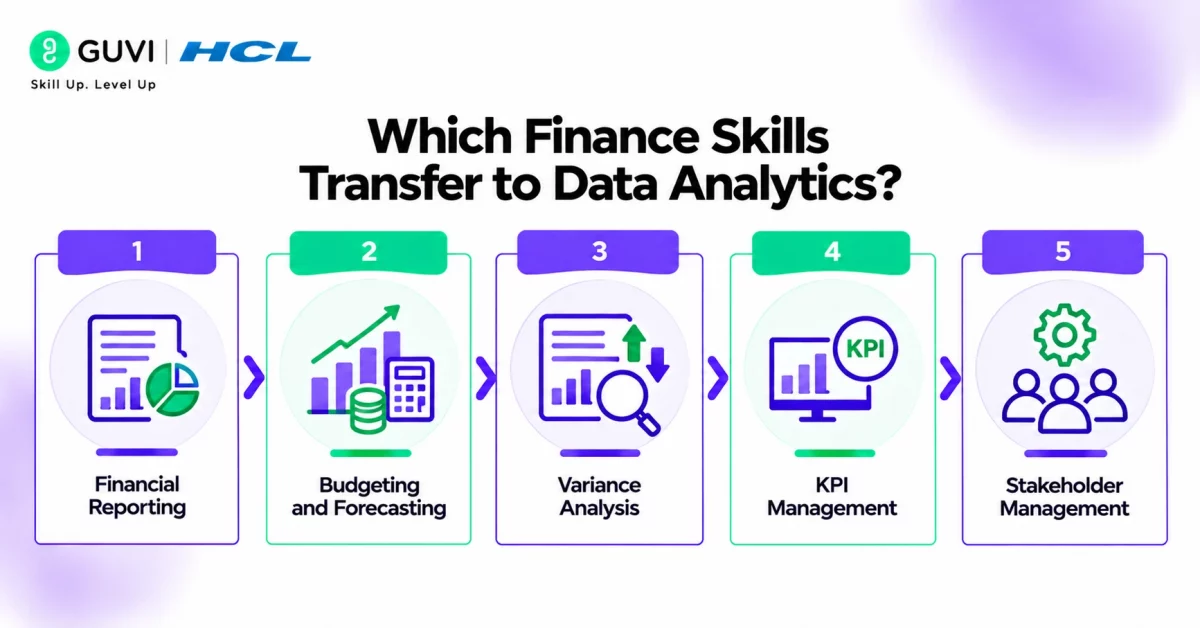
- Which Finance Skills Transfer to Data Analytics?
- Financial Reporting
- Budgeting and Forecasting
- Variance Analysis
- KPI Management
- Stakeholder Management
- What Technical Skills Should a Deputy Manager Learn?
- Advanced Excel
- SQL
- Power BI
- Python
- How Can You Switch to Data Analytics Mid-Career?
- Step 1: Choose a Target Role
- Step 2: Build Technical Skills Around Finance Problems
- Step 3: Create a Finance Analytics Portfolio
- Step 4: Reposition Your Resume
- Should You Leave Finance Completely?
- Conclusion
- FAQs
- Can a Deputy Manager in Finance become a Data Analyst?
- Is a mid-career transition from finance to data analytics difficult?
- Which skills should a finance professional learn first?
- Can a finance manager become a financial data analyst?
- Should I learn SQL before Power BI?
- What projects should a finance professional include in a data analytics portfolio?
- Do I need to take a lower-level role to switch to data analytics?
TL;DR
- Deputy Managers in Finance already have valuable experience working with business and financial data.
- Financial reporting, budgeting, forecasting, and variance analysis can transfer to analytics.
- SQL, Power BI, advanced Excel, and data visualization are important skills to develop.
- Finance analytics and business intelligence can provide practical transition paths.
- A strong portfolio can demonstrate technical ability when professional analytics experience is limited.
Quick Answer
| Yes, a Deputy Manager in Finance can switch to data analytics mid-career. Existing experience in financial analysis, reporting, budgeting, forecasting, and KPI management provides useful domain knowledge. The main gap is usually technical expertise. Learning SQL, Power BI, advanced Excel, and data visualization can help bridge that gap. Finance professionals can initially target financial data analyst, finance BI, FP&A analytics, and business analyst roles. |
Why Is a Finance Background Valuable in Data Analytics?
Data analytics is not only about technical tools. Analysts also need to understand the business problem behind the data.
A Deputy Manager in Finance may already investigate revenue changes, analyze expenses, compare budgets with actual results, monitor financial KPIs, and prepare reports for management.
Which Finance Skills Transfer to Data Analytics?
1. Financial Reporting
Experience preparing management reports can help with data interpretation and communicating insights to stakeholders.
2. Budgeting and Forecasting
Budget-versus-actual analysis involves identifying trends, measuring deviations, and investigating their causes.
3. Variance Analysis
Analyzing financial variances is closely connected to identifying patterns and explaining changes in datasets.
4. KPI Management
Finance professionals often monitor metrics such as revenue, expenses, margins, working capital, and cash flow. This experience can support dashboard and reporting work.
5. Stakeholder Management
As a Deputy Manager, you may already communicate findings with managers and business teams. This can be valuable because Data Analysts must often explain technical findings to non-technical stakeholders.
What Technical Skills Should a Deputy Manager Learn?
The biggest change is learning to work directly with data using modern analytics tools.
1. Advanced Excel
Do not overlook Excel simply because you are moving toward data analytics.
Strengthen skills such as pivot tables, lookup functions, conditional formulas, data cleaning, Power Query, and dashboard creation.
2. SQL
SQL is an important skill for many Data Analyst positions.
For example, you could use SQL to analyze:
- Revenue by month
- Customer payment patterns
- Outstanding invoices
- Departmental expenses
- Budget variances
3. Power BI
Power BI can help convert financial datasets into interactive dashboards.
A finance professional could build dashboards covering profitability, revenue, expenses, cash flow, accounts receivable, or budget performance.
4. Python
Python can be useful for data cleaning, automation, and more advanced analysis.
However, you do not necessarily need to begin with Python. For many finance-to-data transitions, advanced Excel, SQL, and Power BI provide a more practical initial skill set.
How Can You Switch to Data Analytics Mid-Career?
A mid-career transition requires more than completing a certification. You need evidence that you can apply analytics skills.
Step 1: Choose a Target Role
Do not begin by trying to learn every data analytics skill.
First, review job descriptions for financial data analyst, finance BI, and business analyst positions. Identify the most common requirements and use them to create your learning plan.
Step 2: Build Technical Skills Around Finance Problems
Learn SQL and Power BI by solving problems you already understand.
For example, take a sample financial dataset and answer questions such as:
- Which business units exceeded their budgets?
- Which months produced the highest revenue?
- Which expense categories increased the most?
- Which customers have delayed payments?
This approach makes technical learning more practical.

Step 3: Create a Finance Analytics Portfolio
Build two or three projects that demonstrate your ability to transform raw data into useful insights.
Potential projects include:
- Budget Variance Dashboard: Compare planned and actual expenses.
- Profitability Analysis: Compare revenue, costs, and margins.
- Cash Flow Dashboard: Track inflows, outflows, and monthly trends.
- Receivables Analysis: Identify overdue invoices and payment patterns.
For each project, explain the business problem, data preparation, analysis, findings, and recommendations.
Step 4: Reposition Your Resume
- Your finance management experience should remain prominent.
- Highlight genuine analytical responsibilities such as financial reporting, forecasting, KPI monitoring, variance analysis, process improvement, and management reporting.
- Your resume should show a progression rather than make it appear that you are starting your career from scratch.
Should You Leave Finance Completely?
No. In many cases, your finance expertise can be your competitive advantage.
A professional who understands both financial processes and analytics can solve finance-specific problems without needing to learn the business domain from scratch.
This can make roles involving financial data, business intelligence, FP&A analytics, reporting automation, and performance analysis particularly relevant.
Finance professionals can use analytics to move beyond simply reporting what happened. By combining financial knowledge with data tools, they can investigate why performance changed, identify patterns, and provide evidence that supports business decisions.
Conclusion
A Deputy Manager in Finance can make a realistic mid-career transition to data analytics. The strongest approach is to build on existing finance expertise rather than treating it as unrelated experience.
Start with advanced Excel, SQL, and Power BI. Build projects around real finance problems and use them to demonstrate your technical capabilities.
For many professionals, the most practical route is finance to data analytics through a finance data career. Financial data analyst, finance BI, FP&A analytics, and business analyst roles can provide a bridge between existing experience and new technical skills.
FAQs
1. Can a Deputy Manager in Finance become a Data Analyst?
Yes. A Deputy Manager can transition by developing SQL, Power BI, advanced Excel, data visualization, and practical analytics skills.
2. Is a mid-career transition from finance to data analytics difficult?
It can require significant upskilling, particularly in technical tools. However, existing financial and business knowledge can reduce the domain-learning curve.
3. Which skills should a finance professional learn first?
Start with advanced Excel, SQL, and Power BI. Add Python when your target roles require automation or more advanced data analysis.
4. Can a finance manager become a financial data analyst?
Yes. Financial data analyst roles can be a practical transition because they combine finance knowledge with data analysis.
5. Should I learn SQL before Power BI?
Learning both is useful. SQL helps retrieve and analyze data, while Power BI helps model and visualize it. Either can be your starting point depending on your target role.
6. What projects should a finance professional include in a data analytics portfolio?
Budget variance, profitability, cash flow, revenue, and accounts receivable dashboards are relevant projects that connect finance expertise with analytics.
7. Do I need to take a lower-level role to switch to data analytics?
Not necessarily. Look for finance analytics, BI, FP&A analytics, and business analyst positions where your existing experience can support a more senior transition.
Success Stories

About the Author
HCL GUVI
This article was selected and published as part of the HCL GUVI AI Blogathon 2026, an initiative designed to encourage students, AI enthusiasts, and aspiring tech writers to simplify complex AI concepts through impactful technical content. The contest recognized high-quality, original, and insightful AI-focused blogs, with selected authors receiving publication opportunities on the HCL GUVI blog platform along with official author credits and recognition.
View all posts by HCL GUVI
Connect with me @








Did you enjoy this article?