


Data Science Articles
BPO Experience for Data Analyst Jobs Does It Count When Applying? - Best Guide
What's Career Growth After 5 Years in BPO? Are You Missing Out on a Data Analyst Career?
Can a BPO Team Leader Become a Data Analyst?
BPO vs Data Analyst Salary in India: What Changes After the Switch?

Get In Touch For Details! Request More Information

Will Switching From Operations Manager to Data Science Increase Salary?
Oct 07, 2026 3 Min Read 126 Views
(Last Updated)
Switching from operations manager to data science can create new career opportunities and stronger long-term earning potential, but it may not lead to an immediate salary increase. For BPO and non-IT professionals, transitioning through data analytics can be a more practical route. This guide explores salary expectations, transferable skills, suitable data roles, and a step-by-step career transition path.
Table of contents
- TL;DR
- Quick Answer
- Operations Manager vs Data Roles: Salary Outlook
- Why Operations Managers Can Move Into Data
- BPO to Data Analyst: Is It Possible?
- What Skills Should You Learn?
- Excel
- SQL
- Power BI
- Python
- Statistics
- Operations Manager to Data Science: Career Transition Roadmap
- Will You Have to Take a Salary Cut?
- How to Increase Your Salary After Switching
- Should You Move Directly Into Data Science?
- Build Your Data Skills With HCL GUVI
- Conclusion
- FAQs
- Can an Operations Manager become a Data Analyst?
- Can I move from BPO to Data Analytics?
- Will switching to Data Science increase my salary?
- Is Data Analytics easier to enter than Data Science?
- What skills should I learn for a data career?
- Can non-IT professionals become Data Scientists?
- What is the best first data role for an Operations Manager?
TL;DR
- Operations and BPO experience can transfer well into data-related roles.
- Data Analyst or Business Analyst roles can be easier entry points than Data Scientist.
- SQL, Excel, Power BI, Python, and statistics are key skills to develop.
- You may need to accept a salary reset when entering an entry-level data role.
- Long-term salary growth depends on your skills, experience, role, and company.
Quick Answer
| Switching from operations to data can create new career opportunities, but a higher salary is not guaranteed immediately. Coursera notes that Data Analysts typically need skills such as SQL, Python, Excel, statistics, data visualization, and problem-solving. For BPO and operations professionals, building these skills can help support a transition into Data Analyst, Business Analyst, Reporting Analyst, or Operations Analyst roles. |
Operations Manager vs Data Roles: Salary Outlook
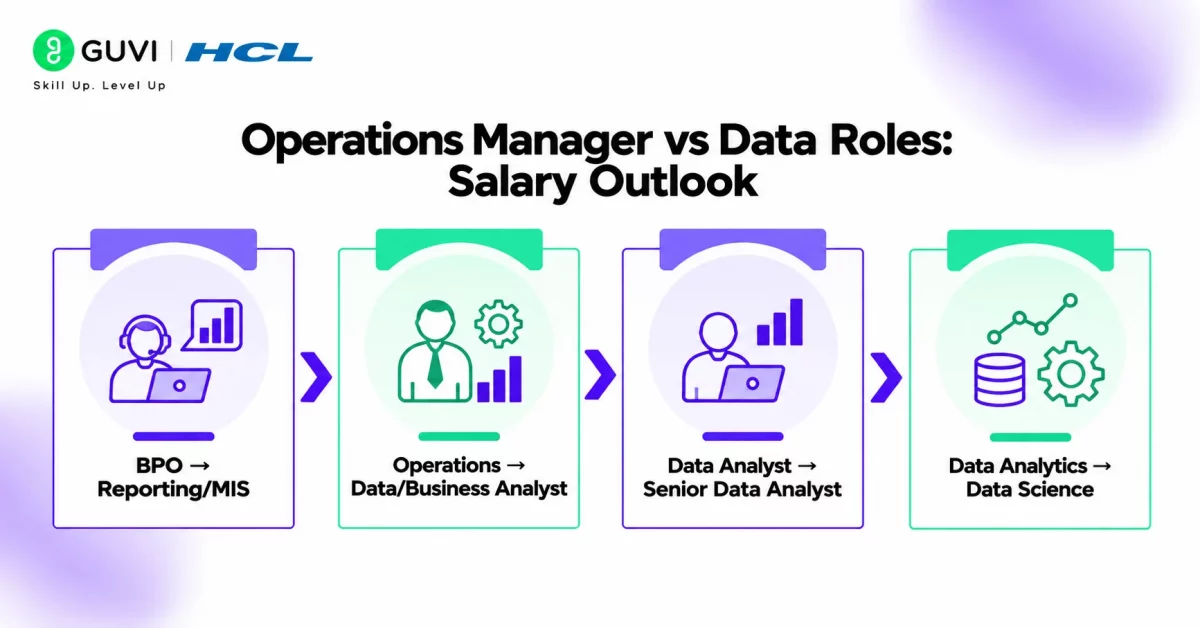
Salary depends heavily on experience, location, industry, and company, so there is no single salary figure that applies to everyone.
- BPO → Reporting/MIS: Entry- to mid-level salary potential.
- Operations → Data/Business Analyst: Moderate to high salary potential.
- Data Analyst → Senior Data Analyst: Higher salary potential with experience.
- Data Analytics → Data Science: Higher potential with advanced skills.
The important point is that switching to data does not automatically mean earning more. Your first data role could pay the same as or less than your current operations salary.
1. Why Operations Managers Can Move Into Data
Operations professionals already work with many types of business data. You may have experience with:
- KPIs and performance metrics
- SLA and productivity reports
- Process improvement
- Customer data
- Team performance
- Forecasting and operational planning
These experiences can become valuable when combined with analytics skills.
For example, instead of simply monitoring employee productivity, a data professional can analyse the data to identify why productivity changes and which factors affect performance.
2. BPO to Data Analyst: Is It Possible?
Yes. You do not have to move directly from BPO into Data Science.
A practical career path could look like:
BPO → MIS/Reporting Analyst → Data Analyst → Senior Data Analyst → Data Science/Advanced Analytics
Your BPO experience can help you understand customer behaviour, processes, quality metrics, and business operations. The goal is to combine that domain knowledge with technical skills.
What Skills Should You Learn?
1. Excel
Excel is a good starting point for professionals moving from operations into analytics. Learn pivot tables, lookups, formulas, data cleaning, and basic dashboards.
2. SQL
SQL helps you retrieve and analyse information stored in databases. Focus on queries, filtering, joins, grouping, aggregate functions, and window functions.
3. Power BI
Power BI can help you convert operational data into dashboards and reports. This is particularly useful if your previous role involved KPI or performance reporting.
4. Python
Python becomes increasingly useful as you move toward advanced analytics and data science. Start with basic Python, then learn Pandas, NumPy, data cleaning, and visualization.
5. Statistics
Learn practical statistics such as averages, distributions, correlation, probability, and hypothesis testing. You do not need advanced mathematics to begin a data analytics transition.
Operations Manager to Data Science: Career Transition Roadmap
A structured transition can make the process more manageable.
Step 1: Identify your existing experience
List the reports, KPIs, dashboards, and business problems you already handle.
Step 2: Strengthen Excel and SQL
Build a foundation in data analysis before moving into advanced tools.
Step 3: Learn Power BI
Create dashboards using business or operational datasets.
Step 4: Add Python and statistics
Use Python for data cleaning, analysis, and automation.
Step 5: Build projects
Create projects around employee attrition, customer support, productivity, sales, or operational performance.
Step 6: Apply for suitable roles
Target Data Analyst, Business Analyst, MIS Analyst, Reporting Analyst, Operations Analyst, and BI positions.

Will You Have to Take a Salary Cut?
Possibly. This is something you should consider before making the switch.
If you are already an experienced Operations Manager, an entry-level Data Analyst position may offer less than your current salary. However, your existing business experience can help you target roles where domain knowledge and analytics skills are both valuable.
Instead of presenting yourself as someone starting from zero, position yourself as an operations professional who has developed the ability to analyse business data and solve operational problems.
How to Increase Your Salary After Switching
Don’t focus only on collecting certificates. Build evidence that you can solve real business problems.
For example, create a project that analyses:
- Employee attrition
- Customer complaints
- Team productivity
- Operational costs
- Customer satisfaction
- Process turnaround time
Use Excel, SQL, Power BI, or Python to analyse the problem and explain the business impact.
This gives employers a reason to value both your previous experience and new technical skills.
Should You Move Directly Into Data Science?
For most Operations Managers and BPO professionals, Data Analytics is a more practical starting point than Data Science.
Data Science generally requires stronger programming, statistics, machine learning, and analytical skills. Data Analytics allows you to build on your existing business experience while developing technical abilities.
Once you gain experience, you can decide whether moving into advanced analytics or Data Science makes sense.
Your operations experience can become an advantage in analytics because companies need professionals who understand both business processes and data.
Build Your Data Skills With HCL GUVI
If you are moving from a non-IT or operations background, structured learning can help you build the required foundation.
HCL GUVI offers both a Data Science eBook for learners exploring the field, while its Zen Class Data Science Course provides a more structured learning path covering areas such as Python, SQL, statistics, machine learning, and projects.
Conclusion
Switching from Operations Manager to Data Science can improve your long-term salary potential, but an immediate salary increase is not guaranteed. For BPO and non-IT professionals, Data Analyst, Business Analyst, MIS, and Reporting roles can provide more realistic entry points.
Build skills in Excel, SQL, Power BI, Python, and statistics, create practical projects, and use your existing operations experience as an advantage. The strongest career transition is not simply from non-IT to IT, it is from business experience to data-driven decision-making.
FAQs
1. Can an Operations Manager become a Data Analyst?
Yes. Experience with KPIs, reporting, processes, and business performance can provide a strong foundation for a Data Analyst role.
2. Can I move from BPO to Data Analytics?
Yes. Start with Excel, SQL, and Power BI, then gradually add Python and statistics.
3. Will switching to Data Science increase my salary?
It can increase your long-term earning potential, but your first data role may involve a salary reset.
4. Is Data Analytics easier to enter than Data Science?
Generally, yes. Data Analytics is often a more accessible starting point for professionals transitioning from operations or BPO.
5. What skills should I learn for a data career?
Start with Excel, SQL, Power BI, and statistics. Then develop Python, Pandas, and machine learning skills.
6. Can non-IT professionals become Data Scientists?
Yes. Non-IT professionals can transition by developing programming, statistics, data analysis, and machine learning skills.
7. What is the best first data role for an Operations Manager?
Data Analyst, Business Analyst, Reporting Analyst, MIS Analyst, or Operations Analyst can be practical starting points depending on your existing experience.
Success Stories

About the Author
HCL GUVI
This article was selected and published as part of the HCL GUVI AI Blogathon 2026, an initiative designed to encourage students, AI enthusiasts, and aspiring tech writers to simplify complex AI concepts through impactful technical content. The contest recognized high-quality, original, and insightful AI-focused blogs, with selected authors receiving publication opportunities on the HCL GUVI blog platform along with official author credits and recognition.
View all posts by HCL GUVI
Connect with me @








Did you enjoy this article?