


Career Articles
Deloitte NLA 2026: Complete Guide to Exam, Eligibility & Recruitment Process
Deloitte NLA Experience 2026: Assessment, Interview & Selection Process
Deloitte NLA Aptitude Questions and Answers: Practice Questions with Solutions - Best Guide


Get In Touch For Details! Request More Information
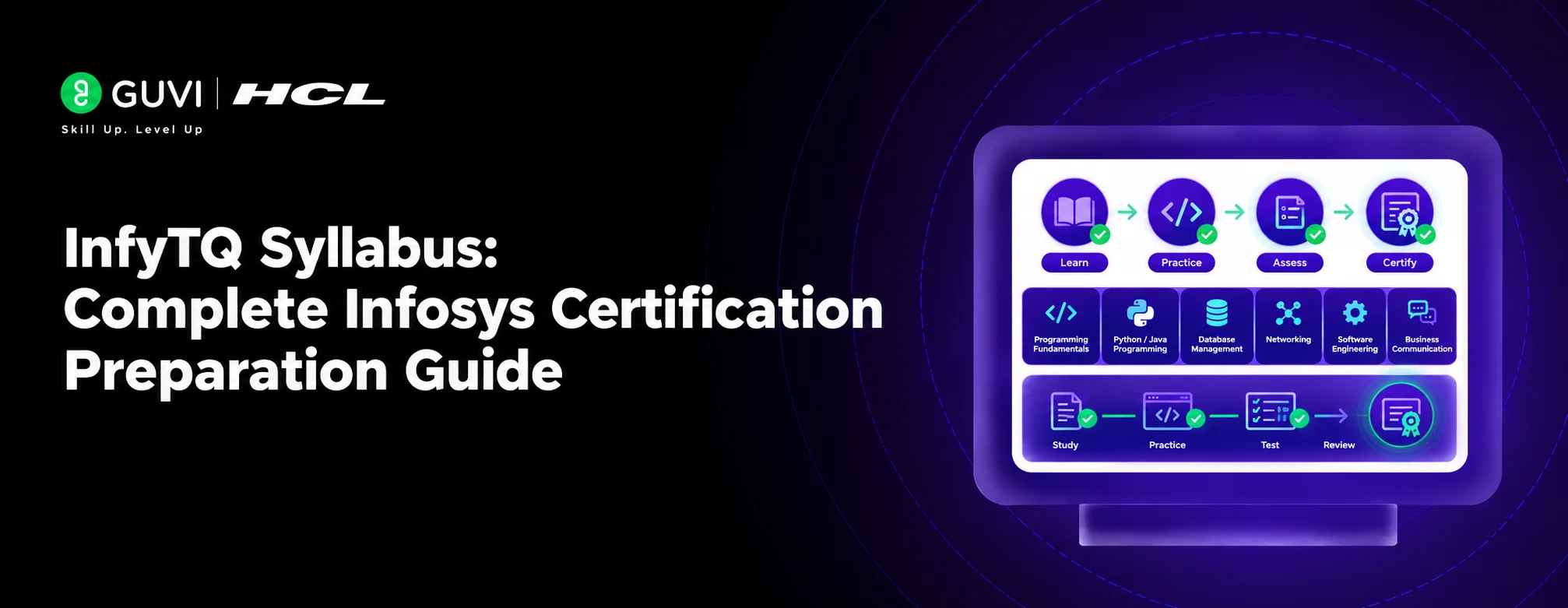
InfyTQ Syllabus 2026: Complete Infosys Certification Preparation Guide
Sep 29, 2026 7 Min Read 202 Views
(Last Updated)
Table of contents
- Introduction
- TL;DR Summary
- What is the InfyTQ Syllabus?
- Why the Infosys InfyTQ Syllabus Matters for Freshers
- InfyTQ Exam Pattern 2026
- InfyTQ Certification Round Pattern
- Key Exam Rules You Should Know
- Complete InfyTQ Certification Syllabus
- Programming Fundamentals in the InfyTQ Syllabus
- Object-Oriented Programming Topics
- Data Structures and Algorithms
- DBMS and SQL Topics
- InfyTQ Subjects and Preparation Topics
- InfyTQ Certification Round vs Advantage Round
- How to Prepare for the InfyTQ Exam
- 4-Week InfyTQ Preparation Roadmap
- Practice Method That Actually Works
- Career Benefits and Salary Scope
- Why Certification Preparation Helps Your Career
- Where the Syllabus Shows Up in Actual Work
- Common Mistakes to Avoid
- Mistake 1: Studying Python or Java Without Coding Practice
- Mistake 2: Ignoring DBMS Until the Last Week
- Mistake 3: Choosing a Language Based on Friends
- Mistake 4: Memorising Definitions Instead of Understanding Output
- Mistake 5: Not Taking Timed Mock Tests
- Build Your Foundation With HCL GUVI
- Conclusion
- FAQs
- What is the InfyTQ syllabus?
- Is the Infosys InfyTQ syllabus the same for Python and Java?
- Is DBMS important in the InfyTQ exam syllabus?
- What are the main InfyTQ subjects?
- How should I start InfyTQ preparation?
- What are the most important InfyTQ preparation topics?
- What score is required to clear the Certification Round?
- What is the Advantage Round in InfyTQ?
- Is the InfyTQ syllabus 2026 enough for placements?
Introduction
The InfyTQ syllabus matters because Infosys Certification is not just another campus test; it checks whether you can actually think like an entry-level software programmer. The official Certification Round tests Java/Python hands-on coding, Java/Python MCQs, and Database Management Systems within a 3-hour format.
So, your preparation cannot stop at watching Python or Java tutorials. You need coding practice, OOP clarity, SQL confidence, and the ability to solve problems under time pressure.
For 2026 aspirants, the practical goal is simple: understand the InfyTQ syllabus, prepare topic by topic, and practise enough to move from “I know the concept” to “I can solve it in the exam.”
TL;DR Summary
- The InfyTQ syllabus mainly covers Python/Java programming, OOP, DSA, DBMS, SQL, and hands-on coding.
- The Certification Round includes 2 coding questions, 10 programming MCQs, and 10 DBMS MCQs.
- You get 3 hours to complete the exam, so speed and accuracy both matter.
- Focus first on loops, strings, arrays/lists, functions, OOP, SQL joins, keys, and normalization.
- DBMS is a scoring section, so do not leave SQL preparation for the last week.
- Pick Python or Java based on your comfort, not based on what others choose.
- The best preparation strategy is daily coding practice, SQL revision, MCQs, and timed mock tests.
What is the InfyTQ Syllabus?
The InfyTQ syllabus includes programming, database, and problem-solving topics that are asked in the Infosys Certification exam. It mainly covers Java or Python programming, object-oriented programming, data structures, algorithms, DBMS, SQL, and hands-on coding tasks designed to evaluate industry readiness for entry-level software roles.
The important part is that the exam checks both theory and application. You may understand loops, joins, or classes individually, but the test expects you to apply them in MCQs and coding questions.
Why the Infosys InfyTQ Syllabus Matters for Freshers
The Infosys InfyTQ syllabus is useful because it gives you a focused preparation path. Instead of trying to study every computer science subject, you can prioritise the topics that directly influence your certification performance.
This matters even more because Infosys says candidates scoring 65% or above in the Certification Round may proceed to the Advantage Round or a techno-behavioral interview for the Systems Engineer role, after necessary checks.
InfyTQ Exam Pattern 2026
Before studying the InfyTQ exam syllabus, understand how the paper is structured. The exam pattern tells you how much weight to give coding, MCQs, and DBMS during preparation.
Infosys’ official examination guidelines state that the Certification Round has objective and hands-on questions, divided into three sections and answered within 3 hours.
InfyTQ Certification Round Pattern
| Section | Question Type | Number of Questions | What It Tests |
| Section I | Java/Python Hands-on | 2 | Your ability to write working code, handle logic, and solve programming problems within time. |
| Section II | Java/Python MCQs | 10 | Your understanding of syntax, OOP, output prediction, data structures, and programming concepts. |
| Section III | DBMS MCQs | 10 | Your clarity in SQL, relational databases, keys, joins, normalization, and database fundamentals. |
Key Exam Rules You Should Know
There is no negative marking in the Certification Round, which means you should attempt all questions strategically.
The Java/Python questions are based on the language selected during test slot booking. So, choose the language you can code in confidently, not the one your friends are choosing.
Complete InfyTQ Certification Syllabus
The InfyTQ certification syllabus can be grouped into four major buckets: programming fundamentals, OOP, DSA, and DBMS/SQL. This grouping helps you prepare in a structured way instead of jumping randomly between topics.
Infosys has also stated that certification assessments are based on four foundation courses available on InfyTQ, designed around essential areas students need for an IT career.
Programming Fundamentals in the InfyTQ Syllabus
Programming fundamentals are the base of the InfyTQ exam syllabus. These topics decide whether you can read a problem, convert it into logic, and write clean code.
Focus on:
- Variables, data types, and operators
- Conditional statements and loops
- Functions and recursion basics
- Strings and string methods
- Lists, arrays, tuples, dictionaries, or language-specific collections
- Input/output handling
- Error handling basics
- Output prediction questions
For example, a question may ask you to count repeated characters in a string or find the second-largest number in a list. These look simple, but they test loops, conditions, edge cases, and clean implementation.
Object-Oriented Programming Topics
OOP is one of the most important InfyTQ subjects because it tests whether you understand how real software is structured.
Focus on:
- Classes and objects
- Constructors
- Encapsulation
- Inheritance
- Polymorphism
- Method overriding and overloading
- Access modifiers, especially for Java learners
- Class variables and instance variables
A practical example would be designing a Student class with marks, grade calculation, and result display. This checks whether you can connect syntax with real program structure.
Data Structures and Algorithms
DSA in the InfyTQ syllabus 2026 is usually beginner-to-intermediate level, but it still needs consistent practice. The goal is not to memorise 500 problems; it is to understand patterns.
Focus on:
- Arrays and lists
- Strings
- Searching and sorting
- Stack and queue basics
- Hashing or dictionary-based counting
- Recursion
- Basic time complexity
- Pattern-based coding questions
Stack Overflow’s 2025 Developer Survey reported that Python adoption grew by 7 percentage points from 2024 to 2025, reflecting its relevance in AI, data science, and backend development. This makes Python a practical choice if you are comfortable with it, but Java is equally valid if your OOP basics are strong.
DBMS and SQL Topics
DBMS is a scoring area because many students focus only on coding and leave databases for the last week. That is a mistake.
Focus on:
- DBMS basics
- Relational model
- Primary key, foreign key, candidate key
- SQL commands: DDL, DML, DCL, TCL
- SELECT queries
- WHERE, GROUP BY, ORDER BY, HAVING
- Joins
- Subqueries
- Normalization
- Transactions and ACID properties
SQL is also highly relevant outside the exam. Stack Overflow’s 2025 data places SQL among the most widely used developer technologies, with third-party reporting of the survey showing SQL used by 58.6% of respondents.
InfyTQ Subjects and Preparation Topics
The InfyTQ preparation topics should be arranged based on exam impact. Start with topics that appear in both MCQs and coding, then move to DBMS, then revise edge cases.
This approach helps you avoid scattered preparation and gives you a measurable weekly roadmap.
| Priority | Topic Area | What You Should Practise |
| High | Coding fundamentals | Practise loops, functions, strings, arrays/lists, number problems, and input/output handling until you can solve basic problems without hints. |
| High | OOP | Understand classes, objects, inheritance, constructors, and polymorphism through small coding examples, not just definitions. |
| High | SQL | Write queries daily using joins, grouping, filtering, sorting, and subqueries because DBMS has a dedicated section. |
| Medium | DSA | Focus on arrays, strings, searching, sorting, hashing, stacks, queues, and recursion-based logic. |
| Medium | MCQ practice | Solve output prediction and concept-based questions to improve accuracy in programming and DBMS sections. |
| Low but useful | Aptitude-style logic | Practise basic logic and pattern thinking, especially if your college placement process adds extra screening rounds. |
InfyTQ Certification Round vs Advantage Round
The Certification Round and Advantage Round are connected, but they test different levels of readiness. You should prepare for the Certification Round first, then gradually increase coding difficulty for the Advantage Round.
The official guideline says the Advantage Round is an advanced test with three programming-based questions of varying difficulty levels, also answered within 3 hours.
| Parameter | Certification Round | Advantage Round |
| Purpose | Tests core programming and DBMS readiness for Infosys Certification. | Tests advanced programming and technical problem-solving skills. |
| Duration | 3 hours. | 3 hours. |
| Question Type | 2 hands-on coding questions, 10 programming MCQs, and 10 DBMS MCQs. | 3 programming-based questions of varying difficulty. |
| Language | Based on Java/Python selected during slot booking. | Candidates may get the option to attempt in other languages on the test day. |
| Outcome | 65% or above may lead to Advantage Round or Systems Engineer interview, subject to checks. | Clearing it may lead to a pre-replacement interview opportunity for Specialist Programmer or Digital Specialist Engineer roles, based on performance. |
SQL can quietly become your score booster in InfyTQ. While most students spend all their energy on coding, a few well-practised joins, subqueries, and GROUP BY questions can help you secure marks faster.
How to Prepare for the InfyTQ Exam
A strong preparation plan for the InfyTQ syllabus should balance concept learning, coding practice, SQL revision, and mock tests. Do not prepare one topic in isolation for too long.
The best preparation method is weekly repetition. Learn a concept, solve problems, revise mistakes, and test yourself under time limits.
4-Week InfyTQ Preparation Roadmap
| Week | Focus Area | Action Plan |
| Week 1 | Programming basics | Revise syntax, loops, functions, strings, arrays/lists, and basic problem-solving. Solve 5–8 beginner coding problems daily. |
| Week 2 | OOP + MCQs | Practise classes, objects, inheritance, constructors, and output-based questions. Build 3–4 mini programs using OOP. |
| Week 3 | DBMS + SQL | Revise keys, normalization, joins, grouping, subqueries, and transactions. Write SQL queries instead of only reading them. |
| Week 4 | Mixed practice | Attempt mock tests with coding, MCQs, and DBMS. Review mistakes and repeat weak topics before the exam. |
Practice Method That Actually Works
Use a 60-30-10 rule for daily preparation.
Spend 60% of your time solving coding problems. Spend 30% revising DBMS and SQL. Use the remaining 10% for MCQs, output prediction, and quick notes.

This keeps your preparation aligned with the actual exam instead of becoming theory-heavy.
Career Benefits and Salary Scope
The main benefit of completing the Infosys InfyTQ syllabus is that you build the exact foundation expected from fresher software roles: programming logic, database understanding, and structured problem-solving.
This is valuable beyond one exam because the Indian tech sector continues to need job-ready talent. Nasscom’s 2026 Strategic Review notes that direct tech sector employment is projected to reach around 6 million in FY26, with a net addition of about 135,000 employees.
Why Certification Preparation Helps Your Career
| Benefit | How It Helps You |
| Stronger coding confidence | Regular practice helps you solve placement questions faster and with fewer syntax mistakes. |
| Better SQL foundation | SQL is useful in software development, data roles, backend development, testing, and support engineering. |
| Interview readiness | OOP, DBMS, and DSA are common fresher interview topics across IT companies. |
| Proof of consistency | Preparing for certification shows recruiters that you can follow a structured learning path. |
Freshers should also remember that employability depends on more than a certificate. Mercer’s India Graduate Skill Index 2025 found that 42.6% of Indian graduates who apply for jobs are overall employable, which means practical skills and interview readiness still matter heavily.
Where the Syllabus Shows Up in Actual Work
In a software services company, these topics appear in everyday tasks. A backend developer may use SQL joins to fetch customer data, OOP to structure service classes, and Python or Java to automate validations.
In a banking project, for example, you may need to write logic for transaction limits, use SQL to retrieve account history, and debug code written by another developer. That is exactly why the InfyTQ subjects focus on programming and DBMS instead of only theoretical computer science.
In an eCommerce project, string handling, dictionaries/hash maps, sorting, and database queries may appear while building search filters, order summaries, or inventory checks. Your exam preparation directly builds these habits.
Common Mistakes to Avoid
Many learners fail to use the InfyTQ preparation topics strategically. They study hard, but not always in the direction the exam needs.
Here are the mistakes you should avoid from day one.
Mistake 1: Studying Python or Java Without Coding Practice
Watching tutorials can make you feel prepared, but the exam checks whether you can write working code. You need to solve problems every day, even if they are small.
Start with simple questions on numbers, strings, and arrays/lists. Then move to medium-level logic problems that combine loops, functions, and conditions.
The fix is simple: after every concept, solve at least 5 questions before moving ahead. Your goal is not passive understanding; it is exam-speed implementation.
Mistake 2: Ignoring DBMS Until the Last Week
DBMS looks easier than coding, so many students postpone it. But the Certification Round has a separate Database Management Systems section with 10 questions.
If you leave SQL for the end, joins, grouping, normalization, and keys may feel confusing together. DBMS becomes scoring only when you revise it repeatedly.
The fix is to practise SQL queries from week one. Even 30 minutes a day can make a big difference by exam week.
Mistake 3: Choosing a Language Based on Friends
The Certification Round questions are based on the programming language selected during test slot booking.
Do not choose Java only because your classmates are choosing it, and do not choose Python only because people say it is easier. Choose the language in which you can debug quickly.
The fix is to solve 20 coding questions in both languages if you are confused. Pick the one where your logic becomes code faster.
Mistake 4: Memorising Definitions Instead of Understanding Output
MCQs often test small details: output, syntax behaviour, object creation, function calls, or query results. Memorising definitions will not help if you cannot trace code.
For example, understanding inheritance theoretically is not enough. You should know what happens when a child class overrides a method or when a constructor is called.
The fix is to practise output-based MCQs and explain the answer to yourself in one line. This builds exam accuracy.
Mistake 5: Not Taking Timed Mock Tests
Many students can solve problems slowly but struggle when the timer starts. The Certification Round gives you 3 hours for a mix of hands-on and objective questions.
Without timed practice, you may spend too long on one coding problem and rush through DBMS. This affects both confidence and accuracy.
The fix is to take at least 3 full-length mocks before the exam. After each mock, review wrong answers and create a “last revision” sheet.
Build Your Foundation With HCL GUVI
If you are preparing for Infosys Certification, start by strengthening the fundamentals it actually tests. You can build problem-solving skills with HCL GUVI’s DSA using Python, revise core coding concepts through Python Programming Zero to Hero, and improve your OOP basics with Object-Oriented Programming and Programming Fundamentals.
For learners who want a guided, project-based path toward software roles, HCL GUVI’s Software and AI Engineer Program can help you build full stack skills alongside certification preparation. You can also use HCL GUVI’s CodeKata to practice coding problems regularly and improve your speed for technical assessments.
The right next step is to pair certification preparation with hands-on projects, because recruiters value both test performance and proof of practical skills.
Conclusion
The InfyTQ syllabus is not difficult if you prepare it in the right order: programming basics, OOP, DSA, DBMS, SQL, and timed mock tests. The official exam pattern clearly shows that both coding and databases matter, so your preparation should not be one-sided. Start with one programming language, practise daily, revise SQL consistently, and test yourself under exam conditions. If you treat the InfyTQ syllabus 2026 as a career foundation rather than just an exam checklist, you will also become stronger for placements, interviews, and entry-level software roles.
FAQs
1. What is the InfyTQ syllabus?
The InfyTQ syllabus includes Java/Python programming, object-oriented programming, data structures, algorithms, DBMS, SQL, and hands-on coding. It tests whether you are ready for entry-level software programming tasks.
2. Is the Infosys InfyTQ syllabus the same for Python and Java?
The core logic, OOP, DSA, and DBMS areas are similar, but programming questions follow the language selected during slot booking. Choose Python or Java based on your coding confidence.
3. Is DBMS important in the InfyTQ exam syllabus?
Yes. DBMS has a dedicated 10-question section in the Certification Round, so SQL, keys, joins, normalization, and transactions should be revised properly.
4. What are the main InfyTQ subjects?
The main InfyTQ subjects are programming fundamentals, OOP, data structures, algorithms, DBMS, SQL, and hands-on coding. These subjects also overlap with common fresher interview topics.
5. How should I start InfyTQ preparation?
Start with one programming language, revise syntax, solve basic coding problems, then move to OOP, DSA, and SQL. After two weeks, begin mixed practice with coding and MCQs.
6. What are the most important InfyTQ preparation topics?
The most important InfyTQ preparation topics are strings, arrays/lists, loops, functions, OOP, searching, sorting, hashing, SQL joins, grouping, subqueries, keys, and normalization.
7. What score is required to clear the Certification Round?
According to Infosys’ official guideline, candidates scoring 65% or above in the Certification Round may proceed to the Advantage Round or a techno-behavioral interview for Systems Engineer, subject to post-round checks.
8. What is the Advantage Round in InfyTQ?
The Advantage Round is an advanced 3-hour programming test with three coding questions of varying difficulty. Candidates who clear it may get a pre-replacement interview opportunity for Specialist Programmer or Digital Specialist Engineer roles, based on performance.
9. Is the InfyTQ syllabus 2026 enough for placements?
The InfyTQ syllabus 2026 builds a strong base for coding and technical interviews, but you should also practise projects, communication, aptitude, and mock interviews for broader placement readiness.
Success Stories













Did you enjoy this article?