


Forward Deployed Engineer Articles
Scale AI Forward Deployed Data Scientist Interview Prep
ElevenLabs Forward Deployed Engineer Interview Guide
Forward Deployed Engineer Resume: A Template That Gets Interviews
Working With Legacy Systems: A Forward Deployed Engineer's Survival Guide


Get In Touch For Details! Request More Information
The Complete Forward Deployed Engineer Interview Guide
Sep 10, 2026 4 Min Read 112 Views
(Last Updated)
Preparing for a forward deployed engineer interview requires more than practicing coding questions. FDEs are expected to understand technical problems, build practical solutions, work with customers, and communicate complex ideas clearly. That means your interview may test several skills at once.
Unlike a traditional software engineering interview, you may be given an unclear customer problem and asked how you would approach it. You could also face questions about coding, APIs, cloud infrastructure, system design, debugging, and your previous projects.
So, how should you prepare? The key is to combine strong engineering fundamentals with structured problem-solving and communication skills. This forward deployed engineer interview guide explains what to expect, which areas to prepare, how to approach customer scenarios, and how to demonstrate the mindset companies look for in successful FDE candidates.
Table of contents
- TL;DR Summary
- What Is a Forward Deployed Engineer Interview Like?
- How Are Coding Skills Tested?
- How Should You Approach a Coding Problem?
- What System Design Questions Can Appear?
- How Are Customer Problem-Solving Skills Tested?
- What Is the Interviewer Looking For?
- What Questions Can Interviewers Ask About Your Projects?
- Example
- How Should You Prepare for the Interview?
- Week 1: Strengthen Fundamentals
- Week 2: Practice Building Systems
- Week 3: Practice FDE Scenarios
- Week 4: Mock Interviews
- How Should You Answer Behavioral Questions?
- What Questions Should You Ask the Interviewer?
- Start Your Learning Journey with GUVI
- Conclusion
- FAQs
- What is included in a Forward Deployed Engineer interview?
- Is coding required for a Forward Deployed Engineer interview?
- What system design questions are asked in FDE interviews?
- How should I prepare for an FDE interview?
- What makes FDE interviews different from software engineering interviews?
- What should I ask at the end of an FDE interview?
TL;DR Summary
- A forward deployed engineer interview guide should cover both technical engineering and customer-facing problem-solving.
- Expect questions on coding, APIs, databases, cloud, debugging, system design, and software architecture.
- You may also face ambiguous business scenarios where you need to clarify requirements before proposing a solution.
- Your projects can become a major part of the interview, so understand your technical decisions deeply.
- Communication matters because FDEs often explain technical solutions to customers and non-technical stakeholders.
- The best preparation combines technical practice, realistic problem-solving, and clear explanations rather than memorizing interview answers.
What Is a Forward Deployed Engineer Interview Like?
A Forward Deployed Engineer interview usually evaluates your ability to build technical solutions, solve ambiguous problems, and communicate effectively with customers or stakeholders.
Unlike a purely coding-focused software engineering interview, an FDE interview can test how you approach a problem from beginning to deployment.
A typical process may include:
- Resume or application screening
- Technical assessment
- Coding interview
- System design or architecture discussion
- Problem-solving or customer scenario
- Behavioral interview
- Final interview
The exact process varies between companies.
So, don’t prepare only for coding questions. You need to demonstrate that you can understand a problem, design a solution, build it, and explain it clearly.
Prepare for emerging AI engineering opportunities with HCL GUVI’s Artificial Intelligence & Machine Learning Course. Build practical skills in AI, machine learning, and real-world application development through hands-on projects.
How Are Coding Skills Tested?
Coding questions usually evaluate whether you can write correct, readable code and explain your reasoning.
You may encounter traditional algorithm questions, but practical coding tasks can also be relevant.
For example:
“Build a Python service that receives customer data through an API and stores the results in a database.”
The interviewer may care about more than whether your code works.
They may evaluate:
- Code structure
- Input validation
- Error handling
- Testing
- Security
- Database design
- API design
How Should You Approach a Coding Problem?
Use a simple process:
Understand → Clarify → Design → Code → Test → ExplainBefore writing code, make sure you understand the requirements.
If something is unclear, ask questions.
That’s particularly important for FDE interviews because real customer requirements are rarely perfectly defined.
FDE interviews can vary significantly between companies because the role itself can range from software-heavy implementation to AI integration and customer-focused solution engineering.
What System Design Questions Can Appear?
System design questions test whether you can break a complex problem into practical components.
For example:
“Design a system that allows a company to upload documents and ask questions about them.”
You might discuss:
User → API → Document Processing → Storage → Retrieval → AI Model → ResponseThen explain:
- Why you selected each component
- How data flows through the system
- How authentication works
- How failures are handled
- How the system could scale
- How you would monitor it
You don’t need to design the most complicated architecture.
The goal is to show structured technical reasoning.
Best Practice: During system design interviews, don’t immediately start drawing architecture. First ask questions about users, scale, data, requirements, constraints, and expected outcomes.
How Are Customer Problem-Solving Skills Tested?
FDE interviews often test whether you can turn an unclear business problem into a clear technical plan.
Consider this scenario:
“A customer says their employees spend too much time processing invoices. What would you build?”
Don’t immediately answer, “I’ll build an AI application.”
Start with questions.
You might ask:
- How are invoices currently processed?
- How many invoices are handled each month?
- What systems are involved?
- Which step takes the most time?
- What errors occur?
- What security requirements exist?
- What would success look like?
Only after understanding the problem should you recommend a solution.
What Is the Interviewer Looking For?
They may be evaluating whether you can:
- Ask useful questions
- Identify constraints
- Break down ambiguity
- Prioritize requirements
- Explain trade-offs
- Recommend a practical solution
This is one of the biggest differences between preparing for an FDE interview and preparing only for a traditional coding interview.
What Questions Can Interviewers Ask About Your Projects?
Expect interviewers to explore your projects deeply, especially if you have limited professional experience.
Don’t assume your project section is just something recruiters glance at.
You could be asked:
- Why did you build this project?
- Why did you choose this technology?
- Why did you use this database?
- How does the architecture work?
- What was the hardest problem?
- What would you change?
- How did you test it?
- How did you deploy it?
- What happens if traffic increases?
- What security issues did you consider?

Example
Suppose your resume says:
Built a Python API for an AI application.
Be ready to explain:
Why Python?
Why that API framework?
How did the application communicate with the AI model?
How did you handle failures?
Where was it deployed?
How did you evaluate the results?
Pro Tip: Before an interview, pick your two strongest projects and practice explaining each one in three versions: 30 seconds, 2 minutes, and 5 minutes.
How Should You Prepare for the Interview?
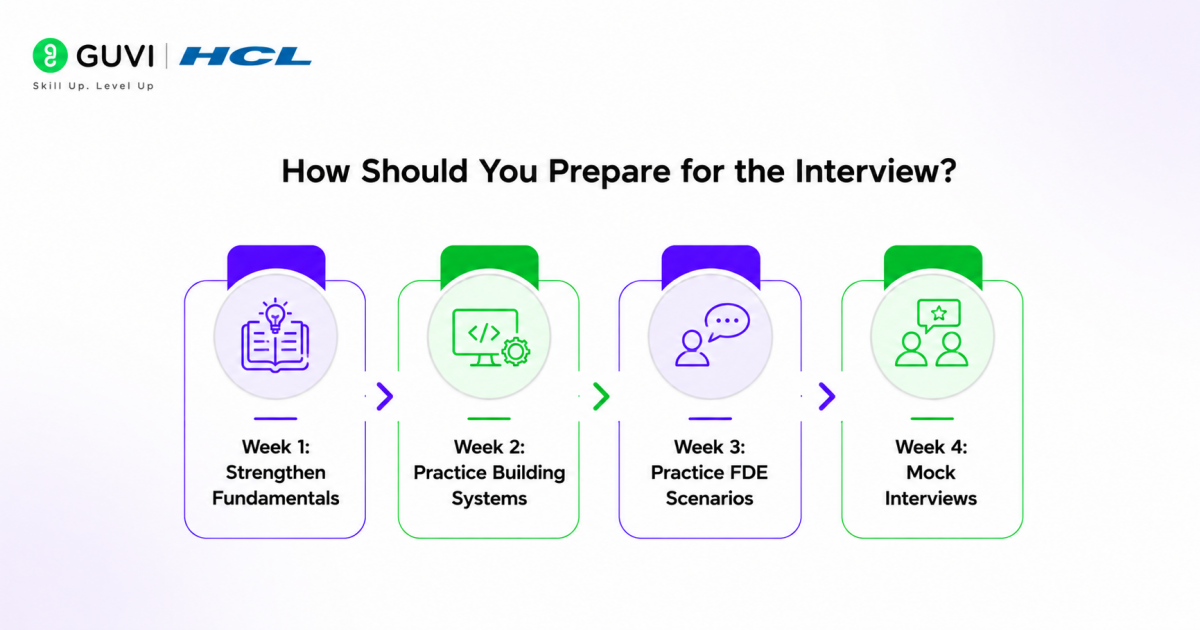
Prepare across four areas: coding, engineering fundamentals, real-world problem-solving, and communication.
Week 1: Strengthen Fundamentals
Review:
- Python or your primary language
- Data structures
- Algorithms
- SQL
- APIs
- Git
- Debugging
Week 2: Practice Building Systems
Work on:
- REST APIs
- Database integration
- Authentication
- Docker
- Cloud deployment
- Basic system design
Week 3: Practice FDE Scenarios
Take ambiguous business problems and practice turning them into technical solutions.
For each scenario:
- Clarify the problem.
- Identify requirements.
- Ask about constraints.
- Propose a solution.
- Explain trade-offs.
- Discuss deployment.
- Define how success would be measured.
Week 4: Mock Interviews
Practice explaining your projects and solving problems out loud.
Ask a friend or mentor to challenge your assumptions.
You can also record yourself answering questions and identify areas where your explanations become unclear.
How Should You Answer Behavioral Questions?
Use real examples and focus on what you personally did.
Common questions include:
- Tell me about a difficult technical problem.
- Describe a time you worked with a difficult stakeholder.
- Tell me about a project that failed.
- How do you handle changing requirements?
- Describe a time you had to learn something quickly.
- How do you prioritize competing requests?
A simple structure is:
Situation → Problem → Action → Result → LessonDon’t spend most of your answer describing the situation.
Focus on your actions and what you learned.
What Questions Should You Ask the Interviewer?
Ask questions that help you understand the actual FDE role and how engineers work with customers.
Useful questions include:
- How much of the role involves software development?
- How are customer requirements translated into engineering work?
- What technologies do FDEs use most frequently?
- How long does a typical customer engagement last?
- How is FDE performance measured?
- What does success look like in the first six months?
- How much travel or customer interaction is expected?
These questions also help you determine whether the role matches what you’re looking for.
Start Your Learning Journey with GUVI
Prepare for emerging AI engineering opportunities with HCL GUVI’s Artificial Intelligence & Machine Learning Course. Build practical skills in AI, machine learning, and real-world application development through hands-on projects.
Conclusion
A successful FDE interview requires more than strong coding ability. You need to demonstrate that you can understand an unclear problem, ask the right questions, design a practical solution, and communicate your decisions clearly.
Use this forward deployed engineer interview guide as a preparation framework rather than a list of answers to memorize. Strengthen your programming and engineering fundamentals, practice system design, and prepare realistic customer scenarios. Most importantly, know the projects on your resume inside out.
The best preparation is to practice thinking like an FDE: understand the problem first, build only what is needed, explain your trade-offs, and stay focused on the outcome.
FAQs
What is included in a Forward Deployed Engineer interview?
FDE interviews can include coding, technical fundamentals, system design, debugging, customer problem-solving, behavioral questions, and discussions about previous projects.
Is coding required for a Forward Deployed Engineer interview?
For engineering-focused FDE roles, coding ability is generally important. The exact depth depends on the company’s role requirements.
What system design questions are asked in FDE interviews?
Questions may involve designing APIs, AI applications, data platforms, integrations, or customer-specific systems. Interviewers usually evaluate your reasoning and trade-offs.
How should I prepare for an FDE interview?
Practice coding, APIs, SQL, cloud fundamentals, system design, debugging, customer scenarios, and project explanations. Research the specific job description as well.
What makes FDE interviews different from software engineering interviews?
FDE interviews can place greater emphasis on customer requirements, ambiguity, communication, system integration, and practical solution design alongside traditional engineering skills.
What should I ask at the end of an FDE interview?
Ask about the technical responsibilities, customer interaction, typical projects, technologies used, performance expectations, travel requirements, and what success looks like in the role.
Success Stories

About the Author
HCL GUVI
This article was selected and published as part of the HCL GUVI AI Blogathon 2026, an initiative designed to encourage students, AI enthusiasts, and aspiring tech writers to simplify complex AI concepts through impactful technical content. The contest recognized high-quality, original, and insightful AI-focused blogs, with selected authors receiving publication opportunities on the HCL GUVI blog platform along with official author credits and recognition.
View all posts by HCL GUVI
Connect with me @








Did you enjoy this article?