


Artificial Intelligence and Machine Learning Articles
Finance Manager to Data Analytics: Career Growth, Salary and Seniority
How to Evaluate LLM Outputs in Production Deployments
AI/ML Skills Gap 2026: Why Companies Can't Find Job-Ready Talent
20 AI/ML Interview Questions Recruiters Can Use Without a Tech Background - Best Guide


Get In Touch For Details! Request More Information
Policy Gradient Methods in Reinforcement Learning
Aug 25, 2026 4 Min Read 289 Views
(Last Updated)
How can an AI agent learn a strategy directly instead of first estimating the value of every possible action? Policy Gradient Methods take a different approach to reinforcement learning — they directly optimize the policy that determines which actions an agent should take.
This makes them especially useful for problems with complex or continuous action spaces. In this guide, you’ll learn how policy gradients work, why they matter, how REINFORCE fits into the picture, and why modern methods such as PPO build on these ideas.
Table of contents
- TL;DR
- What Are Policy Gradient Methods?
- How Do Policy Gradient Methods Work?
- What Is a Policy Gradient?
- How Does REINFORCE Work?
- Why Is Variance a Problem?
- What Is Advantage in Reinforcement Learning?
- Policy Gradients vs Value-Based Methods
- Why Are Policy Gradients Useful for Continuous Actions?
- What Are the Main Advantages?
- What Are the Limitations?
- From REINFORCE to Modern Policy Optimization
- A Simple Real-World Example
- Key Takeaways
- Conclusion
- FAQs
- What are Policy Gradient Methods?
- What is the REINFORCE algorithm?
- What is an advantage function in reinforcement learning?
- Are Policy Gradient Methods suitable for continuous actions?
- What is the difference between DQN and Policy Gradient Methods?
TL;DR
- Policy Gradient Methods directly optimize an agent’s policy.
- The policy determines the probability of selecting each action.
- REINFORCE is one of the simplest policy gradient algorithms.
- These methods can naturally handle continuous action spaces.
- Training can be unstable, so techniques such as baselines and advantage estimation are often used.
What Are Policy Gradient Methods?
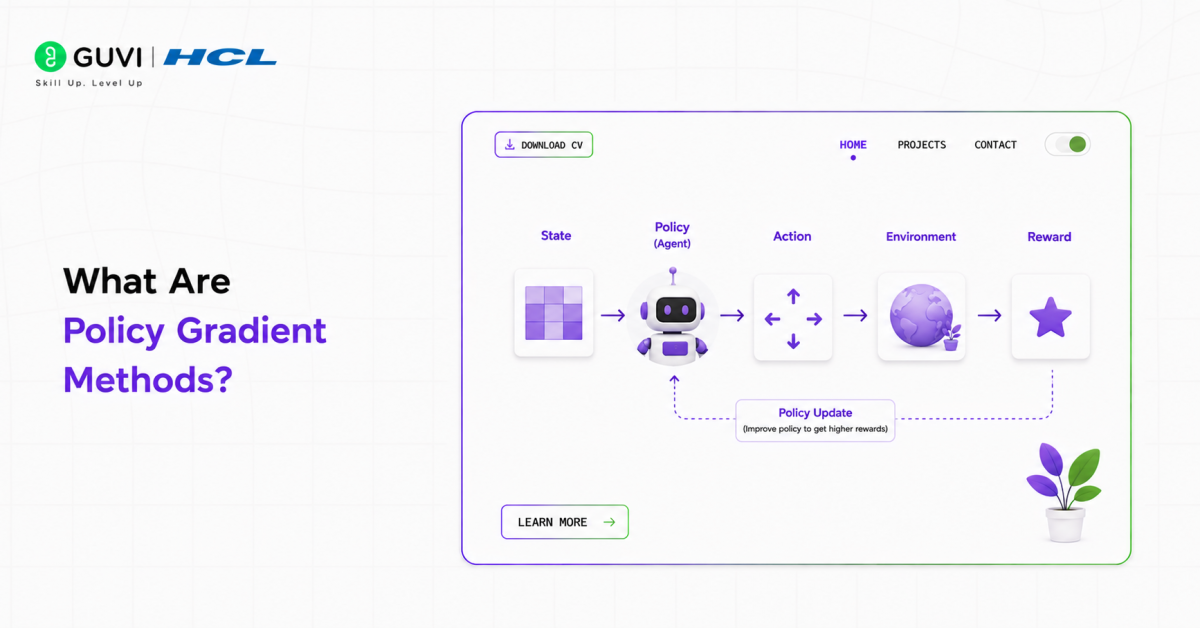
Policy Gradient Methods are reinforcement learning techniques that optimize a parameterized policy directly. Instead of learning a Q-table or estimating values for every possible action, the algorithm adjusts policy parameters so actions that lead to better rewards become more likely.
A policy can be represented as:
π(a | s; θ)
Here, the policy determines the probability of taking action a in state s, while θ represents the parameters being learned.
The objective is simple — increase the probability of actions that produce strong long-term rewards and reduce the probability of actions that perform poorly.
Read More: Gradient Descent in Machine Learning 2026: Complete Beginner Guide
Advance your AI skills with HCL GUVI’s Artificial Intelligence & Machine Learning Course. Learn reinforcement learning, deep learning, and practical AI development through real-world projects.
How Do Policy Gradient Methods Work?
The agent first interacts with its environment and collects experiences. It then evaluates the rewards received and adjusts its policy in the direction that is expected to improve future performance.
A simplified training process looks like this:
- Initialize the policy parameters.
- Run the policy in the environment.
- Collect states, actions, and rewards.
- Calculate the return or advantage.
- Estimate the policy gradient.
- Update the policy parameters.
- Repeat the process.
Over many iterations, the policy gradually shifts toward decisions that generate higher expected rewards.
Policy-based reinforcement learning can represent stochastic behavior directly, meaning an agent can deliberately assign different probabilities to multiple actions instead of always selecting one fixed action.
What Is a Policy Gradient?
A policy gradient describes how the expected reward changes when the parameters of a policy change.
The algorithm uses this direction to update the policy.
A simplified objective can be expressed as:
J(θ) = Expected Return
The goal is to find policy parameters that maximize this objective.
Instead of asking, “What is the value of this action?” the method asks, “How should I change my policy so that better actions become more likely?”
Pro Tip: Think of a policy gradient as a direction for improving the agent’s decision-making strategy. The gradient does not directly tell the agent what action to take — it tells the model how to adjust its policy.
How Does REINFORCE Work?
REINFORCE is one of the classic policy gradient algorithms. It learns from complete episodes and uses the rewards collected during those episodes to update the policy.
Suppose an agent completes a game and receives a high final reward. REINFORCE increases the likelihood of the actions that contributed to that successful episode.
If the outcome is poor, those actions receive less favorable updates.
The basic idea is:
Higher return → Increase probability of selected actions
Lower return → Decrease probability of selected actions
This makes REINFORCE conceptually simple, although its updates can have high variance.
Why Is Variance a Problem?
Policy gradient estimates can be noisy because rewards may vary significantly between episodes. Two similar situations might produce very different returns.
High variance can make training unstable and slow.
One common solution is to introduce a baseline. Instead of judging an action only by its total return, the algorithm can compare that return with an expected value.
This produces a more useful signal about whether the action performed better or worse than expected.
Best Practice: Use a suitable baseline or advantage estimate when implementing policy gradient methods at scale. Reducing variance can make optimization more stable.
What Is Advantage in Reinforcement Learning?
Advantage measures how much better an action performed compared with the expected value of being in that state.
A simplified representation is:
Advantage = Action Value − State Value
If the advantage is positive, the action performed better than expected. If it is negative, the action performed worse.
This signal is widely used in modern policy optimization algorithms because it provides more focused feedback than raw rewards alone.
Policy Gradients vs Value-Based Methods
Policy Gradient Methods and value-based methods approach reinforcement learning differently.
| Feature | Policy Gradient Methods | Value-Based Methods |
| Main objective | Optimize policy | Learn action values |
| Example | REINFORCE | DQN |
| Continuous actions | Naturally supported | More difficult |
| Policy | Learned directly | Derived from value estimates |
| Training variance | Can be high | Often different stability challenges |
DQN, for example, estimates Q-values and selects actions based on those values. A policy gradient algorithm instead learns the policy itself.
Why Are Policy Gradients Useful for Continuous Actions?
One major advantage of policy-based approaches is their ability to work naturally with continuous action spaces.

Imagine a robotic arm that can move by many possible amounts rather than choosing only “move left” or “move right.” A policy can output a probability distribution over continuous actions.
This makes policy gradient ideas useful for:
- Robotics
- Autonomous control
- Simulated environments
- Resource optimization
- Continuous control systems
Data Point: Continuous-control environments often require algorithms designed specifically to produce or optimize continuous action distributions rather than selecting from a small fixed action set.
What Are the Main Advantages?
Policy Gradient Methods provide several important benefits for reinforcement learning.
- Direct policy optimization: The algorithm learns the decision-making strategy itself. This can simplify problems where representing the optimal policy directly is more useful than maintaining action-value estimates.
- Continuous action support: Policies can output continuous distributions. This makes the approach suitable for control problems involving values such as speed, position, or force.
- Stochastic behavior: A policy can intentionally assign probabilities to multiple actions. This provides a natural way to maintain exploration during training.
These strengths explain why policy optimization remains an important area of reinforcement learning research.
What Are the Limitations?
Policy Gradient Methods also introduce challenges. The most common issue is high variance in gradient estimates, particularly with basic algorithms such as REINFORCE.
Other limitations include:
- Potentially unstable training.
- Sensitivity to learning rates.
- Large numbers of environment interactions.
- Difficulty with sparse rewards.
- Risk of poor exploration.
Warning: A policy can become overly confident too early. If exploration decreases before the agent discovers better strategies, training may converge to a poor solution.
From REINFORCE to Modern Policy Optimization
Modern reinforcement learning algorithms build on the basic policy gradient idea. Actor-Critic methods, for example, combine a policy network called the actor with a value estimator called the critic.
The critic evaluates how good a state or action is, while the actor updates the policy.
Algorithms such as Proximal Policy Optimization (PPO) further improve policy optimization by limiting how dramatically the policy can change during a single update.
This creates a more controlled learning process than basic policy gradient approaches.
A Simple Real-World Example
Consider an AI agent controlling a delivery robot in a simulated environment. The robot must choose movement actions that help it reach a destination quickly while avoiding obstacles.
A policy gradient algorithm can increase the probability of movement patterns that result in successful deliveries. Over repeated episodes, the policy learns which actions tend to produce better overall rewards.
The key point is that the system does not need developers to manually program every movement strategy. It learns the policy through interaction and feedback.
Key Takeaways
- Policy Gradient Methods directly optimize reinforcement learning policies.
- REINFORCE is a foundational policy gradient algorithm.
- Advantage estimates help reduce noisy learning signals.
- Policy-based methods naturally support continuous action spaces.
- Actor-Critic algorithms improve on basic policy gradient approaches.
- PPO is a widely used modern policy optimization method.
- High variance and unstable training remain important challenges.
Advance your AI skills with HCL GUVI’s Artificial Intelligence & Machine Learning Course. Learn reinforcement learning, deep learning, and practical AI development through real-world projects.
Conclusion
Policy Gradient Methods provide a powerful alternative to value-based reinforcement learning. Instead of learning which actions have the highest values and deriving a policy from them, these methods directly optimize the strategy an agent uses to make decisions.
The basic idea behind REINFORCE is relatively simple, but it forms the foundation for more advanced approaches such as Actor-Critic algorithms and PPO. Understanding policy gradients therefore gives you a strong starting point for exploring modern reinforcement learning.
FAQs
What are Policy Gradient Methods?
Policy Gradient Methods are reinforcement learning techniques that directly optimize a policy to maximize the expected reward.
What is the REINFORCE algorithm?
REINFORCE is a basic policy gradient algorithm that updates a policy using rewards collected from completed episodes.
What is an advantage function in reinforcement learning?
An advantage function measures how much better or worse an action performed compared with the expected value of the current state.
Are Policy Gradient Methods suitable for continuous actions?
Yes. Policy-based methods can naturally represent continuous action distributions, making them useful for robotics and control problems.
What is the difference between DQN and Policy Gradient Methods?
DQN learns action values and derives decisions from them, while Policy Gradient Methods directly learn the policy used to select actions.
Success Stories

About the Author
HCL GUVI
This article was selected and published as part of the HCL GUVI AI Blogathon 2026, an initiative designed to encourage students, AI enthusiasts, and aspiring tech writers to simplify complex AI concepts through impactful technical content. The contest recognized high-quality, original, and insightful AI-focused blogs, with selected authors receiving publication opportunities on the HCL GUVI blog platform along with official author credits and recognition.
View all posts by HCL GUVI
Connect with me @










Did you enjoy this article?