


Artificial Intelligence and Machine Learning Articles
Q-Learning Explained: A Beginner's Guide
Policy Gradient Methods in Reinforcement Learning


Get In Touch For Details! Request More Information
Deep Q-Networks (DQN) Explained
Aug 25, 2026 4 Min Read 19 Views
(Last Updated)
How can an AI agent learn to make better decisions without being explicitly told what to do at every step? Deep Q-Networks (DQN) provide one answer by combining reinforcement learning with deep neural networks.
DQN allows an agent to learn which actions are likely to produce the highest long-term rewards. Instead of manually defining a strategy, the agent learns from its interactions with an environment and gradually improves its decisions.
Table of contents
- TL;DR
- What Are Deep Q-Networks?
- How Does a DQN Work?
- What Is a Q-Value?
- Why Does DQN Need Experience Replay?
- What Is a Target Network?
- How Does DQN Learn?
- Exploration vs Exploitation
- Where Are Deep Q-Networks Used?
- What Are the Advantages of DQN?
- What Are the Limitations of DQN?
- DQN vs Traditional Q-Learning
- Key Takeaways
- Conclusion
- FAQs
- What is a Deep Q-Network?
- Why does DQN use experience replay?
- What is the purpose of a target network in DQN?
- What is epsilon-greedy exploration?
- Is DQN suitable for continuous actions?
TL;DR
- Deep Q-Networks combine Q-learning with deep neural networks.
- A DQN estimates the value of possible actions in a given state.
- Experience replay improves training stability by reusing past experiences.
- Target networks reduce instability during learning.
- DQN works well for problems with discrete action spaces.
What Are Deep Q-Networks?
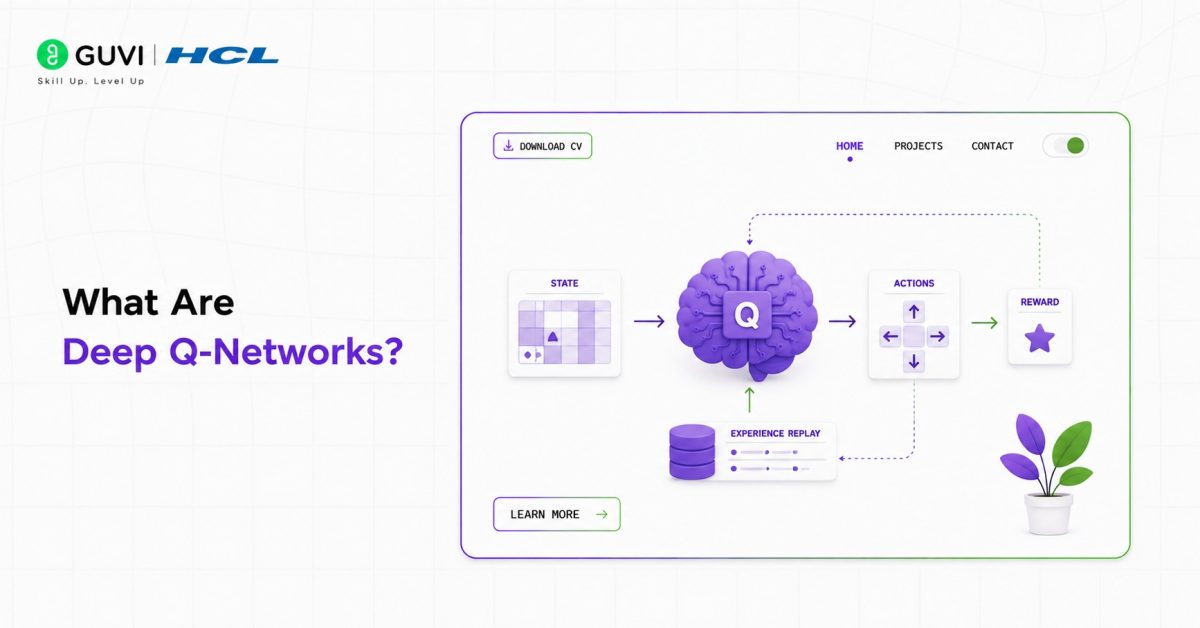
Deep Q-Networks are reinforcement learning models that use a neural network to approximate a Q-function. The Q-function estimates the expected future reward of taking a particular action from a particular state.
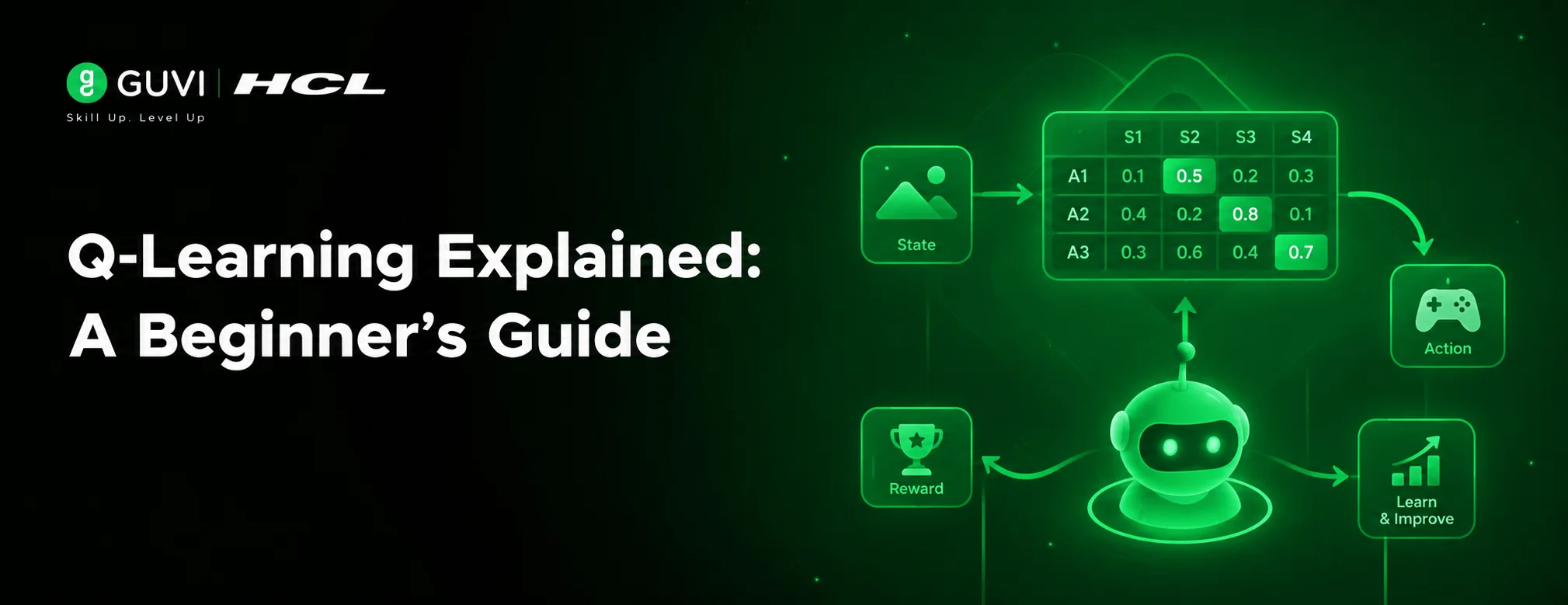
Traditional Q-learning can store Q-values in a table. However, this becomes impractical when environments contain a huge number of possible states.
DQN replaces the table with a deep neural network.
The network receives a state as input and produces estimated Q-values for the available actions.
Read More: What Are Deep Neural Networks? A Comprehensive Guide
Build expertise in reinforcement learning with HCL GUVI’s Artificial Intelligence & Machine Learning Course. Learn AI, deep learning, and reinforcement learning through hands-on projects.
How Does a DQN Work?
A DQN agent interacts with an environment repeatedly. During each interaction, it observes the current state, selects an action, receives a reward, and moves to a new state.
The basic loop is:
- Observe the current state.
- Predict Q-values for available actions.
- Select an action.
- Receive a reward.
- Observe the next state.
- Store the experience.
- Train the neural network.
Over many interactions, the network learns which actions tend to produce better long-term outcomes.
The original DeepMind DQN research demonstrated that one model could learn to play multiple Atari 2600 games directly from screen pixels.
What Is a Q-Value?
A Q-value represents the expected future reward of taking an action from a particular state.
For example, imagine an AI agent navigating a maze. From one position, it might have four possible actions: move up, down, left, or right.
The DQN estimates a Q-value for each action. The agent can then select the action with the highest estimated value.
However, the highest immediate reward is not always the best choice. Q-learning considers future rewards as well, which allows the agent to learn longer-term strategies.
Why Does DQN Need Experience Replay?
Experience replay is one of the key techniques that makes DQN training more stable.
As the agent interacts with the environment, it stores experiences in a replay buffer. Each experience typically contains:
State → Action → Reward → Next State
Instead of training only on the latest experience, the model randomly samples previous experiences from this buffer.
This helps because consecutive experiences are often highly correlated. Random sampling creates more varied training batches and allows useful experiences to be reused.
Pro Tip: A sufficiently diverse replay buffer can help the model learn from important experiences multiple times instead of discarding them after one training step.
What Is a Target Network?
DQN uses a second neural network called the target network to improve training stability.
The main network is updated frequently, while the target network is updated less often. The target network provides more stable Q-value targets during training.
Without this separation, the model could continuously change both its predictions and the targets it is trying to match. That feedback loop can make training unstable.
Best Practice: Update the target network periodically rather than after every optimization step when implementing a basic DQN.
How Does DQN Learn?
DQN learns by minimizing the difference between its predicted Q-value and a target Q-value.
The target generally considers the immediate reward plus the estimated future reward from the next state.
A simplified form is:
Target = Reward + Discount Factor × Maximum Future Q-Value
The discount factor determines how much importance the agent gives to future rewards.
The neural network adjusts its parameters to reduce the error between its predictions and these targets.
Exploration vs Exploitation
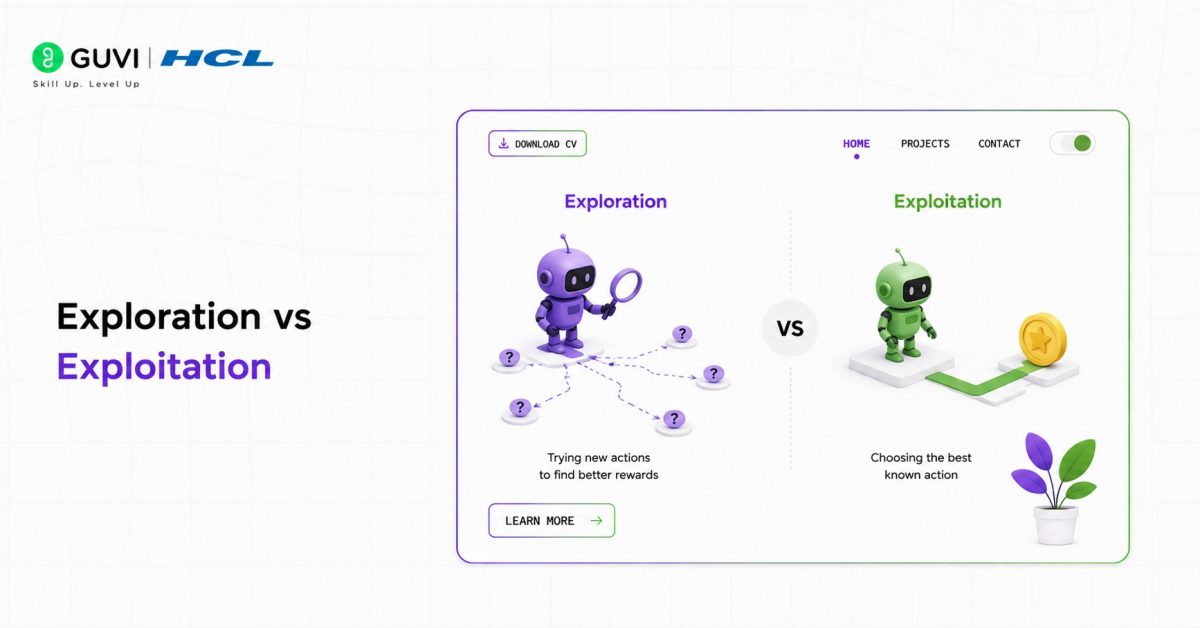
A reinforcement learning agent must balance two competing goals.
Exploration means trying actions that the agent does not know much about. This can reveal better strategies.

Exploitation means choosing actions that the agent already believes will produce strong rewards.
DQN commonly uses an epsilon-greedy strategy. With a higher probability, the agent explores randomly; otherwise, it chooses the action with the highest predicted Q-value.
As training progresses, epsilon is usually reduced so the agent gradually shifts toward exploiting what it has learned.
Where Are Deep Q-Networks Used?
DQN is particularly useful when an agent needs to choose from a finite set of actions.
Applications can include:
- Game-playing agents
- Robotics research
- Resource allocation
- Traffic control simulations
- Recommendation experiments
- Industrial decision-making
For example, a game agent could use DQN to decide whether to move, attack, defend, or collect an item based on the current game state.
What Are the Advantages of DQN?
DQN brought deep learning into problems that were previously difficult for traditional Q-learning.
- Handles large state spaces: Neural networks can approximate Q-values when a simple table would become too large. This allows reinforcement learning to work with complex observations.
- Learns directly from experience: The agent does not need a manually programmed strategy. It discovers useful behavior through interaction and rewards.
- Supports complex inputs: With suitable architectures, DQN can process high-dimensional observations such as images.
These strengths make DQN an important foundation in deep reinforcement learning.
What Are the Limitations of DQN?
DQN is not suitable for every reinforcement learning problem. Its standard form works best when the action space is discrete.
Other limitations include:
- Training can require substantial computation.
- Reward design can strongly affect behavior.
- Learning can be unstable without careful implementation.
- Exploration can be inefficient.
- Continuous action spaces require different approaches.
Warning: A poorly designed reward function can encourage unintended behavior. The agent optimizes the reward you provide—not necessarily the real-world objective you had in mind.
DQN vs Traditional Q-Learning
The key difference is how the Q-function is represented.
| Feature | Traditional Q-Learning | DQN |
| Q-function | Table | Neural network |
| Large state spaces | Difficult | More practical |
| Experience replay | Not required | Commonly used |
| Target network | Not required | Commonly used |
| Complex observations | Limited | Better suited |
DQN can therefore be viewed as a deep-learning extension of the traditional Q-learning approach.
Key Takeaways
- Deep Q-Networks combine Q-learning with deep neural networks.
- The network estimates Q-values for possible actions.
- Experience replay improves training efficiency and stability.
- Target networks help prevent unstable learning targets.
- Epsilon-greedy strategies balance exploration and exploitation.
- DQN is most naturally suited to discrete action spaces.
Build expertise in reinforcement learning with HCL GUVI’s Artificial Intelligence & Machine Learning Course. Learn AI, deep learning, and reinforcement learning through hands-on projects.
Conclusion
Deep Q-Networks changed how reinforcement learning could handle complex environments by replacing traditional Q-tables with neural networks. Techniques such as experience replay and target networks make the learning process considerably more stable.
DQN is especially useful for understanding the foundations of deep reinforcement learning. Although newer methods can outperform it in some settings, its concepts remain important for understanding how AI agents learn to make sequential decisions.
FAQs
What is a Deep Q-Network?
A Deep Q-Network is a reinforcement learning model that uses a neural network to estimate the value of actions in different states.
Why does DQN use experience replay?
Experience replay stores previous interactions and randomly samples them during training, reducing correlation between consecutive experiences.
What is the purpose of a target network in DQN?
A target network provides more stable Q-value targets during training, helping prevent unstable feedback between predictions and targets.
What is epsilon-greedy exploration?
Epsilon-greedy exploration allows an agent to occasionally choose random actions while primarily selecting actions with the highest predicted Q-values.
Is DQN suitable for continuous actions?
Standard DQN is designed for discrete action spaces, while algorithms such as DDPG, TD3, and SAC are commonly used for continuous actions.
Success Stories

About the Author
HCL GUVI
This article was selected and published as part of the HCL GUVI AI Blogathon 2026, an initiative designed to encourage students, AI enthusiasts, and aspiring tech writers to simplify complex AI concepts through impactful technical content. The contest recognized high-quality, original, and insightful AI-focused blogs, with selected authors receiving publication opportunities on the HCL GUVI blog platform along with official author credits and recognition.
View all posts by HCL GUVI
Connect with me @






Did you enjoy this article?