


Artificial Intelligence and Machine Learning Articles
AI/ML Skills Gap 2026: Why Companies Can't Find Job-Ready Talent
20 AI/ML Interview Questions Recruiters Can Use Without a Tech Background - Best Guide
How Industry-Backed AI/ML Bootcamps Are Changing the AI/ML Hiring Pipeline - Best Guide 2026
From IT Support to AI Engineer: A Realistic Career Switch Guide 2026


Get In Touch For Details! Request More Information
Generalized Linear Models (GLM): A Guide for Beginners
Aug 24, 2026 8 Min Read 3326 Views
(Last Updated)
Have you ever wondered why linear regression alone isn’t enough to model the real world? Imagine trying to predict whether a person has a disease (yes/no), or how many customers might visit your store this weekend.
A straight-line equation won’t cut it here, because the outcome isn’t always continuous and numeric.
Generalized Linear Models (GLMs) are a family of statistical models that extend linear regression to handle outcomes that aren’t continuous and normally distributed, like binary yes/no results, counts, and skewed positive values. They keep the core “linear” idea of regression while swapping in the right distribution and link function for the data you actually have.
- What GLMs solve: predicting outcomes linear regression can’t handle well, binary results, counts, proportions, skewed costs
- Three building blocks: a random component (distribution), a systematic component (linear predictor), and a link function connecting them
- Common types: linear regression, logistic regression, Poisson regression, and gamma regression are all GLMs
- Where they’re used: healthcare risk prediction, insurance claims, marketing click-through rates, and defect counts in manufacturing
This guide breaks GLMs down in a way that’s both approachable and mathematically grounded, including a practical Python implementation, a comparison with GAMs and GLMMs, and the mistakes that trip people up in real projects.
Table of contents
- What is a Generalized Linear Model?
- Components of a Generalized Linear Model
- 1) Random component: How your outcome is distributed in Generalized Linear Models
- 2) Systematic component: The Linear Predictor in Generalized Linear Models
- 3) Link function: The bridge between the Mean and the Predictors in Generalized Linear Models
- Types of GLMs
- 1) Linear regression (Normal + identity)
- 2) Binary logistic regression (Binomial + logit)
- 3) Multinomial logistic regression (Multinomial + generalized logit)
- 4) Ordinal logistic regression (Ordinal + logit/probit/cloglog)
- 5) Poisson regression (Poisson + log)
- 6) Gamma regression (Gamma + log or inverse)
- Generalized Linear Models Types at a Glance
- How to Implement Generalized Linear Models in Python
- How Generalized Linear Models Work in Practice?
- 1) Start with the outcome
- 2) Map the business question to features
- 3) Pick a link function that matches how you want to explain results
- 4) Handle exposure, weights, and leakage
- 5) Fit the model and control complexity
- 6) Diagnose honestly
- 7) Explain the effects in plain language
- 8) Stress-test with scenarios
- 9) Ship and monitor Generalized Linear Models
- Generalized Linear Models vs GAM vs GLMM: What's the Difference?
- Real-World Applications of GLMs
- Advantages of Generalized Linear Models
- Limitations of Generalized Linear Models
- Common Mistakes When Building Generalized Linear Models
- Conclusion
- FAQs
- What is the difference between GLM and linear regression?
- Why do we use GLMs?
- What are some real-world examples of GLMs?
- What is a link function in GLMs?
- What are the limitations of GLMs?
What is a Generalized Linear Model?
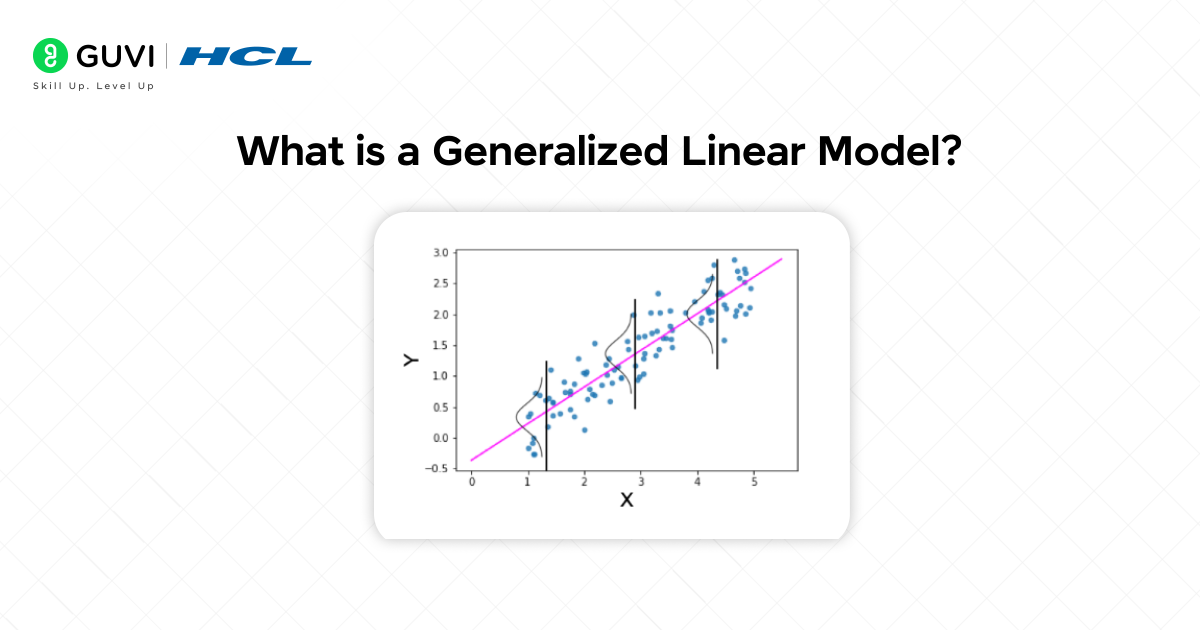
Here’s the thing: linear regression is great when your target is continuous, roughly normal, and the variance doesn’t change with the mean. Real data rarely behaves that nicely.
At its core, a GLM is a framework for predicting outcomes that don’t fit neatly into the “straight line + normal errors” assumption of traditional regression.
Here’s what makes GLMs different:
- They work with many types of outcomes. Not just continuous numbers, but also binary (yes/no), counts (0, 1, 2, …), or skewed positive values.
- They use special transformations, called link functions. These functions connect the predictors to the outcome in a way that makes sense for that type of data.
- They keep the regression idea alive. You still linearly combine predictors, but the link function helps map that linear predictor onto outcomes that fit reality.
Think of GLMs as a flexible toolkit: instead of trying to force every dataset into a straight-line model, you pick the right distribution and link function for the job.
Components of a Generalized Linear Model
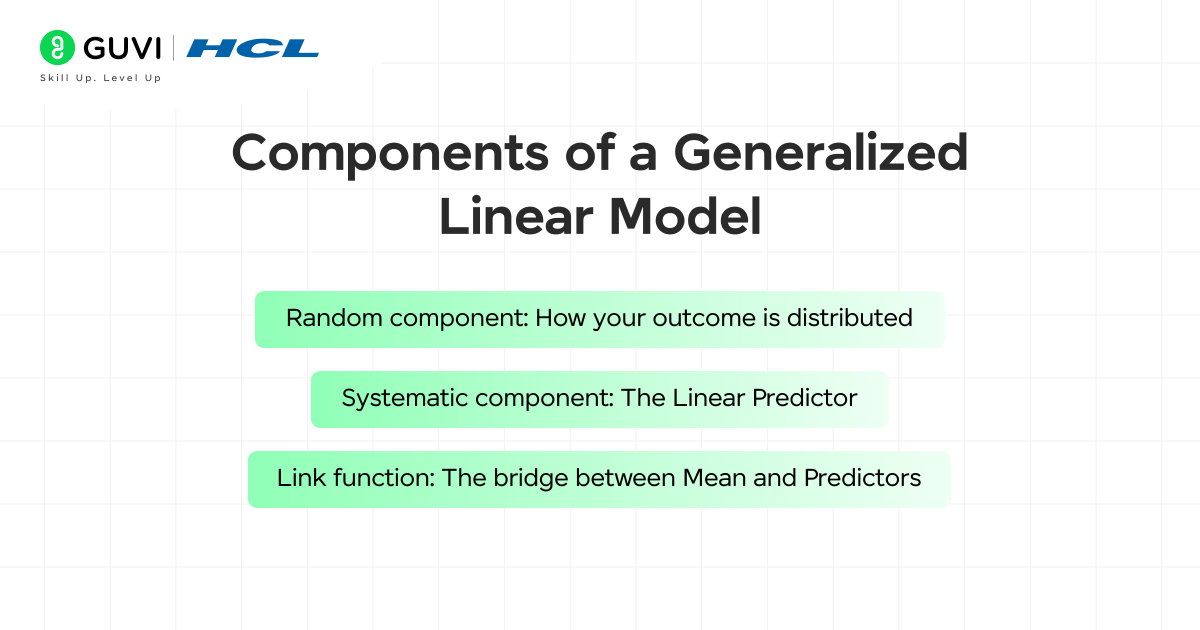
GLMs keep the familiar regression backbone but swap in smarter pieces so the model fits the data you actually have. Think of it as three parts that click together.
1) Random component: How your outcome is distributed in Generalized Linear Models
This is the “data-generating story.” You choose a probability distribution that matches the kind of outcome you’re predicting.
- Normal: For continuous outcomes centered around a mean with roughly constant spread (e.g., test scores, heights).
- Binomial: For binary outcomes (yes/no) or proportions (successes out of trials).
- Poisson: For counts that are non-negative and often “rarer” events (visits, calls, defects).
- Gamma: For positive, right-skewed values (costs, waiting times).
- Inverse Gaussian: Also positive and skewed, useful for some time-to-event data.
Why it matters for Generalized Linear Models: the distribution dictates how variance behaves. Poisson variance grows with the mean, while binomial variance depends on the success probability. If your residuals look off or your uncertainty is understated, your distribution might be wrong.
2) Systematic component: The Linear Predictor in Generalized Linear Models
All predictors feed in linearly to form a single score (the linear predictor). Even when the outcome behaves nonlinearly on its own scale, the relationship is linear after you apply the link function.
What to include:
- Main effects: Your core features (age, price, time on site).
- Interactions: When the effect of one feature depends on another (e.g., discount works differently on weekends).
- Nonlinear terms: Polynomials or splines to capture curvature while staying in the GLM family.
- Categoricals: One-hot or effect coding to represent categories cleanly.
Interpretation lives here. Coefficients tell you the direction and size of effects on the link scale. Convert them back to a more natural scale (odds, rates, or percent changes) when explaining results.
3) Link function: The bridge between the Mean and the Predictors in Generalized Linear Models
The link function maps the model’s linear predictor to the expected outcome in a way that respects the outcome’s bounds.
- Identity: Keeps values as-is (typical for Normal).
- Logit: Maps probabilities to the real line and back to 0-1 (typical for Binomial).
- Log: Keeps predicted means positive and turns multiplicative effects into additive ones on the log scale (typical for Poisson and often for Gamma).
- Probit / complementary log-log: Alternatives to logit with different tail behavior (handy in some risk or time-to-event contexts).
How to choose a link function for Generalized Linear Models:
- Respect the support (probabilities must stay in 0-1, counts must be at least 0).
- Pick for interpretability (logit gives odds ratios; log gives rate ratios or percentage changes).
- Validate with diagnostics (residual plots, information criteria, calibration checks).
Types of GLMs
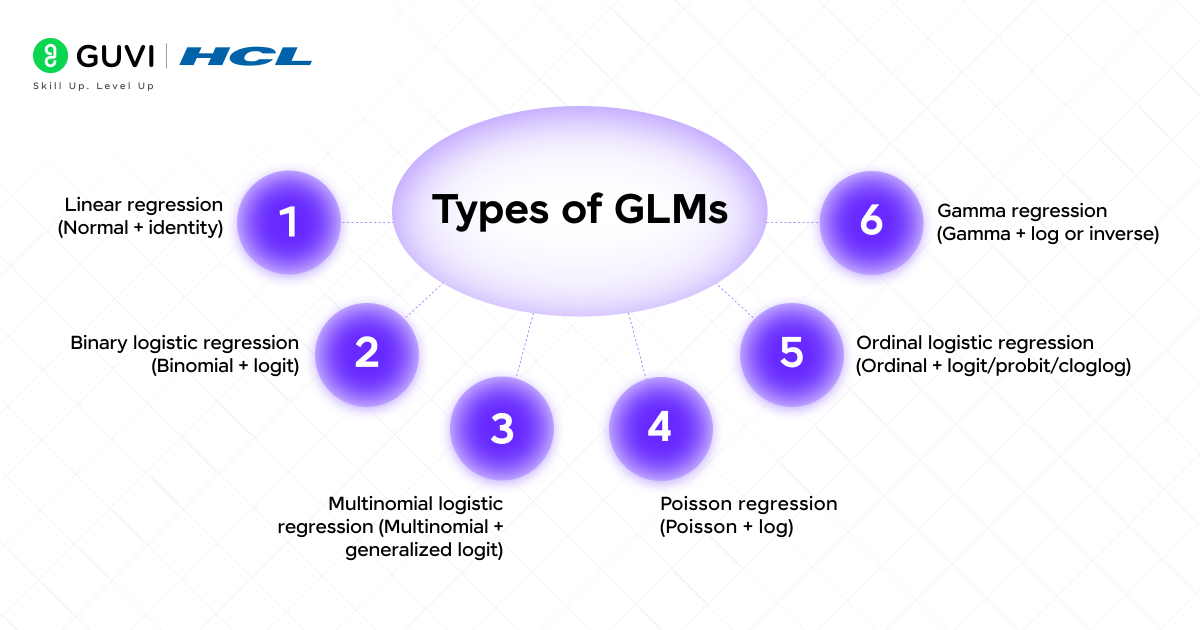
Each “type” is just a sensible pairing of distribution + link, with the linear predictor doing the heavy lifting. Here are the ones you’ll use most, plus when and why.
1) Linear regression (Normal + identity)
Use when your outcome is continuous, roughly symmetric, and the spread doesn’t change much across the range. A one-unit change in a predictor shifts the expected outcome by a fixed amount. Example: predicting the monthly electricity bill from square footage and appliances.
2) Binary logistic regression (Binomial + logit)
Use when the outcome is yes/no or a proportion. Coefficients become odds ratios after exponentiation, easy to communicate (“2x the odds”). Example: likelihood of a user signing up after a trial; disease presence vs absence.
3) Multinomial logistic regression (Multinomial + generalized logit)
Use when there are more than two categories with no natural order (A/B/C choices). Effects are interpreted relative to a reference class. Example: predicting which subscription tier a user chooses.
4) Ordinal logistic regression (Ordinal + logit/probit/cloglog)
Use when categories have a natural order (e.g., low/medium/high). Interpretation shows how predictors shift the odds of being in a higher category. Example: credit ratings, pain scales, customer satisfaction levels.
5) Poisson regression (Poisson + log)
Use when the response is a count and the variance scales with the mean. Often includes an offset for exposure time or population. Exponentiated coefficients are rate ratios (percent change in expected count). Example: number of support tickets per day, incidents per 1000 users.
6) Gamma regression (Gamma + log or inverse)
Use when the outcome is positive and right-skewed (costs, durations). With a log link, coefficients read as multiplicative effects (e.g., +10% cost). Example: claim amounts, length of hospital stay, time to complete a task.
Generalized Linear Models Types at a Glance
Here’s the same six types from above, consolidated into one reference table.
| GLM Type | Distribution + Link | Outcome Type | Example Use Case |
|---|---|---|---|
| Linear regression | Normal + identity | Continuous, roughly symmetric | Predicting electricity bill from usage |
| Binary logistic regression | Binomial + logit | Yes/no, proportions | Predicting trial-to-paid conversion |
| Multinomial logistic regression | Multinomial + generalized logit | Unordered categories | Predicting subscription tier chosen |
| Ordinal logistic regression | Ordinal + logit/probit/cloglog | Ordered categories | Customer satisfaction levels (low/med/high) |
| Poisson regression | Poisson + log | Non-negative counts | Support tickets per day |
| Gamma regression | Gamma + log or inverse | Positive, right-skewed | Insurance claim amounts |
How to Implement Generalized Linear Models in Python
Reading about the theory is one thing; fitting actual Generalized Linear Models is another. Python’s statsmodels library is the standard tool for this, since it gives you the full statistical output (coefficients, standard errors, p-values) that GLMs are typically used for.
Here’s a Poisson regression example, predicting a count outcome from two features:
import statsmodels.api as sm
import pandas as pd

# X = your feature columns, y = your count outcome
X = df[['ad_spend', 'season']]
X = pd.get_dummies(X, drop_first=True).astype(float)
X = sm.add_constant(X)
y = df['visits']

poisson_model = sm.GLM(y, X, family=sm.families.Poisson())
poisson_results = poisson_model.fit()

print(poisson_results.summary())
Switching families in Generalized Linear Models is just a one-line change. For a binary logistic regression instead, swap the family:
logit_model = sm.GLM(y, X, family=sm.families.Binomial())
logit_results = logit_model.fit()
And for a Gamma regression on a positive, skewed outcome (costs, durations):
gamma_model = sm.GLM(y, X, family=sm.families.Gamma())
gamma_results = gamma_model.fit()
A few practical notes: sm.add_constant(X) adds the intercept term, which statsmodels doesn’t include automatically. The .summary() output gives you deviance, AIC, and per-coefficient p-values, exactly what you need for the diagnostic checks covered later in this guide.
One current gotcha worth knowing: pd.get_dummies() now returns boolean-typed columns by default in recent pandas versions, which can cause statsmodels to throw a dtype error. Casting with .astype(float) right after, as shown above, avoids it.
If you’re checking for overdispersion in a Poisson model, compare the residual deviance to the degrees of freedom; a ratio well above 1 suggests you should switch to a Negative Binomial family instead.
If you want to go deeper on evaluating any model you build, including Generalized Linear Models, Sklearn Metrics Explained: The Complete Guide with Code Examples (2026) walks through the metrics you’ll actually use to judge fit quality.
How Generalized Linear Models Work in Practice?
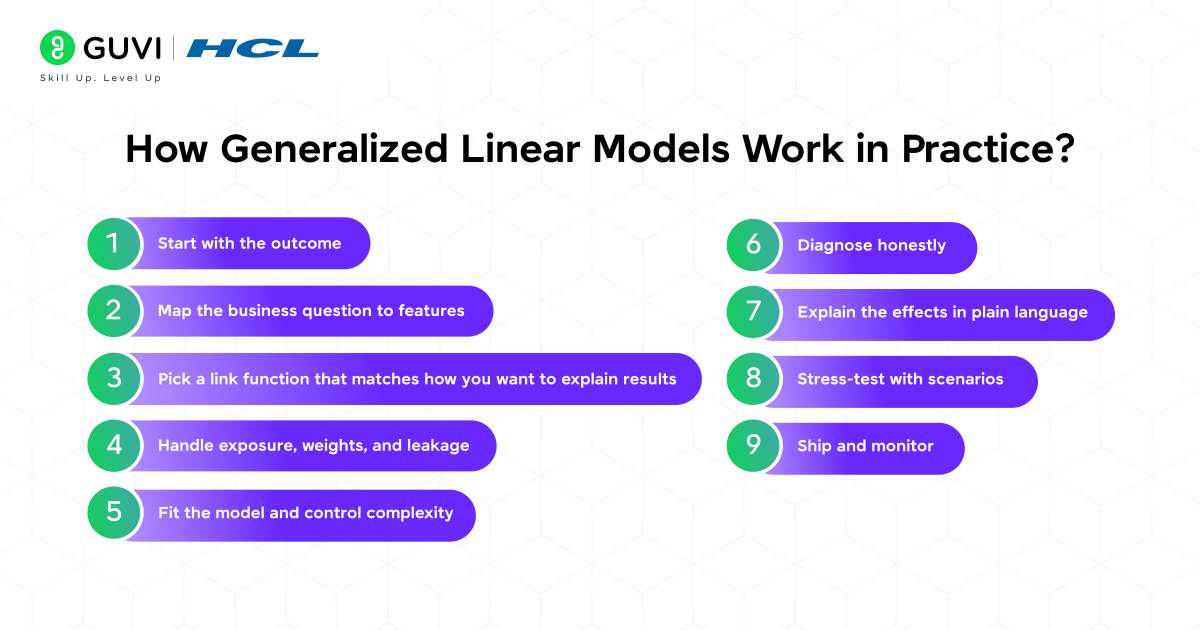
Generalized Linear Models feel intimidating until you see the workflow. After that, it’s a repeatable playbook you can run across projects.
1) Start with the outcome
First ask: what are you predicting?
- A yes/no event (purchase, dropout, disease) leads you to logistic (binomial).
- A count (visits, tickets, claims) means start with Poisson, check if you need negative binomial.
- A positive, skewed value (costs, time spent, length of stay) points to Gamma (often with a log link).
- A continuous value that can go up or down calls for linear regression (normal).
This choice aligns your Generalized Linear Models setup with how the data behave. It keeps predictions valid (no negative counts, no probabilities beyond 0-1).
2) Map the business question to features
List the drivers that plausibly influence the outcome. Make them measurable.
- Use domain logic: “more sessions leads to a higher chance of purchase.”
- Encode categories cleanly (one-hot or effects coding).
- Add interactions only where they make sense (“discount x weekend”).
- For curvature, use splines/polynomials rather than forcing an ML jump.
Tip: document each feature’s “why.” It helps later when you justify the model.

3) Pick a link function that matches how you want to explain results
- Logit for probabilities (odds ratios are easy to communicate).
- Log for counts and positive outcomes (interpret as rate or percent change).
- Identity when differences in original units matter.
Choose the link you can explain to a stakeholder in one sentence.
4) Handle exposure, weights, and leakage
- Offsets: If you’re modeling rates, add exposure as an offset (e.g., time at risk, population, pageviews). This keeps comparisons fair.
- Weights: Use them for aggregated rows (e.g., successes out of trials) or to correct sampling.
- Leakage: Exclude features that wouldn’t be known at prediction time (refund reason, future usage).
5) Fit the model and control complexity
- Start simple. Add complexity only when it clearly improves fit or interpretability.
- If separation or instability appears in logistic models, add regularization (L1/L2) or simplify predictors.
- For high variance or rare events, try class-balanced sampling, penalized likelihood, or Firth correction (conceptually: shrink the extremes).
6) Diagnose honestly
You don’t need formulas to know if your Generalized Linear Models setup is lying to you. Look for:
- Calibration (for probabilities): predicted 0.7 should happen about 70% of the time.
- Discrimination: ROC-AUC/PR-AUC for binary; for counts or costs, compare predicted vs. observed across quantiles.
- Overdispersion: for counts/proportions, if residual variability is larger than the model expects, move to negative binomial or quasi families.
- Residual patterns: strong structure means a missing feature, wrong link, or wrong family.
- Information criteria (AIC/BIC): lower is usually better when comparing reasonable alternatives.
7) Explain the effects in plain language
Translate coefficients on the link scale into something human:
- Logistic: “This factor doubles the odds of conversion.”
- Poisson/NegBin: “A one-unit increase leads to ~12% more tickets on average.”
- Gamma (log link): “This segment has ~18% higher cost holding others constant.”
- Linear: “Adds about ₹1,200 to the expected bill.”
Prefer marginal effects or predicted scenarios over raw coefficients when presenting to non-statisticians.
8) Stress-test with scenarios
Change one input while holding others fixed and see what the model says. Useful checks:
- Are predictions realistic at extremes?
- Does the model react sensibly to business-critical levers (price, time on site)?
- Are there thresholds where policy changes would flip a decision?
9) Ship and monitor Generalized Linear Models
- Logging: store inputs, predictions, and (later) outcomes.
- Drift: watch for shifts in feature distributions or outcome rates.
- Recalibration: if probabilities drift, recalibrate or refit on recent data.
- Governance: version the model, record assumptions, document limitations.
That’s the loop for building Generalized Linear Models: choose the family, build a sensible linear predictor, link it properly, check fit, translate effects, and keep the model honest in production.
Generalized Linear Models vs GAM vs GLMM: What’s the Difference?
These three acronyms, GLM and its close relatives, get confused constantly, and knowing the difference tells you exactly when to reach for something beyond a standard Generalized Linear Model.
| Model | Relaxes | Use When | Example |
|---|---|---|---|
| GLM (Generalized Linear Model) | N/A, this is the baseline | Predictors relate linearly to the outcome on the link scale | Predicting conversion from marketing spend |
| GAM (Generalized Additive Model) | The linearity assumption | A predictor’s true effect is curved, not a straight line (e.g., a U-shaped age effect) | Modeling risk that rises at both very young and very old ages |
| GLMM (Generalized Linear Mixed Model) | The assumption that observations are independent | Your data has repeated or grouped observations (patients, schools, stores) | Repeated measurements from the same patient over time |
A practical way to think about it: start with a GLM. If the relationship looks nonlinear on the link scale, move to a GAM. If your data has repeated or grouped observations, move to a GLMM.
Some problems genuinely need both, which is where Generalized Additive Mixed Models (GAMMs) come in, though that’s a more advanced step beyond this guide.
Real-World Applications of GLMs

Generalized Linear Models show up everywhere:
- Healthcare: Predicting disease occurrence (yes/no), modeling hospital stays, or patient readmission counts.
- Finance & Insurance: Estimating loan default probability, predicting insurance claim frequency, or modeling claim costs.
- Marketing: Estimating click-through rates for ads, predicting customer churn, or analyzing A/B test results.
- Engineering: Modeling machine failure times or the number of defects in a production line.
- Environmental Science: Modeling species counts in an ecosystem, or the probability of extreme weather events.
If you’ve used logistic regression in a project, you’ve already used one of the Generalized Linear Models covered in this guide.
Advantages of Generalized Linear Models
Why use Generalized Linear Models instead of sticking with plain linear regression or jumping straight to complex machine learning?
- Flexibility: They can handle binary, count, proportion, or skewed continuous data.
- Unified framework: Different types (logistic, Poisson, gamma) all follow the same structure, so once you know one, you can learn the rest quickly.
- Interpretability: Results are easier to explain, odds ratios, rate ratios, or percent changes are intuitive for decision-making.
- Software support: Available in R, Python, SAS, SPSS, and nearly every analytics tool.
- Foundation for advanced models: Generalized Linear Models are stepping stones to more advanced methods like Generalized Additive Models (GAMs) and Generalized Linear Mixed Models (GLMMs).
Limitations of Generalized Linear Models
Generalized Linear Models are powerful, but they aren’t perfect. Some limitations include:
- Model specification matters: You need to choose the right distribution and link. The wrong choice can lead to poor results.
- Linearity assumption: GLMs assume predictors relate linearly to the outcome on the link scale. Real-world data may require extra transformations.
- Sensitivity to outliers: In Generalized Linear Models, a few unusual data points can skew the results.
- Not ideal for very complex structures: For hierarchical or highly non-linear data, GLMMs or machine learning methods may be better.
- Overdispersion issues: Especially in Poisson regression, where data has more variability than the model allows.
Common Mistakes When Building Generalized Linear Models
Even people who understand Generalized Linear Models in theory make these mistakes in practice. Watch out for:
- Picking the family based on habit, not the data, when setting up Generalized Linear Models. Defaulting to logistic regression for every binary-looking problem, or Normal for every continuous one, without checking whether the distribution actually fits, is one of the most common errors.
- Forgetting to add the intercept. In Python’s statsmodels,
sm.add_constant(X)isn’t automatic; skipping it silently changes your model’s fit without an obvious error. - Interpreting Generalized Linear Models coefficients on the wrong scale. A logistic regression coefficient of 0.7 isn’t “a 70% increase”; it needs to be exponentiated into an odds ratio first. Misreading this scale is one of the most common mistakes in applied GLM work.
- Ignoring overdispersion in Poisson-family Generalized Linear Models. If you never check whether your residual deviance exceeds your degrees of freedom, you may be reporting confidence intervals that are too narrow.
- Treating a nonlinear relationship as linear when a standard Generalized Linear Models setup won’t fit it. If a predictor’s true effect curves rather than follows a straight line on the link scale, force-fitting a standard GLM will bias your results. This is exactly when a GAM should replace a GLM.
Logistic regression, now a staple in machine learning, was originally used in biology to study how drug doses affect survival.
The Poisson distribution, commonly used in GLMs, was first applied to model deaths by horse-kicks in the Prussian army in the 19th century!
If you’re serious about mastering Machine Learning concepts like GLMs and want to apply them in real-world scenarios, don’t miss the chance to enroll in HCL GUVI’s Intel & IITM Pravartak Certified Artificial Intelligence & Machine Learning Course. Endorsed with Intel certification, this course adds a globally recognized credential to your resume, a powerful edge that sets you apart in the competitive AI job market.
Conclusion
In conclusion, Generalized Linear Models extend linear regression into a powerful family of models that can handle binary outcomes, counts, proportions, and skewed data.
By understanding their components, distribution, linear predictor, and link function, you unlock the ability to model a wide range of real-world problems.
The next time you face data that doesn’t fit into a straight line, remember: a GLM might be the right tool for you.
FAQs
1. What is the difference between GLM and linear regression?
Linear regression is just one special case of GLM, meant for continuous outcomes. GLMs extend this idea to handle binary, count, and skewed data.
2. Why do we use GLMs?
Because not all outcomes are continuous and normal. GLMs give you a way to model outcomes that better reflect reality.
3. What are some real-world examples of GLMs?
Predicting disease risk (logistic), modeling insurance claims (Poisson), and estimating costs (gamma).
4. What is a link function in GLMs?
It’s the transformation that connects predictors to the outcome in a way that respects the outcome’s range (like keeping probabilities between 0 and 1).
5. What are the limitations of GLMs?
They require careful choice of distribution and link, can be sensitive to outliers, and don’t handle very complex data structures on their own.
Success Stories

About the Author
Jebasta
I translate the language of data into stories that anyone can understand. As a writer with a data science background, I simplify analytics, AI, and decision-making so beginners and enthusiasts can confidently explore the world of data.
View all posts by Jebasta
Connect with me @













Did you enjoy this article?