


Artificial Intelligence and Machine Learning Articles
Generative Adversarial Networks (GANs): The Complete Guide
GRU vs LSTM: Which Should You Use?
LSTM Networks Explained: Solving the Vanishing Gradient Problem


Get In Touch For Details! Request More Information
Speech-to-Text Engines Compared: Whisper vs Google vs AWS
Aug 26, 2026 4 Min Read 26 Views
(Last Updated)
Speech-to-text engines convert audio recordings of spoken language into written text using deep learning models trained on large audio datasets. Whisper is OpenAI’s open-source model known for strong multilingual accuracy and offline deployment. Google Speech-to-Text provides real-time streaming transcription with deep integration into Google Cloud. AWS Transcribe offers enterprise-grade features including speaker diarization, custom vocabulary, and native AWS ecosystem integration. The right choice depends on whether you need real-time streaming, offline deployment, multilingual support, or enterprise compliance features.
Table of contents
- Quick TL;DR
- How Modern Speech-to-Text Works
- Whisper: Open-Source Multilingual Transcription
- Google Speech-to-Text: Real-Time Streaming at Scale
- AWS Transcribe: Enterprise Feature Depth
- Side-by-Side Comparison
- Conclusion
- FAQ
- Which speech-to-text engine is most accurate?
- Can Whisper do real-time transcription?
- Which engine is cheapest for high-volume transcription?
- Does AWS Transcribe support multiple speakers?
- Which engine handles medical and technical vocabulary best?
- Is Whisper suitable for production deployment?
Quick TL;DR
- Speech-to-text engines use deep learning to transcribe spoken audio into text, with major differences in accuracy, latency, language support, and deployment model
- Whisper is OpenAI’s open-source model that excels at multilingual accuracy and offline deployment but requires infrastructure management for production use
- Google Speech-to-Text provides low-latency streaming transcription with strong accuracy on clear audio and the broadest language support of any commercial provider
- AWS Transcribe offers the strongest enterprise feature set including speaker diarization, custom vocabulary, PII redaction, and native integration with AWS services
How Modern Speech-to-Text Works
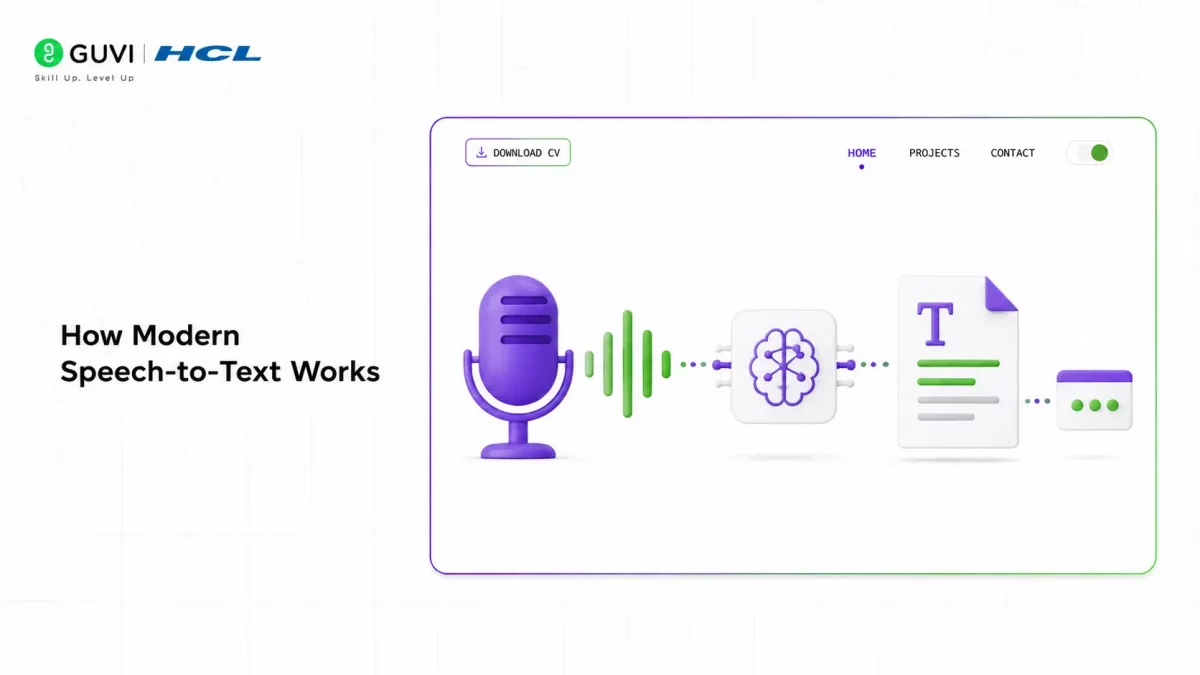
All three engines use variants of the same fundamental architecture: a deep learning model that encodes audio features and decodes them into text tokens.
Audio is first converted into a mel spectrogram, a time-frequency representation that captures the acoustic features of speech in a format suitable for neural network processing. The spectrogram is processed by a Transformer encoder that learns representations of acoustic patterns. A decoder then generates text tokens autoregressively, predicting each word or subword token based on the encoded audio and previously generated tokens.
Training on massive datasets is what differentiates modern speech-to-text from earlier approaches. Whisper was trained on 680,000 hours of multilingual audio. Google’s models are trained on proprietary datasets orders of magnitude larger. This scale of training data is what produces the robustness to accent variation, background noise, and vocabulary diversity that makes modern speech-to-text practically useful.
Read More: AI Speech Recognition: How Machines Understand Voice
Want to build strong AI engineering skills covering speech recognition, NLP, and production audio AI system deployment? Explore HCL GUVI’s Artificial Intelligence & Machine Learning Course, designed to help you develop the practical deep learning foundations that modern AI engineering roles demand.
Whisper: Open-Source Multilingual Transcription
OpenAI released Whisper in 2022 as an open-source speech recognition model available in five sizes from Tiny to Large-V3, trading off inference speed against accuracy.
- Strengths
Whisper’s most significant advantage is multilingual accuracy. Trained on 680,000 hours of multilingual audio spanning 99 languages, Whisper achieves competitive accuracy across languages that commercial providers handle poorly due to limited training data. For low-resource languages, Whisper frequently outperforms commercial alternatives.
Zero marginal cost for self-hosted deployment makes Whisper compelling for high-volume applications where per-second cloud API pricing becomes expensive at scale. Organizations processing thousands of hours of audio monthly find self-hosted Whisper significantly cheaper than cloud alternatives.
Whisper also supports audio translation directly, transcribing non-English audio into English text in a single pass without a separate translation step.
- Limitations
Whisper is a batch processing model, not a streaming model. It processes complete audio files rather than streaming audio incrementally, introducing latency equal to the full audio duration plus processing time. Real-time transcription applications requiring word-by-word output as speech occurs cannot use standard Whisper directly. Faster-Whisper and WhisperX are community implementations that reduce latency through optimized inference, but streaming remains a fundamental architectural limitation.
Production deployment requires managing GPU infrastructure, model loading, batching, and scaling, adding engineering overhead that cloud APIs eliminate.
Google Speech-to-Text: Real-Time Streaming at Scale
Google Speech-to-Text, now part of Google Cloud’s Speech-to-Text V2 API, provides real-time streaming transcription, batch processing, and specialized models for phone calls, video, and medical transcription.
- Strengths
Real-time streaming transcription with word-level timestamps and interim results is Google’s strongest capability differentiation. Applications requiring live subtitles, real-time meeting transcription, or voice command processing receive word-by-word results as audio is spoken rather than waiting for a complete audio file.
Google supports 125 languages and variants, the broadest language coverage of the three compared engines. Automatic language detection identifies the language being spoken without requiring explicit configuration.
Chirp, Google’s latest foundation model for speech recognition, provides improved accuracy particularly for heavily accented speech and noisy audio conditions compared to their previous generation models.
Integration with Google Cloud services including Pub/Sub for streaming pipelines, Cloud Storage for batch processing, and BigQuery for transcription analytics makes it the natural choice for teams already operating in Google Cloud.
- Limitations
Google Speech-to-Text’s per-second pricing becomes substantial at high volumes. Speaker diarization, identifying who is speaking when in multi-speaker audio, is available but less accurate than AWS Transcribe for challenging multi-speaker scenarios. Custom vocabulary adaptation requires explicit configuration compared to the more seamless domain adaptation available in AWS Transcribe.
Did You Know? OpenAI’s Whisper was trained on 680,000 hours of multilingual audio, helping it achieve strong performance across accents and low-resource languages.

AWS Transcribe: Enterprise Feature Depth
AWS Transcribe provides speech-to-text as a managed service with the strongest enterprise feature set of the three options, particularly for compliance-sensitive and call center use cases.
- Strengths
Speaker diarization in AWS Transcribe accurately identifies and labels individual speakers in multi-speaker recordings, a critical capability for call center transcription, meeting minutes, and interview processing. AWS Transcribe’s diarization handles up to ten speakers and performs consistently on phone-quality audio where speaker separation is challenging.
PII redaction automatically identifies and redacts personally identifiable information from transcripts, replacing names, phone numbers, credit card numbers, and social security numbers with placeholder text. This capability is essential for healthcare, financial services, and legal applications where storing raw transcripts with PII creates compliance risk.
Custom vocabulary and custom language models allow domain-specific terminology to be incorporated without fine-tuning a custom model. Medical, legal, and technical domains with specialized vocabulary benefit significantly from custom vocabulary lists that reduce misrecognition of domain terms.
Call Analytics, a specialized AWS Transcribe feature, extracts sentiment, talk time ratios, interruption rates, and issue categories from customer service call recordings, providing structured analytics beyond raw transcription.
Native integration with AWS services including S3, Lambda, and Comprehend for downstream NLP creates cohesive pipelines for teams operating in AWS.
- Limitations
AWS Transcribe’s real-time streaming accuracy on heavily accented speech and non-English languages is less competitive than Google’s Chirp model. The breadth of specialized features adds configuration complexity compared to Google’s simpler API. Language support covers 75 languages, fewer than Google’s 125.
AWS Transcribe Medical is specialized for healthcare terminology and conversations, demonstrating how domain-specific training can improve speech recognition accuracy for specialized vocabulary.
Side-by-Side Comparison
| Dimension | Whisper | Google Speech-to-Text | AWS Transcribe |
| Deployment | Self-hosted | Cloud API | Cloud API |
| Real-time streaming | No (with workarounds) | Yes | Yes |
| Languages | 99 | 125 | 75 |
| Cost model | Infrastructure only | Per second of audio | Per second of audio |
| Speaker diarization | No | Basic | Strong |
| PII redaction | No | No | Yes |
| Custom vocabulary | Fine-tuning required | Yes | Yes |
| Offline capability | Yes | No | No |
| Multilingual accuracy | Excellent | Very good | Good |
| Cloud ecosystem | None | Google Cloud | AWS |
| Best use case | Offline, multilingual, cost-sensitive | Real-time streaming, broad language support | Enterprise, call center, compliance |
Want to build strong AI engineering skills covering speech recognition, NLP, and production audio AI system deployment? Explore HCL GUVI’s Artificial Intelligence & Machine Learning Course, designed to help you develop the practical deep learning foundations that modern AI engineering roles demand.
Conclusion
Whisper, Google Speech-to-Text, and AWS Transcribe represent three distinct positions in the speech-to-text landscape rather than direct substitutes. Whisper offers multilingual accuracy and zero marginal cost for teams willing to manage GPU infrastructure.
Google leads on real-time streaming and language breadth. AWS leads on enterprise compliance features and call center analytics.
FAQ
Which speech-to-text engine is most accurate?
Accuracy depends heavily on audio type and language. Whisper Large-V3 leads on multilingual and accented speech. Google Chirp performs best on noisy real-world audio. AWS Transcribe leads on call center phone-quality audio with multiple speakers.
Can Whisper do real-time transcription?
Standard Whisper is a batch model requiring complete audio before processing. Community implementations like Faster-Whisper and WhisperX reduce latency significantly but true word-by-word streaming requires additional engineering compared to Google and AWS native streaming APIs.
Which engine is cheapest for high-volume transcription?
Self-hosted Whisper eliminates per-second API costs, making it the most cost-efficient option above a threshold volume where infrastructure costs are lower than cloud API fees. Below that threshold, cloud APIs avoid infrastructure management overhead that may exceed API costs.
Does AWS Transcribe support multiple speakers?
Yes. AWS Transcribe’s speaker diarization identifies and labels up to ten speakers in multi-speaker recordings and performs consistently on phone-quality audio, making it the strongest option for call center and interview transcription.
Which engine handles medical and technical vocabulary best?
AWS Transcribe Medical handles clinical terminology with specialized accuracy. All three engines support custom vocabulary lists for technical domains. AWS Transcribe’s custom language model feature provides the most seamless adaptation for domain-specific terminology without fine-tuning.
Is Whisper suitable for production deployment?
Yes, with appropriate infrastructure. Production Whisper deployments use Faster-Whisper or CTranslate2 for optimized inference, GPU autoscaling for variable load, and job queuing for batch processing. The engineering overhead is higher than cloud APIs but well-established for teams with MLOps capability.
Success Stories

About the Author
HCL GUVI
This article was selected and published as part of the HCL GUVI AI Blogathon 2026, an initiative designed to encourage students, AI enthusiasts, and aspiring tech writers to simplify complex AI concepts through impactful technical content. The contest recognized high-quality, original, and insightful AI-focused blogs, with selected authors receiving publication opportunities on the HCL GUVI blog platform along with official author credits and recognition.
View all posts by HCL GUVI
Connect with me @





Did you enjoy this article?