


Artificial Intelligence and Machine Learning Articles
What Is the FP-Growth Algorithm for Association Rule Mining?
Apriori Algorithm and Market Basket Analysis Explained


Get In Touch For Details! Request More Information
Genetic Algorithms: Nature-Inspired Optimization Explained
Aug 25, 2026 4 Min Read 30 Views
(Last Updated)
Every optimization problem asks the same basic question: given many possible solutions, which one is best? Sometimes the answer is straightforward, and mathematical techniques like gradient descent find it efficiently. But many real-world problems are far messier. The search space is enormous, the objective function has no useful gradient, or there are so many constraints that traditional methods get stuck. Genetic algorithms were designed for exactly these situations. They borrow the logic of biological evolution to search for good solutions without needing to understand the mathematical structure of the problem.
Table of contents
- Quick TL;DR
- The Biological Inspiration Behind Genetic Algorithms
- How a Genetic Algorithm Works: Step by Step
- Step 1: Initialize the Population
- Step 2: Evaluate Fitness
- Step 3: Selection
- Step 4: Crossover
- Step 5: Mutation
- Step 6: Replace and Repeat
- Key Components at a Glance
- Conclusion
- FAQ
- What is a genetic algorithm in simple terms?
- What problems are genetic algorithms best suited for?
- What are the three main operations in a genetic algorithm?
- How is a genetic algorithm different from gradient descent?
- What is the fitness function in a genetic algorithm?
Quick TL;DR
- Genetic Algorithms (GAs) are optimization techniques inspired by natural evolution and Darwin’s theory of survival of the fittest
- They work by evolving a population of candidate solutions over many generations using selection, crossover, and mutation
- GAs are used when traditional optimization methods fail because the search space is too large, complex, or poorly understood
- Key applications include neural network architecture search, scheduling problems, robotics, game playing, and engineering design
- You do not need to know the mathematical gradient of your objective function to use a genetic algorithm, which is their biggest practical advantage
- GAs are a foundational concept in evolutionary computation and directly related to modern techniques like genetic programming and neuroevolution
The Biological Inspiration Behind Genetic Algorithms
In nature, a population of organisms exists in an environment with limited resources. Organisms that are better adapted to that environment are more likely to survive, reproduce, and pass their traits to the next generation. Over many generations, the population becomes increasingly well-adapted because the genes of successful organisms spread while the genes of unsuccessful organisms disappear.
Three biological mechanisms drive this process:
- Natural selection
It favors organisms with traits that improve survival and reproduction. Better-adapted individuals have more offspring.
- Crossover (recombination)
It mixes the genetic material of two parents to produce offspring that combine traits from both. This creates new combinations that neither parent had.
- Mutation
It introduces random changes in genetic material. Most mutations are harmful or neutral, but occasionally a mutation produces a trait that improves fitness. Mutation prevents the population from becoming genetically uniform and ensures exploration of new possibilities.
Read More: Escaping the Trap: A Beginner’s Guide to Local Search Algorithms in AI
Want to build strong machine learning and AI foundations covering optimization, evolutionary algorithms, and applied data science? Explore HCL GUVI’s Artificial Intelligence & Machine Learning, designed to help you develop the skills modern AI and ML roles demand.
How a Genetic Algorithm Works: Step by Step
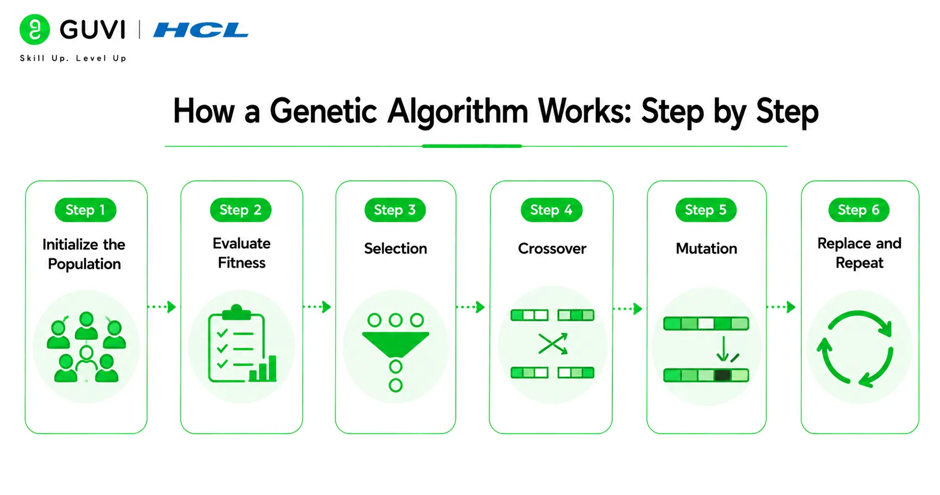
A genetic algorithm follows a clear cycle that repeats for many generations until a good enough solution is found or a stopping condition is met.
Step 1: Initialize the Population
The algorithm starts by creating an initial population of candidate solutions. Each solution is called an individual or chromosome. The population size is typically between 50 and 500 individuals depending on the complexity of the problem.
Each individual is encoded as a string of values, commonly binary (0s and 1s) for simple problems or real-valued vectors for continuous optimization problems. The initial population is usually generated randomly to ensure diversity and broad coverage of the search space.
Step 2: Evaluate Fitness
Every individual in the population is evaluated using a fitness function, which is the mathematical expression of how good a solution is. A higher fitness score means a better solution.
The fitness function is the most important design decision in a genetic algorithm. It must accurately capture what you are optimizing for. If the fitness function does not align with your actual goal, the algorithm will evolve solutions that score well on the function but do not actually solve your problem.
Step 3: Selection
Selection chooses which individuals will become parents for the next generation. The core idea is that fitter individuals should be more likely to be selected, but less fit individuals should still have some chance. This balance between exploiting good solutions and exploring new ones is critical.
Common selection methods include:
- Tournament selection: randomly pick a small group of individuals and select the fittest one from that group. Repeat until you have enough parents.
- Roulette wheel selection: each individual’s selection probability is proportional to its fitness score. Fitter individuals get a larger slice of the wheel.
- Rank selection: individuals are ranked by fitness and selection probability is based on rank rather than raw fitness score, which prevents highly fit individuals from dominating the population too early.
Step 4: Crossover
Crossover combines the genetic material of two selected parents to create offspring. This is how the algorithm combines the best features of different solutions.
In a single-point crossover, a random position in the chromosome is chosen. The offspring gets the genetic material before that point from one parent and everything after it from the other parent.

NASA used a genetic algorithm in 1994 to design a satellite antenna that produced a shape unlike any conventional antenna design, yet outperformed all human-designed alternatives on multiple performance criteria, demonstrating that GAs can discover solutions humans would never think to try.
In uniform crossover, each gene in the offspring is independently chosen from either parent with equal probability, creating more mixing than single-point crossover.
The crossover rate, typically between 60 and 90 percent, controls how often crossover occurs. When crossover does not occur, offspring are simply copies of their parents.
Step 5: Mutation
Mutation introduces random changes in individual chromosomes after crossover. In a binary encoding, mutation flips a 0 to a 1 or vice versa at random positions. In a real-valued encoding, mutation adds a small random perturbation to selected values.
The mutation rate is kept low, typically between 0.1 and 5 percent per gene, because too much mutation destroys good solutions and turns the algorithm into random search. The role of mutation is to maintain diversity and occasionally explore regions of the search space that crossover alone would never reach.
John Holland formally developed genetic algorithms at the University of Michigan in the 1960s and 1970s with the original goal of understanding natural adaptation, not solving optimization problems, making GAs one of the rare cases where theoretical science produced an enormously practical engineering tool.
Step 6: Replace and Repeat
The offspring produced by crossover and mutation form the next generation, replacing the previous population. The cycle of evaluation, selection, crossover, and mutation repeats until a stopping condition is met: a maximum number of generations, a satisfactory fitness level, or a convergence criterion where the population stops improving.
Want to build strong machine learning and AI foundations covering optimization, evolutionary algorithms, and applied data science? Explore HCL GUVI’s Artificial Intelligence & Machine Learning, designed to help you develop the skills modern AI and ML roles demand.
Key Components at a Glance
| Component | Biological Equivalent | Role in GA |
| Individual / Chromosome | Organism | One candidate solution |
| Gene | Trait | One element of the solution encoding |
| Population | Species group | Set of all current candidate solutions |
| Fitness function | Environmental pressure | Scores how good a solution is |
| Selection | Natural selection | Chooses parents for reproduction |
| Crossover | Recombination | Combines two parents to create offspring |
| Mutation | Random mutation | Introduces random changes for diversity |
| Generation | Life cycle | One iteration of the algorithm |
Conclusion
Genetic algorithms represent a fundamentally different approach to optimization than the mathematical methods most data scientists and engineers learn first.
Instead of following a gradient or solving an equation, GAs explore the solution space through the same mechanisms that drive biological evolution: selection, crossover, and mutation applied to populations of candidate solutions across many generations.
FAQ
What is a genetic algorithm in simple terms?
A genetic algorithm is an optimization technique that mimics biological evolution. It starts with many random candidate solutions, evaluates how good each one is, and repeatedly combines and mutates the best ones to produce better solutions over many generations.
What problems are genetic algorithms best suited for?
GAs work best on large, complex optimization problems where the objective function has no useful gradient, the search space is too large to search exhaustively, or traditional mathematical methods get stuck in local optima.
What are the three main operations in a genetic algorithm?
Selection, which chooses the fittest individuals to reproduce. Crossover, which combines two parent solutions to create offspring. Mutation, which introduces random changes to maintain diversity and explore new solutions.
How is a genetic algorithm different from gradient descent?
Gradient descent follows the mathematical gradient of the objective function downhill toward a minimum. A genetic algorithm requires no gradient, works with populations of solutions rather than a single point, and is applicable to non-differentiable and discrete problems where gradient descent fails.
What is the fitness function in a genetic algorithm?
The fitness function evaluates how good each candidate solution is and returns a numerical score. It is the most critical design decision in a GA because it defines what the algorithm is optimizing for.
Success Stories

About the Author
HCL GUVI
This article was selected and published as part of the HCL GUVI AI Blogathon 2026, an initiative designed to encourage students, AI enthusiasts, and aspiring tech writers to simplify complex AI concepts through impactful technical content. The contest recognized high-quality, original, and insightful AI-focused blogs, with selected authors receiving publication opportunities on the HCL GUVI blog platform along with official author credits and recognition.
View all posts by HCL GUVI
Connect with me @









Did you enjoy this article?