


Artificial Intelligence and Machine Learning Articles
Apriori Algorithm and Market Basket Analysis Explained
Genetic Algorithms: Nature-Inspired Optimization Explained


Get In Touch For Details! Request More Information
What Is the FP-Growth Algorithm for Association Rule Mining?
Aug 25, 2026 4 Min Read 26 Views
(Last Updated)
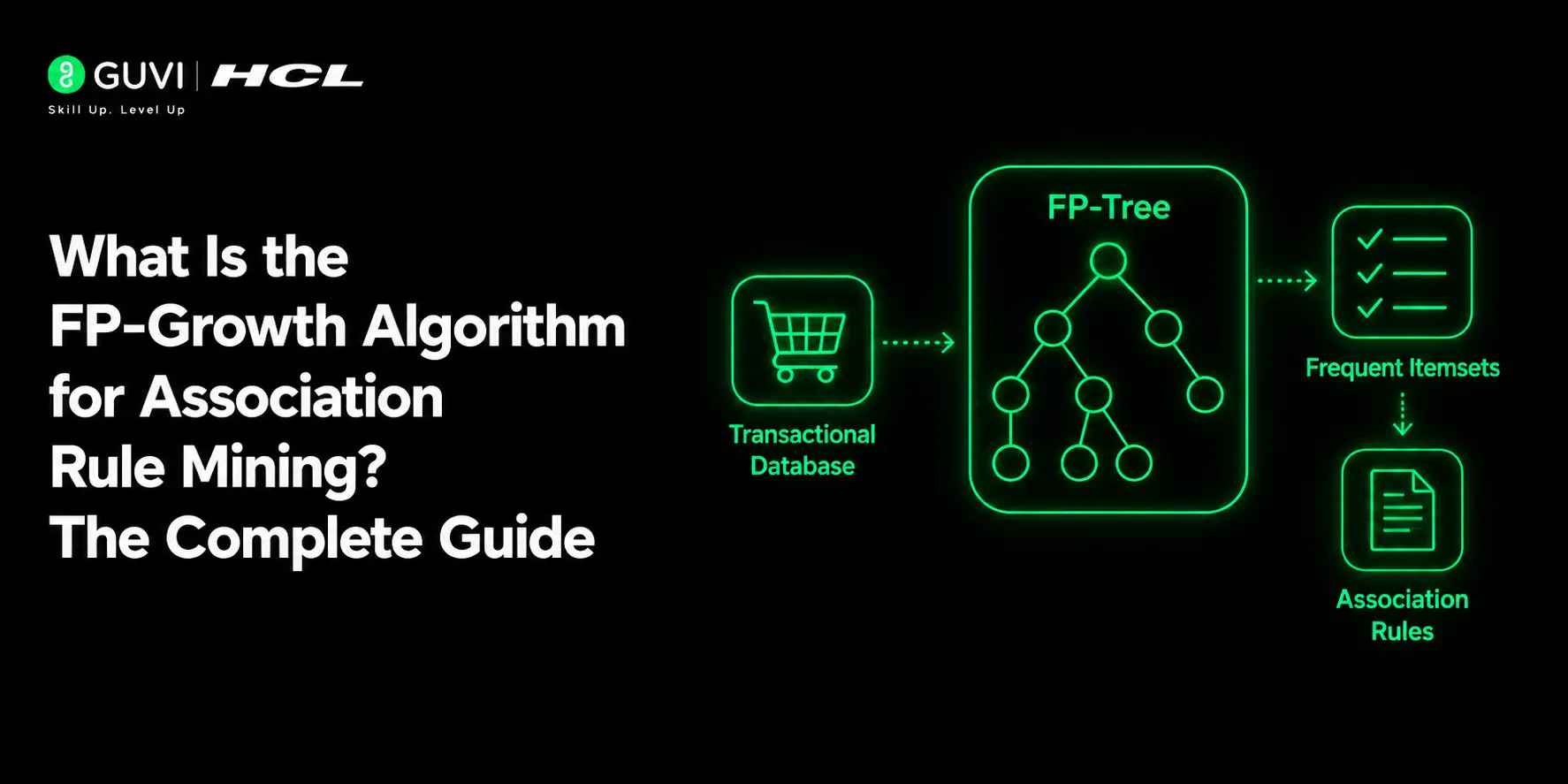
The FP-Growth algorithm for association rule mining discovers items that frequently occur together in transactional data. Instead of creating and testing large numbers of candidate itemsets, it compresses the transaction database into a Frequent Pattern Tree, or FP-tree
Table of contents
- TL;DR Summary Box
- What is the FP-Growth algorithm for association rule mining
- How Does FP-Growth Work?
- Count item frequency
- Build the FP-tree
- Create conditional pattern bases
- My conditional FP-trees
- FP-Growth vs Apriori: Which Is Better?
- What Are the Advantages and Disadvantages?
- Advantages
- Disadvantages
- What Are Real-World Applications?
- Common Mistakes to Avoid
- Conclusion
- FAQs
- What is FP-Growth in association rule mining?
- What is an FP-tree?
- What minimum support should you use with FP-Growth?
- Does FP-Growth generate association rules?
- Does association imply causation?
TL;DR Summary Box
- FP-Growth is an association rule mining algorithm that finds frequent itemsets without generating candidate combinations.
- It compresses transactions into an FP-tree, then mines smaller conditional FP-trees recursively.
- FP-Growth usually reduces the candidate-generation overhead found in Apriori, especially when transactions share common items.
- You still need association-rule metrics such as support, confidence, and lift to separate useful relationships from misleading ones.
- In Python, the mlxtend library provides fpgrowth() for frequent itemsets and association_rules() for rule generation.
What is the FP-Growth algorithm for association rule mining
The FP-Growth algorithm mines a tree to identify frequent combinations efficiently. For example, a retailer may discover that customers who buy coffee often buy filters. FP-Growth identifies the recurring itemset, while association-rule metrics help determine whether the relationship is strong enough to use in a recommendation or promotion.
Association rule mining is useful in:
- Market basket analysis.
- Product recommendations.
- Website clickstream analysis.
- Course or content recommendations.
- Fraud and usage-pattern detection.
- Medical or operational research, where appropriate safeguards apply.
FP-Growth mines frequent itemsets and association rules faster by using an FP-tree instead of candidate generation. Learn AI & ML with HCL GUVI’s Artificial Intelligence and Machine Learning course.
The FP-Growth method was introduced by Han, Pei, and Yin in their 2000 SIGMOD paper, Mining Frequent Patterns Without Candidate Generation. Their approach uses a compressed FP-tree and a pattern-growth strategy to mine frequent patterns.
How Does FP-Growth Work?
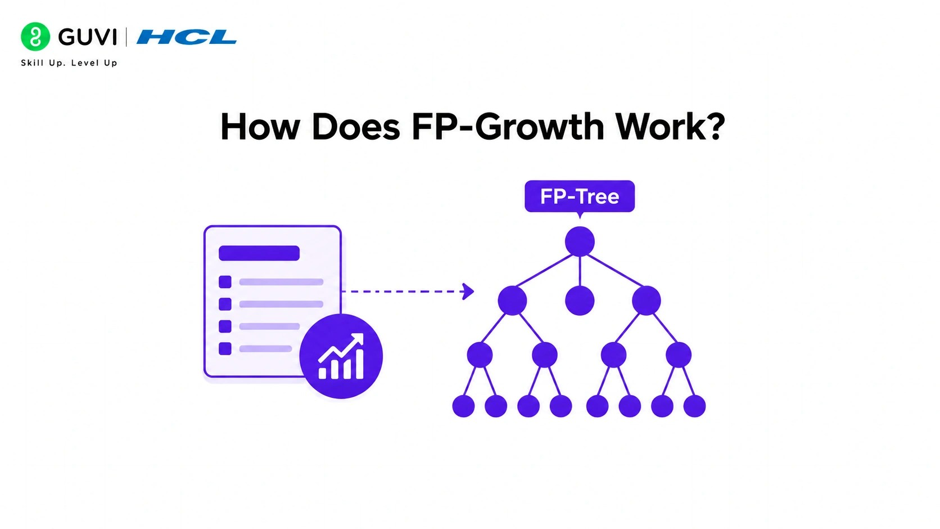
FP-Growth works in two broad phases: building the FP-tree and mining the tree.
1. Count item frequency
First, scan the transaction database and count how often each item occurs.
Assume a store has these transactions:
| Transaction | Items |
| T1 | Bread, Milk |
| T2 | Bread, Diapers, Beer, Eggs |
| T3 | Milk, Diapers, Beer, Cola |
| T4 | Bread, Milk, Diapers, Beer |
| T5 | Bread, Milk, Diapers, Cola |
Suppose the minimum support is 40%. An item must appear in at least two of the five transactions to remain in the dataset.
The algorithm removes items below that threshold. It then sorts the remaining items by descending frequency.
2. Build the FP-tree
Each transaction is reordered using the same global frequency order. The reordered transactions are inserted into a tree.
When two transactions share a prefix, the FP-tree stores that prefix once and increases its count. This compresses repeated transaction patterns.
The FP-tree contains:
- A root node.
- Item nodes with support counts.
- Shared paths for common prefixes.
- Links connecting identical items across different branches.
- A header table for locating each item quickly.
The tree does not store every possible item combination explicitly. That is one reason FP-Growth avoids the candidate explosion associated with Apriori.
3. Create conditional pattern bases
FP-Growth starts with items near the bottom of the header table. For each item, it traces paths from that item back toward the root.
These paths form the item’s conditional pattern base. In simple terms, a conditional pattern base is the collection of prefix paths that occur with a particular item.
For example, if the algorithm is examining Beer, it may find that Beer frequently appears after Bread, Diapers, or Milk. It uses those paths to construct a smaller conditional FP-tree.
4. My conditional FP-trees
The algorithm recursively mines each conditional FP-tree. It combines the suffix item with the patterns found in its conditional tree.
This process is called pattern growth because the algorithm extends known patterns instead of repeatedly generating all possible candidates.
The result is a complete set of frequent itemsets that meet the minimum-support threshold.
FP-Growth vs Apriori: Which Is Better?
Both algorithms mine frequent itemsets, but they explore the search space differently.
| Factor | FP-Growth | Apriori |
| Candidate generation | Does not explicitly generate candidates | Generates candidate itemsets |
| Database scans | Common implementations use two main scans to build the tree and count items | May require repeated scans across itemset levels |
| Main data structure | FP-tree | Candidate itemset lists |
| Strength | Efficiently handles shared transaction prefixes | Simple to explain and implement |
| Memory usage | Can require substantial memory for a large or poorly compressible tree | Can also become expensive because of candidate sets |
| Best use case | Large, repetitive transactional datasets | Small datasets, teaching, or simple experiments |
| Main limitation | Tree construction and recursive mining can be complex | Candidate explosion at lower support thresholds |
FP-Growth is not automatically faster in every situation. If transactions share few items, the tree may compress poorly. A very low support threshold can also produce a huge number of frequent patterns, regardless of the algorithm.

That is the nuanced point many tutorials skip: FP-Growth removes one major bottleneck, but it does not eliminate the cost of discovering an enormous pattern space.
What Are the Advantages and Disadvantages?
Advantages
- Avoids explicit candidate generation.
- Compresses repeated transaction prefixes.
- Can mine useful patterns from large transactional datasets.
- Supports a divide-and-conquer mining strategy.
- Works well for market basket and recommendation analysis.
Disadvantages
- FP-tree construction can consume significant memory.
- Sparse or highly diverse transactions may compress poorly.
- The algorithm can generate too many patterns at low support.
- The tree structure is harder to explain than Apriori’s level-by-level process.
- Frequent patterns do not prove causation.
- Rules may reflect popularity, seasonality, or data collection bias.
What Are Real-World Applications?
A grocery retailer can use FP-Growth to identify products that frequently appear in the same basket. It may use the result to test shelf placement, bundles, or digital recommendations.
An online learning platform can treat a learner’s completed courses as a transaction. FP-Growth may reveal that learners who complete a Python fundamentals course often continue with an API design course. The platform can use that relationship for navigation or recommendations, but it should still evaluate learner goals and course quality.
A content website can treat articles viewed in one session as a transaction. Patterns may reveal that readers of a microservices article often visit an API gateway guide. This insight can improve internal links without forcing irrelevant recommendations.
✅ Best Practice: Add an infographic showing the same five transactions before and after FP-tree compression. Use color to distinguish shared prefixes, conditional pattern bases, and discovered itemsets
FP-Growth mines frequent itemsets and association rules faster by using an FP-tree instead of candidate generation. Learn AI & ML with HCL GUVI’s Artificial Intelligence and Machine Learning course.
Common Mistakes to Avoid
- Using confidence alone: Always compare confidence with the conclusion item’s baseline frequency.
- Ignoring transaction boundaries: Combining items across unrelated sessions can create false associations.
- Setting support too low: This may produce thousands of patterns that nobody can review.
- Treating association as causation: “Customers bought X and Y” does not mean X caused Y.
- Skipping data validation: Duplicate products, refunds, bots, and test orders can distort results.
- Deploying rules without monitoring: Customer behavior changes with season, pricing, and promotions.
- Overclaiming performance: Benchmark FP-Growth on your own data instead of assuming it will always beat Apriori.
FP-Growth is most valuable when it connects pattern discovery to a measurable decision. The algorithm finds relationships; your validation process determines whether those relationships deserve action.
Conclusion
The FP-Growth algorithm for association rule mining offers an efficient way to discover frequent itemsets without explicitly generating candidate combinations. Its FP-tree compresses shared transaction patterns and enables recursive mining through conditional trees.
However, efficient mining does not guarantee useful insight. Clean transaction data, sensible thresholds, lift-based evaluation, domain review, and ongoing testing remain essential. Use FP-Growth as a pattern-discovery tool, not as proof that one item causes another.
FAQs
What is FP-Growth in association rule mining?
FP-Growth is an algorithm that finds frequent itemsets by building and mining an FP-tree. It avoids the explicit candidate-generation step used by Apriori.
What is an FP-tree?
An FP-tree is a compressed prefix-tree representation of transactional data. It stores shared transaction paths with frequency counts and links between matching item nodes.
What minimum support should you use with FP-Growth?
There is no universal value. Start with a threshold that produces a manageable number of itemsets, then adjust it after reviewing pattern quality and business usefulness.
Does FP-Growth generate association rules?
FP-Growth primarily generates frequent itemsets. You must apply a rule-generation step using metrics such as support, confidence, and lift.
Does association imply causation?
No. An association rule shows that items co-occur more or less often than expected. It does not prove that one item causes the other.
Success Stories

About the Author
HCL GUVI
This article was selected and published as part of the HCL GUVI AI Blogathon 2026, an initiative designed to encourage students, AI enthusiasts, and aspiring tech writers to simplify complex AI concepts through impactful technical content. The contest recognized high-quality, original, and insightful AI-focused blogs, with selected authors receiving publication opportunities on the HCL GUVI blog platform along with official author credits and recognition.
View all posts by HCL GUVI
Connect with me @











Did you enjoy this article?