


VLSI Design Articles
Why Chips Fail: A Basic Guide to Chip Defects and IC Failure Analysis
Fun Facts About the Semiconductor Industry
Why Are Semiconductor Chips Expensive? Manufacturing Cost Explained
Instruction Set Architecture: How ISA Shapes Modern Chip Design

Get In Touch For Details! Request More Information
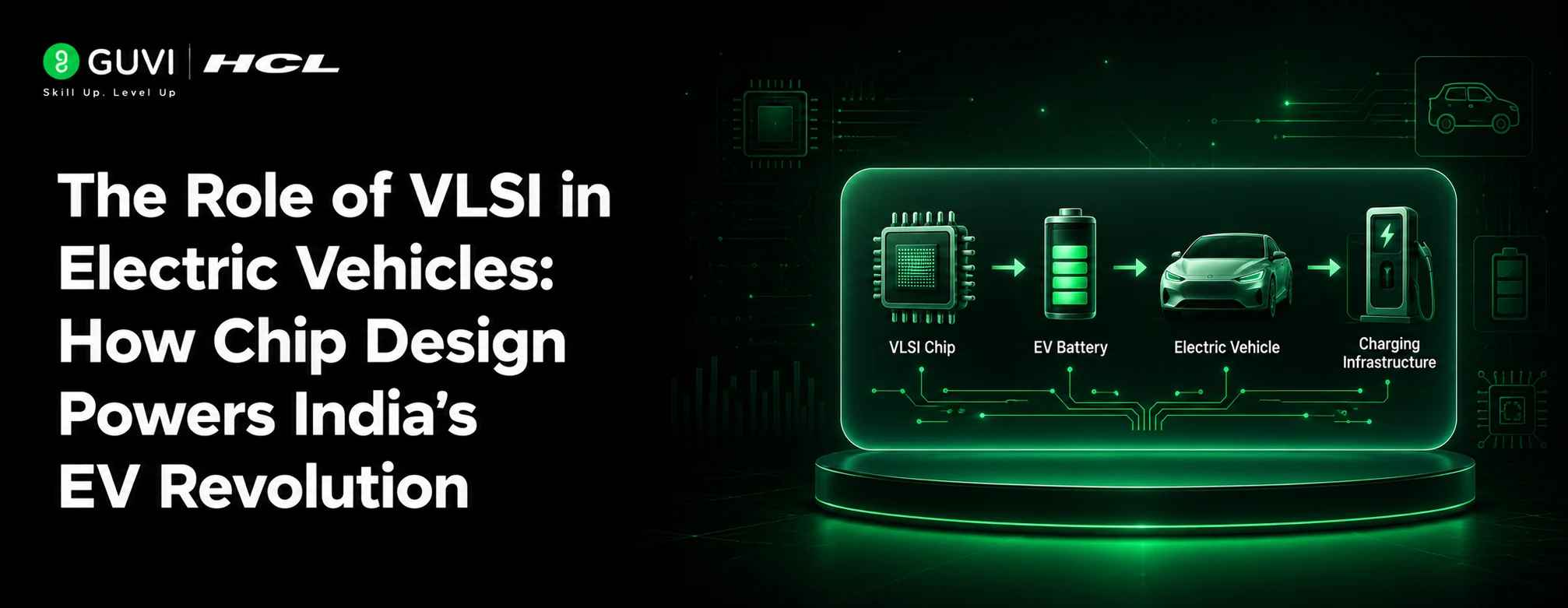
The Role of VLSI in Electric Vehicles: How Chip Design Powers India’s EV Revolution
Jul 22, 2026 8 Min Read 351 Views
(Last Updated)
Table of contents
- TL;DR
- Introduction
- What is VLSI in Electric Vehicles?
- Definition of VLSI in EV
- Why Do Modern EVs Depend on Semiconductor Chips?
- Why is VLSI Important in Electric Vehicles?
- Battery Management Systems (BMS)
- Motor Control Units
- Advanced Driver Assistance Systems (ADAS)
- Infotainment and Connectivity
- Power Electronics and Inverters
- Key Applications of VLSI in Electric Vehicles
- Battery Monitoring
- Fast Charging Systems
- Thermal Management
- Vehicle-to-Everything (V2X)
- Autonomous Driving
- Types of Automotive Semiconductor Chips Used in EVs
- Comparison: Conventional Vehicles vs Electric Vehicles
- Real-World Applications of VLSI in Electric Vehicles
- Tesla
- BYD
- Hyundai
- How VLSI is Powering India's EV Revolution?
- India Semiconductor Mission: Building a Domestic Chip Ecosystem
- Tata Electronics and India's Semiconductor Manufacturing Push
- Dholera Fab: Strengthening India's Automotive Semiconductor Supply
- Sanand: A Growing Semiconductor Manufacturing Hub
- Micron India: Advancing Chip Packaging and Testing
- Production Linked Incentive (PLI) Scheme: Accelerating EV and Semiconductor Growth
- India's EV Manufacturing Ecosystem is Increasing Demand for VLSI
- Rising Demand for Semiconductor Professionals in India
- Future of VLSI in Electric Vehicles
- AI-Powered Automotive Chips
- Silicon Carbide (SiC) and Gallium Nitride (GaN)
- Software-Defined Vehicles
- Vehicle-to-Everything (V2X) Communication
- Challenges of VLSI in Electric Vehicles
- Power Efficiency
- Thermal Management
- Functional Safety
- Semiconductor Supply Chain
- Career Opportunities in Automotive Semiconductor Design
- Skills Required to Work on Automotive Semiconductor Chips
- Salary Trends
- Build Practical VLSI Skills for the EV Industry
- Conclusion
- Frequently Asked Questions
- What is VLSI in Electric Vehicles?
- Why is VLSI important in electric vehicles?
- What types of semiconductor chips are used in EVs?
- How does VLSI improve battery performance?
- What are the biggest challenges in automotive semiconductor design?
- Is VLSI a good career choice for the EV industry?
TL;DR
- VLSI in Electric Vehicles refers to the chip design technology behind battery management, motor control, ADAS, and infotainment systems in EVs.
- A single electric vehicle can carry over 3,000 semiconductor components, nearly double what a petrol car uses.
- India’s automotive semiconductor sector is expanding fast under the India Semiconductor Mission, with fabs in Dholera and Sanand now producing automotive-grade chips.
- For engineering students and early-career professionals, this creates a growing pipeline of VLSI design roles across chip design houses, EV OEMs, and Tier-1 suppliers.
Introduction
Electric vehicles have transformed from an emerging technology into a mainstream mode of transportation. According to the International Energy Agency (IEA), global electric vehicle sales achieved 23 million units in 2026, accounting for more than 28% of all car sales worldwide. Behind this remarkable growth lies an often-overlooked technology: semiconductor chips.
Every modern EV depends on hundreds to thousands of integrated circuits to manage everything from battery performance and motor efficiency to infotainment and driver assistance.
At the heart of these intelligent systems is VLSI in Electric Vehicles, which enables manufacturers to integrate millions, even billions, of transistors onto a single chip while maintaining high performance and low power consumption.
As vehicles become increasingly software-defined and connected, the importance of VLSI in EVs continues to grow. Understanding its role not only explains how electric vehicles function but also highlights why semiconductor engineering is becoming one of the most critical fields in the automotive industry.
What is VLSI in Electric Vehicles?
Definition of VLSI in EV
VLSI (Very Large Scale Integration) in Electric Vehicles is the process of designing highly integrated semiconductor chips that control and optimize essential EV functions such as battery management, motor control, charging systems, communication, infotainment, and vehicle safety.
These chips integrate millions of transistors into compact integrated circuits, enabling high computational performance while minimizing energy consumption and physical space.
Unlike conventional vehicles, which rely on mechanical systems for many operations, electric vehicles rely extensively on electronics. This makes VLSI one of the core technologies enabling efficient, reliable, and intelligent electric mobility.
New to EV technology? Before diving into VLSI, understand the complete architecture of electric vehicles in our beginner-friendly guide on Electric Vehicle Technology and Components.
Why Do Modern EVs Depend on Semiconductor Chips?
Modern EVs are essentially computers on wheels. Instead of relying solely on mechanical components, they use interconnected electronic control units (ECUs) that communicate continuously to monitor vehicle performance and make real-time decisions.
These systems depend on advanced automotive ICs that work together through communication protocols such as:
- Controller Area Network (CAN)
- Local Interconnect Network (LIN)
- Automotive Ethernet
- FlexRay
Without advanced automotive semiconductor technology, many of the intelligent features drivers now expect, such as regenerative braking, adaptive cruise control, or battery optimization, would not be possible.
Why is VLSI Important in Electric Vehicles?
Electric vehicles demand exceptional efficiency, reliability, and safety. VLSI enables manufacturers to achieve these goals by designing compact, energy-efficient chips that can process massive amounts of data in real time.
Battery Management Systems (BMS)
The battery pack is the most valuable component of an electric vehicle, making battery management one of the most critical applications of EV semiconductor chips.
VLSI-powered Battery Management Systems continuously monitor:
- Cell voltage
- Temperature
- Charging cycles
- State of Charge (SoC)
- State of Health (SoH)
- Current flow
This continuous monitoring prevents overheating, extends battery lifespan, improves charging efficiency, and enhances overall vehicle safety.
Motor Control Units
Electric motors require precise electronic control to deliver smooth acceleration and maximize driving efficiency.
VLSI-based motor controllers help:
- Optimize torque output
- Improve acceleration response
- Reduce energy losses
- Support regenerative braking
- Increase driving range
These integrated circuits process sensor data within milliseconds, ensuring efficient power delivery under varying driving conditions.
Advanced Driver Assistance Systems (ADAS)
Many modern EVs include intelligent safety features powered by dedicated semiconductor chips.
Examples include:
- Adaptive Cruise Control
- Lane Keeping Assist
- Automatic Emergency Braking
- Driver Monitoring Systems
- Blind Spot Detection
- Collision Avoidance
These features require specialized automotive ICs capable of processing camera, radar, and sensor data in real time to improve driver safety.
Infotainment and Connectivity
Today’s electric vehicles provide a connected digital experience similar to smartphones.
VLSI enables features such as:
- High-resolution touch displays
- Voice assistants
- GPS navigation
- Smartphone integration
- Cloud connectivity
- Over-the-Air (OTA) software updates
As software-defined vehicles become more common, the demand for intelligent semiconductor solutions continues to increase.
Power Electronics and Inverters
Power electronics convert electrical energy between the battery and motor while ensuring maximum efficiency.
Advanced semiconductor devices help:
- Convert DC power into AC power
- Reduce switching losses
- Improve energy efficiency
- Support high-speed charging
- Enhance overall drivetrain performance
This makes VLSI a key contributor to longer driving ranges and faster charging capabilities.
Key Applications of VLSI in Electric Vehicles
Battery Monitoring
Battery monitoring systems continuously analyze the health of individual cells to maximize battery life and prevent failures. Intelligent semiconductor chips enable accurate voltage balancing and temperature control.
Fast Charging Systems
Fast-charging stations require sophisticated power-management integrated circuits capable of handling high voltages safely and efficiently. VLSI enables optimized charging algorithms that reduce charging time while protecting battery health.
Thermal Management
Heat directly impacts battery efficiency and semiconductor performance.
VLSI-based controllers regulate cooling systems by continuously monitoring component temperatures and activating thermal management mechanisms whenever necessary.
Vehicle-to-Everything (V2X)
Future electric vehicles will communicate seamlessly with surrounding infrastructure, charging stations, pedestrians, and other vehicles.
Advanced semiconductor chips enable secure, low-latency communication, helping improve traffic efficiency and road safety.
Autonomous Driving
Autonomous driving systems rely on AI-enabled semiconductor processors capable of analyzing massive amounts of sensor data in real time.
These processors integrate information from:
- Cameras
- LiDAR
- Radar
- Ultrasonic sensors
- GPS
to make driving decisions within milliseconds.
Types of Automotive Semiconductor Chips Used in EVs
| Semiconductor Type | Primary Function | Common Applications |
| Power ICs | Power conversion | Inverters, chargers |
| Microcontrollers (MCUs) | System control | Battery management, ECUs |
| ASICs | Application-specific processing | Motor control, ADAS |
| Sensors | Environmental monitoring | Temperature, pressure, motion |
| AI Accelerators | High-speed AI computing | Autonomous driving |
| Memory Chips | Data storage | Infotainment, navigation |
Comparison: Conventional Vehicles vs Electric Vehicles
| Feature | Conventional Vehicles | Electric Vehicles |
| Semiconductor Usage | Moderate | Very High |
| Battery Monitoring | Minimal | Advanced BMS |
| Motor Control | Mechanical | Fully Electronic |
| Software Updates | Limited | OTA Enabled |
| Connectivity | Basic | Cloud Connected |
| ADAS Support | Optional | Increasingly Standard |
A premium electric vehicle can contain more than 3,000 semiconductor chips, nearly double the semiconductor content found in many conventional vehicles. As autonomous driving and connected mobility evolve, this number is expected to increase significantly over the next decade.
Real-World Applications of VLSI in Electric Vehicles
Tesla
Tesla uses highly integrated semiconductor architectures to manage battery systems, autonomous driving hardware, infotainment, and vehicle networking. Its centralized computing approach reduces complexity while improving software performance.
BYD
BYD has invested heavily in designing its own semiconductor chips to optimize battery performance and strengthen its supply chain. This vertical integration allows tighter coordination between hardware and software.
Hyundai
Hyundai employs advanced automotive semiconductor technologies across its EV lineup to enhance battery efficiency, regenerative braking, intelligent safety features, and connected driving experiences.
How VLSI is Powering India’s EV Revolution?
India is rapidly emerging as a global hub for both electric vehicle manufacturing and semiconductor development.
As EV adoption accelerates, the demand for automotive semiconductor chips, automotive ICs, and advanced VLSI design expertise is increasing across the country.
Government initiatives such as the India Semiconductor Mission (ISM) and the Production Linked Incentive (PLI) Scheme are encouraging domestic chip manufacturing, while leading automotive companies are expanding their EV portfolios.
Together, these developments are creating new opportunities for semiconductor engineers and making VLSI in Electric Vehicles a critical technology for India’s mobility future.
India Semiconductor Mission: Building a Domestic Chip Ecosystem
Launched in 2021 with a financial outlay of ₹76,000 crore, the India Semiconductor Mission (ISM) aims to establish a self-reliant semiconductor ecosystem by supporting chip fabrication, assembly, testing, packaging, and design.
The mission focuses on:
- Establishing semiconductor fabrication (fab) facilities
- Supporting chip packaging and testing units
- Encouraging semiconductor design startups
- Developing skilled semiconductor professionals
- Reducing India’s dependence on imported chips
For the EV industry, this initiative is particularly significant. Electric vehicles require a much higher number of semiconductor components than conventional vehicles, making a reliable domestic supply chain essential for long-term growth.
Tata Electronics and India’s Semiconductor Manufacturing Push
India’s semiconductor ambitions have gained momentum with major investments from Tata Electronics.
The company is developing one of India’s first semiconductor fabrication facilities in Dholera, Gujarat, in partnership with Powerchip Semiconductor Manufacturing Corporation (PSMC).
The fab will manufacture semiconductor wafers for industries such as automotive, artificial intelligence, telecommunications, and consumer electronics.
In addition, Tata Semiconductor Assembly and Test (TSAT) is setting up an advanced semiconductor assembly and testing facility in Jagiroad, Assam. This plant will handle chip packaging, assembly, and testing, critical stages in producing reliable automotive-grade semiconductor devices.
These investments strengthen India’s semiconductor supply chain and reduce reliance on imported chips for EV manufacturing.
Dholera Fab: Strengthening India’s Automotive Semiconductor Supply
The upcoming semiconductor fabrication facility at Dholera Special Investment Region (SIR) represents one of India’s most significant semiconductor projects.
Once operational, the fab is expected to manufacture chips used in:
- Electric vehicle battery management systems
- Automotive microcontrollers (MCUs)
- Power management ICs
- Communication processors
- Industrial electronics
Although advanced logic chips will continue to be imported in some cases, local fabrication of automotive-grade semiconductors can significantly improve supply chain resilience and reduce production delays.
Sanand: A Growing Semiconductor Manufacturing Hub
Sanand, Gujarat, has evolved into one of India’s fastest-growing electronics and semiconductor manufacturing clusters.
The region already hosts several automotive manufacturing facilities, and new semiconductor investments are strengthening the connection between chip production and vehicle manufacturing.
This ecosystem enables closer collaboration among semiconductor companies, automotive manufacturers, and suppliers, reducing logistics costs and accelerating innovation.
For India’s EV industry, having semiconductor production close to automotive assembly plants improves manufacturing efficiency and enhances supply chain reliability.
Micron India: Advancing Chip Packaging and Testing
While semiconductor fabrication receives significant attention, chip packaging and testing are equally important in the automotive industry.
Micron Technology is establishing a semiconductor assembly and test facility in Sanand, Gujarat, to strengthen India’s backend semiconductor capabilities.
The facility focuses on:
- Chip packaging
- Quality testing
- Memory product assembly
- Reliability validation
Automotive semiconductor chips must operate reliably under extreme temperatures, vibration, and long operational lifecycles. Advanced testing facilities help ensure these stringent quality standards are met before chips are integrated into electric vehicles.

Production Linked Incentive (PLI) Scheme: Accelerating EV and Semiconductor Growth
The Production Linked Incentive (PLI) Scheme has played a significant role in attracting investments across India’s electronics and automotive sectors.
For semiconductor manufacturing, the scheme provides financial incentives to companies investing in domestic production and advanced manufacturing technologies.
Its impact includes:
- Increased semiconductor investments
- Growth of electronics manufacturing
- Expansion of EV supply chains
- Job creation across engineering and manufacturing
- Stronger collaboration between chip designers and automotive manufacturers
By encouraging local manufacturing, the PLI Scheme supports the development of a resilient ecosystem for EV semiconductor chips and automotive electronics.
India’s semiconductor ecosystem is expanding rapidly, creating exciting opportunities for aspiring chip designers. Discover how HCL GUVI’s industry-focused VLSI program prepares learners for real semiconductor careers.
India’s EV Manufacturing Ecosystem is Increasing Demand for VLSI
India has become one of the world’s fastest-growing electric vehicle markets, with both established manufacturers and startups investing heavily in EV production.
Major companies driving this growth include:
- Tata Motors
- Mahindra Electric
- Ola Electric
- Ather Energy
- TVS Motor Company
- Bajaj Auto
These companies rely on sophisticated semiconductor technologies for:
- Battery Management Systems (BMS)
- Motor control units
- Charging systems
- Advanced Driver Assistance Systems (ADAS)
- Connected vehicle platforms
- Infotainment systems
As EV production scales, demand for automotive semiconductor chips and VLSI engineers continues to grow alongside it.
Rising Demand for Semiconductor Professionals in India
India has long been a global center for semiconductor design, with multinational companies operating major R&D centers in cities such as Bengaluru, Hyderabad, Noida, Pune, and Chennai.
Leading semiconductor employers include:
- Texas Instruments India
- Qualcomm India
- NXP Semiconductors
- Intel India
- AMD India
- NVIDIA India
- Synopsys
- Cadence Design Systems
- Infineon Technologies
- Tata Electronics
With new semiconductor fabs, OSAT facilities, and EV manufacturing plants becoming operational, demand is expanding beyond chip design into fabrication, packaging, testing, verification, and automotive functional safety.
For engineering graduates, this creates opportunities across the entire semiconductor value chain from RTL design and ASIC verification to embedded systems and automotive electronics.
Wondering how to start your career in chip design? Explore our step-by-step guide on How to Become a VLSI Designer and learn the skills, tools, and roadmap employers look for.
Future of VLSI in Electric Vehicles
The role of VLSI in Electric Vehicles is evolving rapidly as EVs become smarter, more connected, and increasingly autonomous.
Next-generation VLSI technologies are enabling AI-driven vehicles, ultra-fast charging, software-defined architectures, and intelligent communication between vehicles and infrastructure.
As the automotive industry shifts toward electrification, semiconductor innovation will continue to determine how efficient, safe, and intelligent future EVs become.
AI-Powered Automotive Chips
Artificial Intelligence is becoming a standard feature in premium electric vehicles. Modern automotive semiconductor solutions now integrate dedicated AI accelerators that process massive amounts of sensor data in real time.
These chips enable advanced features such as:
- Driver monitoring systems
- Traffic sign recognition
- Predictive maintenance
- Intelligent route optimization
- Autonomous driving assistance
Instead of sending data to external servers, AI-enabled chips perform computations inside the vehicle, reducing latency while improving safety and responsiveness.
Silicon Carbide (SiC) and Gallium Nitride (GaN)
Traditional silicon-based chips are gradually being complemented by wide-bandgap semiconductor materials such as Silicon Carbide (SiC) and Gallium Nitride (GaN).
Compared to conventional silicon, these technologies provide:
- Higher power efficiency
- Faster switching speeds
- Lower heat generation
- Better thermal performance
- Faster charging capabilities
Many EV manufacturers are already adopting SiC-based power devices to improve driving range and charging performance.
Software-Defined Vehicles
Modern electric vehicles are transitioning from hardware-centric designs to software-defined architectures.
Instead of replacing hardware to introduce new features, manufacturers can deploy:
- Over-the-Air (OTA) software updates
- Performance improvements
- Battery optimization algorithms
- Enhanced cybersecurity
- New infotainment capabilities
This evolution requires increasingly sophisticated automotive ICs capable of supporting centralized computing platforms while maintaining high reliability.
Vehicle-to-Everything (V2X) Communication
The next generation of EVs will communicate with:
- Other vehicles
- Smart traffic infrastructure
- Charging stations
- Cloud services
- Emergency response systems
Advanced EV semiconductor chips make this real-time communication possible by ensuring secure, low-latency data transmission. This improves traffic flow, reduces accidents, and supports autonomous driving technologies.
Challenges of VLSI in Electric Vehicles
While VLSI enables many of the intelligent features found in electric vehicles, designing semiconductor solutions for automotive applications presents several engineering challenges.
Power Efficiency
Electric vehicles rely entirely on stored battery energy, making power efficiency a top priority.
VLSI designers must develop chips that deliver high computational performance while consuming as little energy as possible. Even small improvements in chip efficiency can contribute to increased driving range.
Thermal Management
Semiconductor devices generate heat during operation, especially in high-power systems such as inverters and motor controllers.
Efficient thermal management is essential to:
- Maintain chip reliability
- Prevent overheating
- Improve battery performance
- Extend component lifespan
Modern EVs use intelligent cooling systems controlled by dedicated semiconductor devices to regulate operating temperatures.
Functional Safety
Unlike consumer electronics, automotive chips operate in safety-critical environments where failures can have serious consequences.
To ensure reliability, automotive semiconductor manufacturers follow rigorous standards such as ISO 26262, which governs the functional safety of electrical and electronic systems in road vehicles.
These standards require extensive verification and testing before chips are deployed in production vehicles.
Semiconductor Supply Chain
The global chip shortage highlighted how dependent the automotive industry is on semiconductor manufacturing.
As EV adoption increases, manufacturers continue investing in localized semiconductor production and diversified supply chains to reduce future disruptions.
According to McKinsey & Company, semiconductor content in electric vehicles can be two to three times higher than in traditional internal combustion engine vehicles. As autonomous driving features become more common, semiconductor demand is expected to grow even further.
Career Opportunities in Automotive Semiconductor Design
Professionals with VLSI expertise can pursue roles such as:
- RTL Design Engineer
- ASIC Design Engineer
- Physical Design Engineer
- Verification Engineer
- FPGA Engineer
- Functional Safety Engineer
- Embedded Systems Engineer
Some of the leading recruiters include:
- NXP Semiconductors
- Infineon Technologies
- Texas Instruments
- Qualcomm
- NVIDIA
- Bosch
- STMicroelectronics
- Renesas
- Tata Electronics
- Continental
Skills Required to Work on Automotive Semiconductor Chips
As electric vehicles become more semiconductor-intensive, employers increasingly look for engineers with both theoretical knowledge and practical implementation skills.
Key technical skills include:
| Skill | Why It Matters |
| Digital Electronics | Foundation of chip design |
| CMOS Technology | Semiconductor fundamentals |
| Verilog/SystemVerilog | RTL development |
| FPGA Development | Hardware prototyping |
| ASIC Design Flow | Production chip design |
| Static Timing Analysis | Performance optimization |
| Functional Verification | Chip reliability |
| ISO 26262 | Automotive safety compliance |
Looking to master industry-standard chip design tools? Check out our guide to the Top VLSI Design Tools in 2026 and learn the software used by leading semiconductor companies.
Salary Trends
Growing investments in semiconductor manufacturing and electric mobility have made VLSI one of the highest-paying domains in electronics engineering.
| Experience | Average Salary (India) |
| Fresher | ₹6-8 LPA |
| 2-5 Years | ₹8-18 LPA |
| Senior Engineer | ₹18-35 LPA |
| Principal Engineer | ₹35 LPA+ |
Note: Salaries vary depending on technical expertise, company, location, and specialization.
Build Practical VLSI Skills for the EV Industry
As electric vehicles continue to evolve, understanding semiconductor design is becoming increasingly valuable for aspiring electronics and embedded systems engineers.
Building practical expertise in digital design, HDL programming, ASIC workflows, and verification can help you understand the technologies driving modern EV innovation.
If you’re looking to develop these industry-relevant skills, the HCL GUVI VLSI Design Course offers hands-on learning in digital electronics, Verilog, FPGA development, ASIC design flow, and real-world projects.
These practical experiences can help bridge the gap between academic concepts and the semiconductor technologies powering today’s electric vehicles.
Conclusion
VLSI in Electric Vehicles connects two of India’s fastest-growing sectors: semiconductors and EV manufacturing.
From battery management to ADAS processors, chip design decisions directly shape how safe, efficient, and intelligent an EV can be.
With India Semiconductor Mission investments accelerating domestic chip production, engineering students now have a genuine pathway into automotive VLSI careers. Building strong fundamentals in circuit design, RTL coding, and automotive safety standards today can position you well for this expanding job market.
Frequently Asked Questions
1. What is VLSI in Electric Vehicles?
VLSI in Electric Vehicles refers to the design of highly integrated semiconductor chips that manage battery systems, motor control, charging, safety features, communication, and other electronic functions within an EV.
2. Why is VLSI important in electric vehicles?
VLSI enables compact, energy-efficient, and high-performance semiconductor chips that improve battery efficiency, vehicle safety, charging performance, and intelligent driving capabilities.
3. What types of semiconductor chips are used in EVs?
Electric vehicles use several types of automotive ICs, including power ICs, microcontrollers (MCUs), ASICs, memory chips, sensor ICs, and AI accelerators.
4. How does VLSI improve battery performance?
VLSI-powered Battery Management Systems continuously monitor battery voltage, temperature, current, and charging cycles to improve efficiency, extend battery life, and enhance safety.
5. What are the biggest challenges in automotive semiconductor design?
Some of the major challenges include power efficiency, thermal management, functional safety, cybersecurity, and maintaining a resilient semiconductor supply chain.
6. Is VLSI a good career choice for the EV industry?
Yes. As electric vehicles continue to rely on advanced semiconductor technologies, demand for VLSI professionals is increasing across automotive manufacturers, semiconductor companies, and embedded systems organizations.
Success Stories

About the Author
Hashmithaa
Hi, I’m Hashmithaa — a content writer with a love for words. Writing isn’t just what I do; it’s how I connect, communicate, and create meaning in a noisy digital world. And if my words help someone make a better decision, learn something new, or feel more confident, then I’ve done my job well.
View all posts by Hashmithaa
Connect with me @












Did you enjoy this article?