


Product Management Articles
Enterprise Product Management: Unique Challenges, Skills & Strategy
B2B vs B2C Product Management: Key Differences, Skills, Strategy & Career Scope
Working with Engineers as a Product Manager: A Practical Guide


Get In Touch For Details! Request More Information
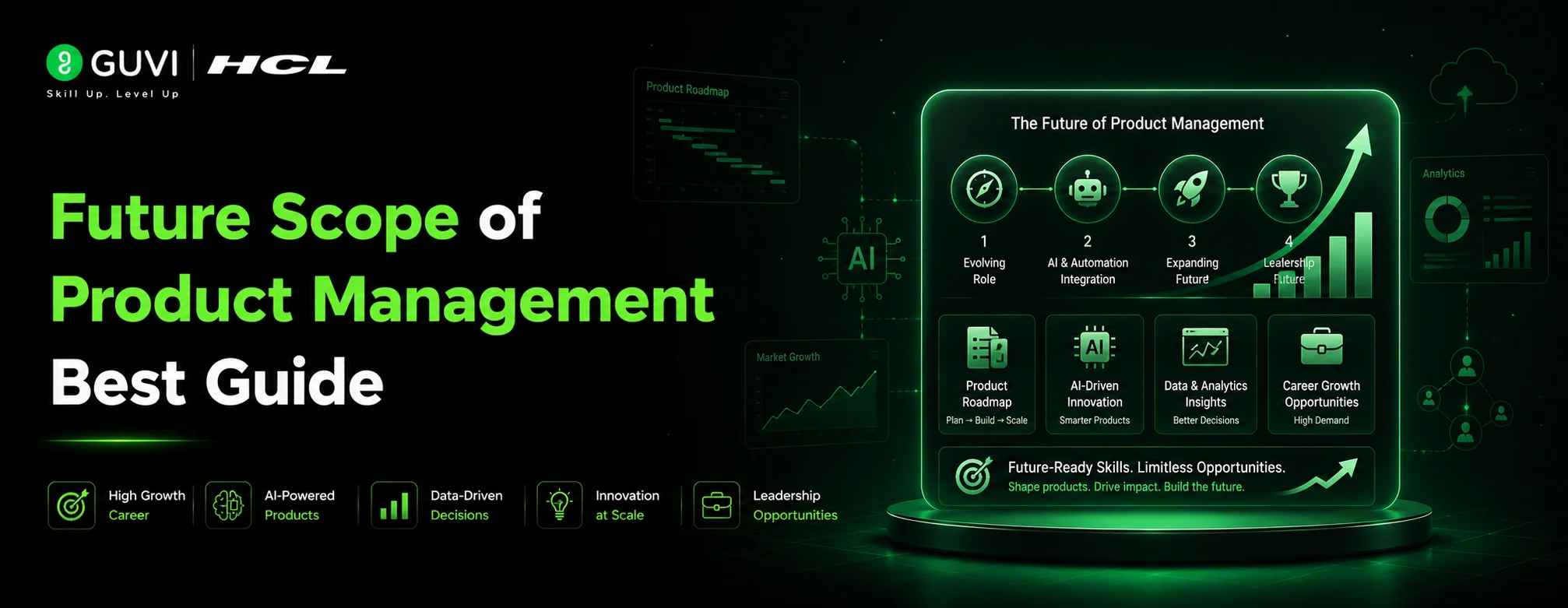
Future Scope of Product Management in 2026- Best Guide
Jul 16, 2026 9 Min Read 534 Views
(Last Updated)
Table of contents
- TL;DR
- What Is the Future Scope of Product Management?
- Is Product Management a Good Career in 2026?
- Current Product Management Market Snapshot in India
- Why Is the Future Scope of Product Management Growing in India?
- AI Investment and Adoption
- Digital Products Across Traditional Industries
- How Will the Product Manager Role Change by 2030?
- Will AI Replace Product Managers?
- Product Management Tasks AI Can Assist
- Responsibilities That Still Need Human Accountability
- Which Product Management Roles Will Grow?
- AI Product Manager
- Data Product Manager
- Platform Product Manager
- Growth Product Manager
- Product Operations Manager
- Trust, Safety, and Responsible AI Product Manager
- Enterprise and B2B Product Manager
- Domain Product Manager
- Which Industries Offer Future scope of Product Management Opportunities?
- What Skills Will Future Product Managers Need?
- What Is the Product Manager Career and Salary Outlook in India?
- Current Salary Context
- How Can You Prepare for the Future scope of Product Management?
- Months 1–3: Learn Product Fundamentals
- Months 4–6: Build Research and Data Skills
- Months 7–9: Learn AI-Supported Product Work
- Months 10–12: Build a Domain Case Study
- Real-World Example: Building an AI-Assisted UPI Support Product
- Step 1: Define the User Problem
- Step 2: Decide Whether AI Is Appropriate
- Step 3: Design the Experience
- Step 4: Define AI and Product Metrics
- Step 5: Launch Carefully
- What Challenges Will Future Product Managers Face?
- Leaner Teams and Wider Scope
- Fewer Routine Entry-Level Tasks
- Greater Accountability for AI Outcomes
- Pressure to Prove Business Impact
- Constant Skill Change
- Common Mistakes to Avoid
- Build Future-Ready Product Management Skills With HCL GUVI
- Conclusion
- FAQs
- What is the Future Scope of Product Management?
- Is Product Management a good career in India in 2026?
- Will AI replace Product Managers?
- Which Product Management roles have the strongest future scope?
- Does a future Product Manager need coding skills?
- Which industries hire Product Managers in India?
- What skills should a Product Manager learn for 2030?
- Can freshers enter Product Management in the AI era?
- Is an MBA compulsory for Product Management?
- How can I future-proof my Product Management career?
TL;DR
The Future Scope of Product Management remains strong, but the profession is becoming more specialised, strategic, technical, and AI-enabled. AI will assist with research summaries, first-draft documents, data exploration, prototypes, and routine reporting. Product Managers will remain responsible for selecting valuable problems, understanding customers, making trade-offs, managing risk, aligning teams, and delivering business outcomes. Opportunities are expanding across AI, fintech, SaaS, healthcare, platforms, data products, climate technology, and digital public services. Future-ready PMs will need business acumen, AI literacy, data skills, customer understanding, technical fluency, domain knowledge, and strong communication.
The Future Scope of Product Management is shaped by AI adoption, expanding digital services, specialised product roles, and higher expectations from Product Managers.
The role is not disappearing. However, professionals who only manage backlogs, write basic requirements, or coordinate meetings may find those activities increasingly automated or distributed across smaller teams.
This guide explains where Product Management is heading, which opportunities are growing in India, and what you should learn to remain valuable.
What Is the Future Scope of Product Management?
The Future Scope of Product Management refers to how Product Manager roles, responsibilities, skills, industries, and career paths are expected to develop over the coming years.
Product Managers will continue to connect customer needs, technology, design, business goals, and execution. What will change is the level of ownership expected from them.
These expectations build on the core Product Manager roles and responsibilities, but future scope of product management roles will demand greater ownership of strategy, risk, and measurable outcomes.
Future scope of product management roles will demand Product Managers to spend less time manually preparing routine outputs and more time on:
- Selecting the right problems
- Understanding customer behaviour
- Evaluating business opportunities
- Setting product direction
- Using data to make decisions
- Designing and reviewing experiments
- Managing AI-related risks
- Aligning cross-functional teams
- Connecting product work with revenue, cost, adoption, or retention
- Taking responsibility for measurable outcomes
The future scope of product management is therefore not simply about having more Product Manager job titles. It is about Product Managers becoming more accountable for the value and business impact of the products they guide.
Is Product Management a Good Career in 2026?
Product Management can remain a strong career choice in 2026 for people who enjoy solving unclear problems, working across teams, understanding customers, and making decisions that combine business and technology.
However, entry is becoming more competitive. Employers increasingly expect practical evidence such as product case studies, data analysis, user research, experiments, prototypes, or previous ownership of a business problem.
Current Product Management Market Snapshot in India
| Market Indicator | July 2026 Snapshot | Important Context |
| Product Manager jobs listed on LinkedIn India | 14,000+ | Includes different seniority levels, industries, and related titles |
| Product Management internships listed on LinkedIn India | 1,000+ | Search results change continuously and may include related roles |
| Glassdoor average Product Manager salary | Approximately ₹22.25 LPA | Based on 23,379 submitted salaries |
| Indeed average Product Manager salary | Approximately ₹14.16 LPA | Based mainly on salary data associated with job postings |
LinkedIn’s live India listings show opportunities across Associate Product Manager, Product Manager, Technical Product Manager, Senior PM, Product Lead, and Product Director titles. These counts are a temporary platform snapshot rather than a forecast.
Salary estimates also vary because Glassdoor relies largely on anonymous employee submissions, while Indeed uses information associated with job postings and reported salaries. Treat these amounts as reference points rather than guaranteed compensation.
A Product Management career is likely to reward depth more than title-chasing. Professionals who understand a domain, measure outcomes, communicate clearly, and work effectively with AI will have stronger long-term prospects.
Why Is the Future Scope of Product Management Growing in India?
India’s Product Management opportunities are closely connected to the expansion of its digital economy.
A MeitY report estimates that India’s digital economy contributed 11.74% of national GVA in 2022–23 and could reach 19.4% by 2029–30 under its broader measurement. This expansion may create more opportunities for Product Managers across banking, retail, education, SaaS, logistics, and other digitally evolving industries.
As more industries develop digital products, they require professionals who can decide what to build, which users to serve, how to measure success, and how to balance customer needs with technical and commercial limits, which is increasing the future scope of product management.
Atlassian’s State of Product 2026 found that 85% of Product Managers feel they have a place in strategic business discussions. This shows that Product Management is moving beyond feature coordination towards product strategy, business priorities, and measurable outcomes.
AI Investment and Adoption
The IndiaAI Mission received an approved five-year outlay of approximately ₹10,372 crore for computing infrastructure, datasets, innovation, skills, and responsible AI development. This investment does not guarantee Product Manager jobs directly, but it supports an environment in which more organisations can develop AI products and services.
Product Managers will be needed to define valuable AI use cases, test user trust, measure model performance, identify failure conditions, set guardrails, and connect technical capabilities with business outcomes.
Digital Products Across Traditional Industries
Product Management is no longer limited to consumer applications and software startups.
Banks, manufacturers, retailers, universities, logistics providers, hospitals, government services, and media organisations now operate digital customer journeys, internal platforms, data products, and automation systems.
This creates opportunities for professionals who combine Product Management knowledge with industry expertise and there by increasing the future scope of product management.
How Will the Product Manager Role Change by 2030?
The future scope of Product Management for product managers will expect them to contribute more directly to strategy, economics, risk, and product outcomes.
| Area | Traditional PM Emphasis | Future PM Emphasis |
| Documentation | Manually writing detailed documents | Reviewing and improving AI-assisted drafts |
| Research | Running occasional interviews and surveys | Combining continuous qualitative, quantitative, and AI-assisted research |
| Data | Reading prepared dashboards | Asking better analytical questions and validating AI-generated insights |
| Prototyping | Waiting for design or engineering resources | Building early concepts with AI-assisted tools |
| Roadmaps | Maintaining feature timelines | Connecting investments to outcomes and strategic choices |
| AI | Using general productivity tools | Defining AI use cases, evaluations, guardrails, and failure responses |
| Technical knowledge | Understanding basic software concepts | Understanding APIs, data systems, models, agents, and system limits |
| Business | Supporting stakeholder requests | Evaluating revenue, cost, risk, adoption, and strategic value |
| Leadership | Coordinating meetings | Resolving trade-offs and influencing without authority |
| Performance | Shipping features | Producing measurable customer and business outcomes |
As Product Managers move from feature delivery towards long-term outcomes, a clear product strategy will become more important for deciding where to compete and what not to build.
This combination is particularly relevant to Product Management. The role requires enough technical knowledge to understand new possibilities and enough human judgment to decide when and why those possibilities should be used.
Will AI Replace Product Managers?
AI is unlikely to replace the complete Product Manager role. It can, however, reduce the time required for many individual PM activities.
Companies may expect a smaller number of Product Managers to handle wider scopes. Entry-level professionals may also receive fewer purely administrative tasks because those tasks can be completed with AI assistance.
Product Management Tasks AI Can Assist
AI can help with:
- Summarising research interviews
- Grouping customer feedback
- Preparing first-draft PRDs
- Producing meeting notes
- Comparing competitor information
- Creating initial SQL queries
- Drafting release communication
- Generating prototype concepts
- Identifying patterns in support tickets
- Preparing alternative roadmap scenarios
- Translating product content
- Creating early test cases
For a detailed view of evolving workflows, responsibilities, and skills, understand how AI is changing the Product Manager role
Responsibilities That Still Need Human Accountability
Product Managers must still take responsibility for:
- Deciding which problem matters
- Checking whether evidence is reliable
- Understanding customer and cultural context
- Making ethical and commercial trade-offs
- Managing stakeholder conflict
- Choosing acceptable risks
- Setting product direction
- Evaluating unintended consequences
- Protecting user trust
- Explaining and defending decisions
- Deciding whether an AI-generated output should be used
Product teams using AI reported saving around two hours per day, mainly by automating routine tasks and product documentation. However, teams still found AI less effective for complex work such as prioritisation, strategic planning, and advanced analysis.
This means the future scope of product management demands Product Managers to have AI literacy, but they should not assume every product needs an autonomous agent. The stronger skill is matching the technology to a meaningful user and business problem.
Which Product Management Roles Will Grow?
The Product Manager title is divided into specialized career paths. Not every company will use the same titles, but the underlying responsibilities are becoming clearer. This means the future scope of product management will be:
1. AI Product Manager
An AI Product Manager identifies valuable AI use cases and works with data, machine learning, engineering, design, legal, and business teams.
The role requires knowledge of model limitations, evaluation metrics, data quality, user trust, privacy, and human oversight. Production coding may not be mandatory, but technical understanding is important.
2. Data Product Manager
A Data Product Manager guides products such as analytics platforms, data pipelines, recommendation systems, internal datasets, and reporting tools.
The role combines user requirements with data quality, governance, accessibility, and measurable decision value.
3. Platform Product Manager
A Platform Product Manager works on APIs, infrastructure, developer platforms, integrations, internal systems, or reusable product capabilities.
These roles require stronger technical fluency because the users may be developers, internal teams, partners, or other products.
4. Growth Product Manager
Growth Product Managers focus on acquisition, activation, engagement, retention, conversion, and monetisation.
The future of this role will involve faster experimentation, stronger causal thinking, personalisation, and careful management of dark patterns and customer trust.
5. Product Operations Manager
Product Operations supports the systems that help product teams work effectively.
Responsibilities may include research repositories, planning processes, metrics governance, tool administration, product reviews, launch coordination, and cross-team communication.
6. Trust, Safety, and Responsible AI Product Manager
These Product Managers focus on safety controls, user reporting, moderation, explainability, compliance, model behaviour, and risk reduction.
The role is especially relevant to finance, healthcare, marketplaces, social platforms, education, and AI products.
7. Enterprise and B2B Product Manager
Enterprise PMs work with complex buying processes, integrations, security requirements, administrative controls, and long implementation cycles.
Domain knowledge and stakeholder management are often as important as interface design.
8. Domain Product Manager
Domain PMs combine Product Management skills with knowledge of areas such as fintech, health technology, climate technology, logistics, cybersecurity, manufacturing, education, or agriculture.
As digital products enter regulated and specialised sectors, this combination can create stronger differentiation than being a generalist alone.
Which Industries Offer Future scope of Product Management Opportunities?
The Future scope of Product Management scope in India is broadening across industries that are becoming more digital, data-driven, and platform-based.
| Industry | Future Product Opportunities | Useful Domain Knowledge |
| Artificial intelligence | AI assistants, agents, evaluations, model platforms, workflow automation | AI systems, model limits, data, responsible AI |
| Fintech | Payments, lending, wealth products, fraud systems, financial operations | Financial behaviour, trust, risk, compliance |
| SaaS | Collaboration, analytics, automation, developer and enterprise tools | B2B workflows, pricing, onboarding, retention |
| Healthcare | Patient platforms, hospital operations, remote monitoring, clinical workflows | Safety, privacy, healthcare processes |
| E-commerce and retail | Search, recommendations, fulfilment, seller platforms, loyalty | Merchandising, logistics, conversion |
| Logistics and mobility | Routing, fleet systems, supply-chain platforms, delivery experience | Operations, mapping, cost, reliability |
| Education technology | Learning platforms, assessments, student support, career products | Learning behaviour, content, accessibility |
| Manufacturing | Connected equipment, digital twins, quality systems, industrial platforms | Operations, hardware, supply chains |
| Cybersecurity | Identity, access, threat monitoring, compliance platforms | Security concepts, risk, enterprise requirements |
| Climate technology | Energy platforms, carbon data, mobility, resource management | Sustainability, regulation, physical systems |
| Digital public services | Citizen services, identity, payments, multilingual access | Accessibility, public systems, inclusion |
| Media and creator products | Content tools, monetisation, recommendation, community products | Audience behaviour, rights, trust and safety |
You can also explore product-based companies hiring Product Managers to understand where these roles appear across SaaS, fintech, e-commerce, AI, and enterprise technology.
The growth of India’s digital economy suggests that Product Management opportunities will increasingly appear inside established organisations, not only technology startups. This is an inference based on the wider digitalisation of economic sectors described by MeitY.
What Skills Will Future Product Managers Need?
Future Product Manager skills will combine strategic, technical, analytical, commercial, and interpersonal abilities.
| Skill | Why It Matters | How to Demonstrate It |
| Problem framing | AI can generate solutions, but the PM must identify the correct problem | Write a clear problem statement supported by evidence |
| User research | Products still need a deep understanding of customer goals and behaviour | Conduct interviews and summarise recurring patterns |
| Product strategy | PMs must choose where the product will compete and what it will not do | Prepare a strategy brief with target users and choices |
| Business acumen | Companies expect PMs to understand value, revenue, cost, and risk | Add basic unit economics to a case study |
| Data literacy | AI-generated insights still require verification | Analyse a funnel or experiment and explain limitations |
| AI literacy | PMs must evaluate AI capabilities, risks, and suitable use cases | Build and assess a small AI prototype |
| Technical fluency | Technical understanding improves scope and trade-off decisions | Explain APIs, databases, model calls, and system dependencies |
| Experimentation | Teams need evidence before making large investments | Design an A/B test with a hypothesis and guardrail metrics |
| Communication | PMs must align people with different incentives | Present a product decision in a short written memo |
| Influence | Product Managers rarely control every team involved | Show how you resolved a trade-off in a group project |
| Domain expertise | Specialised industries require context that general frameworks cannot provide | Build a case study in one chosen industry |
| Responsible judgment | AI products can create privacy, bias, safety, and trust risks | Include risk analysis and human oversight in your proposal |

What Is the Product Manager Career and Salary Outlook in India?
The Product Manager career path can progress through wider scope, higher-impact decisions, and leadership responsibility.
| Career Stage | Typical Scope |
| Product Intern or Product Analyst | Research, analytics, support work, and defined product tasks |
| Associate Product Manager | A feature, workflow, experiment, or small product area |
| Product Manager | A customer problem, product area, or measurable outcome |
| Senior Product Manager | Complex and uncertain product areas with wider influence |
| Principal PM or Product Lead | High-impact strategy across products or teams |
| Group Product Manager | Several Product Managers or connected product areas |
| Director or Head of Product | Product portfolio, organisation, hiring, and investment decisions |
| VP Product or Chief Product Officer | Company-wide product direction and business alignment |
Professionals can also remain senior individual contributors instead of moving into people management.
Current Salary Context
Glassdoor’s July 2026 Product Manager estimate is approximately ₹22.25 LPA, with a typical reported range of ₹13–₹34 LPA. Its estimate is based on 23,379 submissions. Indeed reports a lower average of approximately ₹14.16 LPA because its methodology and dataset differ.
For a more detailed comparison across experience levels, cities, companies, and specialisations, review the Product Manager salary in India.
Compensation depends on:
- Role scope
- Experience
- Company stage
- Industry
- City
- Technical depth
- Domain knowledge
- Fixed salary
- Performance bonus
- Equity
- Team and product impact
Do not choose Product Management only because the future scope of product management salary platforms show attractive averages. The role involves ambiguity, accountability, difficult trade-offs, and frequent communication.
How Can You Prepare for the Future scope of Product Management?
A future-ready learning plan should build practical evidence, not just certificates or framework knowledge.
Follow a structured Product Manager roadmap to organise the concepts, tools, projects, and interview preparation needed at each career stage.
Months 1–3: Learn Product Fundamentals
Study:
- Product discovery
- User research
- Product strategy
- Prioritisation
- Product roadmaps
- Product metrics
- Product requirements
- Product lifecycle
- Go-to-market basics
Choose one product and write a short teardown explaining its users, problem, value, business model, and important metrics.
Months 4–6: Build Research and Data Skills
Conduct five user interviews around a small problem.
Create:
- A research plan
- Interview notes
- A problem statement
- A user journey
- A basic funnel
- A metric tree
- A prioritised problem list
Learn spreadsheet analysis, SQL basics, conversion, retention, cohorts, and experiment design.
Months 7–9: Learn AI-Supported Product Work
Practise using AI for:
- Research synthesis
- First-draft requirements
- Competitor monitoring
- Product analytics questions
- Prototype creation
- Test-case generation
- Risk identification
Check every output against original evidence. Document where the AI was helpful and where it produced incorrect or weak conclusions.
Months 10–12: Build a Domain Case Study
Choose one sector such as fintech, SaaS, education, healthcare, logistics, or climate technology.
Create a complete case study containing:
- User problem
- Research evidence
- Market and business context
- Proposed solution
- Low-fidelity prototype
- Technical flow
- Success and guardrail metrics
- Risks
- Launch plan
- Post-launch learning plan
Apply for internships, Associate Product Manager roles, Product Analyst roles, Product Operations roles, and internal transfers where your existing experience is relevant.
Real-World Example: Building an AI-Assisted UPI Support Product
Consider an Indian fintech company that receives thousands of questions about failed, pending, or delayed UPI transactions.
The company wants to build an AI assistant that explains a transaction’s status and recommends the next step.
A future-ready Product Manager would not begin by asking the engineering team to add a chatbot.
Step 1: Define the User Problem
The PM studies:
- Common support questions
- Transaction-status confusion
- Repeat contacts
- Language preferences
- Trust concerns
- Fraud-related risks
- Cases that require human support
Step 2: Decide Whether AI Is Appropriate
The PM evaluates where an AI assistant can provide useful guidance and where fixed rules or human agents are safer.
The assistant should not guess a transaction status or invent financial guidance.
Step 3: Design the Experience
The PM works with design and engineering to create:
- Clear transaction summaries
- Multilingual explanations
- Next-step guidance
- Escalation to human support
- Visible limitations
- Fraud and account-security warnings
Step 4: Define AI and Product Metrics
Possible metrics include:
- Successful support resolution
- Repeat contact rate
- Time to resolution
- Incorrect guidance rate
- Human escalation rate
- Customer satisfaction
- Fraud-risk escalation
- User trust rating
Step 5: Launch Carefully
The team begins with a limited group of low-risk support questions.
The Product Manager reviews failures, user feedback, and model behaviour before expanding the assistant’s scope.
This example shows the future of Product Management clearly. The PM does not need to train the model personally, but must connect customer needs, business value, technology, safety, metrics, and operational processes.
What Challenges Will Future Product Managers Face?
Leaner Teams and Wider Scope
AI may allow smaller teams to complete more work. Product Managers could receive wider ownership without receiving more time or support.
Success will require better prioritisation and the confidence to reject low-value work.
Fewer Routine Entry-Level Tasks
Entry-level Product Managers traditionally learn through research summaries, documentation, reporting, and backlog preparation.
As AI assists with these activities, beginners must demonstrate judgment earlier through projects, analysis, prototypes, and real problem ownership.
Greater Accountability for AI Outcomes
AI products can produce incorrect, biased, unsafe, or confusing results.
Product Managers may be expected to define acceptable behaviour, evaluation systems, escalation processes, and user safeguards.
Pressure to Prove Business Impact
Shipping more features will not be enough.
Future PMs must explain how product investments affect adoption, retention, revenue, cost, risk, or strategic position.
Constant Skill Change
Product tools, AI capabilities, regulations, and customer expectations will keep changing.
Common Mistakes to Avoid
1. Treating AI-tool knowledge as Product Management skill: Knowing several AI tools does not prove that you can select a useful problem. Use tools to support evidence-backed decisions.
2. Becoming dependent on AI-generated documents: A polished PRD may still contain weak assumptions or incorrect information. Verify outputs and take responsibility for the final decision.
3. Remaining a generalist without domain depth: General Product Management knowledge helps you enter the field, but domain expertise can improve your value in specialised industries.
4. Focusing only on feature delivery: Future roles will reward measurable outcomes. Connect every initiative with customer and business results.
5. Ignoring communication and influence: Technical and data skills are important, but Product Managers still need to resolve conflict and build agreement across teams.
Before selecting a learning programme, compare the curriculum, projects, duration, teaching format, and mentor support offered by different Product Management courses in India.
Build Future-Ready Product Management Skills With HCL GUVI
Future Product Managers need more than isolated frameworks. They must connect product strategy, customer understanding, analytics, AI, execution, and leadership.
The Certificate Program in Product Management by IIM Indore and HCL GUVI offers an eight-month structured learning experience. The current curriculum includes the end-to-end product lifecycle, Generative and Agentic AI, applied project work, live learning, and campus immersion at IIM Indore. Program details, eligibility, fees, and dates may change, so verify them on the official page before applying.
The programme can help working professionals develop the strategic, analytical, AI, and leadership abilities required for evolving Product Management roles.
Conclusion
The Future Scope of Product Management remains promising, but the profession will demand more judgment, technical awareness, domain knowledge, and accountability. AI will reduce time spent on routine research, documentation, analysis, and prototyping, while increasing the value of problem selection, strategy, ethics, stakeholder alignment, and business thinking. India’s growing digital economy is creating opportunities across AI, fintech, SaaS, healthcare, logistics, education, manufacturing, and public services. To prepare, build one strong domain case study, learn data and AI fundamentals, practise customer research, and show how your decisions create measurable user and business value.
FAQs
1. What is the Future Scope of Product Management?
The Future Scope of Product Management includes AI-enabled workflows, specialized PM roles, greater business accountability, and opportunities across digital and traditional industries adopting technology.
2. Is Product Management a good career in India in 2026?
Yes, Product Management can be a strong career in India for professionals who combine customer understanding, data skills, business thinking, communication, and technical awareness. Entry-level competition remains high.
3. Will AI replace Product Managers?
AI will automate or accelerate parts of Product Management, including summaries, document drafts, analytics queries, and prototypes. Human Product Managers will remain responsible for context, trade-offs, strategy, risk, and final decisions.
4. Which Product Management roles have the strongest future scope?
AI Product Manager, Data Product Manager, Platform PM, Growth PM, Product Operations, Enterprise PM, and Trust and Safety PM are among the growing specialisations.
5. Does a future Product Manager need coding skills?
Production coding is not required for every PM role. However, understanding APIs, databases, data flows, AI models, system limitations, and software development improves product decisions.
6. Which industries hire Product Managers in India?
Product Managers work across technology, fintech, SaaS, healthcare, retail, e-commerce, logistics, manufacturing, cybersecurity, education, climate technology, and digital public services.
7. What skills should a Product Manager learn for 2030?
Future Product Managers should develop problem framing, product strategy, business acumen, data literacy, AI literacy, user research, experimentation, technical fluency, communication, and domain expertise.
8. Can freshers enter Product Management in the AI era?
Yes, but freshers need practical evidence. User research projects, product case studies, analytics exercises, prototypes, internships, and measurable project ownership can strengthen an application.
9. Is an MBA compulsory for Product Management?
No. Product Managers come from engineering, business, design, analytics, operations, marketing, and other backgrounds. Employers usually evaluate relevant skills and evidence of product thinking.
10. How can I future-proof my Product Management career?
Choose a useful domain, learn AI and data fundamentals, stay close to customers, understand business outcomes, build technical fluency, and continuously update your portfolio with evidence-backed product work.
Success Stories

About the Author
Reemsha Khan
Always been a storyteller at heart. Now, I turn complex topics into simple, easy-to-understand stories through content. Hope you find it helpful.
View all posts by Reemsha Khan
Connect with me @









Did you enjoy this article?