


Full Stack Development Articles
Claude for Architecture and Engineering Documentation
Freelancing as a Python Developer: Getting Your First Client


Get In Touch For Details! Request More Information
Who Is a Full Stack Developer? A Complete Beginner’s Guide
Aug 19, 2026 6 Min Read 1123 Views
(Last Updated)
A full-stack developer builds both the visible parts of a web app and the invisible systems behind them, handling everything from UI design to server logic and databases. They work across the entire technology stack, frontend, backend, and data storage- so a single engineer can take a feature from the first pixel to persistent data.
Think of them as a Swiss Army knife for software: one day they craft an interactive page; the next, they implement authentication, APIs, or database schemas. Their breadth enables faster iterations and clearer coordination across a product’s end‑to‑end flow.
In this article, you will learn exactly who a full stack developer is, what they do day to day, what technologies they need to know, what popular stacks exist, and how you can start your journey toward becoming one.
Table of contents
- TL;DR
- Understanding the Two Sides: Front End and Back End
- What Does a Full Stack Developer Actually Do?
- The Technologies a Full-Stack Developer Needs to Know
- Front-End Technologies
- Back-End Technologies
- Database Technologies
- Other Essential Tools
- Popular Full Stack Technology Combinations
- Full Stack Developer Career and Salary
- Will AI Replace Full Stack Developers?
- How to Start Your Journey as a Full Stack Developer
- Final Thoughts
- FAQ
- 1: Do I need to master everything in the stack to call myself full‑stack?
- 2: Which stack should a beginner learn first?
- 3: How important is DevOps for full‑stack developers?
- 4: Will AI replace full‑stack developers?
- How do I build a portfolio that gets interviews?
TL;DR
- A full‑stack developer builds both the front end (UI) and back end (server, APIs, database) and can take a feature from wireframe to production.
- Core front‑end skills: HTML, CSS, JavaScript, plus a framework (React, Vue, or Angular). Core back‑end skills: a server language/framework (Node.js/Express, Python/Django/Flask, etc.) and REST/GraphQL APIs.
- Databases: know relational (Postgres/MySQL) and at least one NoSQL (MongoDB). Also learn Git, basic DevOps (deployment, containers), and monitoring.
- Popular stacks: MERN (MongoDB, Express, React, Node), MEAN, Django + Postgres, and LAMP—pick one and build projects to demonstrate end‑to‑end ability.
- AI helps with boilerplate and speed but won’t replace the judgment, architecture, and product understanding full‑stack devs provide.
What Is a Full Stack Developer?
A Full Stack Developer is a software professional who works on both the front end and back end of a web application. This means they build the user interface that people interact with, the server-side logic that powers the application, and the database systems that store and manage data. Instead of specializing in just one layer of development, full stack developers understand the entire architecture of an application, allowing them to design, build, and maintain complete end-to-end solutions effectively.
Understanding the Two Sides: Front End and Back End
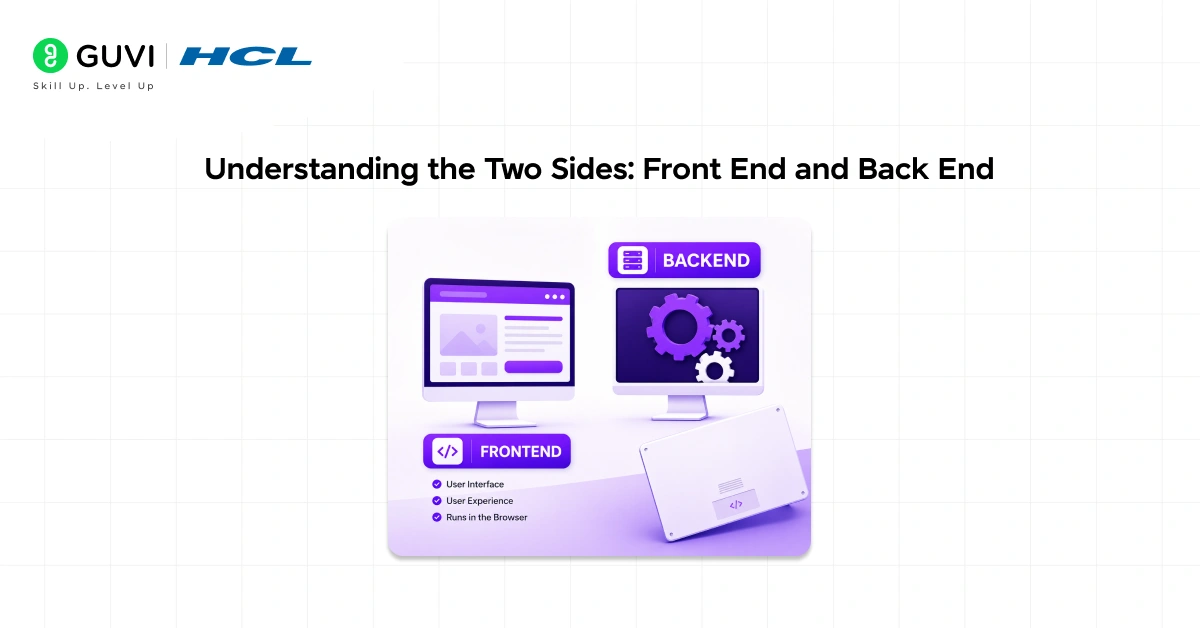
- Front end essentials
The front end is what users see and interact with: layout, buttons, menus, and visual styling. It’s built with HTML for structure, CSS for presentation, and JavaScript for interactivity, focused on usability and polish. - Back end essentials
The back end handles server-side logic like authentication, transactions, and data storage, using languages such as Python, Java, PHP, or Node.js. It ensures correct processing, secure data handling, and reliable scaling. - How they communicate
Front-end actions trigger requests that travel to the back end, which processes them and returns responses (usually via APIs). Understanding this request-response flow is key to diagnosing issues and designing features. - What a full stack developer does
A full stack developer works across both layers, able to build and troubleshoot the entire user journey from UI to database. They bridge client-side experience and server-side logic, making end-to-end development faster and more coherent.
What Does a Full Stack Developer Actually Do?
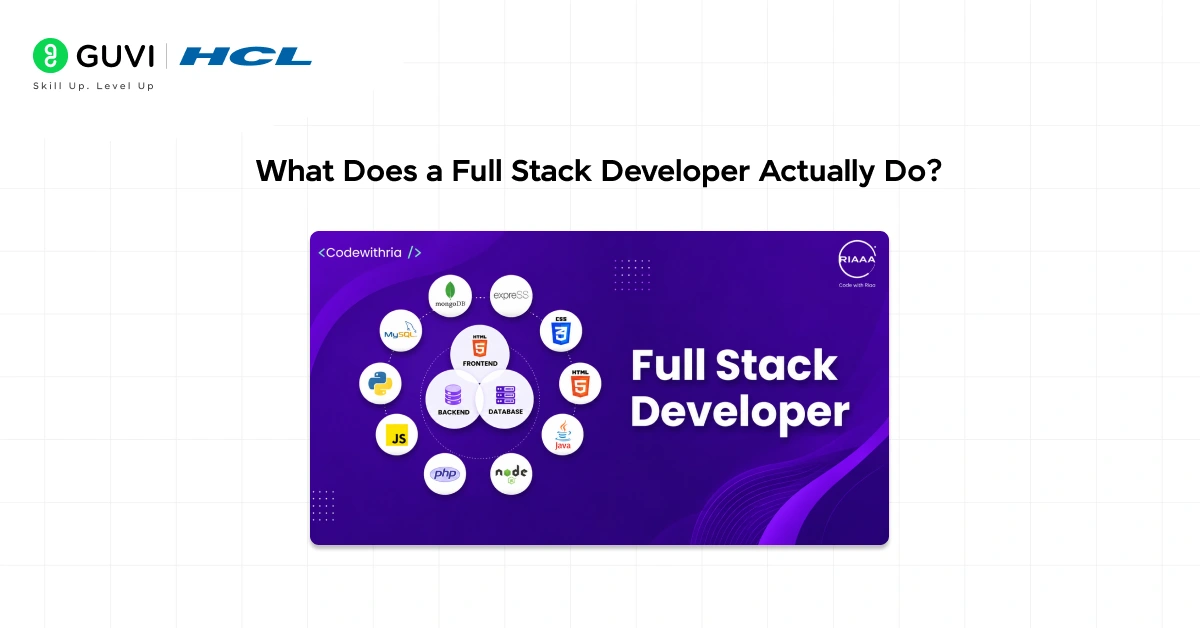
- Daily scope
- Design and build user interfaces: create screens, layouts, and interactions that users see and use.
- Implement server-side logic: write backend code that processes requests, enforces business rules, and returns responses.
- Data and integration
- Design and manage databases: decide schemas, storage strategies, and query patterns.
- Build and maintain APIs: create the connectors that let front end, back end, and external services exchange data.
- Quality and collaboration
- Test and debug: write tests, track down bugs, and fix issues to keep the product stable.
- Cross-functional teamwork: collaborate with designers, product managers, and other engineers to define and ship features.
- Industry context
- Role prevalence: the 2025 Stack Overflow survey found full stack development was the most common role (27% of ~43,000 respondents).
- Team fit: This role is especially central in startups and small teams where one engineer often handles multiple layers.
Full-stack development is one of the most commonly reported roles among software engineers, with many surveys showing a significant portion of developers working across both frontend and backend systems. Startups, in particular, often prefer full-stack engineers because they can quickly prototype, build, and ship complete features without needing separate specialists for each layer of the stack. However, while broad exposure is useful, employers typically place higher value on deep expertise in a single technology stack—such as MERN or Django—combined with the ability to build and deploy real-world projects. Ultimately, demonstrable experience with production-ready applications tends to matter more than simply listing multiple tools or frameworks.
The Technologies a Full-Stack Developer Needs to Know
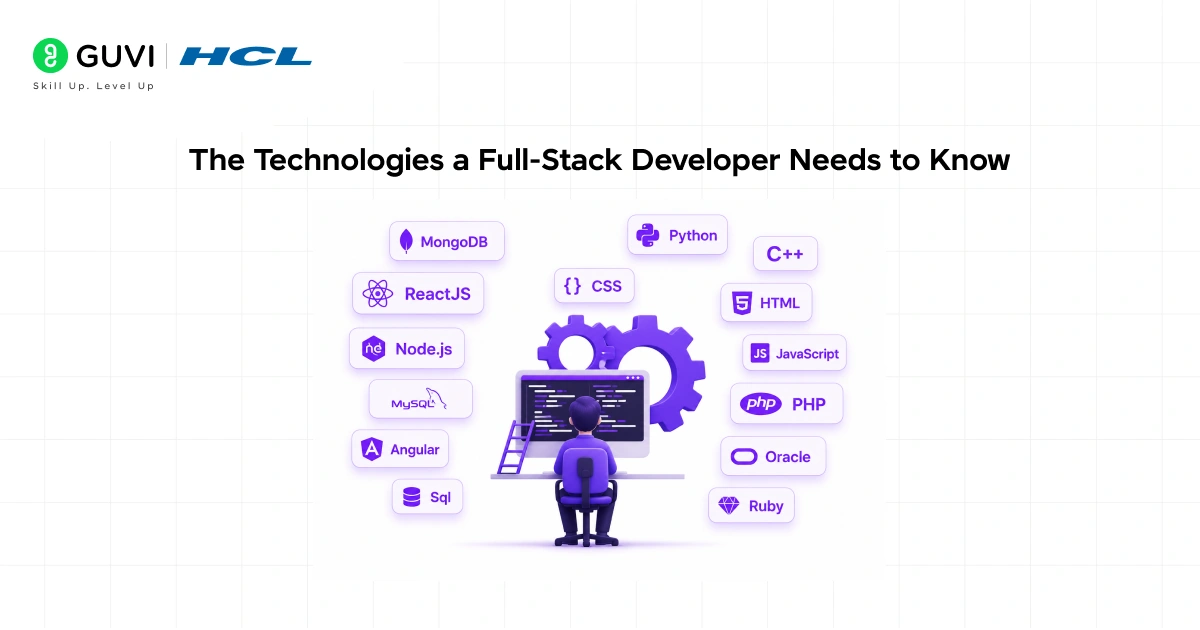
A full-stack developer does not need to be an expert in every tool that exists, but they do need a solid working knowledge of technologies across the front end, back end, and database layers. Here is a breakdown of what that typically involves.
1. Front-End Technologies
- HTML, CSS, and JavaScript are non-negotiable starting points.
- Beyond those core three, most full-stack developers work with at least one front-end framework or library. React.js, maintained by Meta, is currently the most widely used; it allows developers to build fast, component-based user interfaces in a clean and organized way.
- Angular, maintained by Google, is another popular choice, especially for building large-scale single-page applications.
- Vue.js is a lighter alternative that many developers love for its simplicity and flexibility. Bootstrap is a CSS framework that helps developers build responsive, mobile-friendly layouts quickly without writing all the styling from scratch.
2. Back-End Technologies
- On the server side, full-stack developers typically learn one or more back-end languages and the frameworks that go with them.
- Node.js is especially popular because it lets developers use JavaScript on the back end too, meaning they only need to deeply know one language to work across the entire stack.
- Python is another common choice, often paired with the Django or Flask frameworks. PHP, Java, and Ruby on Rails are also widely used in professional environments.
- The back end is also where developers work with APIs sets of rules and endpoints that define how different systems communicate and exchange data.
3. Database Technologies
- Every web application needs a way to store and retrieve data, which is where databases come in. Full stack developers typically work with both relational and non-relational databases.
- SQL-based databases like MySQL and Microsoft SQL Server store data in organized tables with defined relationships between them, making them excellent for structured data like user accounts, orders, and transactions.
- MongoDB is the most popular NoSQL database it stores data in a more flexible, document-based format, which works well for applications where the data structure might vary or evolve.
4. Other Essential Tools
- Beyond languages and frameworks, full-stack developers regularly use Git for version control a system that tracks code changes and makes it possible to collaborate with a team without accidentally overwriting each other’s work.
- They also work with cloud platforms like AWS to deploy and host applications, use package managers like npm or yarn to manage libraries and dependencies, and rely on browser developer tools to debug front-end issues directly in the browser.

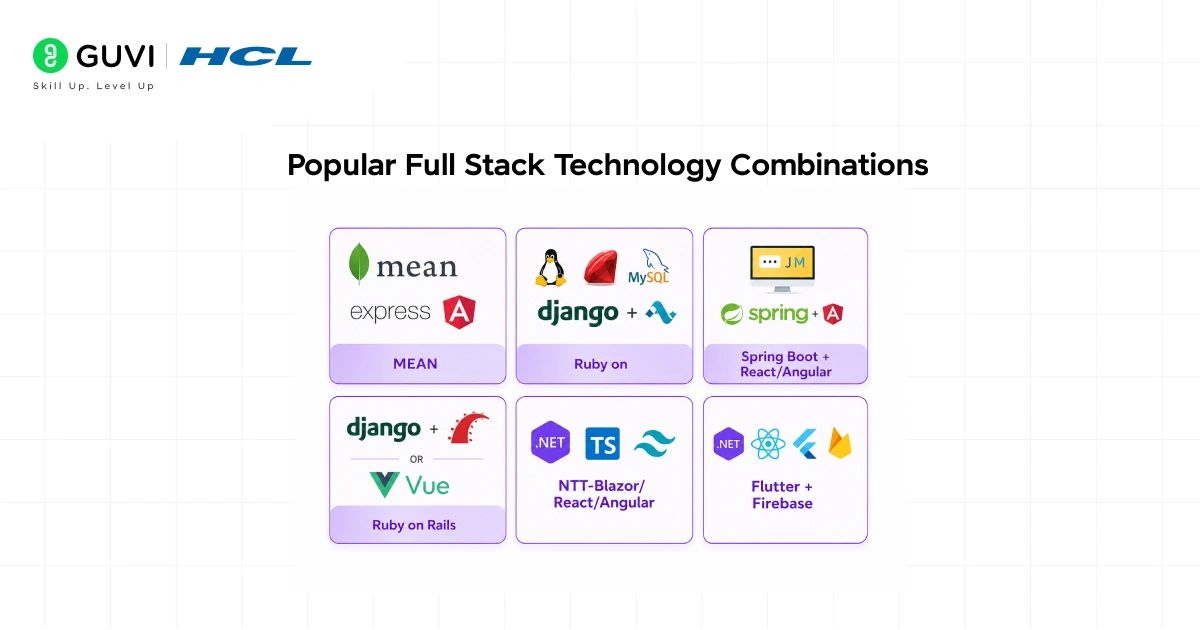
Popular Full Stack Technology Combinations
- What stacks are
- Stacks are pre‑bundled combinations of tools that work well together, letting developers move faster by using established patterns and integrations.
- MERN (MongoDB, Express, React, Node)
- All-JavaScript stack popular for full-stack projects; MongoDB as the database, Express for backend APIs, React for the frontend, and Node as the runtime.
- Good when you want language consistency across client and server and rapid iteration.
- MEAN (MongoDB, Express, Angular, Node)
- Similar to MERN but uses Angular instead of React, offering a more opinionated, structured frontend framework.
- Fits teams that prefer convention and built‑in architectural patterns.
- Django stack (Django, MySQL/Postgres, Python)
- Python‑centric stack using Django for backend, typically paired with MySQL or Postgres.
- Favored for fast setup, strong security defaults, and batteries‑included features.
- LAMP (Linux, Apache, MySQL, PHP)
- Classic, battle‑tested stack powering many legacy and enterprise sites (including WordPress).
- Reliable, widely supported, and common in environments with longstanding PHP ecosystems.
Full Stack Developer Career and Salary
- Job market momentum
The World Economic Forum’s Future of Jobs Report 2025 lists software and application developers among the top five fastest-growing jobs globally for 2025–2030, reflecting how central software has become across industries.
Demand for full-stack developers remains strong as companies seek versatile engineers who can move projects forward quickly.
- Compensation and progression
In India, the average full-stack developer salary was around ₹600,000 in 2025 (Glassdoor), with earnings rising substantially with experience and seniority.
International markets (US, UK) pay significantly more, so relocation or remote roles can meaningfully increase total compensation.
- Why companies hire full-stack devs
Full stack developers offer versatility by covering both front-end and back-end work, reducing coordination overhead and headcount needs.
For startups, a developer who can build an MVP end-to-end is especially valuable, enabling faster iteration and lower early-stage costs.
Will AI Replace Full Stack Developers?
- This question comes up often now, and it is worth addressing directly. AI tools like GitHub Copilot and other code-generation assistants can help developers write code faster, catch errors, suggest completions, and automate repetitive tasks.
- That is genuinely useful, and full stack developers who learn to use these tools effectively will be more productive than those who do not.
- However, AI is unlikely to fully replace full stack developers, at least not in the foreseeable future.
- Building real-world software requires understanding a business’s specific needs, designing systems that fit unique constraints, making tradeoffs between performance and maintainability, and exercising judgment in situations where there is no single clearly correct answer.
- Those things require human creativity, context, and critical thinking that AI cannot yet replicate reliably.
- The more realistic picture is that AI will change what full stack developers spend their time on less on boilerplate code and more on architecture, design decisions, and complex problem-solving.
You just learned who a full-stack developer is and what it takes to build both front-end and back-end systems. Take it further with HCL GUVI’s Full Stack Development Course and become job-ready. Learn HTML, CSS, JavaScript, React, Node.js, and databases, and deploy real-world full-stack apps.
How to Start Your Journey as a Full Stack Developer
- Learn the fundamentals
- HTML, CSS, JavaScript. These three are the universal foundation of web development.
- Choose a back-end language
- Stay with JavaScript: Node.js (easy full‑stack path). Prefer Python: Django (readable, simple).
- Build real projects
- Start small personal projects to apply skills and create portfolio pieces you can show employers.
- Learn databases
- Understand relational (Postgres, MySQL) and/or NoSQL (MongoDB) depending on your projects.
- Master version control
- Learn Git: commits, branches, merges, pull requests, and basic workflows used by teams.
- Understand APIs
- Learn REST and basic concepts of authentication, request/response, and JSON. Try building and consuming APIs.
- Add frameworks and tools as needed
- Front-end: React/Vue/Angular. Back-end: Express, Flask, or others. Pick tools that solve real project needs.
- Deploy and observe
- Learn deployment basics (containers, serverless, cloud hosting) and monitoring/logging for running apps.
- Iterate and learn continuously
- Expand skills based on project needs, follow best practices, and keep building to grow your portfolio and experience.
Final Thoughts
A full-stack developer is someone who can see the entire picture of how a web application comes together, from the design of a button to the database query that runs when a user clicks it. They are flexible, versatile, and in high demand across the tech industry.
Whether you are considering a tech career, exploring what different developer roles actually involve, or just curious about how the apps and websites you use every day get built, understanding the full-stack developer role gives you a clear and honest window into the world of modern software development.
FAQ
1: Do I need to master everything in the stack to call myself full‑stack?
No. Employers expect solid competence in both front and back end and practical experience deploying apps. Depth in at least one area plus working knowledge of the others is usually enough demonstrated via projects.
2: Which stack should a beginner learn first?
MERN (React + Node.js + Express + MongoDB) is a great beginner path because you use JavaScript end to end. If you prefer Python, the Django + Postgres stack is also beginner‑friendly and powerful.
3: How important is DevOps for full‑stack developers?
Important enough to know the basics: deploying apps (Heroku, Vercel, or cloud providers), containerization (Docker), CI/CD concepts, and monitoring/logging. Deep SRE skills are not required but are valuable as you senior up.
4: Will AI replace full‑stack developers?
I will automate repetitive tasks and speed development, but it won’t replace designers’ empathy, product judgment, architectural tradeoffs, or complex debugging. Use AI as a productivity multiplier, not a replacement.
5. How do I build a portfolio that gets interviews?
Ship 2–4 end‑to‑end projects that show front end, back end, database, and deployment. Include a README or short case study describing the problem, your design choices, key tradeoffs, and measurable outcomes. Host code on GitHub and live demos (Vercel/Heroku) when possible.
Success Stories

About the Author
Vishalini Devarajan
An Aerospace Engineer turned content writer, I focus on making complex concepts easy to understand through well-structured, reader-friendly blogs. Whether it’s a technical topic or a non-technical one, I love creating content that is clear, engaging, and impactful.
View all posts by Vishalini Devarajan
Connect with me @


























Did you enjoy this article?