


Data Science Articles
Accountant vs Data Analyst Salary in India After Switching Careers - Best Guide
Finance Managers: Could Data Science Be Your Next Career Move?
Insurance Claims Executive to Data Analyst: Is It a Good Switch?
Banking Executive (Loans, KYC) to Data Analyst: Skills and Career Path

Get In Touch For Details! Request More Information
Who Is a Data Scientist? Roles, Skills, and Career Path
Jul 20, 2026 6 Min Read 1111 Views
(Last Updated)
Imagine you have mountains of customer data but do not know how to extract valuable insights. You need someone who understands data, mathematics, and programming to find hidden patterns. This is what a data scientist does.
A data scientist is a professional who uses data, mathematics, and programming to solve business problems and uncover insights. They turn raw data into actionable information that helps companies make better decisions. Whether in tech, finance, healthcare, or retail, data scientists are transforming how businesses operate.
This guide explains what a data scientist is, what they do, what skills they need, and how they differ from related roles.
Table of contents
- Quick TL;DR Summary
- What Do Data Scientists Actually Do?
- The Data Science Workflow
- Step 1: Define the problem
- Step 2: Collect data
- Step 3: Explore and clean data
- Step 4: Analyze and visualize
- Step 5: Build models
- Step 6: Evaluate models
- Step 7: Deploy models
- Step 8: Communicate results
- Skills Required to Be a Data Scientist
- Types of Data Science Work
- Data Science Projects in Real Companies
- How to Become a Data Scientist
- Data Science Salaries and Job Market
- Conclusion
- FAQs
- Do I need a degree to become a data scientist?
- How long does it take to become a data scientist?
- What programming language should I learn first?
- Can I switch to data science from another career?
- What is the difference between big data and data science?
Quick TL;DR Summary
- This guide explains who is a data scientist, professionals who combine programming, mathematics, and business knowledge to extract insights from data and solve business problems.
- You will learn what data scientists actually do on a daily basis, from collecting and cleaning data to building predictive models and presenting findings to decision makers.
- The guide covers the skills required to become a data scientist including programming languages, statistical knowledge, machine learning, and business understanding.
- Step-by-step explanations show how data scientists work, typical projects they handle, and why companies desperately need them.
- You will understand the difference between data scientists and related roles like data analysts, machine learning engineers, and statisticians, plus career paths and salary information.
Turn your passion for data into a career. Join HCL GUVI’s IIT-M Pravartak Certified Data Science Course to master industry-relevant skills, build a strong portfolio, and become job-ready with hands-on projects and certification.
Who Is a Data Scientist?
A data scientist is a professional who combines expertise in programming, statistics, mathematics, and domain knowledge to extract valuable insights from data and solve complex business problems. They collect, clean, analyze, and interpret large datasets, build predictive and machine learning models, and communicate their findings to stakeholders. By uncovering patterns, trends, and opportunities within data, data scientists help organizations make informed, evidence-based decisions and improve business outcomes.
They combine skills from multiple disciplines including statistics, computer science, and domain expertise.
Data scientists are problem solvers who use data as their primary tool. They ask questions like: What patterns exist in our data? Can we predict customer behavior? Which factors drive business outcomes? Their answers drive real business decisions.
The role is relatively new. Ten years ago, most companies did not have data scientists. Today, data scientists are among the most sought-after professionals, commanding high salaries and working on critical business problems.
Read More: Roles and Responsibilities of a Data Scientist
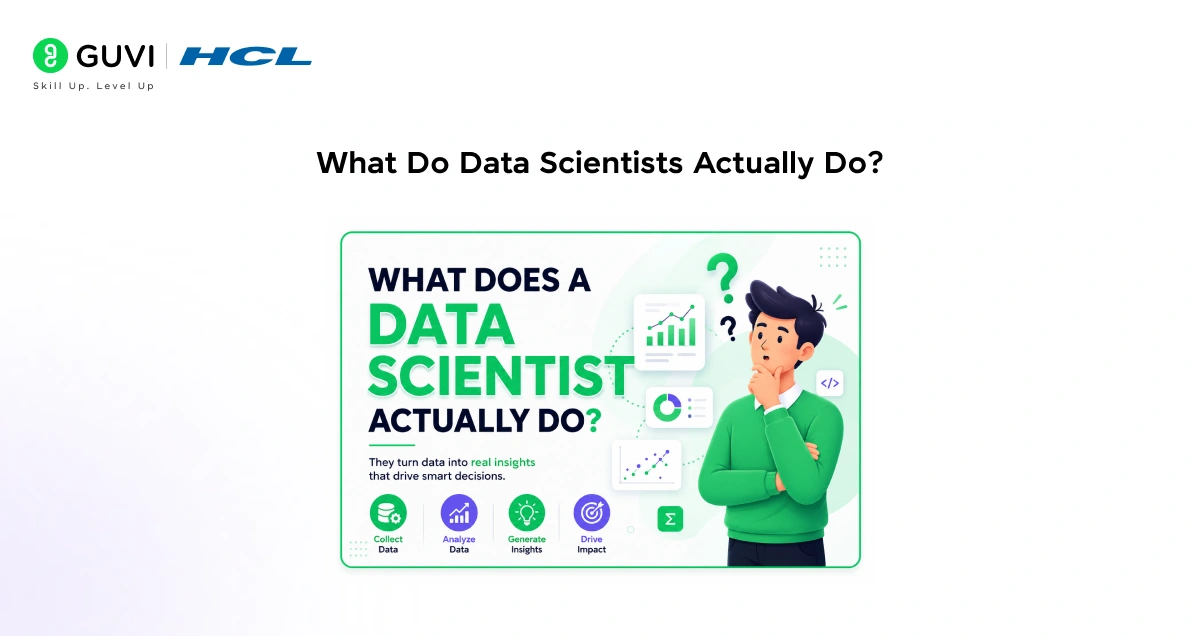
What Do Data Scientists Actually Do?
- Asking the right questions
Data scientists start by understanding the business problem. Instead of jumping into data, they ask: What are we trying to learn? What decision does this answer help us make? The right question is more important than the most sophisticated analysis.
- Collecting and preparing data
Data rarely comes clean and ready for analysis. Data scientists collect data from various sources like databases, APIs, and log files. They clean and prepare it by removing errors, handling missing values, and transforming it into usable formats.
- Exploring data for patterns
Before building models, data scientists explore data to understand what it contains. They create visualizations showing trends, distributions, and relationships. This exploratory analysis often reveals unexpected patterns.
- Building predictive models
Data scientists build mathematical models that predict future outcomes based on historical data. They might predict customer churn, demand forecasting, or fraud detection. These models learn patterns from data and apply them to new situations.
- Evaluating model performance
Not all models are good. Data scientists test models on data they did not use for training. They measure accuracy and decide if the model is ready to use in production.
- Presenting findings
Data insights only matter if decision makers understand them. Data scientists create visualizations, reports, and presentations that explain findings clearly. They translate complex analysis into business language.
- Implementing solutions
Some data scientists deploy models into production systems. Others hand off their work to engineers. Either way, they ensure that models actually improve business outcomes.
- Monitoring and maintaining
Once in production, models need monitoring. Data scientists check if models are still performing well and update them as new data arrives.
A common observation in the data science industry is that a significant portion of a data scientist’s time is spent on data preparation, including cleaning, transforming, validating, and organizing data before any modeling begins. Real-world datasets are often incomplete, inconsistent, or spread across multiple sources, making data quality a critical factor in project success. While machine learning models and advanced analytics often receive the most attention, experienced data scientists know that reliable insights depend on well-prepared data. This is why skills such as data wrangling, exploratory analysis, and feature engineering are considered just as important as building predictive models. In many cases, the quality of the data preparation process has a greater impact on results than the complexity of the algorithm itself.
The Data Science Workflow
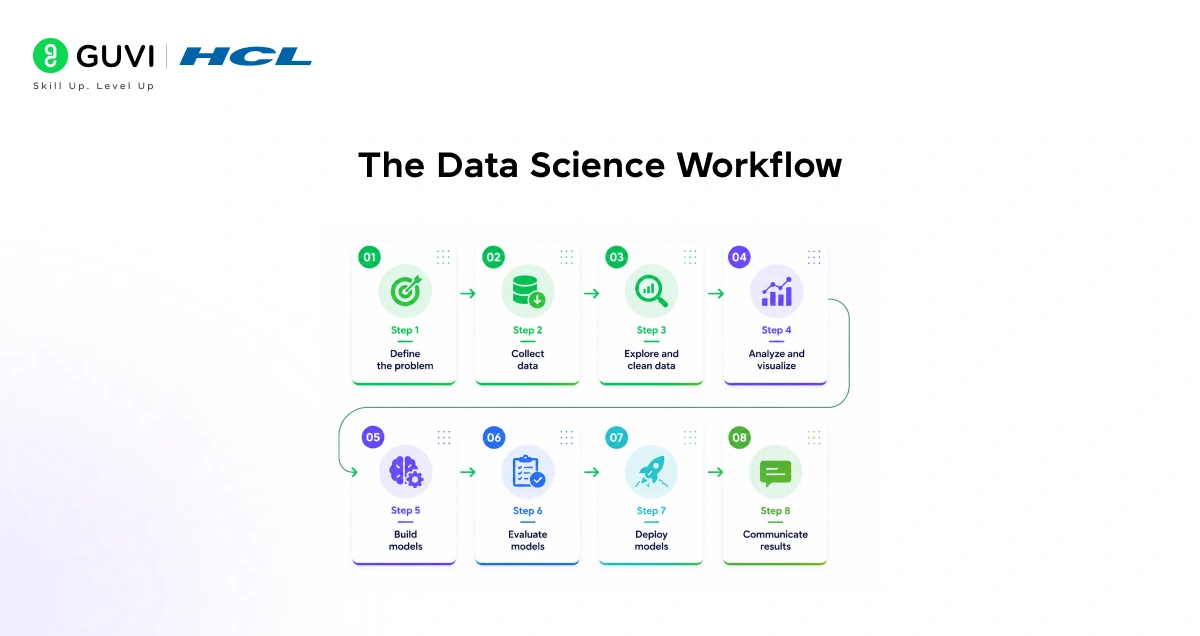
Step 1: Define the problem
Work with business stakeholders to understand what they want to know. Turn business questions into data science problems. This step is critical and often overlooked.
Step 2: Collect data
Gather data from relevant sources. This might involve querying databases, calling APIs, or collecting new data through surveys. Ensure you have enough quality data to answer the question.
Step 3: Explore and clean data
Understand what the data contains. Look for missing values, outliers, and errors. Clean and prepare data so it is ready for analysis. This is often the longest step.
Step 4: Analyze and visualize
Create visualizations and run statistical tests to understand patterns. Look for relationships between variables. Form hypotheses about what the data means.
Step 5: Build models
Create mathematical models that capture patterns in the data. Train models on historical data. Different questions might require different types of models.
Step 6: Evaluate models
Test models on data they have not seen before. Measure accuracy and performance. Compare different models to see which works best.
Step 7: Deploy models
Move successful models into production where they make real predictions. Set up monitoring to ensure models continue working well.
Step 8: Communicate results
Create reports, presentations, and visualizations explaining what you found. Make it easy for non-technical people to understand and act on findings.
The rise of the citizen data scientist is transforming how organizations use data. Citizen data scientists are professionals in fields such as marketing, finance, operations, and human resources who leverage data analysis tools and techniques without having formal data science training. Modern low-code and no-code analytics platforms, AI-powered tools, and user-friendly visualization software have made data-driven decision-making more accessible than ever before. As a result, data skills are no longer limited to specialized analytics teams; they are becoming valuable across nearly every business function. This shift is creating new opportunities for professionals who can combine domain expertise with data literacy, helping organizations make faster, more informed decisions in an increasingly data-driven world.
Skills Required to Be a Data Scientist
- Technical skills
Programming languages like Python and R SQL for database queries Statistical analysis and hypothesis testing Machine learning algorithms Data visualization libraries Big data tools like Spark or Hadoop Version control with Git

- Mathematics and statistics
Probability and statistics Linear algebra Calculus Experimental design A/B testing methodology
- Business skills
Understanding business metrics Domain knowledge in your industry Problem solving and critical thinking Communication and storytelling Project management
- Soft skills
Curiosity and asking good questions Attention to detail Collaboration with non-technical people Patience with repetitive work Ability to explain complex ideas simply
Types of Data Science Work
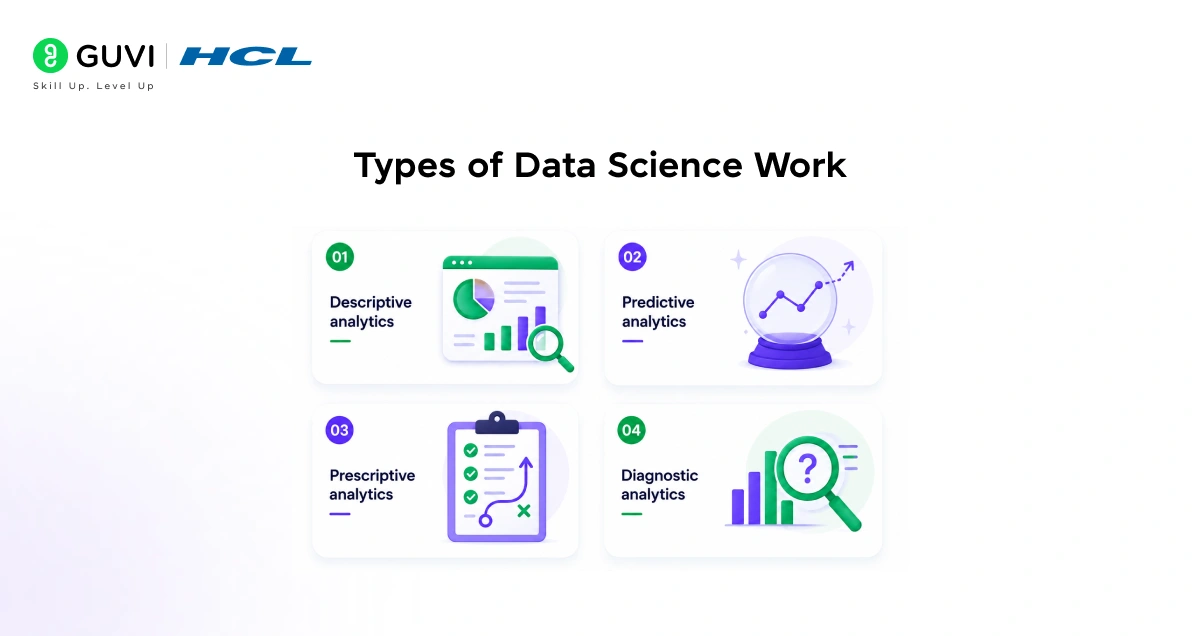
- Descriptive analytics
Understanding what happened in the past. Answering questions like: How many customers did we lose last month? What was our revenue trend? These analyses describe historical patterns.
- Predictive analytics
Predicting what will happen in the future. Building models that forecast customer behavior, demand, or equipment failure. These predictions help companies prepare.
- Prescriptive analytics
Recommending what actions to take. Not just predicting outcomes, but suggesting optimal decisions. This is the most sophisticated type of data science.
- Diagnostic analytics
Understanding why something happened. If sales dropped, diagnostic analysis finds the root causes. It digs deeper than just describing what happened.
To learn more about becoming a Data Scientist, enroll in HCL GUVI’s IIT-M Pravartak Certified Data Science course. Designed for aspiring data professionals, this program helps you master data analysis, statistics, machine learning, data visualization, and real-world problem-solving through hands-on projects. Learn from industry experts, build a strong portfolio, gain practical experience with industry-standard tools, and earn an IIT-M Pravartak certification to become placement-ready for a successful career in data science.
Data Science Projects in Real Companies
- Customer churn prediction
Predict which customers are likely to leave so you can reach out to them. This helps companies retain customers before they cancel.
- Demand forecasting
Predict future product demand to optimize inventory and production. Accurate forecasts reduce waste and stockouts.
- Fraud detection
Build models that flag suspicious transactions before customers are harmed. These models learn what fraud looks like from historical data.
- Recommendation systems
Predict what products customers will like. Amazon recommendations, Netflix suggestions, and Spotify playlists all use data science.
- Price optimization
Determine optimal prices for products based on demand, competition, and customer segments. Data science helps maximize revenue.
How to Become a Data Scientist
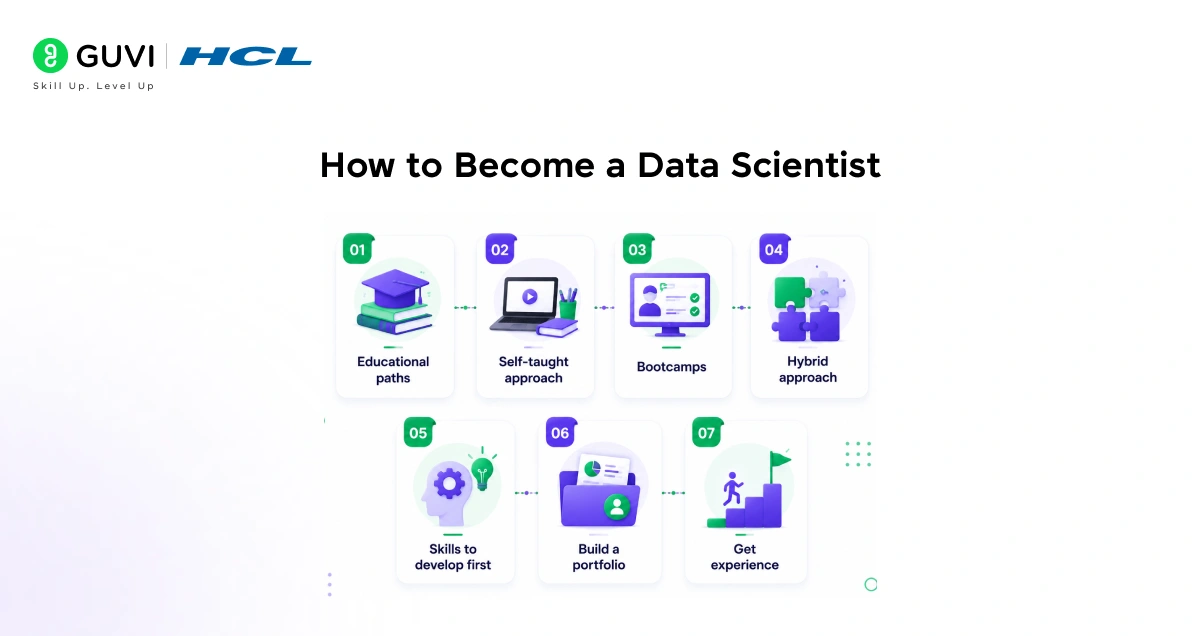
- Educational paths
Many data scientists have degrees in mathematics, statistics, computer science, or engineering. Some have advanced degrees like a master’s in data science or machine learning.
- Self-taught approach
You can learn data science through online courses, bootcamps, and self-study. Platforms like Guvi, Coursera, Udemy, and DataCamp teach data science skills. Building projects and portfolios shows employers what you can do.
- Bootcamps
Data science bootcamps offer intensive programs lasting weeks to months. They teach practical skills employers want. Bootcamps are faster than degrees but less comprehensive.
- Hybrid approach
Many successful data scientists combine formal education with online learning and project work. Study core concepts in school. Learn specific tools online. Build projects to apply learning.
- Skills to develop first
Start with Python or R programming. Learn SQL to query databases. Study statistics and probability. Take machine learning courses. Build projects on real datasets.
- Build a portfolio
Create projects using public datasets. Write about your work on blogs or GitHub. Employers want to see what you can actually do, not just what you studied.
- Get experience
Start in related roles like data analyst. Move to junior data scientist positions. Each role builds skills for the next.
Data Science Salaries and Job Market
- Salary ranges
Data scientists earn significantly more than average software engineer salaries. Entry-level data scientists earn 80,000 to 110,000 dollars. Senior data scientists earn 150,000 to 250,000 dollars. Top positions at big tech companies pay even more.
- Job demand
Data science is one of the fastest-growing career fields. Nearly every company wants data scientists. Demand far exceeds supply, giving data scientists negotiating power.
- Geographic variation
Salaries are highest in tech hubs like San Francisco, New York, and Seattle. Remote positions let you work from anywhere. Even smaller cities have data science jobs.
- Industry variation
Tech companies pay the most. Finance and healthcare also pay well. Retail and startups might pay less but offer learning opportunities.
Conclusion
Data scientists spend most of their time preparing data and asking good questions rather than building sophisticated models. The real value comes from extracting actionable insights that help companies make better decisions.
Building models is important, but cleaning data and asking the right questions is where the work truly happens.
The job market for data scientists is strong with high demand exceeding supply. Salaries are competitive, and opportunities span every industry from tech to healthcare to finance. If you enjoy working with data and solving complex problems, data science offers a rewarding and lucrative career path with excellent growth prospects.
FAQs
1. Do I need a degree to become a data scientist?
No, but it helps. Many successful data scientists have degrees, but self-taught paths and bootcamps work too. What matters most is demonstrating skills and building a portfolio of projects.
2. How long does it take to become a data scientist?
With prior programming and math skills, 6-12 months of focused learning is reasonable. From zero experience, 1-2 years of study and practice is more realistic. You will continue learning throughout your career.
3. What programming language should I learn first?
Python is the best choice for beginners. It has great libraries for data science and is easier to learn than other languages. R is also popular in data science but Python is more versatile.
4. Can I switch to data science from another career?
Yes. People come to data science from engineering, finance, economics, and other fields. Your domain expertise combined with data science skills is valuable. The transition usually takes 1-2 years.
5. What is the difference between big data and data science?
Big data refers to very large datasets that require special tools to process. Data science uses big data tools but also works with regular sized datasets. Big data is about scale. Data science is about extracting insights.
Success Stories

About the Author
Vishalini Devarajan
An Aerospace Engineer turned content writer, I focus on making complex concepts easy to understand through well-structured, reader-friendly blogs. Whether it’s a technical topic or a non-technical one, I love creating content that is clear, engaging, and impactful.
View all posts by Vishalini Devarajan
Connect with me @













Did you enjoy this article?