


Artificial Intelligence and Machine Learning Articles
AI/ML Skills Gap 2026: Why Companies Can't Find Job-Ready Talent
20 AI/ML Interview Questions Recruiters Can Use Without a Tech Background - Best Guide
How Industry-Backed AI/ML Bootcamps Are Changing the AI/ML Hiring Pipeline - Best Guide 2026
From IT Support to AI Engineer: A Realistic Career Switch Guide 2026

Get In Touch For Details! Request More Information
What Are NLP Chatbots? A Complete Guide
Aug 19, 2026 5 Min Read 469 Views
(Last Updated)
Conversations are the most natural way humans exchange information. Yet for decades, getting a machine to participate in one required rigid menus, exact keywords, or trained specialists. That changed with natural language processing.
Today, NLP chatbots power customer service desks, healthcare triage, e-commerce assistants, and enterprise help desks handling millions of conversations simultaneously, around the clock, in dozens of languages.
But what actually makes an NLP chatbot different from a simple rule-based bot? How does it understand what you mean, not just what you type? And where is the technology heading?
This guide answers all of that, from core concepts to real-world applications.
Table of contents
- TL;DR
- Rule-Based Bots vs NLP Chatbots
- Rule-Based Chatbots
- NLP Chatbots
- How NLP Chatbots Work: The Core Pipeline
- Input Preprocessing
- Tokenisation
- Intent Recognition
- Entity Extraction (NER)
- Dialogue Management
- Response Generation
- Key NLP Technologies Behind Chatbots
- Transformers and Attention Mechanisms
- BERT and Bidirectional Understanding
- Large Language Models (LLMs)
- Retrieval-Augmented Generation (RAG)
- Real-World Applications of NLP Chatbots
- Customer Service and Support
- Healthcare
- E-Commerce and Retail
- Banking and Financial Services
- HR and Internal Support
- Benefits of NLP Chatbots
- Challenges and Limitations
- Ambiguity and Sarcasm
- Context Over Long Conversations
- Hallucination in Generative Models
- Multilingual and Dialectal Variation
- Privacy and Compliance
- Building an NLP Chatbot: Key Decisions
- Conclusion
- FAQs
- What is the difference between a chatbot and an NLP chatbot?
- Do NLP chatbots require large amounts of training data?
- Can NLP chatbots support multiple languages?
- How do NLP chatbots handle sensitive or regulated industries?
- What is the role of large language models in modern NLP chatbots?
TL;DR
- NLP chatbots use AI to understand the meaning and intent behind user messages, not just keywords.
- Core NLP components include tokenisation, intent recognition, entity extraction, and response generation.
- Modern conversational AI is powered by large language models (LLMs) such as GPT and BERT.
- NLP chatbots are deployed across customer service, healthcare, e-commerce, and enterprise support.
- Key challenges include context tracking, multilingual support, and handling ambiguous queries.
What Is an NLP Chatbot?
An NLP chatbot is a conversational AI system that uses Natural Language Processing (NLP) to understand, interpret, and generate human language. It analyzes user messages to identify intent, extract important information, and produce contextually relevant responses. Unlike rule-based chatbots that follow predefined scripts, NLP chatbots can handle variations in wording, ambiguity, and natural conversation patterns, enabling more flexible and human-like interactions across customer support, virtual assistants, and business applications.
Rule-Based Bots vs NLP Chatbots
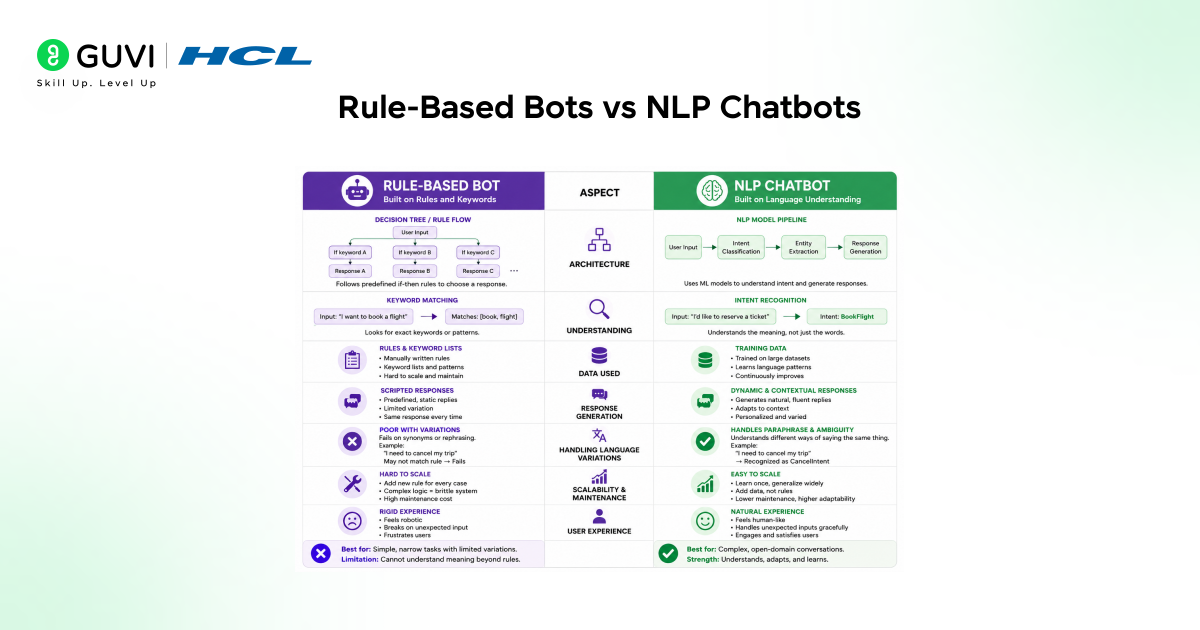
Not all chatbots are the same. The distinction between rule-based and NLP-powered bots is fundamental.
Rule-Based Chatbots
Rule-based bots operate on predefined decision trees and keyword matching. A user must phrase their query in a way the bot’s script anticipates, or the conversation breaks down. These bots are cheap to build and easy to control, but they:
• Fail on synonyms or paraphrasing
• Cannot handle multi-part questions
• Require manual updates for every new query type
• Provide a rigid, often frustrating user experience
NLP Chatbots
NLP chatbots replace the rigid script with trained models that understand language statistically and semantically. They can:
• Interpret the same intent expressed in dozens of different ways
• Extract specific information (names, dates, locations) from free-form text
• Maintain context across multiple turns of conversation
• Learn from new data to improve over time
The practical result is a conversational AI that feels less like a menu system and more like a genuine assistant.
How NLP Chatbots Work: The Core Pipeline
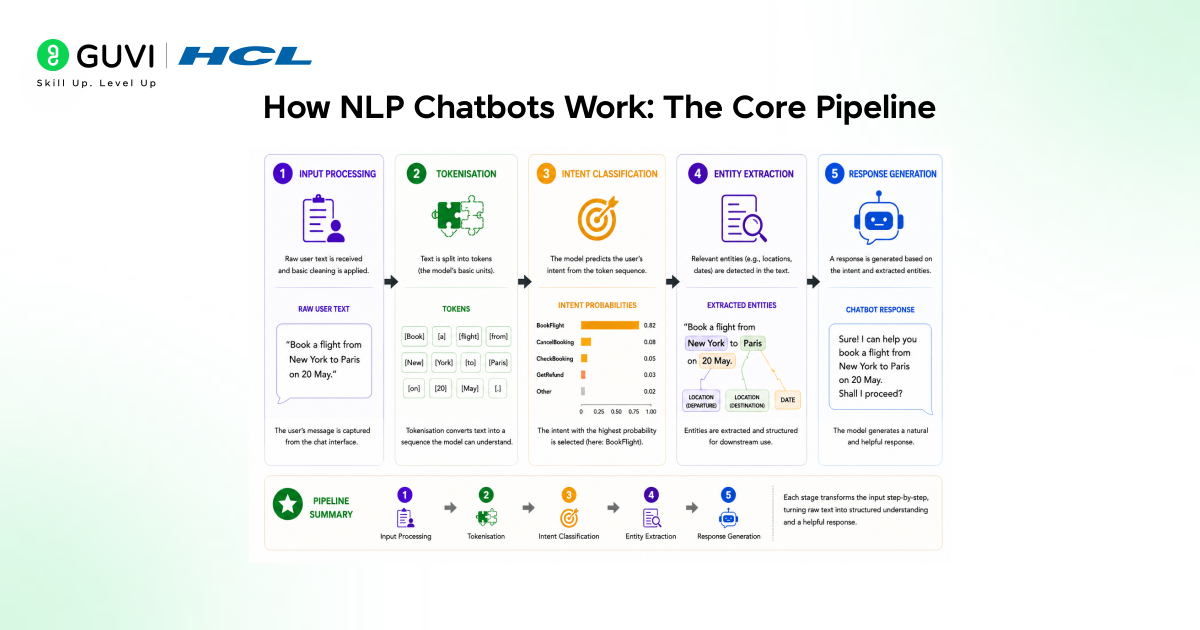
Under the hood, every NLP chatbot runs a processing pipeline that transforms raw user text into a structured response. The steps are consistent across most architectures, though the sophistication of each step varies.
1. Input Preprocessing
Before any understanding happens, the raw text is cleaned and normalised:
• Lowercasing and punctuation removal
• Spell correction and typo handling
• Stopword filtering (removing words like “the”, “is”, “at” that carry little meaning)
• Stemming or lemmatisation, reducing words to their root forms (“running” → “run”)
2. Tokenisation
Tokenisation splits the input into individual units — words, subwords, or characters — that the model can process. Modern transformer-based models use subword tokenisation (e.g., Byte Pair Encoding), which handles rare words and multiple languages more effectively than word-level splits.
3. Intent Recognition
Intent recognition is the classification step: determining what the user wants to do. A trained classifier assigns the input to one of the chatbot’s defined intents — for example, “check order status”, “request refund”, or “find product”.
Deep learning models, particularly transformer architectures fine-tuned on domain data, achieve high accuracy even on ambiguous or colloquial phrasing.
4. Entity Extraction (NER)
Named Entity Recognition (NER) identifies and extracts specific pieces of information from the input, such as the what, who, where, and when that the chatbot needs to act on:
• “Track my order from last Tuesday” → Entity: [order], [last Tuesday]
• “Book a flight to London for two adults” → Entity: [London], [two adults]
• “What are the symptoms of diabetes?” → Entity: [diabetes]
NER allows the chatbot to populate back-end queries, API calls, and database lookups with the right parameters.
5. Dialogue Management
Dialogue management maintains the state of the conversation what has been said, what information has been gathered, and what the next logical step is. It tracks context across multiple turns, enabling multi-step interactions such as booking flows, troubleshooting sequences, or form-filling dialogues.
6. Response Generation
The final step produces a reply. There are two main approaches:
- Retrieval-based: The system selects the most appropriate response from a predefined set, ranked by relevance to the intent and context.
- Generative: Large language models generate novel, contextually appropriate responses token by token, enabling more natural, flexible conversation.
Most enterprise chatbots use a hybrid approach: LLM-generated responses constrained by guardrails that ensure accuracy, brand compliance, and safety.
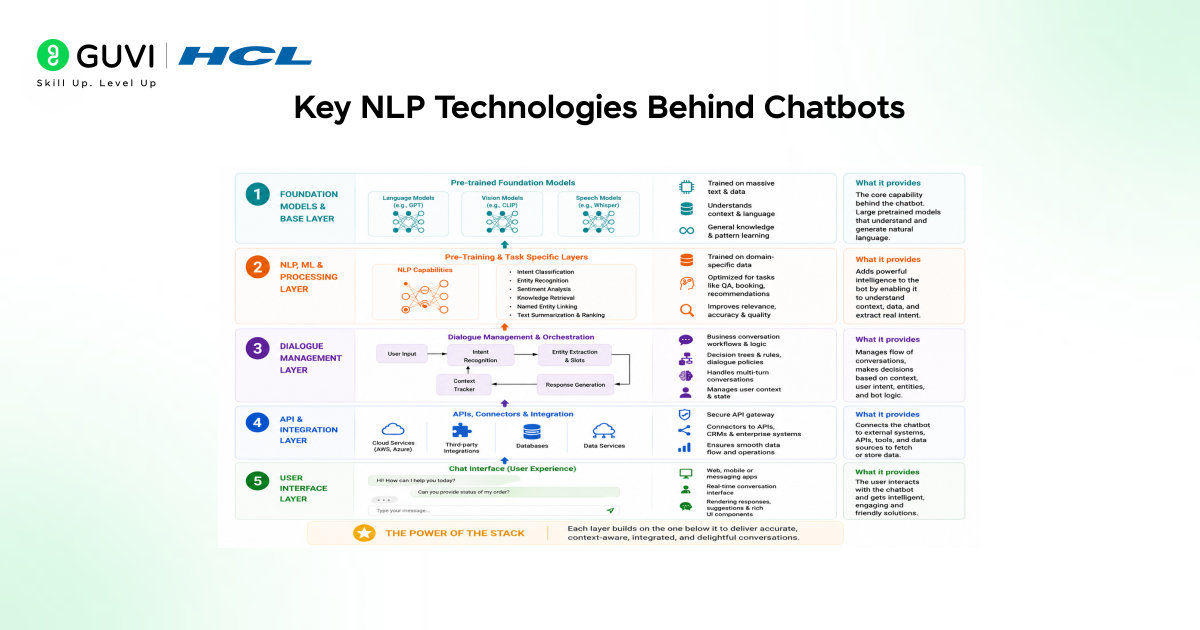
Key NLP Technologies Behind Chatbots
Transformers and Attention Mechanisms
The transformer architecture, introduced in the 2017 paper “Attention Is All You Need”, revolutionised NLP. By processing all tokens in a sequence simultaneously and using attention mechanisms to weigh the relevance of each token to every other, transformers capture long-range dependencies far better than previous recurrent architectures.
All modern high-performance NLP models, BERT, GPT, T5, and LLaMA, are transformer-based.
BERT and Bidirectional Understanding
BERT (Bidirectional Encoder Representations from Transformers) reads text in both directions simultaneously, giving it a richer understanding of context. A word’s meaning is influenced by everything before and after it. BERT captures this bidirectional context, making it particularly effective for intent classification and entity extraction.
Large Language Models (LLMs)
LLMs like GPT-4 and Claude are trained on vast corpora and can generate coherent, contextually relevant text across virtually any domain. When fine-tuned or prompted appropriately, they form the response generation engine of state-of-the-art conversational AI systems.
Retrieval-Augmented Generation (RAG)
RAG combines the generative capability of LLMs with a retrieval step that fetches relevant documents from a knowledge base before generating a response. This grounds the chatbot’s replies in accurate, up-to-date information critical for enterprise deployments where factual accuracy is non-negotiable.
The global chatbot market has grown rapidly as organizations increasingly deploy NLP-powered virtual assistants to automate interactions and improve customer experiences. Valued at more than $7 billion in 2024, the market is projected to expand significantly through the end of the decade, driven by adoption across industries such as customer service, healthcare, banking, and financial services. Modern chatbots can handle routine inquiries, provide personalized assistance, and operate around the clock, helping businesses reduce operational costs while improving response times and service availability.
Real-World Applications of NLP Chatbots
Customer Service and Support
NLP chatbots handle the first line of customer enquiries — order tracking, returns, FAQs, and account management, deflecting a high volume of routine queries from human agents. Advanced deployments use sentiment analysis to detect frustrated customers and escalate seamlessly to a live agent.

Healthcare
Conversational AI assists with appointment scheduling, symptom triage, medication reminders, and patient intake. NLP chatbots can ask structured clinical questions in natural language, extract relevant information, and surface it for clinicians — reducing administrative burden without replacing clinical judgement.
E-Commerce and Retail
Virtual assistants guide shoppers through product discovery, personalised recommendations, size queries, stock checks, and checkout support. They integrate with inventory and CRM systems to provide real-time, personalised responses at scale.
Banking and Financial Services
Banks deploy NLP chatbots for balance enquiries, transaction history, fraud alerts, loan applications, and financial guidance. Strict compliance requirements drive the use of retrieval-based and RAG architectures that ground responses in verified product information.
HR and Internal Support
Enterprise chatbots answer employee queries about HR policies, benefits, IT issues, and onboarding procedures, reducing the volume of internal helpdesk tickets and freeing HR teams for higher-value work.
Benefits of NLP Chatbots
- 24/7 availability: NLP chatbots operate continuously without fatigue, handling peak volumes at any hour without additional staffing cost.
- Scalability: A single chatbot deployment can handle thousands of simultaneous conversations, something no human team can match.
- Consistency: Every user receives the same quality of response, eliminating the variability inherent in human-handled interactions.
- Cost efficiency: Automating high-volume, routine queries significantly reduces cost per interaction and frees human agents for complex cases.
- Personalisation: Integration with CRM and user history enables responses tailored to individual context, preferences, and past interactions.
- Data and insights: Conversation logs provide rich data on user needs, common pain points, and unmet demand, and actionable intelligence for product and service teams.
Challenges and Limitations
Ambiguity and Sarcasm
Human language is full of ambiguity, irony, and sarcasm nuances that even advanced NLP models handle imperfectly. A message like “Oh great, another delayed delivery” requires understanding of context and tone that goes beyond literal interpretation.
Context Over Long Conversations
Maintaining coherent context across many conversation turns remains technically challenging, particularly when users switch topics, refer back to earlier statements, or provide information out of sequence.
Hallucination in Generative Models
LLM-based chatbots can generate plausible-sounding but factually incorrect responses — a phenomenon known as hallucination. RAG architectures and output verification layers mitigate this risk but do not eliminate it entirely.
Multilingual and Dialectal Variation
While multilingual models have improved significantly, performance degrades for low-resource languages and regional dialects. Organisations operating globally must invest in language-specific training data and evaluation.
Privacy and Compliance
Chatbots that handle personal data are subject to data protection regulations (GDPR, HIPAA, and others). Ensuring that user data is processed, stored, and audited in compliance with applicable law is a non-trivial engineering and governance challenge.
Building an NLP Chatbot: Key Decisions
Organisations deploying NLP chatbots face several key architectural decisions:
- Build vs buy: Pre-built platforms (Dialogflow, Amazon Lex, Microsoft Bot Framework) reduce time to deployment but limit customization. Custom builds offer full control but require significant ML expertise.
- Domain-specific fine-tuning: A general-purpose LLM will underperform in specialised domains without fine-tuning on domain-specific data, particularly for technical, medical, or legal content.
- Knowledge base design: RAG-based chatbots are only as good as the documents they retrieve from. Maintaining an accurate, structured, and up-to-date knowledge base is an ongoing operational commitment.
- Human escalation paths: No chatbot handles every case. Defining clear escalation triggers, sentiment thresholds, intent confidence scores, or explicit user requests is critical to user experience.
- Evaluation and monitoring: Tracking resolution rate, containment rate, CSAT, and intent accuracy continuously is essential for identifying degradation and driving improvement.
If you want practical experience working with activation functions, neural networks, and deep learning models, HCL GUVI’s AI and ML programs can help you understand how concepts like sigmoid, backpropagation, and gradient descent are implemented using frameworks such as TensorFlow and PyTorch through hands-on projects.
Conclusion
NLP chatbots represent one of the most impactful practical applications of artificial intelligence, transforming how organisations communicate with customers, patients, employees, and users at scale.
At their core, they are language understanding machines: systems that take the richness and variability of human expression and convert it into structured, actionable intent — then respond in kind. The technology stack behind them has advanced rapidly, from hand-crafted grammars to deep learning classifiers to transformer-based LLMs capable of nuanced, multi-turn conversation.
The limitations are real hallucination, context management, multilingual gaps, and compliance complexity, all of which require careful engineering. But the trajectory is clear. As foundation models improve and enterprise tooling matures, NLP chatbots will handle an increasingly wide range of interactions with increasing reliability.
For any organisation looking to scale communication, reduce support costs, or deliver better digital experiences, understanding NLP chatbots and deploying them thoughtfully is no longer optional. It is a strategic imperative.
FAQs
1. What is the difference between a chatbot and an NLP chatbot?
A basic chatbot follows fixed rules and keyword triggers. An NLP chatbot uses machine learning to understand intent and context, handling varied phrasing and multi-turn dialogue.
2. Do NLP chatbots require large amounts of training data?
Pre-trained LLMs reduce the data requirement significantly. Fine-tuning on a few hundred to a few thousand domain-specific examples is often sufficient for good performance.
3. Can NLP chatbots support multiple languages?
Yes. Multilingual models like mBERT and XLM-R support dozens of languages, though performance varies by language based on training data availability.
4. How do NLP chatbots handle sensitive or regulated industries?
Through compliance-aware architectures: data minimisation, on-premise or private cloud deployment, audit logging, and response guardrails that restrict output to verified content.
5. What is the role of large language models in modern NLP chatbots?
LLMs serve as the response generation engine, providing fluent, context-aware replies. Combined with RAG for factual grounding, they form the backbone of state-of-the-art conversational AI
Success Stories

About the Author
Vishalini Devarajan
An Aerospace Engineer turned content writer, I focus on making complex concepts easy to understand through well-structured, reader-friendly blogs. Whether it’s a technical topic or a non-technical one, I love creating content that is clear, engaging, and impactful.
View all posts by Vishalini Devarajan
Connect with me @





Did you enjoy this article?