


Artificial Intelligence and Machine Learning Articles
How Generative AI in Business is Changing Operations
Claude + Obsidian: AI-Powered Note-Taking Setup


Get In Touch For Details! Request More Information
AI Hallucination: When AI Makes Things Up
Jul 14, 2026 7 Min Read 388 Views
(Last Updated)
Imagine asking a trusted expert a question and receiving a confident, detailed answer that sounds completely reasonable. But when you verify the facts, you discover the expert made up every single detail. This is exactly what happens when AI systems hallucinate.
AI hallucination is not a minor glitch. It is a fundamental limitation of how large language models work. ChatGPT, Claude, and other AI assistants can generate responses that are factually wrong, cite sources that do not exist, or invent statistics that sound plausible but are completely fabricated. They do this while sounding completely confident.
If you are building AI systems, deploying chatbots, or relying on language models for critical decisions, understanding hallucinations is essential.
This guide explains what AI hallucination is, why it happens, and how to prevent your AI systems from confidently stating false information.
Table of contents
- Quick TL;DR Summary
- Why AI Hallucination Is a Fundamental Problem
- How AI Hallucination Works: The Technical Reality
- Step 1: Model receives a prompt that requires factual knowledge
- Step 2: Model searches its learned patterns for similar contexts
- Step 3: Model generates statistically probable next tokens
- Step 4: Model maintains coherence without fact-checking
- Step 5: No verification or correction mechanism exists
- Types of AI Hallucinations You Need to Recognize
- How to Detect AI Hallucinations: Practical Methods
- Step 1: Verify Specific Claims Against Reliable Sources
- Step 2: Look for Internal Inconsistencies in Responses
- Step 3: Test Knowledge Boundaries with Follow-up Questions
- Step 4: Check for Plausibility Versus Actual Verification
- Step 5: Use Multiple Models and Compare Outputs
- Step 6: Evaluate Source Quality for Cited References
- Step 7: Monitor for Overly Confident Language About Uncertain Topics
- Real-World Impact of AI Hallucinations
- Conclusion
- FAQs
- What causes AI to hallucinate?
- Can AI hallucinations be completely eliminated?
- How do I know if an AI response is hallucinated?
- Do more advanced AI models hallucinate less?
- When should I not use AI because of hallucination risks?
Quick TL;DR Summary
- This guide explains what AI hallucination is and why large language models generate false information that sounds convincing but is factually incorrect.
- You will learn the technical reasons behind hallucinations, including training data limitations, pattern matching without understanding, and the fundamental probabilistic nature of language models.
- The guide covers different types of hallucinations, from factual errors and source fabrication to logical inconsistencies and outdated information.
- Step-by-step strategies show you how to detect hallucinations in AI outputs and implement mitigation techniques like retrieval augmented generation (RAG), prompt engineering, and validation systems.
- You will understand when hallucinations are most likely to occur, how to measure their frequency in your specific use case, and how to build systems that minimize false information while maintaining usefulness.
What Is AI Hallucination?
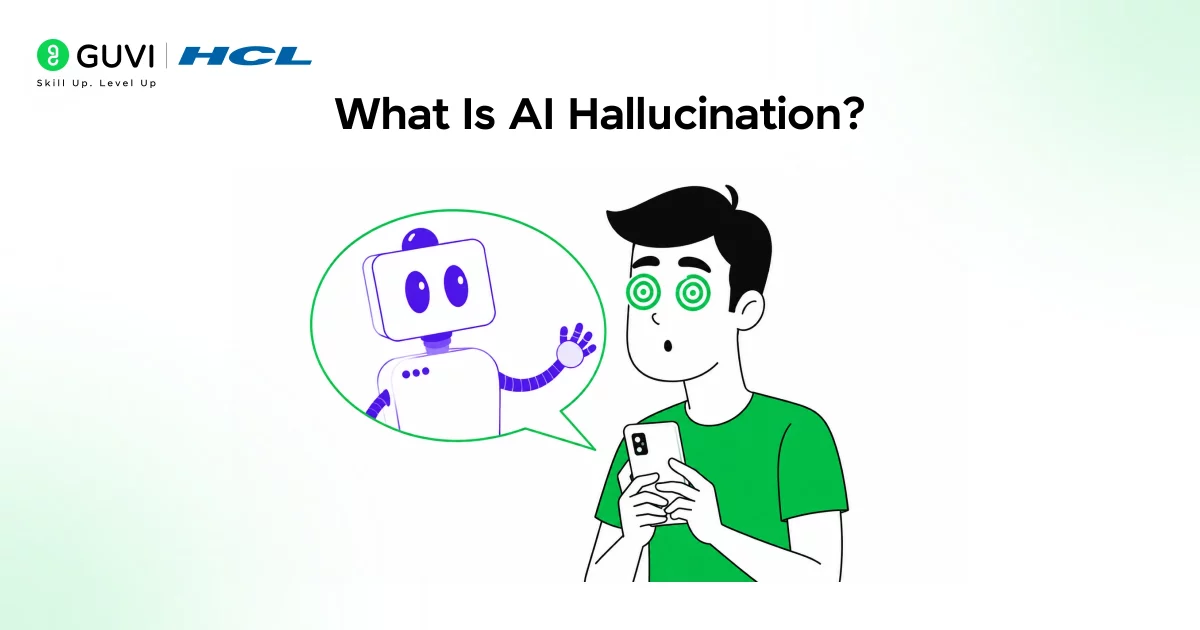
AI hallucination occurs when an artificial intelligence system, especially a large language model, generates information that is false, fabricated, misleading, or nonsensical while presenting it confidently as if it were accurate. These hallucinations can include invented facts, incorrect citations, imaginary events, or logically inconsistent responses, often caused by limitations in training data, reasoning, or context understanding.
Why AI Hallucination Is a Fundamental Problem
- Language models predict words, not truth
Large language models work by predicting the next most likely word based on patterns in their training data. They are not retrieving facts from a database or reasoning about truth. They are performing sophisticated pattern matching. When a model generates “Paris is the capital of France,” it is not because it knows what a capital is or where France is located. It has seen that exact phrase pattern many times and learned it is a high-probability sequence.
- Training data contains errors and biases
Models learn from billions of web pages, books, and documents. This training data includes misinformation, outdated information, fictional content, and contradictory claims. The model cannot distinguish between a scientific paper and a Reddit post making wild claims. It treats all text as equally valid training material and learns patterns from everything.
- Models fill gaps with plausible-sounding fabrications
When a model encounters a question about something not in its training data, it does not say “I do not know.” Instead, it generates text that fits the statistical patterns it has learned. If you ask about a nonexistent book, it might invent a plausible title, author, publication date, and plot summary because it has learned the pattern of how book descriptions are structured.
- Confidence does not correlate with accuracy
A model can state completely false information with the same confident tone it uses for accurate facts. The probability scores the model assigns to its outputs reflect how well the text matches learned patterns, not how factually correct the information is. High confidence means “this sounds like something I have seen before,” not “this is definitely true.”
- Hallucinations increase with abstraction and complexity
Models hallucinate more frequently when asked about niche topics, recent events, specific details, or anything requiring multi-step reasoning. They are better at repeating common knowledge patterns than handling edge cases. The more specific your question, the more likely the model will fabricate details to complete a plausible-sounding response.
Read More: Transfer Learning: Trending and Hottest Topic in NLP

How AI Hallucination Works: The Technical Reality

Step 1: Model receives a prompt that requires factual knowledge
Someone asks the AI a question like “What did the 2023 Nobel Prize in Chemistry recognize?” or “What are the side effects of medication X?” The model has no way to access current information or verify facts in real time. It only has the patterns it learned during training, which happened months or years before.
Step 2: Model searches its learned patterns for similar contexts
The model processes the prompt and activates the neural network patterns most similar to what it has seen before. If the training data contained many discussions about Nobel Prizes and chemistry, those patterns activate strongly. If the specific 2023 prize was not in the training data, the model has no direct information but still has general patterns about how prize announcements are structured.
Step 3: Model generates statistically probable next tokens
The model begins producing text one token (word or word piece) at a time. Each token is selected based on probability distributions learned from training data. For “The 2023 Nobel Prize in Chemistry was awarded to,” the model predicts plausible next words. It might generate actual winners if they appeared in training data, or it might fabricate names that sound like chemistry researchers.
Step 4: Model maintains coherence without fact-checking
As the model generates more tokens, it conditions on its own previous outputs to maintain internal consistency. If it invents a researcher name, it will generate plausible biographical details that fit that invented name. The response will be grammatically correct and logically structured even if every fact is wrong. The model optimizes for coherent text, not accurate information.
Step 5: No verification or correction mechanism exists
The model has no built-in fact-checking system. It cannot access external databases, search the web, or verify its own outputs against ground truth. Once it generates text, that text becomes part of the context for subsequent generation, potentially compounding errors. If an early hallucination is plausible, the model will build on that hallucination to create an entirely fabricated but internally consistent response.
Early natural language AI systems from the 1960s and 1970s relied heavily on manually constructed knowledge bases filled with explicit facts and symbolic rules about the world. Modern large language models took a radically different approach by learning statistical patterns directly from enormous text corpora instead of depending on handcrafted knowledge representation. This shift enabled dramatically greater fluency and flexibility, but it also introduced the well-known hallucination problem, where models can generate convincing but incorrect information because they predict likely text patterns rather than verify factual truth internally.
Types of AI Hallucinations You Need to Recognize
- Factual hallucinations: Stating false information as fact
The model claims something happened that did not happen, cites statistics that are wrong, or attributes quotes to people who never said them. Example: “Studies show that 73% of users prefer method A” when no such studies exist. These are the most dangerous hallucinations because they appear authoritative and are difficult to detect without verification.
- Source fabrication: Inventing citations and references
The model generates references to papers, books, articles, or datasets that do not exist. It might create plausible-looking URLs, DOIs, or publication details. Example: “According to Smith et al. (2022) published in the Journal of Advanced Computing…” when no such paper exists. This is common when the model is prompted to provide sources.
- Logical inconsistencies: Contradicting itself within responses
The model states something in one part of the response and contradicts it later. Example: First saying a technique was developed in 2018, then referring to its use in 2015 later in the same response. These hallucinations reveal that the model is not reasoning logically but generating locally coherent text.
- Temporal hallucinations: Wrong dates, sequences, or timing
The model gets when things happen wrong, confuses the order of events, or invents timelines. Example: Claiming a technology was released before the company that created it was founded. Language models struggle with temporal reasoning because they do not maintain an explicit timeline.
- Attribute hallucinations: Wrong properties or characteristics
The model assigns incorrect attributes to entities. Example: Claiming a person holds a position they never held, stating a technology has features it lacks, or attributing work to the wrong author. These hallucinations occur because the model conflates similar entities or transfers properties between related concepts.
- Extrapolation hallucinations: Going beyond what data supports
The model takes limited information and invents details to complete a response. Example: Given one fact about a person, it might invent their education, career history, and achievements. The model has learned that complete descriptions have certain components and fills in missing pieces with plausible fabrications.
Want to understand and control hallucinations in Generative AI systems? Download HCL GUVI’s free Generative AI ebook to master core concepts, practical safeguards, and real-world implementation strategies.
How to Detect AI Hallucinations: Practical Methods
Here is exactly how to identify when AI outputs contain hallucinated information before they cause problems.
Step 1: Verify Specific Claims Against Reliable Sources
Cross-check facts before trusting any specific claim
Do not accept statistics, dates, names, or citations without verification. For any specific factual claim, check authoritative sources. If the AI cites a paper, actually look up the paper and verify it exists and say what the AI claims. If it states a statistic, find the original source. Most hallucinations collapse immediately when you attempt basic fact-checking.
Step 2: Look for Internal Inconsistencies in Responses
Hallucinations often contradict themselves within the same output
Read through the complete response looking for statements that conflict with each other. If the AI says a method was developed in one year but later describes its use before that year, that is a red flag. Hallucinated content often lacks the logical coherence of true information because each part is generated independently.
Step 3: Test Knowledge Boundaries with Follow-up Questions
Ask for more detail about suspicious claims
When something sounds questionable, ask the model to elaborate or provide more context. Hallucinated information typically falls apart under scrutiny because the model has no deeper knowledge to draw from. If it confidently stated a fact but cannot provide any supporting details when pressed, that suggests hallucination.
Step 4: Check for Plausibility Versus Actual Verification
Something sounding reasonable is not the same as being true
Hallucinations are often plausible because they follow learned patterns of how true information is typically structured. A fabricated research paper citation will have a realistic journal name, plausible authors, and reasonable-sounding findings. Do not mistake structural plausibility for factual accuracy. Verify actual existence.
Step 5: Use Multiple Models and Compare Outputs
Different models trained on different data will hallucinate differently
Run the same query through multiple AI systems. If they give consistent answers, the information is more likely to be in their training data and accurate. If they contradict each other or provide completely different facts, at least one is hallucinating. This method helps identify which specific claims need verification.
Step 6: Evaluate Source Quality for Cited References
Hallucinated citations have telltale patterns
Check every citation thoroughly. Fabricated sources often have slightly off journal names, wrong publication years, or author names that do not match real researchers in that field. URLs in citations might look plausible but lead nowhere. DOI numbers might be formatted correctly but not actually exist. Verify every single reference.
Step 7: Monitor for Overly Confident Language About Uncertain Topics
Unwarranted certainty is a hallucination red flag
If the model provides extremely specific details about something that should be difficult to know with certainty, be suspicious. Real expertise includes acknowledging uncertainty. Hallucinations often lack this nuance because the model is simply generating high-probability text patterns without understanding what it can and cannot know.
Researchers discovered that encouraging large language models to reason step by step before answering—a technique known as chain-of-thought prompting—can reduce certain types of hallucinations and improve reasoning accuracy on complex tasks. By making intermediate reasoning explicit, the model is more likely to expose contradictions or weak assumptions before producing a final answer. However, chain-of-thought prompting is not a complete solution, because models can still generate incorrect reasoning steps that sound logically convincing even when the conclusion is wrong.
Real-World Impact of AI Hallucinations
- Academic: Fake research papers and false citations
Students and researchers using AI to help write papers have included citations to studies that do not exist. The AI generated plausible author names, journal titles, and publication years for nonexistent research. This undermines academic integrity and wastes time as people try to track down sources that were never real.
- Business: Incorrect data analysis and fabricated insights
Companies using AI to analyze data have received confident reports containing fabricated statistics and trends. The AI might claim “sales increased 23% in region X” when the actual data shows a decrease. Business decisions based on hallucinated insights can be costly. Always verify AI data analysis against actual data sources.
- News: False information in AI-generated articles
Media organizations experimenting with AI-generated content have published articles containing factual errors, invented quotes, and false attributions. Some news outlets were forced to issue corrections after AI systems hallucinated names, events, or statements. This threatens journalistic credibility and demonstrates why human fact-checking remains essential.
To learn more about AI reliability and building trustworthy AI systems,do not miss the chance to enroll in this HCL GUVI’s AI and Machine Learning course covering AI fundamentals, Python, deep learning, NLP, and computer vision through hands-on projects and expert guidance with certification.
Conclusion
AI hallucination is not a bug that will be fixed in the next update. It is an inherent characteristic of how large language models work. They generate plausible text based on statistical patterns, not factual knowledge retrieval.
The solution is not to avoid AI but to use it correctly. Implement verification systems, use retrieval augmented generation, design prompts carefully, and maintain human oversight for critical decisions. Treat AI outputs as drafts requiring verification rather than authoritative facts.
If you are deploying AI systems, measuring and mitigating hallucinations should be core to your evaluation process. The question is not whether your model hallucinates but how often and in what contexts.
FAQs
1. What causes AI to hallucinate?
Language models predict probable text based on training data patterns. They do not have factual knowledge databases or truth verification mechanisms. When they encounter questions about things not in their training data or need to fill gaps in responses, they generate plausible-sounding text that matches learned patterns even if it is factually incorrect.
2. Can AI hallucinations be completely eliminated?
No. Hallucinations are inherent to how probabilistic language models work. You can reduce their frequency significantly through techniques like retrieval augmented generation, careful prompting, and domain fine-tuning, but you cannot eliminate them entirely. The best approach is building systems that detect and handle hallucinations when they occur.
3. How do I know if an AI response is hallucinated?
Verify specific factual claims against authoritative sources. Check for internal inconsistencies in the response. Test suspicious claims with follow-up questions asking for more detail. Use multiple AI models and compare outputs for agreement. Any citations or references should be manually verified to ensure they actually exist.
4. Do more advanced AI models hallucinate less?
Generally yes, but even the most advanced models still hallucinate. Larger models trained on more data tend to have more accurate knowledge, but they also sound more confident when hallucinating, making their errors harder to detect. No model is immune to this problem.
5. When should I not use AI because of hallucination risks?
Avoid using AI without verification for medical decisions, legal advice, financial recommendations, safety-critical systems, academic citations, news reporting, or any context where false information could cause harm. Use AI as a drafting tool in these domains but always verify outputs with human experts before taking action.
Success Stories

About the Author
Vishalini Devarajan
An Aerospace Engineer turned content writer, I focus on making complex concepts easy to understand through well-structured, reader-friendly blogs. Whether it’s a technical topic or a non-technical one, I love creating content that is clear, engaging, and impactful.
View all posts by Vishalini Devarajan
Connect with me @













Did you enjoy this article?