


Artificial Intelligence and Machine Learning Articles
AI/ML Skills Gap 2026: Why Companies Can't Find Job-Ready Talent
20 AI/ML Interview Questions Recruiters Can Use Without a Tech Background - Best Guide
How Industry-Backed AI/ML Bootcamps Are Changing the AI/ML Hiring Pipeline - Best Guide 2026
From IT Support to AI Engineer: A Realistic Career Switch Guide 2026


Get In Touch For Details! Request More Information
A* Algorithm in AI: Finding the Optimal Path Fast
Aug 25, 2026 7 Min Read 1161 Views
(Last Updated)
Every time a navigation app finds the fastest route to your destination, every time a game character moves intelligently through a level, and every time a robot plans a path across a factory floor, a search algorithm is working to find the optimal solution. Of all the search algorithms developed in artificial intelligence, one stands out for its elegance, efficiency, and enduring practical value.
That algorithm is A*.
The A* algorithm, pronounced “A-star”, is the gold standard for optimal pathfinding in AI. Introduced in 1968, it combines the guaranteed optimality of Dijkstra’s algorithm with the speed of greedy best-first search by using a heuristic function to guide the search intelligently toward the goal. The result is an algorithm that finds the shortest path faster than uninformed approaches, without sacrificing correctness.
This article explains how A* works, what makes it powerful, how it is implemented, and where it is applied in real-world AI systems.
Table of contents
- TL;DR
- The Problem A* Solves: Pathfinding in a Graph
- The A* Formula: f(n) = g(n) + h(n)
- g(n) — The Known Cost
- h(n) — The Heuristic Estimate
- f(n) — The Total Estimated Cost
- How A* Works: Step-by-Step
- A* Algorithm: Python Implementation
- Real-World Applications of A* in Artificial Intelligence
- Navigation and Mapping
- Video Game AI and Pathfinding
- Robotics and Motion Planning
- Network Routing
- AI Planning and Problem Solving
- Conclusion
- FAQs
- Is A* always guaranteed to find the optimal path?
- What is the difference between an admissible and a consistent heuristic?
- What is the time complexity of A*?
- How is A* different from Dijkstra's algorithm?
- Can A* handle dynamic environments where edges or costs change?
- What is the difference between an AI course and an AI & ML course?
- Why is SQL important for AI & ML professionals?
- What job roles can I apply for after completing an AI & ML course?
- How do I choose the best AI course for my career goals?
- What should I look for before enrolling in an AI & ML course?
- How should I evaluate AI & ML certifications before enrolling?
TL;DR
- A* uses f(n) = g(n) + h(n) to evaluate each node, balancing known cost with an estimated future cost.
- The heuristic function h(n) guides the search intelligently, making A* far more efficient than uninformed search.
- A* is complete and optimal when the heuristic is admissible (never overestimates the true cost).
- It uses a priority queue (open list) to always expand the most promising node first.
- A* is used in navigation systems, game AI, robotics, and network routing wherever optimal pathfinding matters.
What Is the A* Algorithm?
The A* (A-star) algorithm is an informed heuristic search algorithm used in artificial intelligence to find the shortest or least-cost path between a start node and a goal node in a weighted graph. It evaluates nodes using the function f(n) = g(n) + h(n), where g(n) represents the known cost from the start node to the current node and h(n) is a heuristic estimate of the remaining cost to the goal. When the heuristic is admissible, meaning it never overestimates the true cost, A* is guaranteed to find the optimal path.
The Problem A* Solves: Pathfinding in a Graph
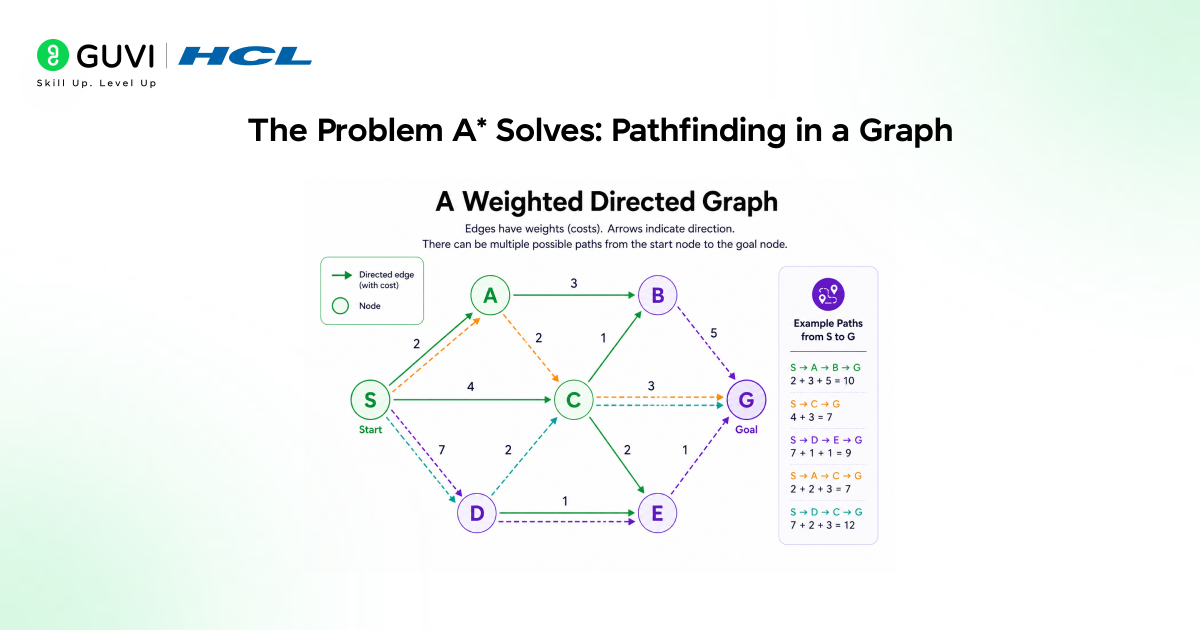
Before understanding A*, it helps to understand the problem it solves: finding the optimal path in a graph.
In AI, a graph is a structure consisting of nodes (states) and edges (transitions between states). Each edge has a cost, the expense of moving from one node to another. In a navigation problem, nodes are locations and edges are roads with associated distances or travel times. In a game, nodes are positions on a map, and edges connect adjacent positions with movement costs.
The pathfinding problem asks: given a start node and a goal node, what sequence of edges (path) gets from start to goal with the lowest total cost?
Uninformed search algorithms such as breadth-first search and depth-first search answer this question by exploring the graph exhaustively, without any knowledge of where the goal might be. This works, but is inefficient. For large graphs, uninformed search wastes enormous time exploring nodes that are clearly in the wrong direction.
A* solves this by using domain knowledge encoded in the heuristic function to focus the search toward the goal, dramatically reducing the number of nodes that need to be explored.
The A* Formula: f(n) = g(n) + h(n)
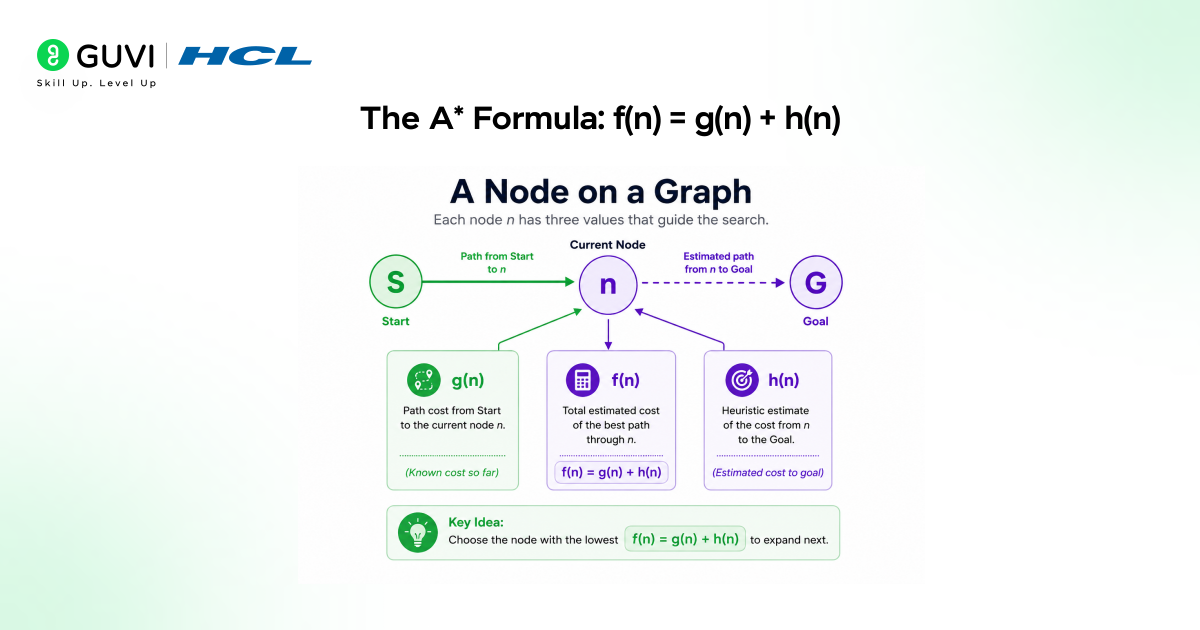
The heart of A* is a single evaluation function that assigns every node a score representing its total estimated cost:
f(n) = g(n) + h(n)
Each component of this formula has a precise meaning:
g(n) — The Known Cost
g(n) is the actual cost of the path from the start node to the current node n. This is not an estimate; it is the exact accumulated cost of all edges traversed to reach n along the current path. As the algorithm explores the graph, g(n) is updated whenever a cheaper path to a node is found.
h(n) — The Heuristic Estimate
h(n) is the heuristic function, an estimate of the cost from node n to the goal. This is the intelligent component of A*. Rather than knowing the exact remaining cost (which would require solving the problem), the heuristic provides a fast, approximate estimate based on domain knowledge.
Common heuristics include:
- Manhattan distance: For grid-based maps where movement is restricted to horizontal and vertical steps, the Manhattan distance (sum of absolute horizontal and vertical differences) is a natural and admissible heuristic.
- Euclidean distance: The straight-line distance between two points. Admissible for any graph where actual path costs are at least as large as straight-line distances.
- Chebyshev distance: For grids where diagonal movement is permitted at unit cost, the Chebyshev distance (maximum of absolute differences in coordinates) provides a tight admissible heuristic.
f(n) — The Total Estimated Cost
f(n) is the sum of g(n) and h(n), the total estimated cost of the cheapest path from start to goal that passes through node n. A* always expands the node with the lowest f(n) value, ensuring it explores the most promising nodes first.
The A* algorithm was invented in 1968 by Peter Hart, Nils Nilsson, and Bertram Raphael at the Stanford Research Institute. It was originally developed for the Shakey the Robot project, one of the earliest AI initiatives focused on building a mobile robot capable of perceiving its environment, planning actions, and reasoning about how to reach goals autonomously.
How A* Works: Step-by-Step
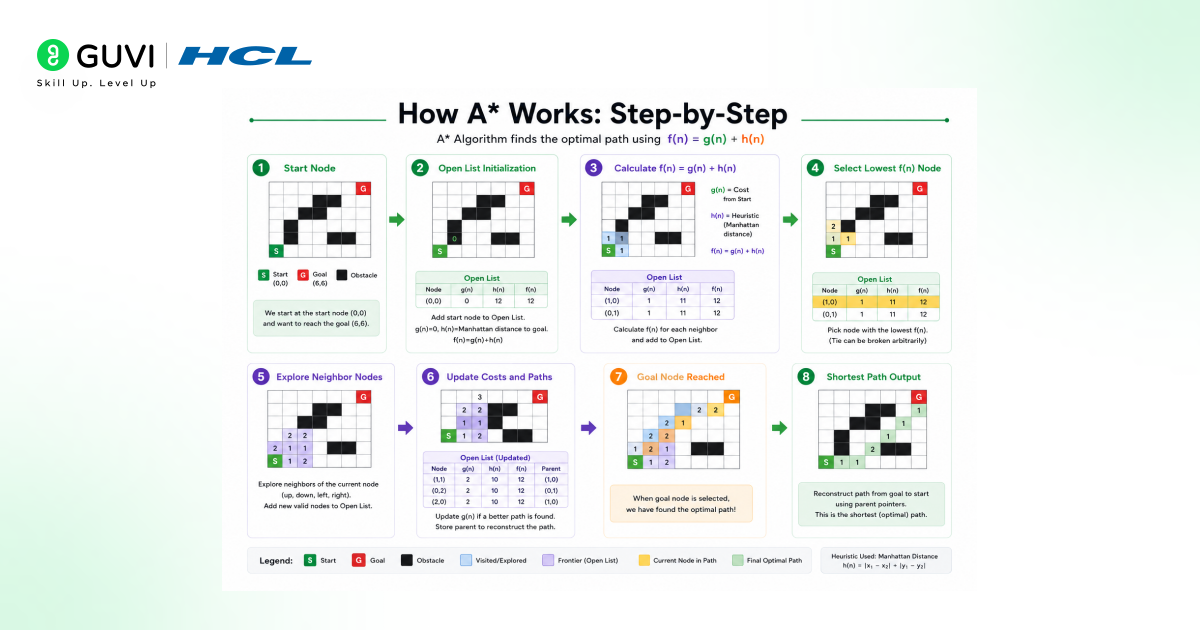
A* maintains two data structures throughout its execution:
- Open list (priority queue): Contains nodes that have been discovered but not yet fully explored. Ordered by f(n) value, the node with the lowest f(n) is always at the front.
- Closed list (visited set): Contains nodes that have already been fully explored. Nodes on the closed list are not re-expanded unless a cheaper path to them is discovered.
The algorithm proceeds as follows: Initialize: Add the start node to the open list with g(start) = 0 and f(start) = h(start).
- Select: Remove the node n with the lowest f(n) value from the open list.
- Goal check: If n is the goal node, the algorithm terminates. Trace back the path using parent pointers to reconstruct the optimal route.
- Expand: For each neighbour n’ of n, calculate the tentative cost: g_tentative = g(n) + cost(n, n’).
- Update: If n’ is not in the open or closed list, or if g_tentative is less than n’s current g(n’) value, update n’s g, f, and parent values, and add n’ to the open list.
- Archive: Add n to the closed list.
- Repeat: Return to step 2. If the open list becomes empty without reaching the goal, no path exists.
The priority queue ensures that A* always expands the most promising node,e the one with the lowest total estimated cost, rather than blindly exploring in all directions.
A* Algorithm: Python Implementation
Here is a clean Python implementation of A* for a weighted graph, illustrating the core logic:
| import heapq def astar(graph, start, goal, heuristic): # open_list: (f(n), g(n), node, path) open_list = [] heapq.heappush(open_list, (heuristic(start, goal), 0, start, [start])) closed_set = set() while open_list: f, g, current, path = heapq.heappop(open_list) if current == goal: return path, g # optimal path and total cost if current in closed_set: continue closed_set.add(current) for neighbour, cost in graph[current].items(): if neighbour not in closed_set: g_new = g + cost f_new = g_new + heuristic(neighbour, goal) heapq.heappush(open_list, (f_new, g_new, neighbour, path + [neighbour])) return None, float(‘inf’) # no path found |
Key implementation notes:
- heapq: Python’s heapq module provides an efficient min-heap, implementing the priority queue with O(log n) insertion and extraction.
- closed_set: A Python set provides O(1) membership checks, ensuring already-expanded nodes are not re-processed.
- Path reconstruction: The path is built incrementally by appending each node to the current path during expansion, avoiding the need for separate parent pointer traversal.
Real-World Applications of A* in Artificial Intelligence
A* is not an academic curiosity; it is one of the most widely deployed algorithms in production AI systems worldwide.

Navigation and Mapping
Navigation applications use A* (and its variants) to compute driving, cycling, and walking routes across road networks with millions of nodes. The heuristic,c typically Euclidean or Manhattan distance,ce focuses the search toward the destination, making real-time routing on complex road networks computationally tractable. Google Maps, Apple Maps, and OpenStreetMap routing engines all use A*-based approaches.
Video Game AI and Pathfinding
Game AI is one of A*’s most visible applications. Non-player characters (NPCs) in strategy games, role-playing games, and action games use A* to navigate game maps, avoid obstacles, and find the shortest path to objectives. The algorithm runs thousands of times per second across all active game entities, making efficiency critical. Bidirectional A* and hierarchical A* variants are commonly used to handle very large game worlds.
Robotics and Motion Planning
Autonomous robots use A* to plan collision-free paths through physical environments. In warehouse automation, surgical robotics, and autonomous vehicles, A* operates on grid representations or configuration space graphs to find feasible, optimal movement trajectories. The algorithm is often combined with occupancy grid maps from sensor data to navigate dynamic environments.
Network Routing
In computer networking, routing protocols use A* variants to find the optimal data packet path through network topologies. Link-state routing algorithms such as OSPF use Dijkstra’s algorithm (A* with h=0) to compute shortest paths through network graphs where edge weights represent bandwidth, latency, or reliability.
AI Planning and Problem Solving
Beyond spatial pathfinding, A* applies to any problem that can be formulated as a graph search. It has been applied to puzzle solving (the 8-puzzle, sliding tile problems), automated planning (finding sequences of actions to achieve a goal), natural language parsing (finding the most probable parse tree), and bioinformatics (sequence alignment in computational biology).
If you want to learn more about building skills for Claude Code and automating your procedural knowledge, do not miss the chance to enroll in HCL GUVI’s Intel & IITM Pravartak Certified Artificial Intelligence & Machine Learning courses. Endorsed with Intel certification, this course adds a globally recognized credential to your resume, a powerful edge that sets you apart in the competitive AI job market.
Conclusion
The A* algorithm is one of the most important algorithms in the history of artificial intelligence. Its elegance lies in the simplicity of its core idea: guide the search toward the goal using a heuristic, while maintaining the guarantees of optimal search through the careful accounting of known costs. The formula f(n) = g(n) + h(n) encodes a profound insight about how to search intelligently rather than exhaustively.
More than five decades after its invention, A* remains the algorithm of choice for optimal pathfinding across an extraordinary range of applications, from the navigation app on your phone to the robots navigating warehouses, from the NPCs in modern video games to the network routers forwarding your internet traffic.
Understanding A* is foundational for anyone studying AI, building intelligent systems, or working on problems where finding the best path matters. Its principles informed search, heuristic design, and the balance between exploration and exploitation underpin much of what makes modern AI effective.
FAQs
1. Is A* always guaranteed to find the optimal path?
A* is guaranteed to find the optimal path if and only if the heuristic function h(n) is admissible meaning it never overestimates the true cost to reach the goal. If the heuristic is inadmissible (it overestimates for some nodes), A* may find a suboptimal path. When the heuristic is both admissible and consistent, A* is also optimally efficient; it expands no more nodes than any other optimal algorithm using the same heuristic.
2. What is the difference between an admissible and a consistent heuristic?
An admissible heuristic never overestimates the true remaining cost to the goat his guarantees A* finds the optimal path. A consistent (monotonic) heuristic additionally satisfies the triangle inequality: h(n) ≤ cost(n, n’) + h(n’) for every edge. Consistency implies admissibility and ensures that f(n) values never decrease along a path, meaning nodes never need to be re-expanded. Most natural heuristics (Manhattan distance, Euclidean distance) are both admissible and consistent.
3. What is the time complexity of A*?
The time complexity of A* depends on the quality of the heuristic. In the worst case, with a trivial heuristic h(n) = 0 (equivalent to Dijkstra’s algorithm), it is O(E log V) for a graph with V nodes and E edges, due to the priority queue operations. With a perfect heuristic that gives the exact remaining cost, A* expands only the nodes on the optimal path, achieving O(d) complexity where d is the path length. In practice, the complexity falls between these extremes and depends heavily on how tight the heuristic is.
4. How is A* different from Dijkstra’s algorithm?
Dijkstra’s algorithm is a special case of A* where the heuristic h(n) = 0 for all nodes. Dijkstra’s algorithm explores outward from the start node in all directions, expanding nodes in order of their distance from the start. A* uses the heuristic to focus exploration toward the goal, expanding nodes in order of their estimated total cost f(n) = g(n) + h(n). On the same graph, A* with a good admissible heuristic will always expand fewer nodes than Dijkstra’s, while still guaranteeing the optimal path.
5. Can A* handle dynamic environments where edges or costs change?
Standard A* is designed for static environments where the graph structure and edge costs are known in advance. For dynamic environments such as moving obstacles in robotics or changing traffic conditions in navigation variants like D* (Dynamic A*) and D* Lite have been developed. These algorithms efficiently repair the search tree when the environment changes, rather than recomputing from scratch, making real-time replanning computationally feasible.
6. What is the difference between an AI course and an AI & ML course?
An AI course focuses on artificial intelligence concepts, while an AI & ML course includes machine learning, deep learning, NLP, computer vision, and practical model-building skills. If you’re looking for hands-on AI and ML training, explore the HCL GUVI AI & ML Programme.
7. Why is SQL important for AI & ML professionals?
SQL helps AI & ML professionals extract, clean, and analyze data from databases, making it essential for building accurate machine learning models. Most industry-focused AI & ML programmes include SQL as a core data skill.
8. What job roles can I apply for after completing an AI & ML course?
You can apply for roles such as AI Engineer, Machine Learning Engineer, Data Scientist, NLP Engineer, Computer Vision Engineer, and AI Developer. To prepare for these roles, consider a project-based AI & ML Programme with career support.
9. How do I choose the best AI course for my career goals?
Choose an AI course based on your career goals, curriculum, hands-on projects, mentor support, industry tools, and placement assistance. A structured AI & ML Programme can help you build practical skills and a strong portfolio.
10. What should I look for before enrolling in an AI & ML course?
Look for a structured curriculum, practical projects, experienced mentors, updated AI tools, certification value, and career support. Compare programmes carefully before enrolling in an AI & ML Programme.
11. How should I evaluate AI & ML certifications before enrolling?
Evaluate AI & ML certifications based on industry recognition, curriculum relevance, hands-on learning, project experience, and career outcomes. You can also compare what’s included in the HCL GUVI AI & ML Programme before making a decision.
Success Stories

About the Author
Vishalini Devarajan
An Aerospace Engineer turned content writer, I focus on making complex concepts easy to understand through well-structured, reader-friendly blogs. Whether it’s a technical topic or a non-technical one, I love creating content that is clear, engaging, and impactful.
View all posts by Vishalini Devarajan
Connect with me @












Did you enjoy this article?