


Artificial Intelligence and Machine Learning Articles
Finance Manager to Data Analytics: Career Growth, Salary and Seniority
How to Evaluate LLM Outputs in Production Deployments
AI/ML Skills Gap 2026: Why Companies Can't Find Job-Ready Talent
20 AI/ML Interview Questions Recruiters Can Use Without a Tech Background - Best Guide


Get In Touch For Details! Request More Information

CSP in AI: How Constraint Satisfaction Problems Power Intelligent Problem Solving
Aug 18, 2026 7 Min Read 1663 Views
(Last Updated)
Many real-world problems share a common structure: you have a set of decisions to make, each with a range of possible choices, and a collection of rules that restrict which combinations are acceptable. Scheduling a university timetable, solving a Sudoku puzzle, assigning frequencies to radio towers, all of these fit the same pattern.
Constraint Satisfaction Problems (CSPs) give AI systems a principled way to model and solve this class of problems. Instead of treating a problem as a black-box search through an exponentially large space, CSP in AI decomposes it into variables, domains, and constraints — a structure that enables powerful reasoning techniques to eliminate impossible assignments before they are ever explored.
In this article, we break down what CSP in AI means, how its core components work, what algorithms are used to solve them, and where constraint satisfaction drives real-world AI applications today.
Table of contents
- TL;DR
- The Three Core Components of a Constraint Satisfaction Problem
- Variables
- Domains
- Constraints
- CSP in AI: A Concrete Example The Map Colouring Problem
- Formalizing Map Colouring as a CSP
- Backtracking Search: The Foundational Algorithm for Solving CSPs
- How Backtracking Search Works
- Why Pure Backtracking Is Often Insufficient
- Constraint Propagation: Reducing the Search Space Before It Is Explored
- Forward Checking
- Arc Consistency (AC-3)
- Key Benefits of Constraint Propagation
- Search Heuristics: Making Backtracking Search Intelligent
- Variable Ordering Heuristics
- Value Ordering Heuristics
- Why the Combination Matters
- Consistency Techniques: The Theoretical Backbone of CSP Solving
- Real-World Applications of CSP in Artificial Intelligence
- Scheduling and Timetabling
- Configuration Problems
- Circuit Design and Hardware Verification
- Limitations of CSP in AI You Should Understand
- Conclusion
- FAQs
- What is a Constraint Satisfaction Problem in AI?
- What is the difference between backtracking search and constraint propagation?
- What is arc consistency, and why does it matter?
- What is the Minimum Remaining Values (MRV) heuristic?
- What are the most common real-world applications of CSP in AI?
TL;DR
- A CSP is defined by variables, domains (possible values for each variable), and constraints (rules restricting combinations).
- Backtracking search is the foundational algorithm for solving CSP. It assigns values and backtracks when a conflict is reached.
- Constraint propagation techniques like arc consistency dramatically reduce the search space before and during search.
- Heuristics such as Minimum Remaining Values (MRV) and Least Constraining Value (LCV) make search significantly more efficient.
- CSP in AI powers scheduling, planning, configuration, resource allocation, and combinatorial optimization.
What Is CSP in AI?
A Constraint Satisfaction Problem (CSP) in AI is a framework for modelling and solving problems using a set of variables, their possible values, and constraints that define which value combinations are valid. Instead of exploring every possible solution blindly, CSP techniques use methods such as constraint propagation, backtracking search, and consistency checking to eliminate invalid options early and solve complex problems more efficiently.
The Three Core Components of a Constraint Satisfaction Problem
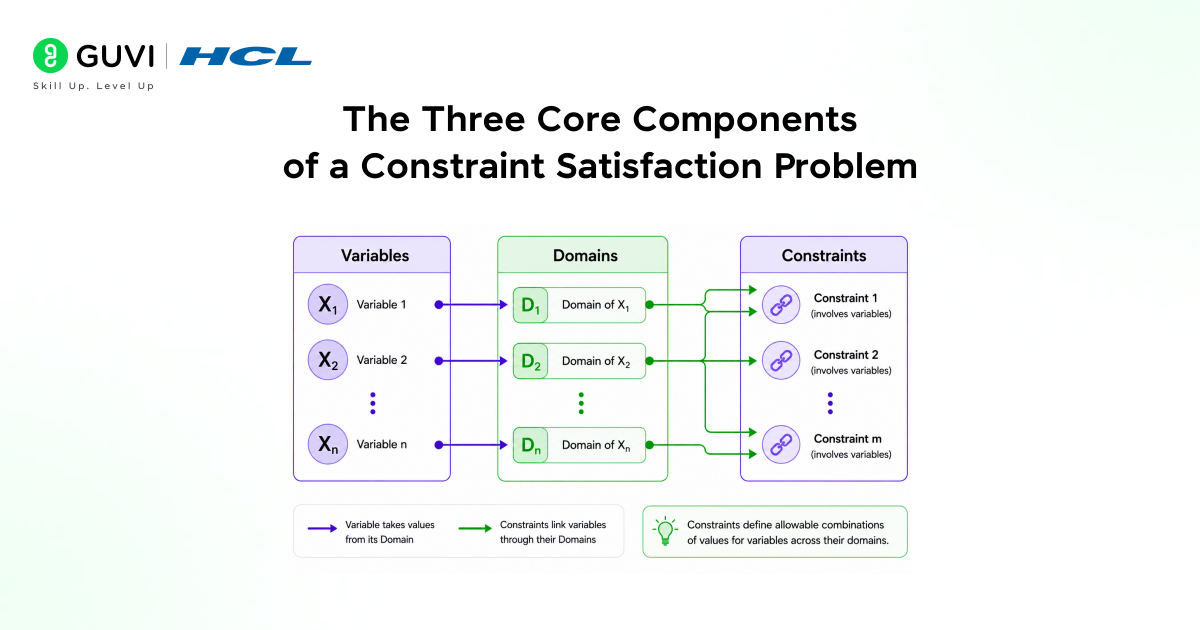
Exactly three components define every Constraint Satisfaction Problem. Understanding these components precisely is essential because every CSP algorithm, from basic backtracking to sophisticated constraint propagation, operates directly on this structure.
1. Variables
Variables are the decisions that need to be made. Each variable represents one unknown that the AI system must assign a value to. In a university timetable problem, each course that needs to be scheduled is a variable. In a map colouring problem, each region of the map is a variable. The set of variables defines the full scope of the decision problem.
2. Domains
The domain of a variable is the set of values it is permitted to take. Domains define the space of possible choices for each individual decision. In a timetable problem, the domain of each course variable might be the set of all available time slots. In a Sudoku puzzle, the domain of each empty cell is {1, 2, 3, 4, 5, 6, 7, 8, 9}.
One of the key insights of CSP in AI is that constraint propagation progressively shrinks domains during solving, removing values that are provably incompatible with other variables’ assignments without ever needing to try them.
3. Constraints
Constraints are the rules that restrict which combinations of variable values are valid. They define the relationships between variables and encode the requirements of the problem.
- Unary constraints: Restrict the values of a single variable. Example: Course A cannot be scheduled on a Friday.
- Binary constraints: Restrict the relationship between two variables. Example: Course A and Course B cannot be scheduled at the same time.
- Higher-order constraints: Involve three or more variables simultaneously. Example: Three courses must collectively cover all five days without overlap.
- Global constraints: Apply to a set of variables as a whole. The AllDifferent constraint, requiring all variables in a set to take distinct values, is the most widely used example.
CSP in AI: A Concrete Example The Map Colouring Problem

The map colouring problem is the canonical introductory example for CSP in AI. The task is to assign colours to the regions of a map such that no two adjacent regions share the same colour. It is simple enough to reason about intuitively, but rich enough to illustrate all the core CSP concepts.
Formalizing Map Colouring as a CSP
• Variables: Each region of the map WA, NT, SA, Q, NSW, V, T (for Australia).
• Domains: Each variable can take one of three values: {Red, Green, Blue}.
• Constraints: Adjacent regions must have different colours: WA ≠ NT, WA ≠ SA, NT ≠ SA, NT ≠ Q, SA ≠ Q, SA ≠ NSW, SA ≠ V, Q ≠ NSW, NSW ≠ V.
A solution is any complete assignment of colours to all regions that satisfies every constraint simultaneously. The CSP framework makes this problem tractable: rather than testing all 3^7 = 2,187 possible colour combinations, constraint propagation and intelligent search reduce the problem to a handful of candidates.
Backtracking Search: The Foundational Algorithm for Solving CSPs
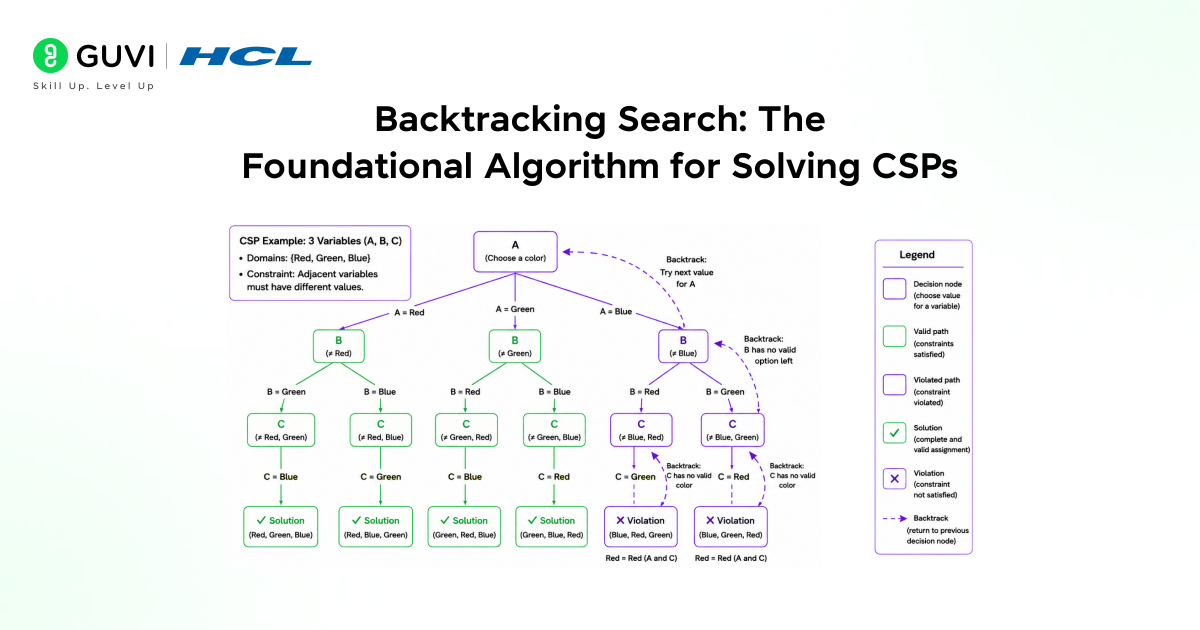
The most fundamental algorithm for solving a Constraint Satisfaction Problem is backtracking search, a depth-first search that assigns values to variables one at a time and backtracks as soon as a constraint violation is detected. It is the core search algorithm upon which all more sophisticated CSP techniques are built.
How Backtracking Search Works
1. Select an unassigned variable.
2. Iterate through the values in its domain.
3. Assign the first value that does not violate any constraint with already-assigned variables.
4. Recursively attempt to assign values to the remaining variables.
5. If no valid value exists for the current variable, backtrack to the most recent decision point and try the next value.
6. Continue until all variables are assigned (solution found) or all options are exhausted (no solution exists).
Why Pure Backtracking Is Often Insufficient
Without enhancements, backtracking search can be extremely slow on large or tightly constrained problems. It may repeatedly explore branches that are doomed to fail because a constraint violation far down the tree is inevitable from the current partial assignment.
This is why backtracking alone is rarely used in practice. Real-world CSP solvers combine it with constraint propagation and intelligent variable and value ordering heuristics to eliminate entire subtrees before they are explored.
Constraint Propagation: Reducing the Search Space Before It Is Explored
Constraint propagation is the family of techniques that use known constraint information to remove values from variable domains before or during search. Rather than discovering a conflict only when all variables are assigned, propagation detects and eliminates inevitable failures early, dramatically shrinking the effective search space.
Forward Checking
Forward checking is the simplest and most widely used form of constraint propagation. Whenever a value is assigned to a variable, forward checking immediately examines all unassigned variables that share a constraint with the assigned variable and removes any values from their domains that are now inconsistent.
If any variable’s domain becomes empty as a result, forward checking immediately backtracks, avoiding the need to descend further into a dead-end subtree. This alone can reduce search time by orders of magnitude on typical CSP instances.
Arc Consistency (AC-3)
Arc consistency is a more powerful form of constraint propagation. An arc (X, Y) is arc-consistent if for every value in X’s domain, there exists at least one value in Y’s domain that satisfies the constraint between X and Y. If no such supporting value exists, the value is removed from X’s domain.
The AC-3 algorithm enforces arc consistency across all variable pairs by maintaining a queue of arcs to check. When a domain reduction occurs, all arcs pointing to the affected variable are re-added to the queue for re-checking. AC-3 runs in O(ed³) time, where e is the number of constraints and d is the maximum domain size.
Key Benefits of Constraint Propagation
• Detects dead ends early before descending into provably failed subtrees.
• Reduces domain sizes before search begins, fewer values to try at each step.
• Can solve highly constrained problems without any search at all.
• Combines naturally with backtracking to form the Maintaining Arc Consistency (MAC) algorithm.
Search Heuristics: Making Backtracking Search Intelligent
Even with constraint propagation, the order in which variables are selected and values are tried has a profound impact on search efficiency. Well-designed heuristics can reduce search time from hours to milliseconds on the same problem. These heuristics are the difference between a naive solver and a practical one.
Variable Ordering Heuristics
• Minimum Remaining Values (MRV) Fail-First: Always select the variable with the fewest remaining legal values in its domain. Variables with tiny domains are most likely to cause a failure; addressing them first detects dead ends sooner and prunes larger subtrees.
• Degree Heuristic: Among variables with equal domain sizes, prefer the variable that is involved in the most constraints with other unassigned variables. This maximizes the propagation effect of each assignment.

Value Ordering Heuristics
• Least Constraining Value (LCV): When selecting a value to assign, prefer the value that removes the fewest options from the domains of neighbouring unassigned variables. This maximizes flexibility for future assignments and reduces the chance of creating a dead end.
Why the Combination Matters
MRV tells you which variable to assign next. LCV tells you which value to try first. Together, they implement a fail-first, succeed-first strategy: fail quickly on the hardest variables while trying the most promising values first. This combination is the most effective general-purpose heuristic approach for CSP in AI and is used in virtually all practical constraint solvers.
Consistency Techniques: The Theoretical Backbone of CSP Solving
Beyond arc consistency, a range of stronger consistency techniques provides different trade-offs between preprocessing cost and solution quality. Understanding these techniques is important for designing effective AI problem-solving systems for complex, large-scale constraint problems.
• Node Consistency: Removes values from a single variable’s domain that violate unary constraints. The simplest level of consistency is always applied first as a preprocessing step.
• Arc Consistency (AC): Enforces consistency on pairs of variables. The most widely used consistency technique offers an excellent trade-off between pruning power and computational cost.
• Path Consistency: Extends arc consistency to triplets of variables. Stronger but more computationally expensive enforces that every consistent assignment of two variables can be extended to a third.
• k-Consistency: A generalization where any consistent assignment of k−1 variables can be extended to any k-th variable. Achieving strong k-consistency can solve the CSP without search, but the cost grows exponentially with k.
• Global Constraints: Dedicated constraint types like AllDifferent, Sum, and Cumulative have specialized propagation algorithms that enforce consistency far more efficiently than decomposing them into binary constraints.
Real-World Applications of CSP in Artificial Intelligence
Constraint Satisfaction Problems are not a theoretical abstraction. They model a wide range of critical real-world problems where decisions are interdependent and must collectively satisfy a complex set of requirements. CSP in AI is the principled framework that makes these problems computationally tractable.
Scheduling and Timetabling
University timetabling, employee shift scheduling, exam scheduling, and sports fixture planning are all classic CSP applications. Variables represent courses, employees, exams, or matches. Domains are available time slots or venues. Constraints encode conflicts, capacity limits, availability windows, and regulatory requirements. CSP solvers automate what would take human planners days to produce manually.
Configuration Problems
Product configuration systems used by manufacturers to build customized products from component catalogues are natural CSPs. Each configurable component is a variable, its options form the domain, and compatibility rules between components are the constraints. Car configurators, computer build systems, and industrial equipment selectors all use
Circuit Design and Hardware Verification
Electronic design automation tools use CSP techniques to route wires on circuit boards, assign frequencies to components, and verify that circuit designs meet timing and power constraints. The variables are component placements or signal timings; the constraints encode physical and electrical rules.
IBM’s ILOG CP Optimizer, one of the world’s most advanced constraint programming solvers, is used across industries like aviation, healthcare, manufacturing, and logistics to optimize complex scheduling and planning problems, with modern constraint satisfaction and optimization systems collectively saving businesses billions of dollars every year through improved operational efficiency.
Limitations of CSP in AI You Should Understand
CSP techniques are powerful, but every AI practitioner needs to understand where they reach their limits and what alternative or complementary approaches are available.
• Scalability on very large problems: Even with arc consistency and MRV heuristics, CSPs with millions of variables or extremely tight constraints can become intractable. Industrial solvers use sophisticated decomposition, parallelism, and hybrid metaheuristic approaches to scale.
• Modelling difficulty: Translating a real-world problem accurately into variables, domains, and constraints requires expertise. A poor model can make an easy problem appear hard, or it can miss crucial constraints that make the solution invalid in practice.
• Hard constraints only: Standard CSP formulations require every constraint to be satisfied completely. Real-world problems often have soft constraints, preferences, desiderata, and optimization objectives that require extensions like Weighted CSP or Constraint Optimization Problems (COPs).
• Dynamic and online problems: Standard CSP algorithms solve static problems where all variables, domains, and constraints are known upfront. Real-world problems that change over time, new bookings, cancellations, and unexpected failures require dynamic CSP techniques or online constraint solving.
• No uncertainty handling: CSP in AI assumes all constraint information is precise and complete. Stochastic constraints, uncertain domains, or probabilistic requirements need frameworks like Stochastic CSP or hybrid probabilistic-constraint models.
If you want to learn more about building skills for Claude Code and automating your procedural knowledge, do not miss the chance to enroll in HCL GUVI’s Intel & IITM Pravartak Certified Artificial Intelligence & Machine Learning courses. Endorsed with Intel certification, this course adds a globally recognized credential to your resume, a powerful edge that sets you apart in the competitive AI job market.
Conclusion
Constraint Satisfaction Problems represent one of the most powerful and broadly applicable frameworks in artificial intelligence.By decomposing complex decision problems into variables, domains, and constraints.
CSP in AI provides a rigorous structure that enables intelligent search algorithms to eliminate impossibilities early and find valid solutions efficiently, even in spaces that would be completely intractable through naive enumeration.
The combination of backtracking search, constraint propagation, arc consistency, and intelligent heuristics like MRV and LCV transforms what would otherwise be exponential search problems into solvable ones. From Sudoku puzzles to university timetables, from circuit design to global logistics optimization, constraint satisfaction techniques power AI problem solving at every scale.
FAQs
1. What is a Constraint Satisfaction Problem in AI?
A Constraint Satisfaction Problem (CSP) in AI is a formal framework where a problem is defined by a set of variables, each with a domain of possible values, and a set of constraints that restrict which combinations of values are valid. The goal is to find an assignment of values to all variables that satisfies every constraint simultaneously.
2. What is the difference between backtracking search and constraint propagation?
Backtracking search is a depth-first algorithm that assigns values to variables one at a time and undoes assignments when a constraint violation is detected. Constraint propagation is a complementary technique that uses constraint information to proactively remove impossible values from variable domains before they are tried.
3. What is arc consistency, and why does it matter?
Arc consistency is a constraint propagation technique that ensures every value in a variable’s domain has at least one compatible value in each neighbouring variable’s domain. Values that lack a supporting value are removed from the domain. Arc consistency matters because it significantly reduces domain sizes before search begins often eliminating large portions of the search space and making previously intractable problems solvable.
4. What is the Minimum Remaining Values (MRV) heuristic?
The Minimum Remaining Values (MRV) heuristic, also called the fail-first heuristic, directs backtracking search to always select the unassigned variable with the fewest remaining legal values in its domain.
5. What are the most common real-world applications of CSP in AI?
CSP in AI is applied across a wide range of domains: scheduling and timetabling (university courses, shift planning, exam scheduling); product and system configuration (car configurators, computer build systems); resource allocation and logistics planning; circuit design and hardware verification; and puzzle solving (Sudoku, graph colouring, constraint-based crossword generation).
Success Stories

About the Author
Vishalini Devarajan
An Aerospace Engineer turned content writer, I focus on making complex concepts easy to understand through well-structured, reader-friendly blogs. Whether it’s a technical topic or a non-technical one, I love creating content that is clear, engaging, and impactful.
View all posts by Vishalini Devarajan
Connect with me @













Did you enjoy this article?