


Artificial Intelligence and Machine Learning Articles
Finance Manager to Data Analytics: Career Growth, Salary and Seniority
How to Evaluate LLM Outputs in Production Deployments
AI/ML Skills Gap 2026: Why Companies Can't Find Job-Ready Talent
20 AI/ML Interview Questions Recruiters Can Use Without a Tech Background - Best Guide


Get In Touch For Details! Request More Information
How n8n Handles Vulnerability Disclosure – and Why We Do It This Way
Aug 04, 2026 5 Min Read 671 Views
(Last Updated)
Most people believe that security is all about prevention of attacks. But actually it is more about how systems respond when something goes wrong.
No software, no matter how well-built, is completely immune to vulnerabilities. What truly defines a platform’s reliability is how quickly and responsibly it reacts when a weakness is discovered.
For n8n, this responsibility is even greater.
N8n links tools, processes data, and runs workflows and frequently deals with sensitive data such as API keys, customer data, internal business logic. A single vulnerability if not properly handled can spread to several systems.
This is why the process of vulnerability disclosure in n8n is strategically designed plan that revolves around:
User protection
- Transparent communication
- Cooperation with security researchers.
- Open-source accountability
In this blog, we will discuss how n8n handles vulnerability disclosure, the need to do such disclosure and how it fits with modern security and responsible disclosure practices.
Quick Answer:
n8n follows a responsible disclosure process where vulnerabilities are validated, fixed privately before being made public, and patched quickly with clear communication to users. This ensures secure workflows, protects sensitive data, and maintains trust within the open-source ecosystem.
Table of contents
- What Is Vulnerability Disclosure
- Types of Vulnerability Disclosure
- Full Disclosure
- Responsible Disclosure
- Coordinated Disclosure
- Non-Disclosure (Silent Fix)
- The Importance of Security in n8n
- The Philosophy Behind How n8n Handles Vulnerability
- Security First, Visibility Second
- Transparency Without Chaos
- Respect for Security Researchers
- Open-Source Responsibility
- Step-by-Step: How n8n Handles Vulnerability Disclosure
- Step 1: Vulnerability Reporting
- Step 2: Acknowledgment & Severity Assessment
- Step 3: Reproducing the Issue
- Step 4: Fix Development
- Step 5: Disclosure Planning.
- Step 6: Patch Release
- Step 7: Public Disclosure
- Step 8: Researcher Recognition
- Common Vulnerabilities in Automation Platforms
- What the Users Should do
- Wrapping it up:
- FAQs
- What does “n8n Handles Vulnerability” mean?
- Does n8n follow responsible disclosure?
- Why does n8n not disclose vulnerabilities immediately?
- How are vulnerabilities reported in n8n?
What Is Vulnerability Disclosure
Before we get into n8n, let’s first simplify the concepts.
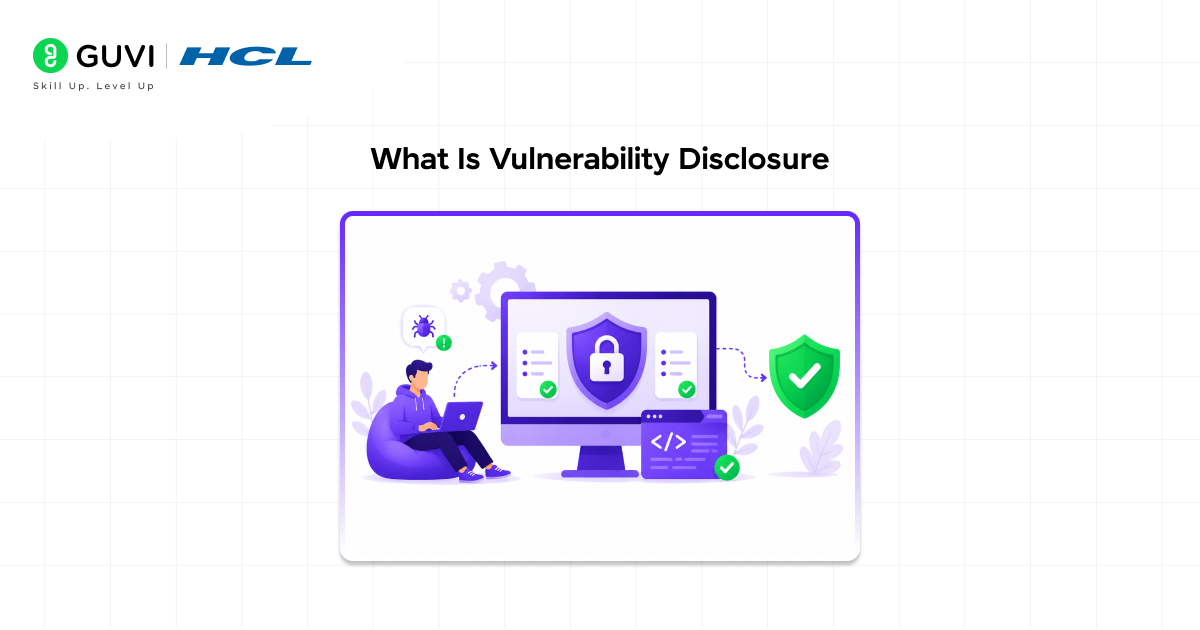
A vulnerability is any weakness in a system that could be exploited to compromise security, this could include:
- Unauthorized access to data
- Malicious code execution.
- Exposure of sensitive credentials
- Logic flaws in workflows
The process of reporting, fixing and communicating these issues is called vulnerability disclosure.
Also check out What is n8n: Build AI Workflows with n8n
Types of Vulnerability Disclosure
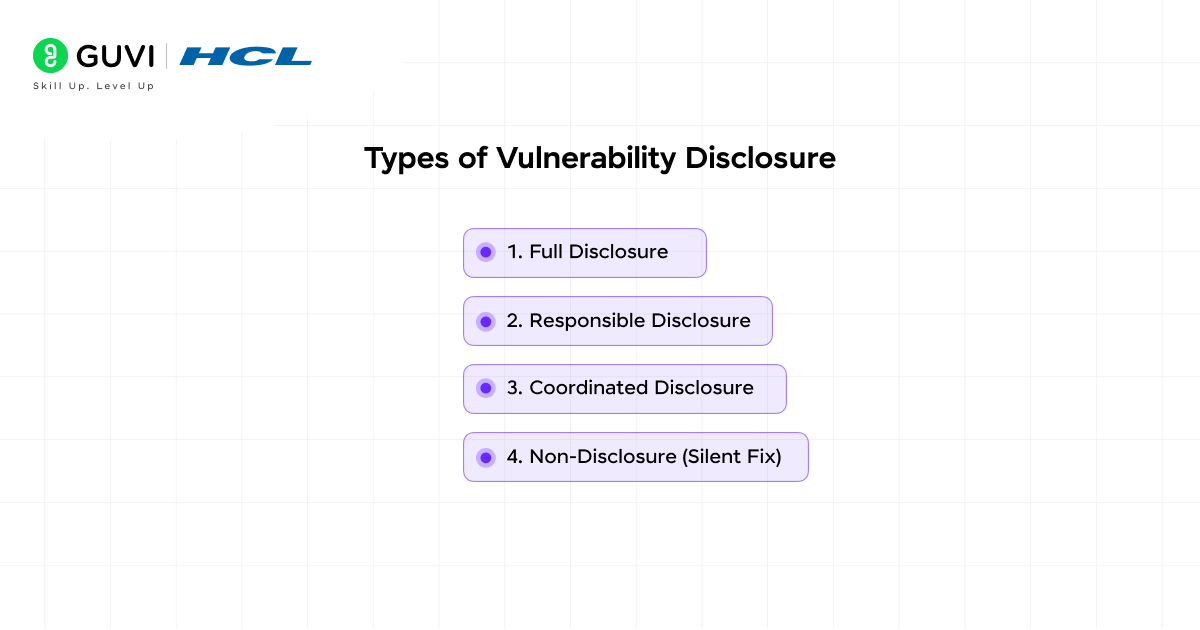
1. Full Disclosure
- Full disclosure means that the vulnerability is disclosed as soon as it is found, without waiting for a fix to be developed or released.
- This approach ensures maximum transparency and rapid awareness, but it also creates a serious risk because attackers can exploit the issue before users are protected.
- It is often considered controversial, as it prioritizes openness over immediate user safety.
2. Responsible Disclosure
- Responsible disclosure involves reporting the vulnerability privately to the organization or developers, giving them time to fix the issue before it becomes public.
- This approach helps protect users by ensuring that a patch or mitigation is available before attackers learn about the vulnerability.
- It is generally regarded as a fair and ethical measure of dealing with security matters.
3. Coordinated Disclosure
- Coordinated disclosure is a more structured version of responsible disclosure where the researcher and the organization work together on a planned timeline for fixing and publishing the vulnerability.
- This can be done through clear communication, deadlines and in some cases official advisories such as CVEs (Common Vulnerabilities and Exposures).
- It ensures that both security and transparency are maintained in a controlled and professional manner.
4. Non-Disclosure (Silent Fix)
- In non-disclosure, the vulnerability is resolved internally without providing information about the vulnerability to the public.
- Although this method can help to avoid panic or exploitation at the moment, it reduces transparency and does not allow users or researchers to learn from the issue.
- It is generally not preferred in open-source ecosystems, where transparency is important for trust.
The Importance of Security in n8n
Why is this risky?
- N8n can connect two or more services together, so a single vulnerability would potentially leak data on many integrated platforms at once.
- The platform stores credentials such as API keys, so any security weakness could lead to unauthorized access to external services and systems.
- Automated workflows run without constant supervision, meaning an attacker could exploit vulnerabilities to trigger actions without user awareness.
- As workflows can process sensitive business information, any form of breach can result in data leak, loss of money or even operational disruption.
A single vulnerability in automation tools like n8n can impact multiple connected systems at once due to their integration-heavy nature.
n8n follows responsible disclosure practices, fixing security issues before making them public to reduce risk.
Interestingly, many vulnerabilities are discovered by independent security researchers, not just internal teams.
The Philosophy Behind How n8n Handles Vulnerability
n8n’s method of dealing with vulnerabilities is based on a clear and intentional philosophy that puts a high priority on both security and trust.
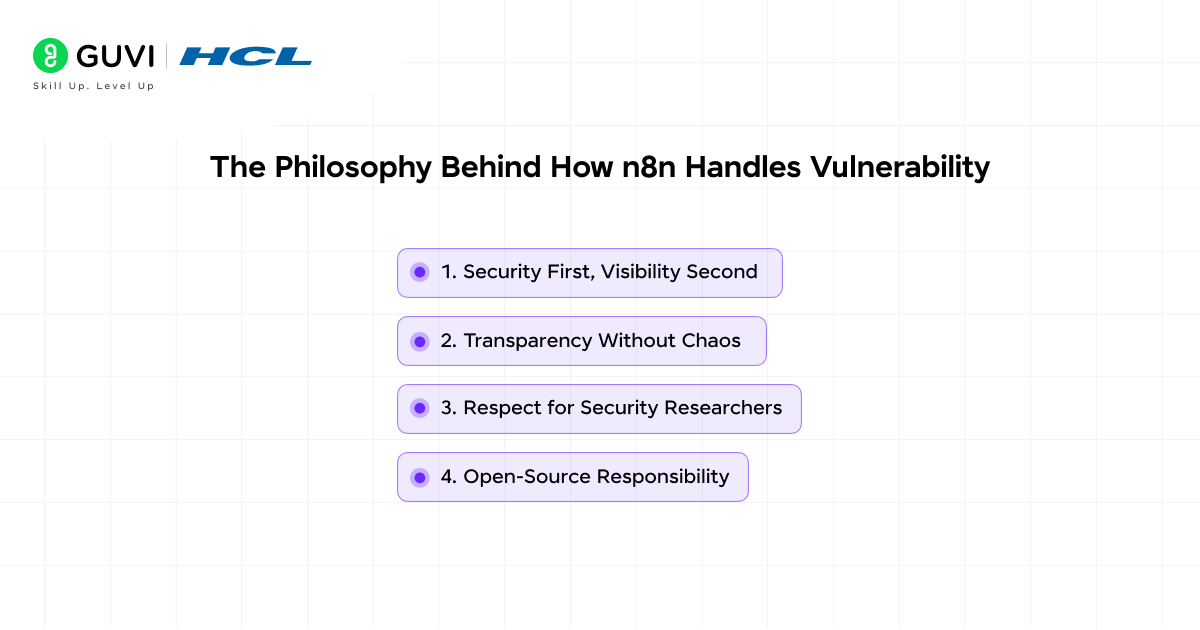
1. Security First, Visibility Second
n8n has a policy of providing fixes prior to being announced so that the user is protected before the details of the vulnerability become public. By adopting this policy, n8n is able to shorten the amount of time that an exploitable vulnerability exists (“vulnerable window”) and prevents potential attackers from using it.
2. Transparency Without Chaos
n8n is committed to being transparent regarding how it handles vulnerabilities, while at the same time is doing so in a manner that does not unnecessarily create additional risk or panic. Users are given information regarding vulnerabilities and clear descriptions of the issues, only after fixes or mitigation of risks are available to them, thereby allowing them to take immediate action without exposing themselves to danger.
3. Respect for Security Researchers
n8n treats security researchers as partners in protecting their product rather than as outsiders and potential threats. The team communicates regularly with reporters and acknowledges their contributions publicly and develops long-term relationships with them to foster a responsible and ethical approach to reporting vulnerabilities.
4. Open-Source Responsibility
As an open-source platform, n8n understands that its code is visible to everyone, which increases both transparency and potential risk.
To balance this, n8n follows strict security practices and disciplined disclosure processes to ensure that openness does not compromise user safety.
Also check out: How to Build AI Agents with n8n? 10 Steps is All it Takes
Step-by-Step: How n8n Handles Vulnerability Disclosure
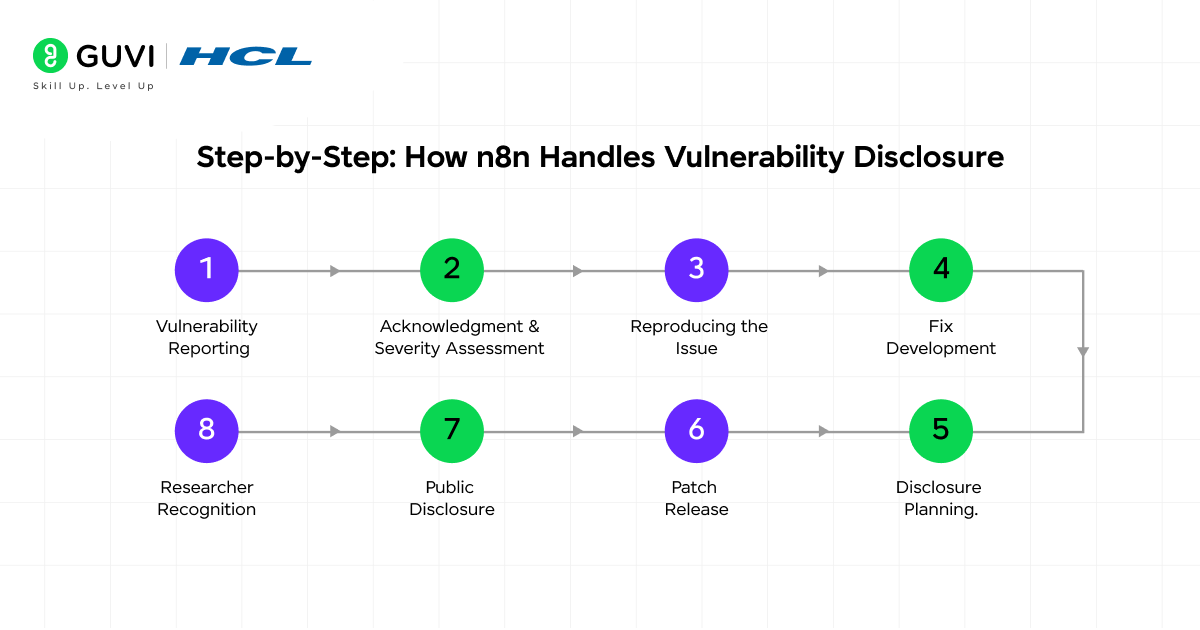
Step 1: Vulnerability Reporting
- Security researchers or users present elaborate reports on the vulnerability, how it happens and how it can be reproduced.
- These reports are shared through secure and private channels to ensure the information does not become publicly accessible too early.

Step 2: Acknowledgment & Severity Assessment
- The n8n team acknowledges the report quickly so the researcher knows the issue is being taken seriously and actively reviewed.
- The vulnerability is evaluated based on its severity, including how easily it can be exploited and the potential impact on users.
Step 3: Reproducing the Issue
- The team tries to duplicate the vulnerability in a controlled setting to ensure that it behaves as described in the report.
- This is done to make sure that resources are only diverted to valid and impactful issues and not false positives or misconceptions.
Step 4: Fix Development
- Instead of coming up with temporary solutions, developers examine the root cause and develop a solution that eliminates the vulnerability at the source.
- The fix is tested in various conditions to make sure that it does not create new problems or impact on the functionality.
Step 5: Disclosure Planning.
- The team and the researcher come to an agreement of a timeline where the vulnerability stays confidential until users are protected.
- The documentation and communication materials are prepared beforehand so that when the issue is disclosed the user can have a clear understanding of the issue.
Step 6: Patch Release
- A new version of n8n is released with the fix, and users are strongly encouraged to update their systems immediately to stay secure.
- The release notes specify the issues that have been resolved and the need to update.
Step 7: Public Disclosure
- Once the patch is widely available, the vulnerability is publicly disclosed to ensure transparency and inform the broader community.
- This disclosure will contain technical information, versions that are impacted, and instructions on how to remain secure.
Step 8: Researcher Recognition
- The person that reported the vulnerability gets his/her name publicly recognised as a token of appreciation to help in enhancing security.
- The understanding would motivate more ethical hackers to report the issues responsibly, rather than take advantage of them.
Common Vulnerabilities in Automation Platforms
- Credential Exposure: Sensitive information like API keys or tokens could be stored or sent in a non-protected manner, allowing the unauthorized user to obtain it.
- Injection Attacks: Attackers can inject malicious input into workflows and can make the system execute unwanted commands or queries.
- Authentication Issues: Weak authentication mechanisms can allow unauthorized users to bypass login systems and gain access to restricted features.
- Workflow Exploits: Vulnerabilities in workflow logic may enable attackers to trigger or modify workflows in a manner that interferes with the usual operations.
- Dependency Risks: Third-party libraries used by n8n may contain vulnerabilities, which can introduce security risks even if the core platform is secure.
What the Users Should do
- Always keep n8n up to date since security patches are regularly issued to address vulnerabilities recently discovered.
- Ensure that you use strong authentication techniques so that unauthorized users cannot easily access your workflows or credentials.
- Limit user access to workflows and environments so that only authorized users can make any changes or activate automation processes.
- Regularly monitor the work of the system in order to identify any suspicious activity and eliminate it before it becomes a serious problem.
- Keep yourself updated on security patches to be able to act swiftly in response to any vulnerabilities that are announced.
Go beyond concepts with HCL GUVI’s AI & Machine Learning Course, where you’ll learn Python, build practical projects, and explore how modern tools like n8n manage security, vulnerability handling, and automation workflows.
Wrapping it up:
Security is often treated as a feature, however, it is really a series of decisions made in rapidly and under considerable pressure over time. What makes n8n stand out is not just how it prevents vulnerabilities, but how deliberately it responds when they inevitably appear.
The methodology used by n8n to handle vulnerabilities after discovery is rooted in planned disclosure rather than rapid disclosure, and utilizing collaboration amongst all parties instead of being silent until exposed. Therefore, n8n’s processes from all aspects of notifying a user privately that a vulnerability has been discovered through coordinating with developers to fix the vulnerability and ultimately notifying the public that a vulnerability existed in the system is an example of a different company’s commitment to protecting its users while maintaining transparency.
FAQs
1. What does “n8n Handles Vulnerability” mean?
It describes how n8n identifies, resolves, and discloses any security issues through a standardised disclosure process.
2. Does n8n follow responsible disclosure?
Yes, n8n uses a responsible and coordinated approach to ensure that all vulnerabilities are resolved and fixed before being publicly disclosed.
3. Why does n8n not disclose vulnerabilities immediately?
The need for immediate disclosure places users at risk through exposure. Therefore, n8n will resolve the issue before making the information public.
4. How are vulnerabilities reported in n8n?
Security vulnerabilities are reported on a private basis using secure communication channels, enabling the team to investigate and remediate the issue safely.
Success Stories

About the Author
Vishalini Devarajan
An Aerospace Engineer turned content writer, I focus on making complex concepts easy to understand through well-structured, reader-friendly blogs. Whether it’s a technical topic or a non-technical one, I love creating content that is clear, engaging, and impactful.
View all posts by Vishalini Devarajan
Connect with me @















Did you enjoy this article?