


Data Structure Articles
Sliding Window Technique: Explained with Examples
Two Pointer Technique: Problems and Applications


Get In Touch For Details! Request More Information

What is the Floyd-Warshall Algorithm? Working, Example, & Applications
Sep 14, 2026 4 Min Read 1304 Views
(Last Updated)
Quick Answer: The Floyd-Warshall Algorithm is a dynamic programming technique that computes the shortest distance between every pair of nodes in a graph by systematically testing whether routing through each intermediate node shortens the path, until no shorter path remains.
Every network, from city roads to computer systems, hides a puzzle: what’s the fastest way to get from any point to every other point? The Floyd-Warshall Algorithm solves exactly that. It calculates the shortest possible path between every pair of nodes in a graph, checking each route through every other node until the best one emerges.
Most algorithms make you choose a starting point. This one doesn’t care where you begin. It maps out the entire network at once, turning a maze of connections into a clear table of shortest distances, ready whenever you need to compare any two points instantly.
Robert Floyd published the Floyd-Warshall algorithm in 1962, making it one of the earliest solutions to the all-pairs shortest path problem in computer science.
Table of contents
- What is the Floyd-Warshall Algorithm?
- Key Concepts of Floyd-Warshall Algorithm
- Benefits of Floyd-Warshall Algorithm
- Computes Shortest Paths Between All Vertex Pairs Simultaneously
- Supports Negative Edge Weights
- Simplifies Dense Graph Processing
- Real-World Use Cases of Floyd-Warshall Algorithm
- Network Routing Optimization in Computer Networks
- Traffic Navigation and Smart Transportation Systems
- Airline and Railway Route Planning Systems
- Distributed System Communication Analysis
- Social Network Relationship Analysis
- How the Floyd-Warshall Algorithm Works (Step-by-Step Guide)
- Example of Floyd-Warshall Algorithm
- Limitations of Floyd-Warshall Algorithm
- Conclusion
- FAQs
- What is the Floyd-Warshall Algorithm used for?
- What is the time complexity of the Floyd-Warshall Algorithm?
- Can Floyd-Warshall handle negative edge weights?
- How is Floyd-Warshall different from Dijkstra's algorithm?
- How do you detect a negative cycle using this algorithm?
- Is the Floyd-Warshall Algorithm suitable for large graphs?
- What data structure does the Floyd-Warshall Algorithm use?
What is the Floyd-Warshall Algorithm?

The Floyd-Warshall Algorithm is a dynamic programming-based graph algorithm that finds the shortest paths between all pairs of vertices in a weighted graph.
Unlike Dijkstra’s algorithm, which solves single-source shortest paths, Floyd-Warshall computes all-pairs shortest paths by repeatedly checking whether an intermediate vertex produces a shorter route between two nodes.
It works using an adjacency matrix and updates distances iteratively. The algorithm has a time complexity of O(V3), making it suitable for dense graphs, network routing, traffic optimization, and distributed system analysis.
Master data structures, algorithms, and full stack development with HCL GUVI’s Software and AI Engineer Programme. Learn Java, React, Node.js, MongoDB, and AI-assisted development through hands-on projects and mentorship from industry professionals at companies like Microsoft and Amazon. Get placement support, mock interviews, and an IITM Pravartak certification. Start building real-world software engineering skills today!
Key Concepts of Floyd-Warshall Algorithm
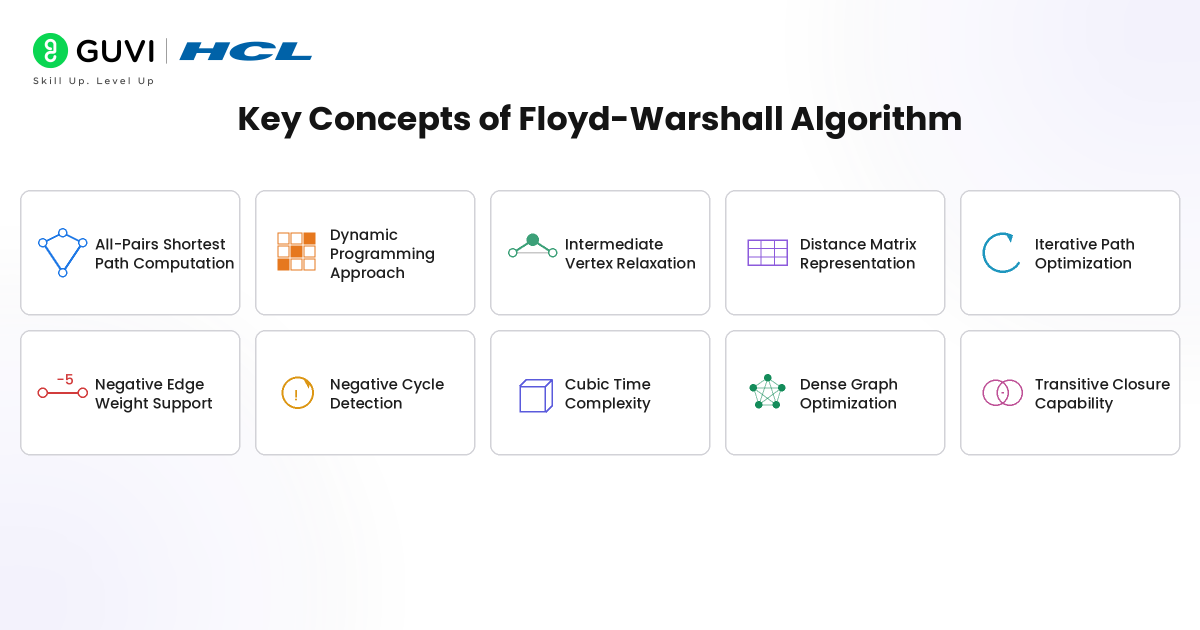
- All-Pairs Shortest Path Computation: The algorithm computes the shortest distances between every possible pair of vertices in a graph instead of focusing on a single source node.
- Dynamic Programming Approach: Floyd-Warshall uses dynamic programming to iteratively improve shortest-path solutions by storing and updating intermediate results in a distance matrix.
- Intermediate Vertex Relaxation: For every vertex (k), the algorithm checks whether passing through (k) produces a shorter path between vertices (i) and (j).
- Distance Matrix Representation: The graph is typically represented using an adjacency matrix where each cell stores the current shortest known distance between two vertices.
- Iterative Path Optimization: Distances are repeatedly updated using the transition relation:
dist[i][j] = \min(dist[i][j],\ dist[i][k] + dist[k][j]) - Negative Edge Weight Support: Unlike Dijkstra’s algorithm, the algorithm can process graphs with negative edge weights, provided negative weight cycles are absent.
- Negative Cycle Detection: If any diagonal element in the final distance matrix becomes negative, the graph contains a negative weight cycle.
- Cubic Time Complexity: Floyd-Warshall has a computational complexity of O(V3) due to its triple-nested iteration across all vertices.
- Dense Graph Optimisation: The algorithm performs efficiently in dense graphs where the number of edges approaches the maximum possible connections between vertices.
- Transitive Closure Capability: Floyd-Warshall can also be extended to compute graph reachability and transitive closure in directed graphs.
Strengthen your problem-solving and algorithmic thinking with HCL GUVI’s DSA for Programmers Course Bundle. Learn data structures, graph algorithms, dynamic programming, and coding techniques through hands-on practice and industry-focused training designed for real-world software development.
Benefits of Floyd-Warshall Algorithm

1. Computes Shortest Paths Between All Vertex Pairs Simultaneously
Unlike single-source shortest path algorithms, the Floyd-Warshall graph algorithm in data structures calculates the shortest distances between every pair of vertices in a single execution.
This makes the data structure algorithm highly efficient for complete network-wide path analysis in routing systems, transportation networks, and distributed infrastructures.
2. Supports Negative Edge Weights
Floyd-Warshall can process graphs with negative edge weights without failing, as long as they contain no negative cycles. This capability makes it suitable for financial modeling, weighted dependency analysis, and optimization problems where edge costs may decrease overall path values.
3. Simplifies Dense Graph Processing
The graph algorithm performs particularly well on dense graphs where many vertices are interconnected. Its matrix-based implementation enables straightforward path updates, efficient transitive closure computation, and simplified graph reachability analysis in highly connected systems.
Real-World Use Cases of Floyd-Warshall Algorithm
1. Network Routing Optimization in Computer Networks
Floyd-Warshall is widely used in network routing systems to calculate the shortest communication paths between all routers in a network simultaneously.
Large-scale enterprise networks and telecom infrastructures use all-pairs shortest path computation to optimize packet forwarding, reduce latency, and improve bandwidth utilization across interconnected routing nodes.
2. Traffic Navigation and Smart Transportation Systems
Smart traffic management platforms use Floyd-Warshall to analyze optimal travel routes between multiple city intersections and road networks.
The algorithm helps transportation systems evaluate shortest travel distances, detect congestion-efficient alternate routes, and improve large-scale route planning in GPS navigation and urban traffic control systems.
3. Airline and Railway Route Planning Systems
Airline reservation systems and railway scheduling platforms apply Floyd-Warshall to calculate minimum travel costs and shortest connectivity paths between all stations or airports.
This enables efficient multi-stop route optimization, fare estimation, transit scheduling, and network-wide transportation analysis.
4. Distributed System Communication Analysis
Distributed computing environments use Floyd-Warshall to optimize communication paths between servers, processing nodes, and microservices across data centers.

The algorithm helps identify low-latency communication routes, minimize inter-service transmission costs, and improve workload coordination inside distributed architectures.
5. Social Network Relationship Analysis
Social media and graph analytics platforms use Floyd-Warshall to analyze shortest relationship paths between users in large social graphs.
This helps identify indirect connections, mutual interaction chains, influencer proximity, recommendation pathways, and overall network connectivity patterns in social network analysis systems.
How the Floyd-Warshall Algorithm Works (Step-by-Step Guide)
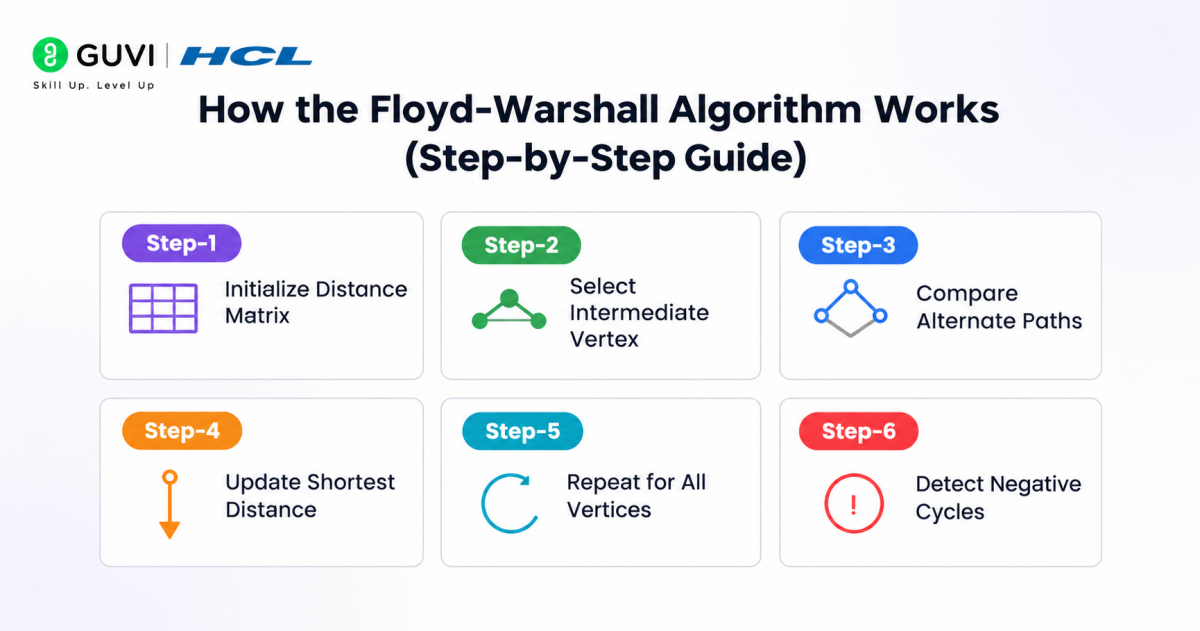
Step 1: Build the Distance Matrix
Start by creating a matrix that stores the direct distance between every pair of vertices. If two vertices are connected, use the edge weight. If there’s no direct connection, mark it as infinity. Every vertex’s distance to itself is 0.
Step 2: Pick an Intermediate Vertex
Go through each vertex one at a time and treat it as a possible stopover point between every other pair of vertices.
Step 3: Check If a Shorter Path Exists
For every pair of vertices (i) and (j), check if passing through the current intermediate vertex (k) gives a shorter distance than the one already stored.
Step 4: Update the Distance If Needed
If the path through (k) is shorter, replace the old value with the new one using this rule:
dist[i][j] = min(dist[i][j], dist[i][k] + dist[k][j])
Step 5: Repeat for Every Vertex
Do this same check for all vertices as intermediate points, one after another, until every pair of vertices has been tested through every possible route.
Step 6: Check for Negative Cycles
Once all updates are done, look at the diagonal of the final matrix. If any value there is negative, the graph has a negative-weight cycle, and the shortest-path results can’t be trusted.
Example of Floyd-Warshall Algorithm
Consider the following weighted graph:
| From | To | Weight |
|---|---|---|
| A | B | 3 |
| A | C | 8 |
| B | C | 2 |
| B | D | 5 |
| C | D | 1 |
Initial Distance Matrix
| A | B | C | D | |
|---|---|---|---|---|
| A | 0 | 3 | 8 | ∞ |
| B | ∞ | 0 | 2 | 5 |
| C | ∞ | ∞ | 0 | 1 |
| D | ∞ | ∞ | ∞ | 0 |
This matrix reflects only the direct connections between vertices. Anywhere there’s no direct edge, the value is set to infinity.
Shortest Path Updates
Once the initial matrix is ready, the algorithm checks every pair of vertices to see if routing through another vertex gives a shorter path.
Take A to D. There’s no direct edge between them, so the initial value is infinity. But two indirect routes exist:
Through B: A → B → D = 3 + 5 = 8
Through C: A → B → C → D = 3 + 2 + 1 = 6
Since 6 is smaller, the shortest distance from A to D updates to 6.
The same logic applies to B and D. The direct edge gives B → D = 5, but going through C gives a shorter route:
B → C → D = 2 + 1 = 3
Since 3 is smaller than 5, B to D updates to 3 as well.
Final Shortest Distance Matrix
| A | B | C | D | |
|---|---|---|---|---|
| A | 0 | 3 | 5 | 6 |
| B | ∞ | 0 | 2 | 3 |
| C | ∞ | ∞ | 0 | 1 |
| D | ∞ | ∞ | ∞ | 0 |
This final matrix holds the shortest possible distance between every pair of vertices in the graph, after accounting for all possible intermediate routes.
Limitations of Floyd-Warshall Algorithm
Here are the following limitations of the Floyd-Warshall Algorithm:
- Its O(V3) computational complexity makes it inefficient for very large graphs.
- Requires significant memory usage due to adjacency matrix storage.
- Performs unnecessary computations for sparse graphs with fewer edges.
- Cannot produce valid shortest paths when negative weight cycles exist.
- Less efficient than Dijkstra’s algorithm for single-source shortest path problems.
Conclusion
The Floyd-Warshall Algorithm gives you the full picture of a network in one go, every shortest path between every pair of points, calculated at once. That completeness is its real strength. It’s not built for speed on huge graphs, but for situations where knowing every possible shortest route matters more than computing it fast. It trades speed for completeness, and that’s exactly what makes it useful.
FAQs
1. What is the Floyd-Warshall Algorithm used for?
It finds the shortest paths between every pair of vertices in a graph, making it useful for network routing, traffic systems, and distributed computing.
2. What is the time complexity of the Floyd-Warshall Algorithm?
O(V3), since it runs three nested loops across all vertices.
3. Can Floyd-Warshall handle negative edge weights?
Yes, as long as the graph has no negative weight cycles.
How is Floyd-Warshall different from Dijkstra’s algorithm?
Dijkstra finds the shortest path from one source, while this algorithm computes shortest paths between all pairs at once.
4. How do you detect a negative cycle using this algorithm?
Check the diagonal of the final distance matrix. A negative value there means a negative-weight cycle exists.
5. Is the Floyd-Warshall Algorithm suitable for large graphs?
Not ideally. Its O(V3) complexity makes the Floyd-Warshall Algorithm slower and more memory-intensive for very large graphs.
6. What data structure does the Floyd-Warshall Algorithm use?
It uses an adjacency matrix to store and update shortest distances between vertices.
Success Stories

















Did you enjoy this article?