


Data Structure Articles
Sliding Window Technique: Explained with Examples
Two Pointer Technique: Problems and Applications


Get In Touch For Details! Request More Information

The Merge k Sorted Arrays algorithm becomes fun the moment we imagine, say, multiple sorted arrays displayed right in front of us. And we need to merge these sorted arrays without disturbing their order, for even a moment. For 2 sorted arrays, it seems simple, but what if the numbers keep on increasing?
One wrong move can turn a clean arrangement into complete disorder. In this blog, we will understand the Merge k Sorted Arrays algorithm and its different aspects.
Table of contents
- TL;DR Summary
- Merge k Sorted Arrays: Understanding the Algorithm
- Purpose
- Example:
- How the Merge k Sorted Arrays Algorithm Works
- Code Example
- Code Explanation:
- Conclusion
- FAQs
- Why do we need multiple pointers in this algorithm?
- What happens if one array gets completed earlier than the others?
- Why is finding the smallest element important here?
- Why does the loop run continuously using while (true)?
- What is the role of minIndex in the code?
- Why is the optimal solution faster than the basic approach?
- Why is Min Heap the best approach for Merge K Sorted Arrays?
TL;DR Summary
- Helps you clearly understand what the Merge k Sorted Arrays problem actually means before jumping into the solution.
- Makes the merging process easier to visualise through a simple example and step-by-step algorithm explanation.
- Breaks down the code logic in a simple way so you can understand how the merging is happening internally.
Merge k Sorted Arrays: Understanding the Algorithm
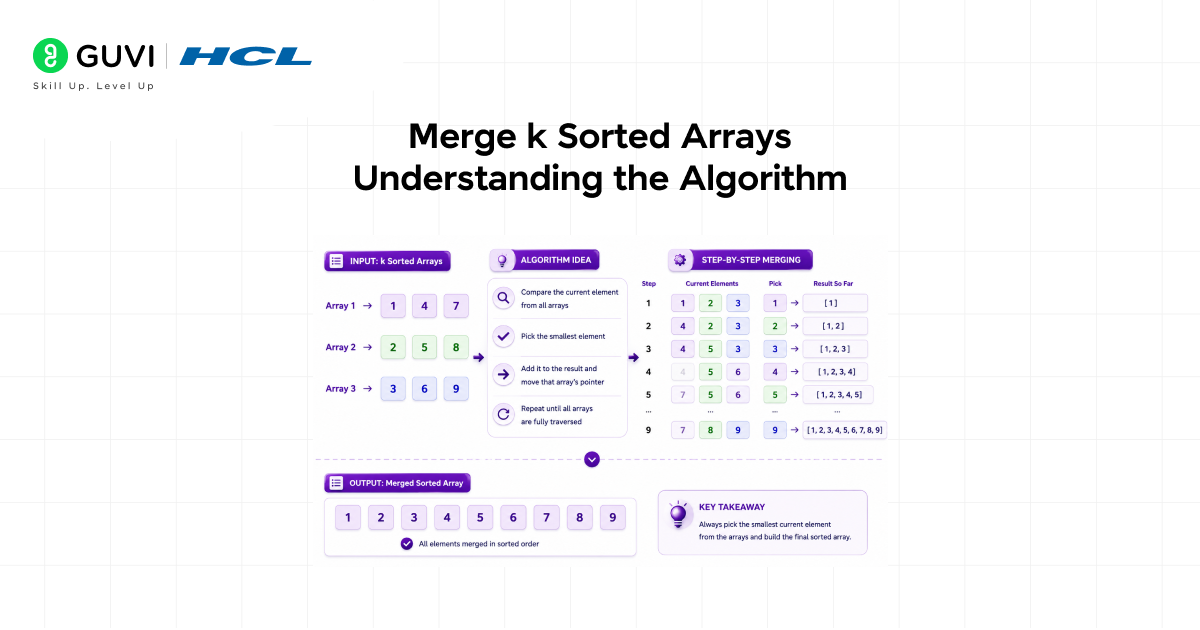
The Merge k Sorted Arrays algorithm merges multiple sorted arrays into a single sorted array. Since the arrays are already sorted, the main task is to devise an efficient algorithm for merging them.
Purpose
- To merge several sorted arrays into one final sorted sequence.
- To gain an understanding of the efficient algorithms for sorting and merging.
Example:
Array 1 → [1, 4, 7]
Array 2 → [2, 5, 8]
Array 3 → [3, 6, 9]
After merging all the sorted arrays together, the final array becomes:
[1, 2, 3, 4, 5, 6, 7, 8, 9]
Here, the elements are combined while preserving the overall order.
Also Read: Sorting in Data Structure
Prepare Data Structures and Algorithms with HCL GUVI’s DSA for Programmers Course, where you will delve deep into algorithmic problem-solving and logic flow.
Explore: Leaders in An Array
How the Merge k Sorted Arrays Algorithm Works
- The Merge k Sorted Arrays algorithm selects the smallest element from each array and adds it to the resultant merged array.
- Once the smallest element has been included in the merged array, the algorithm proceeds only in the array from which it was removed, then compares the next available elements across all arrays.
- This process continues until all the elements from all arrays are combined into a single, fully sorted array.
Code Example
For this example, we will use JavaScript as the programming language; you can use any language you are comfortable with.
function mergeKSortedArrays(arrays) {
let result = [];
let pointers = [];
// Initialize pointers for each array
for (let i = 0; i < arrays.length; i++) {
pointers[i] = 0;
}
while (true) {
let minValue = Infinity;
let minIndex = -1;
// Find the smallest current element
for (let i = 0; i < arrays.length; i++) {
if (
pointers[i] < arrays[i].length &&
arrays[i][pointers[i]] < minValue
) {
minValue = arrays[i][pointers[i]];
minIndex = i;
}
}
// Stop if all arrays are fully traversed
if (minIndex === -1) {
break;
}

// Add smallest element to result
result[result.length] = minValue;
// Move pointer forward
pointers[minIndex]++;
}
return result;
}
// Example
let arrays = [
[1, 4, 7],
[2, 5, 8],
[3, 6, 9]
];
console.log(mergeKSortedArrays(arrays));
Input:
[
[1, 4, 7],
[2, 5, 8],
[3, 6, 9]
]
Output:
[1, 2, 3, 4, 5, 6, 7, 8, 9]
Time Complexity: O(n × k)
Space Complexity: O(k)
Note:
- Time Complexity: Shows how much time an algorithm takes to run.
- Space Complexity: Shows how much extra memory an algorithm uses.
Also Read: Understanding Complexity Analysis in Data Structures
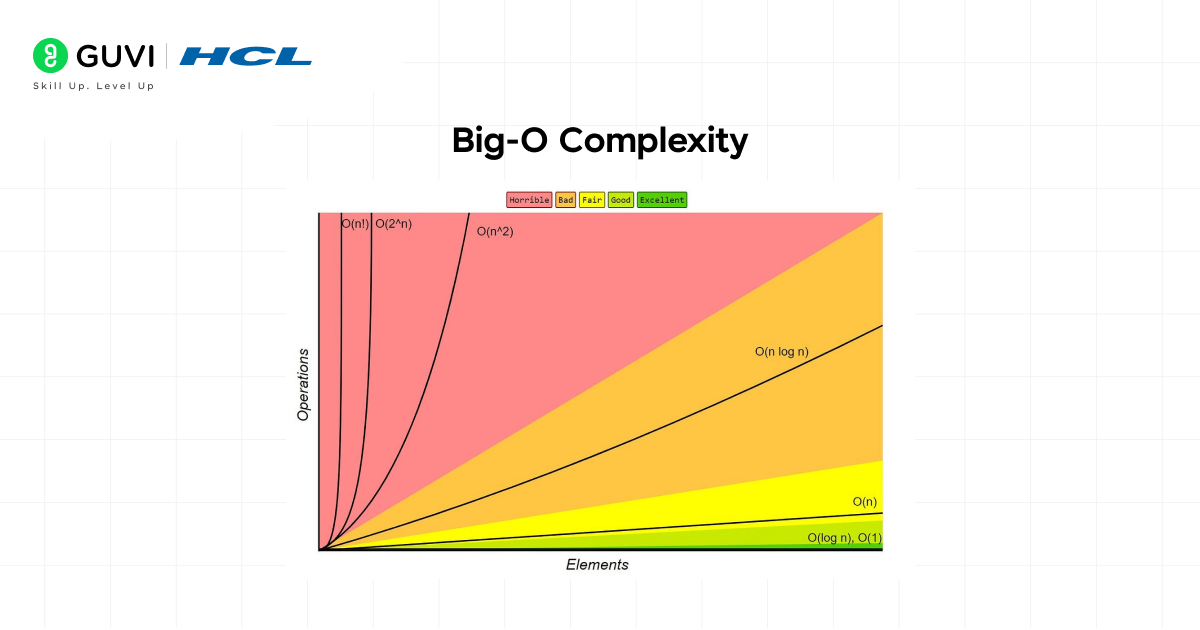
Refer to the Big-O Complexity chart below to get a quick overview of the performance of an algorithm based on its time and space complexities.
Code Explanation:
- The function starts by creating a result array to store the final merged output and a pointers array to track the current index of each array.
- A while loop runs continuously, and inside it, the for loop iterates over the array elements using pointers[i].
- During each iteration, minValue stores the smallest current element and minIndex stores the index of the array from which that element came.
- Once the smallest element is found, it is added to the result array using:
result[result.length] = minValue;
- Then the pointer of that array moves forward using:
pointers[minIndex]++;
- So the next element from that array can be checked.
- This process repeats until minIndex becomes -1, indicating that all arrays have been completely traversed, and the final merged, sorted array is returned.
Want to explore more DSA concepts like Merge k Sorted Arrays with guided learning and structured practice? The HCL GUVI’s DSA using Java Course helps you build strong problem-solving skills through simple explanations, coding exercises, and real algorithm understanding. Start learning today and make complex DSA problems feel simpler!
Conclusion
The Merge K Sorted Arrays algorithm seems easier to grasp after walking through the merging logic, pointer movement, and the minimum-element-extraction step by step. With the help of the algorithm explanation, the example, and the code breakdown, the entire merging operation begins to appear more systematic and lucid.
FAQs
1. Why do we need multiple pointers in this algorithm?
Pointers help track the current element being checked in each array during the merging process.
2. What happens if one array gets completed earlier than the others?
The algorithm simply stops checking that array and continues merging the remaining arrays.
3. Why is finding the smallest element important here?
Picking the smallest available element each time keeps the final merged array properly sorted.
4. Why does the loop run continuously using while (true)?
The loop continues until all arrays are fully traversed and no elements remain.
5. What is the role of minIndex in the code?
minIndex stores which array currently contains the smallest element.
6. Why is the optimal solution faster than the basic approach?
The optimal approach reduces repeated comparisons by using a Min Heap to efficiently access the smallest element.
7. Why is Min Heap the best approach for Merge K Sorted Arrays?
A Min Heap solves the Merge K Sorted Arrays problem efficiently by always selecting the smallest element, giving the Merge K Sorted Arrays algorithm an optimal time complexity of O(N log K).
Success Stories

















Did you enjoy this article?