


Data Structure Articles
Sliding Window Technique: Explained with Examples
Two Pointer Technique: Problems and Applications


Get In Touch For Details! Request More Information

5 Cycle Detection Patterns in Undirected Graphs (2026 Guide)
Aug 06, 2026 5 Min Read 827 Views
(Last Updated)
Cycle Detection in Undirected Graphs is not just a DSA topic; it goes beyond that. Cycle Detection is implemented in real software systems where recognising patterns plays a crucial role.
To visualise it better, think of a map app like Google Maps. In these kinds of apps, developers have already added the Cycle Detection algorithm to find circular routes and alternative paths. On social networking platforms, the cycles are generally used to display groups of people who are closely connected.
By now, I hope you have got a brief idea of Cycle Detection. So, let’s move on to the next sections of this blog.
Table of contents
- TL;DR Summary
- Understanding Cycle Detection in Undirected Graph
- Real-world Example:
- 5 Types of Cycle Detection Patterns
- Visited Again Pattern
- Parent Check Pattern
- Back Edge Pattern
- Fast and Slow Pointer Pattern
- Union-Find Pattern
- Conclusion
- FAQs
- Why do some cycle detection algorithms use extra memory while others do not?
- Why is the parent node ignored in undirected graphs?
- Which cycle-detection approach is easiest for beginners to understand?
- Why is depth-first search commonly used in cycle detection?
- What problems can happen if cycles are not detected in systems?
- Where is the fast and slow pointer technique mainly used in real applications?
TL;DR Summary
- This blog helps you clearly understand Cycle Detection in Undirected Graphs by showing how cycles form step by step.
- Makes complex graph concepts easier using simple arrow flows, visuals, and real examples.
- Shows how 5 different types of cycle detection patterns work with clear execution flow and beginner-friendly explanations.
- Improves your understanding of coding by connecting patterns, logic, and code execution in a simple way.
Tech giants like Google and Meta use graph-based systems with cycle detection for routing, recommendations, and dependency analysis.
Understanding Cycle Detection in Undirected Graph
“Cycle Detection in Undirected Graphs” refers to detecting cycles in graphs with bidirectional edges. Here, the Graph is a collection of nodes connected by edges.
If the edges connected together form a loop or a circular path, then the graph has a cycle. Identifying these cycles is known as cycle detection.
Real-world Example:
Imagine 4 houses connected by roads. If you travel A → B → C → D → A and return to the starting house, it forms a cycle.
Level up fast, join DSA for Programmers Course by HCL GUVI, master algorithms at your own pace, and get interview-ready with real-world problem solving.
5 Types of Cycle Detection Patterns
To better understand this algorithm, let’s go through the different types of cycle patterns and see how the loop is actually formed step by step inside a graph.
Here, we consider the 5 main types of Cycle Detection Patterns commonly used in software development to detect loops, circular dependencies, repeated paths, or infinite flows in a system.
1. Visited Again Pattern
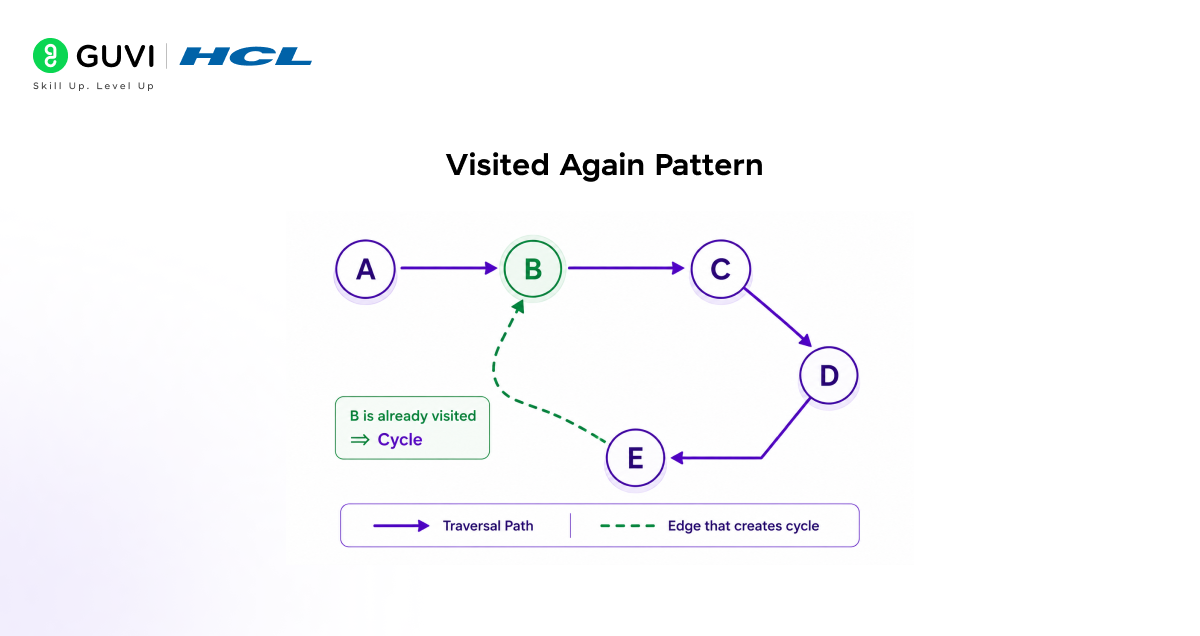
This pattern means a previously visited node appears again during traversal.
Execution Flow:
A → B → C → D → E → B
- Here we start moving normally from A → B → C → D → E. While continuing the traversal, we again reach B.
- Since B had already visited on the same path, we came back on the same route.
- This repeated visit shows that the traversal is moving in a circle, so a cycle exists.
Code
function hasCycle(graph) {
let visited = new Set();
function dfs(node) {
if (visited.has(node)) return true;
visited.add(node);
for (let neighbor of graph[node]) {
if (dfs(neighbor)) return true;
}
return false;
}
return dfs(‘A’);
}
// Output: true
Code Explanation:
- A visited set keeps track of nodes that have already been explored.
- The traversal starts at node A and continues deeper using DFS.
- If a node appears in the visited set again, the function immediately returns true, indicating a cycle exists.
2. Parent Check Pattern
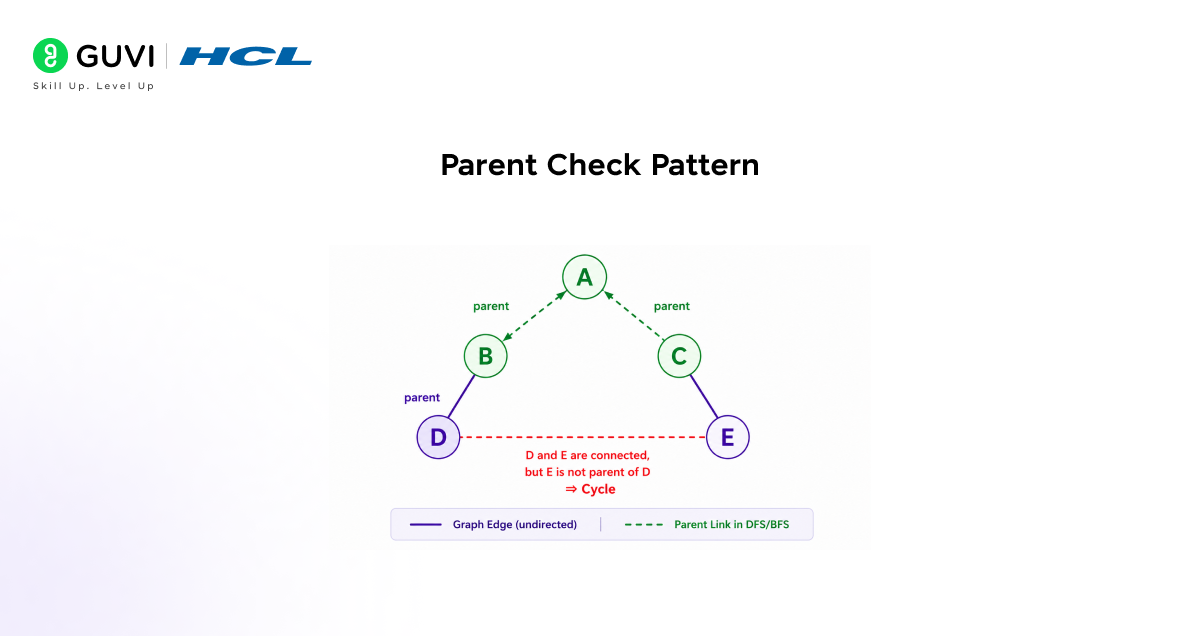
This pattern indicates that the traversal reaches a visited node that is not the parent node.
Execution Flow:
A → B → D
A → C → E
D ↔ E
- This pattern is used in undirected graphs, where going back to the immediate previous node is normal.
- We first move A → B → D, and another path goes A → C → E.
- Now D and E are connected. So when traversal reaches E and sees D already visited, it checks: “Is D the parent I directly came from?” If the answer is no, then a cycle is found.
Code
function hasCycle(graph) {
let visited = new Set();
function dfs(node, parent) {
visited.add(node);
for (let neighbor of graph[node]) {
if (!visited.has(neighbor)) {
if (dfs(neighbor, node)) return true;
} else if (neighbor !== parent) {
return true;
}
}
return false;
}
return dfs(‘A’, null);
}
// Output: true
Code Explanation:
- The code moves through the graph using DFS while also storing the current node’s parent.
- Visiting the parent node again is normal in an undirected graph, so it is ignored.
- If traversal reaches a visited node that is not the parent, the code confirms a cycle.
3. Back Edge Pattern
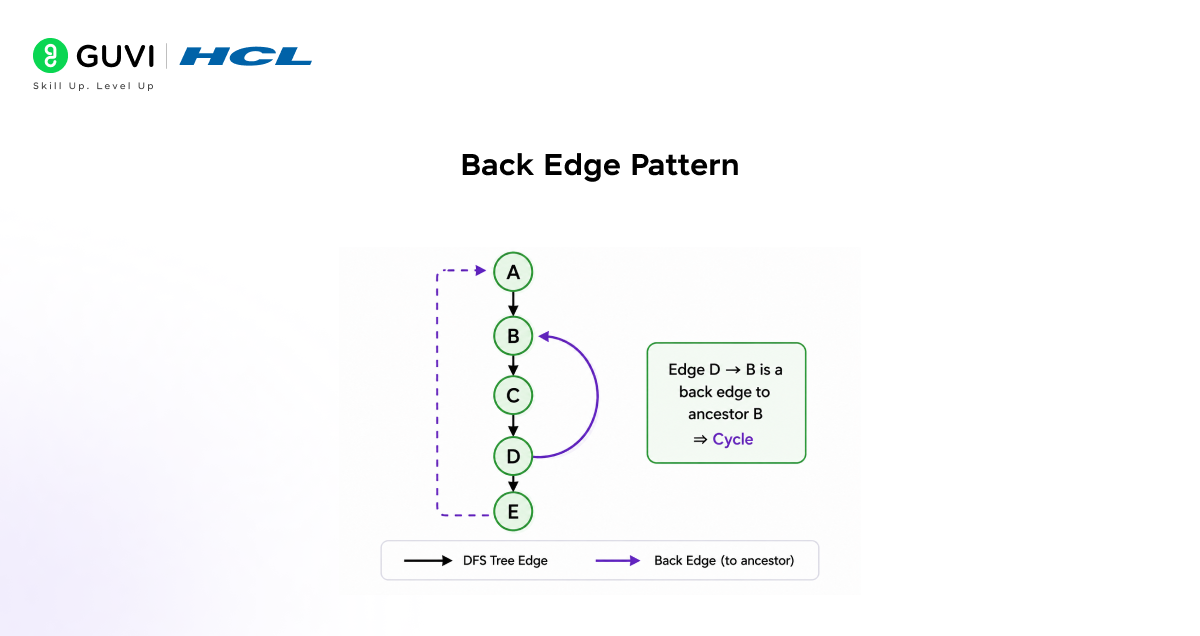
This pattern means a node creates a direct backward connection to an older node.
Execution Flow:
A → B → C → D → E
D → B
- We first move forward normally from A → B → C → D → E. But while standing at D, there is one direct connection from D back to B.
- This creates a backward jump instead of moving to a new node. Now, the traversal can rotate through B → C → D → B repeatedly, forming a cycle.
Code
function hasCycle(graph) {
let visited = new Set();
let stack = new Set();
function dfs(node) {
visited.add(node);
stack.add(node);
for (let neighbor of graph[node]) {

if (!visited.has(neighbor)) {
if (dfs(neighbor)) return true;
} else if (stack.has(neighbor)) {
return true;
}
}
stack.delete(node);
return false;
}
return dfs(‘A’);
}
// Output: true
Code Explanation:
- Two sets are used here: one for visited nodes and another for the current DFS path stack.
- As traversal moves deeper, each node is temporarily added to the stack.
- If a node points back to another node already present inside the current stack, a back edge is found, and the cycle is detected.
4. Fast and Slow Pointer Pattern
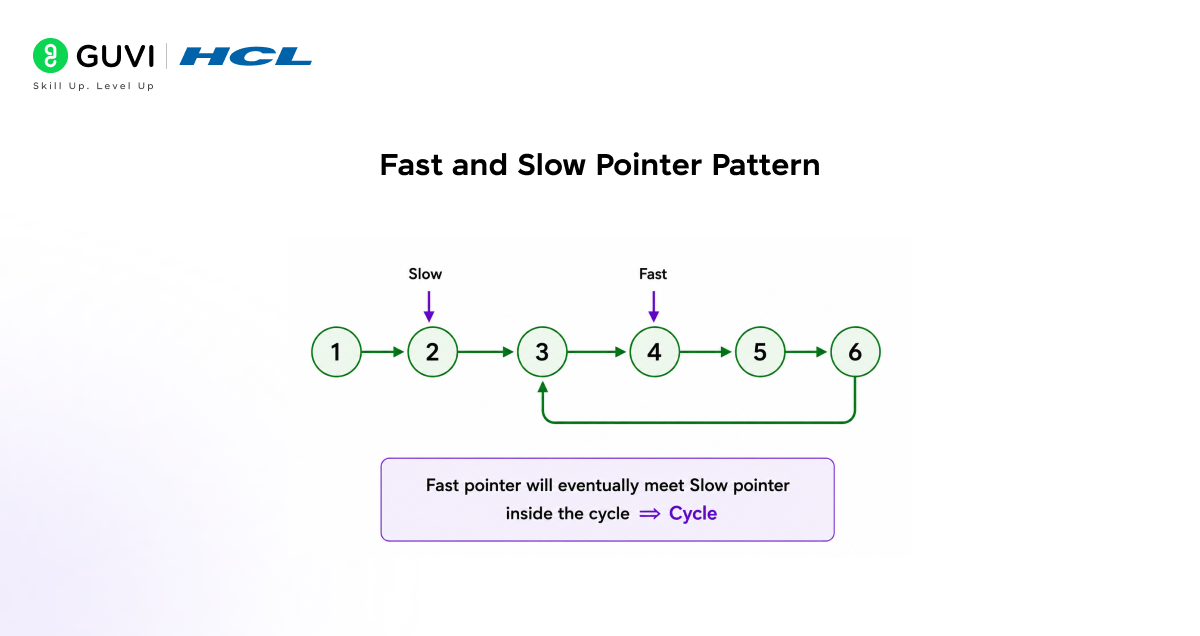
This pattern means two moving pointers meet within a loop.
Execution Flow:
1 → 2 → 3 → 4 → 5 → 6 → 3
- Here, two pointers move inside the same path. The slow pointer moves one step at a time, while the fast pointer moves faster.
- The flow goes 1 → 2 → 3 → 4 → 5 → 6, but node 6 again connects back to 3.
- Because of this loop, both pointers keep rotating around the same cycle, and eventually the fast pointer catches up to the slow pointer.
Code
function hasCycle(head) {
let slow = head;
let fast = head;
while (fast && fast.next) {
slow = slow.next;
fast = fast.next.next;
if (slow === fast) {
return true;
}
}
return false;
}
// Output: true
Code Explanation:
- Two pointers are created: slow moves one step at a time, while fast moves two steps at a time.
- If there is no loop, the fast pointer reaches the end and traversal stops.
- If a cycle exists, both pointers keep rotating within the loop and eventually meet.
5. Union-Find Pattern
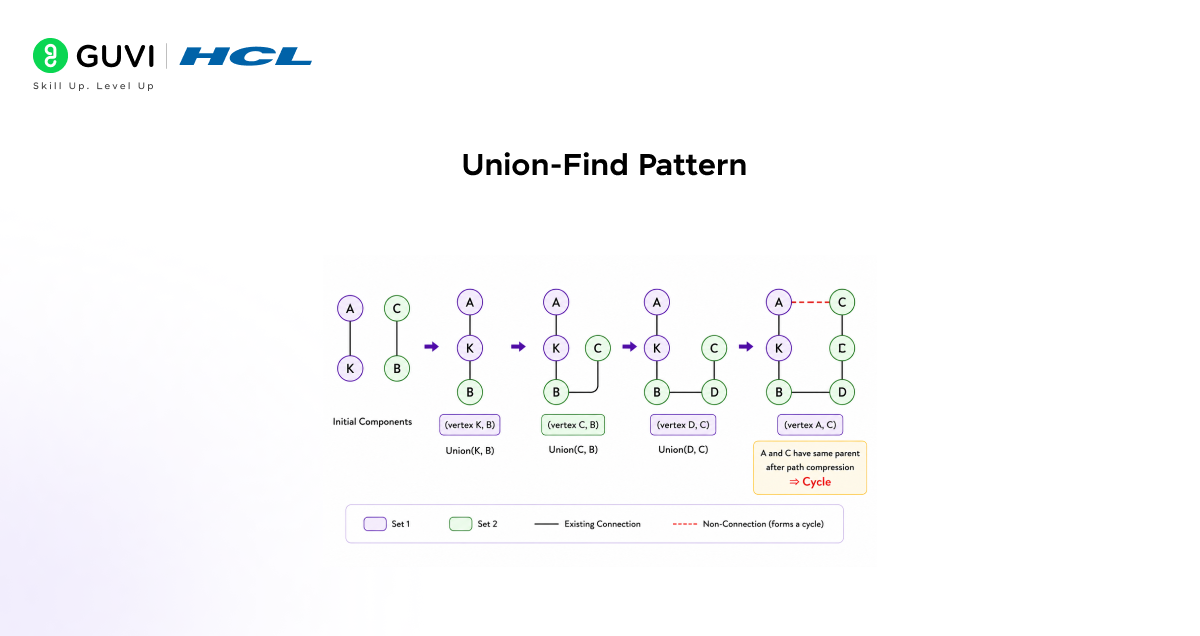
This pattern means two nodes from the same connected group are connected again.
Execution Flow:
(A, B) → (C, D) → (B, D)
- In this pattern, nodes are grouped. First, A connects with B, then C connects with D.
- After that, we try connecting B to D. But B and D are already indirectly connected through earlier connections, so adding another connection closes the path and creates a cycle.
Code
function hasCycle(edges) {
let parent = {};
function find(x) {
if (parent[x] === undefined) parent[x] = x;
if (parent[x] !== x) {
parent[x] = find(parent[x]);
}
return parent[x];
}
for (let [a, b] of edges) {
let pa = find(a);
let pb = find(b);
if (pa === pb) return true;
parent[pa] = pb;
}
return false;
}
// Output: true
Code Explanation:
- Every node is placed inside a group using the Union-Find technique.
- Before connecting two nodes, the code checks whether both already belong to the same parent group.
- If both nodes are already connected indirectly, adding the new edge creates a cycle.
Get DSA-ready with HCL GUVI’s DSA using Python Course—simple, clear concepts, real problem-solving practice, and smart step-by-step learning that builds strong thinking skills and makes you interview-ready with confidence.
Conclusion
Cycle Detection in an undirected graph helps identify patterns within a connected component before they can lead to infinite loops or broken dependencies. By simply exploring concepts such as visited tracking, parent checking, DFS back edges, fast-slow pointers, and Union-Find, we can efficiently detect cycles in various real-world systems. Once we understand these patterns, it is much easier to break down the graph problems into more understandable chunks.
FAQs
Why do some cycle detection algorithms use extra memory while others do not?
Some methods store visited nodes to track traversal, while others use pointers or grouping techniques to avoid extra storage.
Why is the parent node ignored in undirected graphs?
Because going back to the node you just came from is a normal move and does not indicate a cycle.
Which cycle-detection approach is easiest for beginners to understand?
The method that marks and checks visited nodes during traversal feels the most direct and simple to follow.
Why is depth-first search commonly used in cycle detection?
Because it explores one path deeply, making it easier to notice when a path starts repeating.
What problems can happen if cycles are not detected in systems?
Systems may get stuck in loops, experience delayed processing, or have broken dependency chains.
Where is the fast and slow pointer technique mainly used in real applications?
It is mainly used in structures where elements are connected in sequence, enabling efficient detection of loops.
Success Stories















Did you enjoy this article?