


Data Structure Articles
Sliding Window Technique: Explained with Examples
Two Pointer Technique: Problems and Applications


Get In Touch For Details! Request More Information

“Leaders in an Array” is a basic idea derived from observing the behaviour of elements by comparing each element with all others to its right. It suggests a new approach to considering the list’s internal order.
The concept simply relates the small details to form a comprehensible structure of how elements are highlighted in the list. In this blog, we will discuss Leaders in an Array in detail to build a clear understanding of how they work.
Table of contents
- TL;DR Summary
- Leaders in An Array: Definition
- Example:
- Variations of Leaders in An Array
- Standard Leaders in an Array
- Leaders in Reverse Order
- Count of Leaders in an Array
- Conclusion
- FAQs
- Is Leaders in an Array only about comparing adjacent elements?
- Do we need to reverse the result in this problem?
- Can an array have multiple leaders?
- What happens if the array is in decreasing order?
- Is extra space required to solve this problem?
- Why is the last element always a leader?
TL;DR Summary
- This blog helps you understand Leaders in an Array simply by clearly explaining the core idea.
- It explores the key variations of Leaders in an Array to better understand and practice them.
- It shows a simple idea of how the concept can be linked to stock analysis (future peak checking).
Leaders in an Array is a concept used in stock analysis: stock prices are treated as an array, and we scan from right to left to find days when the price exceeds all subsequent prices.
Leaders in An Array: Definition
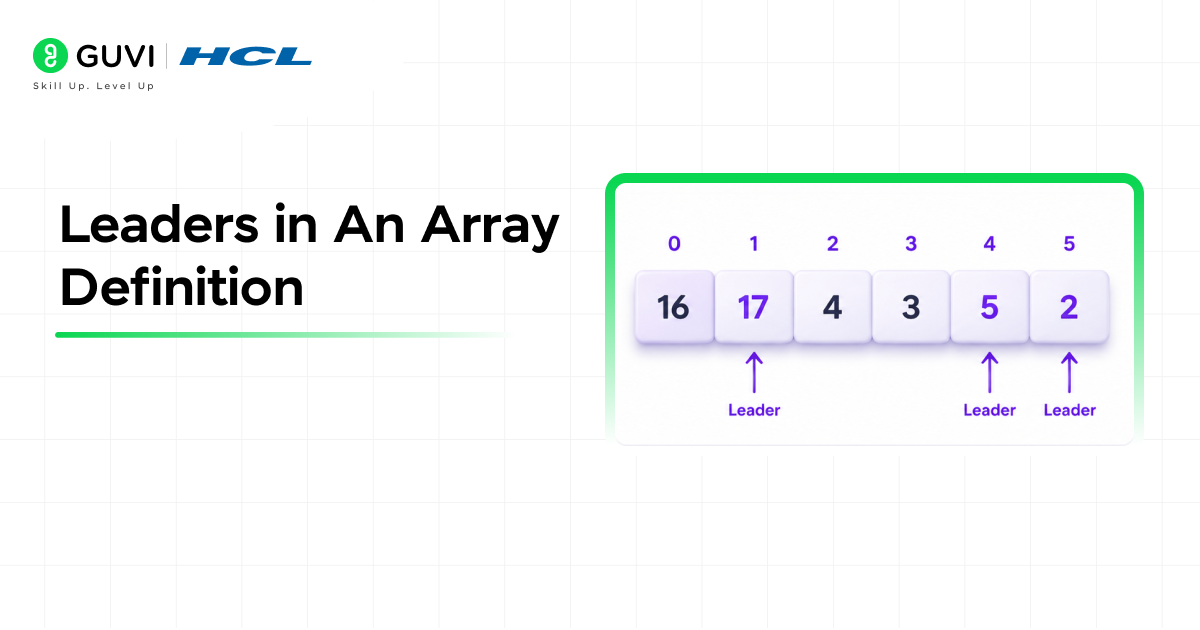
A leader in an Array is an element in the array that is greater than all elements to its right. It involves traversing each value and checking whether any subsequent value is greater than it. Only elements that are not smaller than any value that follows them are considered leaders.
Let’s understand this using an array.
Example:
Array:
[16, 17, 4, 3, 5, 2]
Leaders:
17, 5, 2
Why?
- 17 > 4, 3, 5, 2
- 5 > 2
- 2 is the last element
Visual understanding:
16 17 4 3 5 2
=> These underlined elements are the leaders here.
Important Note:
Remember, the last element is always a leader because nothing is on its right.
Logical Flow
- Start from the right side
- Keep track of the maximum element seen
- If the current element > max, it is a leader
Pseudo flow:
- Start from the last element
- max = last element
- Move left
- If current > max:
- add to answer
- update max
Check out HCL GUVI’s comprehensive self-paced DSA for Programmers Course, designed specifically for individuals who want to master algorithmic problem-solving and prepare for technical interviews with real-world applications.
Variations of Leaders in An Array
In this section, we will discuss mainly 3 variations of Leaders in an Array. Though there are nearly 6 variations, we will restrict ourselves to discussing these 3, as these specific versions more authentically capture the core logic, output handling, and optimisation:
1. Standard Leaders in an Array
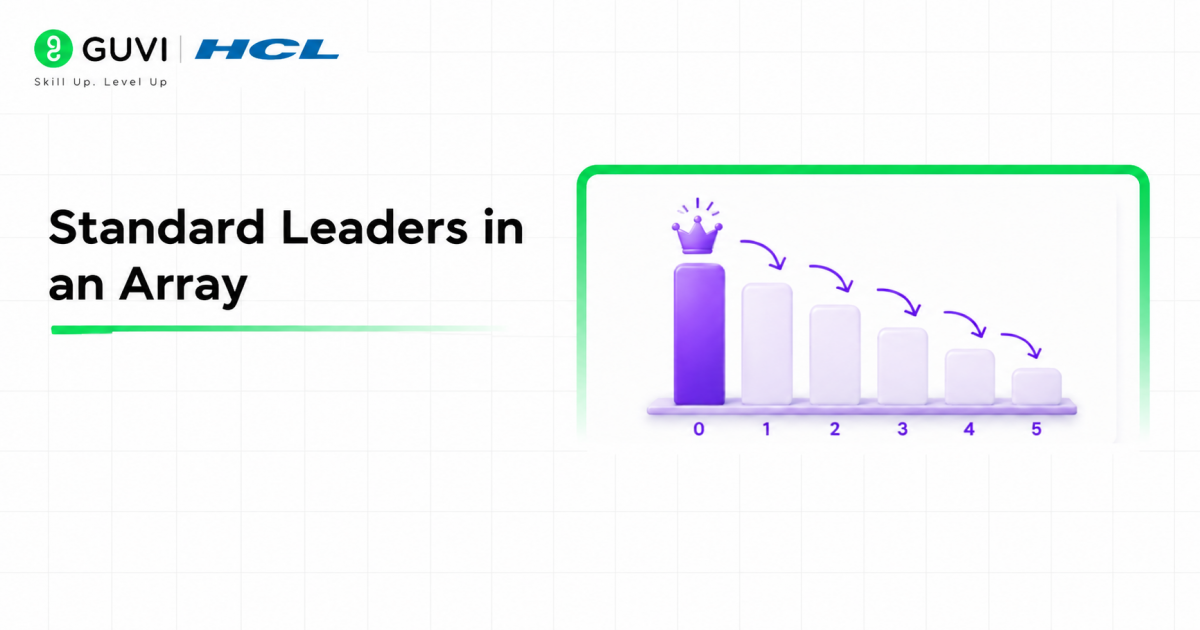
This is the basic form of the problem: you go through an array and find all elements that are greater than every element to their right. The focus is on identifying all such important elements and listing them as the final result.
Example:
Input:
[16, 17, 4, 3, 5, 2]
Output:
[17, 5, 2]
function leadersArray(arr) {
let result = [];
let rIndex = 0;
let maxFromRight = arr[arr.length – 1];
result[rIndex] = maxFromRight;
rIndex++;
for (let i = arr.length – 2; i >= 0; i–) {
if (arr[i] > maxFromRight) {
result[rIndex] = arr[i];
rIndex++;
maxFromRight = arr[i];
}
}
// manual reverse
let start = 0;
let end = rIndex – 1;
while (start < end) {
let temp = result[start];
result[start] = result[end];
result[end] = temp;
start++;
end–;
}
return result;
}
Explanation:
- In this code, we start at the right end of the array and use the last element as the first maximum reference (maxFromRight).
- Then we move left and check each element: if it is greater than max, we store it in the result and update the max.
- We continue this till the start of the array. At the end, we reverse the result because the elements were collected from right to left, giving us the correct order of leaders.
2. Leaders in Reverse Order
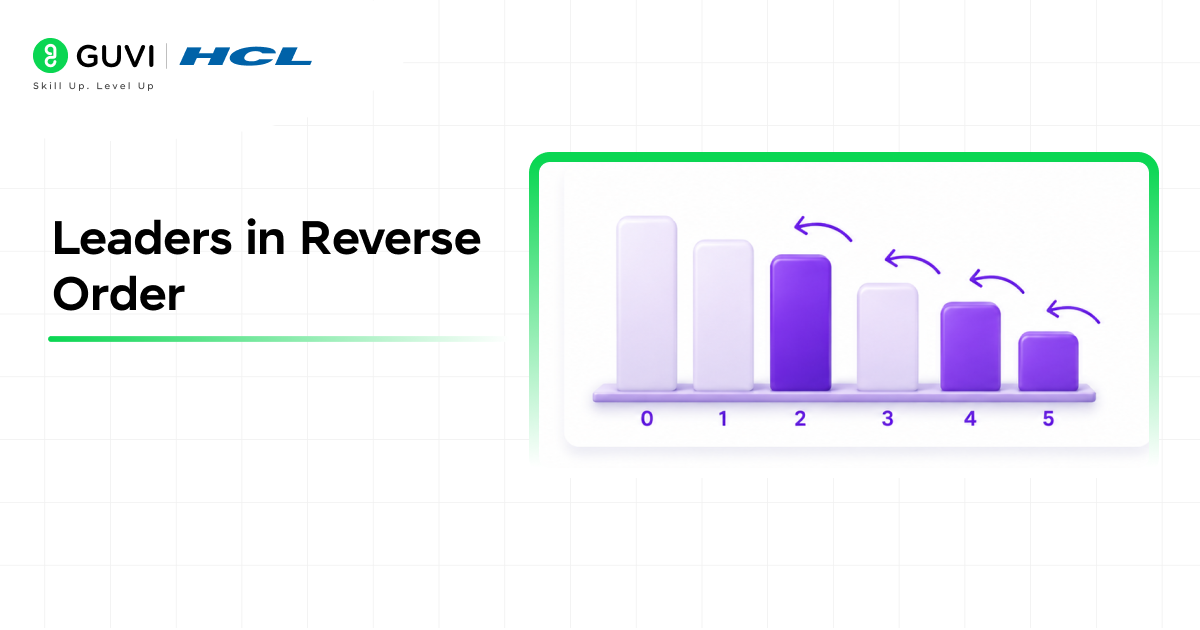
In this variation, you still find the same leader elements, but the output is given in the opposite direction. Instead of arranging them in the original order, they are shown from right to left.

Example:
Input:
[7, 10, 4, 10, 6, 5, 2]
Output:
[2, 5, 6, 10]
function leadersReverseOrder(arr) {
let result = [];
let rIndex = 0;
let maxFromRight = arr[arr.length – 1];
result[rIndex] = maxFromRight;
rIndex++;
for (let i = arr.length – 2; i >= 0; i–) {
if (arr[i] > maxFromRight) {
result[rIndex] = arr[i];
rIndex++;
maxFromRight = arr[i];
}
}
return result;
}
Explanation:
- Here, we again start from the rightmost element as the initial maxFromRight.
- We move left, and whenever an element exceeds max, we store it in the result.
- We do not reverse the result because we already want the leaders in reverse order, so we return the collected values directly.
3. Count of Leaders in an Array
Here, instead of listing the leader elements, you only calculate how many such elements exist in the array. The main focus is on finding the total number of leaders, not on displaying them.
Example:
Input:
[10, 22, 12, 3, 0, 6]
Output:
3
function countLeaders(arr) {
let count = 1;
let maxFromRight = arr[arr.length – 1];
for (let i = arr.length – 2; i >= 0; i–) {
if (arr[i] > maxFromRight) {
count++;
maxFromRight = arr[i];
}
}
return count;
}
Explanation:
- In this case, we don’t store elements; we only use a count variable. We start from the right side, set the last element as the initial max, and treat it as a leader.
- Then we move left, and whenever we find an element greater than max, we increase the count and update max.
- Finally, we return the total number of leaders.
Crack DSA rounds the smart way with HCL GUVI’s DSA using Python Course. Learn Data Structures & Algorithms in a simple, no-confusion style with real problem-solving practice that actually builds your thinking. From basics to solid concepts, everything is designed to level up your coding skills. Get certified, build confidence, and start your DSA grind today!
Conclusion
We’ve come to the end of this blog on Leaders in an Array. This topic shows how a simple idea can lead to a clear pattern of thinking when working with arrays. With the concepts and variations we discussed, you now have a better understanding of how to look at such problems in a structured way. Keep practising these patterns, and they will start feeling more natural over time.
FAQs
Is Leaders in an Array only about comparing adjacent elements?
It is about comparing each element with all elements on its right, not just the ones nearby.
Do we need to reverse the result in this problem?
Reversal depends on how the leaders are collected during traversal and the required output order.
Can an array have multiple leaders?
An array can contain several leader elements based on how the values are distributed.
What happens if the array is in decreasing order?
Every element becomes a leader because each one is greater than all elements to its right.
Is extra space required to solve this problem?
The problem can be solved using a single pass with minimal additional space.
Why is the last element always a leader?
The last element has no elements on its right side for comparison.
Success Stories














Did you enjoy this article?