


Artificial Intelligence and Machine Learning Articles
Optical Character Recognition (OCR): How It Works
Speech-to-Text Engines Compared: Whisper vs Google vs AWS


Get In Touch For Details! Request More Information

What is Particle Swarm Optimization: A Beginner’s Guide
Aug 26, 2026 5 Min Read 19 Views
(Last Updated)
Imagine a flock of birds searching for food across a large field. No single bird knows exactly where the food is, but each bird remembers the best spot it has personally found so far and can see where the rest of the flock is heading. By combining their individual memory with the collective knowledge of the flock, the birds find the food faster than any single bird searching alone. Particle Swarm Optimization takes this simple observation and turns it into a powerful mathematical optimization algorithm.
Table of contents
- TL;DR Summary
- The Biological Inspiration Behind PSO
- How Particle Swarm Optimization Works
- PSO Parameters Explained
- PSO Parameters at a Glance
- Implementing PSO in Python
- Conclusion
- FAQ
- What is Particle Swarm Optimization in simple terms?
- When should I use PSO instead of gradient descent?
- What are the most important PSO parameters to tune?
- How is PSO different from a Genetic Algorithm?
- How many particles should I use in PSO?
- How is PSO different from a Genetic Algorithm?
- How many particles should I use in PSO?
- Can PSO get stuck in local optima?
TL;DR Summary
- Particle Swarm Optimization (PSO) is a nature-inspired optimization algorithm that simulates the social behavior of birds flocking or fish schooling to find the best solution to a problem
- It works by maintaining a population of candidate solutions called particles that move through the search space, guided by their own best position and the best position found by any particle in the swarm
- PSO requires no gradient information, making it applicable to non-differentiable, noisy, and black-box optimization problems
- The two most important parameters are inertia weight, which controls how much a particle keeps moving in its current direction, and the cognitive and social coefficients, which balance individual versus group influence
The Biological Inspiration Behind PSO
When a flock of birds searches for food, each bird follows two simple rules. First, it moves toward the best location it has personally visited. Second, it moves toward the best location any bird in the flock has ever visited. No central coordinator tells the birds what to do. The collective intelligence of the flock emerges from these two simple individual behaviors repeated across every bird at every time step.
Kennedy and Eberhart realized this behavioral model could be turned into an optimization algorithm. Replace birds with candidate solutions. Replace the search for food with the search for the minimum or maximum of a mathematical function. The result is an algorithm that searches large, complex spaces efficiently using the combined memory and social influence of a population of solutions.
Read More: Multi-Agent AI Systems: Intelligent Agents Solving Problems
Want to build strong machine learning and AI optimization skills that apply across real data science and engineering problems? Explore HCL GUVI’s Artificial Intelligence & Machine Learning Course, designed to help you develop the practical ML foundations modern data roles demand.
How Particle Swarm Optimization Works
- The Core Concepts
In PSO, each candidate solution is called a particle. A particle has three properties:
- Position: Where the particle currently is in the search space. For a problem with two parameters, position is a two-dimensional coordinate. For a problem with ten parameters, position is a ten-dimensional vector.
- Velocity: How fast and in which direction the particle is moving. At each time step, the particle moves by adding its velocity to its current position.
- Personal best (pBest): The best position this particle has ever visited, measured by the objective function you are trying to optimize.
The swarm also tracks one global property:
- Global best (gBest): The best position any particle in the entire swarm has ever visited.
PSO has been applied to the problem of training deep neural networks as an alternative to backpropagation, and in several studies on small to medium-sized networks, PSO-trained networks matched or exceeded the accuracy of gradient descent trained networks while being more robust to the choice of initial weights. This is because PSO explores the weight space globally rather than following a local gradient that can lead to poor local minima.
- The Update Rules
At each time step, every particle updates its velocity and then its position using two simple equations.
The velocity update combines three components:
- Inertia: The particle keeps some fraction of its current velocity, controlled by the inertia weight parameter. This helps particles keep moving rather than stopping immediately when they find a good spot.
- Cognitive component: The particle is attracted toward its personal best position. This represents individual memory and encourages each particle to return to where it personally found the best solution.
- Social component: The particle is attracted toward the global best position. This represents social influence and encourages the swarm to converge toward the best solution found collectively.
PSO Parameters Explained
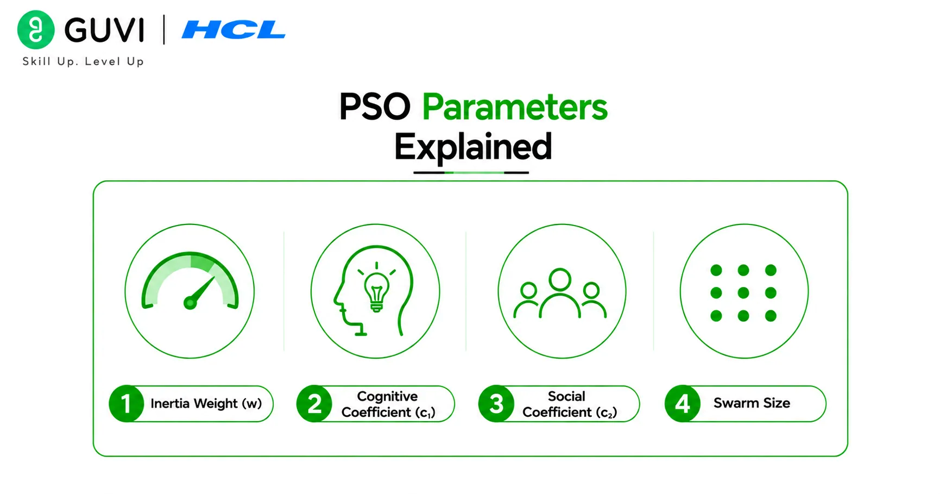
- Inertia Weight (w)
Inertia weight controls how much the particle’s previous velocity influences its new velocity. A high inertia weight keeps particles moving quickly in their current direction, encouraging exploration of new regions. A low inertia weight slows particles down, encouraging exploitation of regions already found to be good.
A common strategy is to start with a higher inertia weight around 0.9 and gradually decrease it to around 0.4 over the course of optimization. This encourages broad exploration early and focused exploitation later.
- Cognitive Coefficient (c1)
The cognitive coefficient controls how strongly each particle is attracted toward its own personal best position. A higher c1 makes particles more individualistic, relying more on their own experience.
- Social Coefficient (c2)
The social coefficient controls how strongly each particle is attracted toward the global best position. A higher c2 makes particles more socially influenced, converging faster toward the best known solution.
A common starting point is to set both c1 and c2 to 2.0, which has been shown to work well across a wide range of problems. The ratio between c1 and c2 controls the balance between individual exploration and collective convergence.
- Swarm Size
The number of particles is typically set between 20 and 50 for most problems. More particles give better coverage of the search space but increase computation time. For simple low-dimensional problems, 20 particles is usually enough. For complex high-dimensional problems, 50 to 100 particles may be needed.
PSO Parameters at a Glance
| Parameter | Typical Range | Effect of Higher Value |
| Inertia weight (w) | 0.4 to 0.9 | More exploration, faster movement |
| Cognitive coefficient (c1) | 1.5 to 2.5 | Particles rely more on personal memory |
| Social coefficient (c2) | 1.5 to 2.5 | Faster convergence to global best |
| Swarm size | 20 to 100 | Better coverage, slower per iteration |
| Max iterations | 100 to 1000 | More time to find better solutions |
James Kennedy, one of the two researchers who invented PSO in 1995, was a social psychologist rather than a computer scientist or engineer. His background in human social behavior directly shaped the cognitive and social components of the algorithm, making PSO one of the few optimization algorithms whose design was explicitly guided by psychological research on how individuals learn from personal experience and social influence.
Implementing PSO in Python
Here is a clean, minimal PSO implementation for minimizing a function:

import numpy as np

def pso(objective_function, bounds, n_particles=30, n_iterations=100,

        w=0.7, c1=2.0, c2=2.0):

    n_dimensions = len(bounds)

    lower = np.array([b[0] for b in bounds])

    upper = np.array([b[1] for b in bounds])

    positions = lower + np.random.rand(n_particles, n_dimensions) * (upper - lower)

    velocities = np.zeros((n_particles, n_dimensions))

    personal_best_positions = positions.copy()

    personal_best_scores = np.array([objective_function(p) for p in positions])

    global_best_idx = np.argmin(personal_best_scores)

    global_best_position = personal_best_positions[global_best_idx].copy()

    global_best_score = personal_best_scores[global_best_idx]

    for iteration in range(n_iterations):

        r1 = np.random.rand(n_particles, n_dimensions)

        r2 = np.random.rand(n_particles, n_dimensions)

        velocities = (w * velocities

                     + c1 * r1 * (personal_best_positions - positions)

                     + c2 * r2 * (global_best_position - positions))

        positions = positions + velocities

        positions = np.clip(positions, lower, upper)

        scores = np.array([objective_function(p) for p in positions])

        improved = scores < personal_best_scores

        personal_best_positions[improved] = positions[improved]

        personal_best_scores[improved] = scores[improved]

        if scores.min() < global_best_score:

            global_best_score = scores.min()

            global_best_position = positions[scores.argmin()].copy()

    return global_best_position, global_best_score

def sphere_function(x):

    return sum(xi**2 for xi in x)

bounds = [(-5, 5)] * 3

best_position, best_score = pso(sphere_function, bounds)

print(f"Best position: {best_position}")

print(f"Best score: {best_score:.6f}")
This implementation handles any objective function and any number of dimensions. Pass your own function and bounds to optimize any problem you choose.
Want to build strong machine learning and AI optimization skills that apply across real data science and engineering problems? Explore HCL GUVI’s Artificial Intelligence & Machine Learning Course, designed to help you develop the practical ML foundations modern data roles demand.
Conclusion
Particle Swarm Optimization is one of the most accessible and practical optimization algorithms available to data scientists and engineers in 2026.
Its simple update rules, few parameters, and intuitive biological inspiration make it easy to understand and implement, while its performance on real-world optimization problems makes it genuinely useful beyond toy examples.
FAQ
What is Particle Swarm Optimization in simple terms?
PSO is an optimization algorithm inspired by bird flocking. A population of candidate solutions called particles moves through the search space guided by their own best position and the best position found by any particle, gradually converging on the optimal solution.
When should I use PSO instead of gradient descent?
Use PSO when your objective function has no gradient, is noisy or discontinuous, or when gradient descent consistently gets stuck in poor local optima. For smooth, differentiable functions where gradient descent works well, PSO is usually unnecessary.
What are the most important PSO parameters to tune?
Inertia weight controls exploration versus exploitation. Cognitive and social coefficients control the balance between individual memory and collective knowledge. Start with w=0.7, c1=2.0, c2=2.0 and adjust based on whether you need more exploration or faster convergence.
How is PSO different from a Genetic Algorithm?
PSO uses velocity and position updates inspired by social behavior. Genetic algorithms use selection, crossover, and mutation inspired by biological evolution. PSO is simpler to implement and generally faster on continuous problems. Genetic algorithms handle discrete and combinatorial problems more naturally.
How many particles should I use in PSO?
for low-dimensional problems and increase to 50 to 100 for complex high-dimensional problems. More particles give better coverage but increase computation time per iteration.
How is PSO different from a Genetic Algorithm?
PSO uses velocity and position updates inspired by social behavior. Genetic algorithms use selection, crossover, and mutation inspired by biological evolution. PSO is simpler to implement and generally faster on continuous problems. Genetic algorithms handle discrete and combinatorial problems more naturally.
How many particles should I use in PSO?
Start with 20 to 30 particles for low-dimensional problems and increase to 50 to 100 for complex high-dimensional problems. More particles give better coverage but increase computation time per iteration.
Can PSO get stuck in local optima?
Yes. PSO can suffer from premature convergence, especially when social influence is too strong. Using a higher inertia weight early in optimization, restarting with new random particles if convergence stalls, or using variants like PSO with constriction factor can help avoid this problem.
Success Stories

About the Author
HCL GUVI
This article was selected and published as part of the HCL GUVI AI Blogathon 2026, an initiative designed to encourage students, AI enthusiasts, and aspiring tech writers to simplify complex AI concepts through impactful technical content. The contest recognized high-quality, original, and insightful AI-focused blogs, with selected authors receiving publication opportunities on the HCL GUVI blog platform along with official author credits and recognition.
View all posts by HCL GUVI
Connect with me @













Did you enjoy this article?