


Artificial Intelligence and Machine Learning Articles
GRU vs LSTM: Which Should You Use?
LSTM Networks Explained: Solving the Vanishing Gradient Problem


Get In Touch For Details! Request More Information
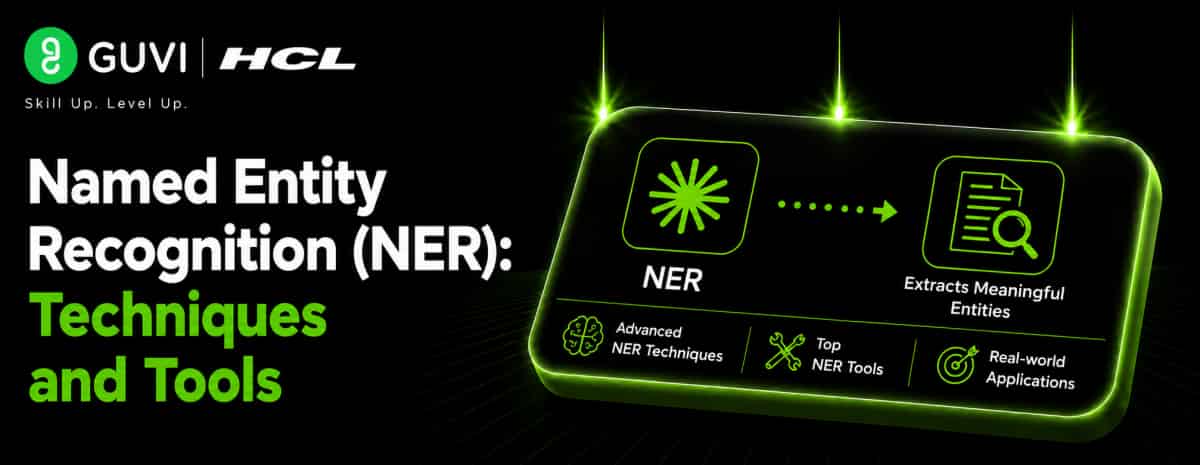
Named Entity Recognition (NER): Techniques and Tools
Aug 26, 2026 4 Min Read 22 Views
(Last Updated)
Text contains important information about people, organizations, locations, dates, products, and other entities. Named Entity Recognition (NER) is a Natural Language Processing (NLP) technique that identifies these entities and assigns them meaningful categories. NER helps AI systems turn unstructured text into structured information, making it useful for search, information extraction, document analysis, and many other applications.
Table of contents
- TL;DR
- Quick Answer
- Why Named Entity Recognition Matters
- What Is Named Entity Recognition?
- How NER Works
- Step 1: Prepare the Text
- Step 2: Tokenize the Text
- Step 3: Analyze Context
- Step 4: Identify Entities
- Step 5: Classify Entities
- Step 6: Return Structured Information
- Common NER Techniques
- Rule-Based NER
- Statistical NER
- Machine Learning NER
- Transformer-Based NER
- Common NER Tools
- spaCy
- NLTK
- Hugging Face Transformers
- NER in an NLP Pipeline
- Common Applications
- Search
- News Analysis
- Customer Support
- Knowledge Graphs
- Benefits of Named Entity Recognition
- Automated Information Extraction
- Better Search
- Faster Document Processing
- Support for Other NLP Tasks
- When Should You Use Named Entity Recognition?
- Information Extraction
- Search
- News Analysis
- Customer Support
- Knowledge Graphs
- Key Concepts to Remember
- A Practical NER Workflow
- Prepare the Text
- Tokenize the Text
- Analyze Context
- Detect Entities
- Classify Entities
- Structure the Results
- Evaluate the Results
- Real-World Applications
- Search Engines
- News Processing
- Customer Support
- Knowledge Graphs
- Best Practices
- Conclusion
- FAQs
- What is Named Entity Recognition?
- What are common NER entity types?
- How does NER identify entities?
- What techniques are used for NER?
- What tools can be used for NER?
- Where is NER used?
- Why is context important in NER?
TL;DR
- NER identifies important entities in text.
- Entities can include people, organizations, locations, and dates.
- NER converts unstructured text into structured information.
- Rule-based and machine learning approaches can be used.
- NER is widely used in information extraction and search.
Quick Answer
| Named Entity Recognition (NER) is an NLP technique that identifies entities in text and classifies them, such as people, organizations, locations, dates, and products. NER systems can use rules, statistical methods, or machine learning models to recognize entities. The extracted information can then support search, document analysis, question answering, and other NLP applications. |
Why Named Entity Recognition Matters
Large amounts of useful information are stored in unstructured text. NER helps applications identify important entities without requiring users or developers to manually extract them.
NER can help with:
- Information extraction
- Document analysis
- Search
- Question answering
- Text classification
- Knowledge graph construction
What Is Named Entity Recognition?
Named Entity Recognition identifies specific entities in a piece of text and assigns each one a category.
For example:
Apple announced a new product in California.
An NER system could identify:
- Apple → Organization
- California → Location
Other common entity types include:
- Person
- Organization
- Location
- Date
- Time
- Money
- Product
The exact categories depend on the NER model and application.
How NER Works
A typical NER workflow includes several stages.
Step 1: Prepare the Text
The input text is cleaned or processed as required by the NLP system.
Step 2: Tokenize the Text
The text is divided into smaller units such as words or tokens.
Step 3: Analyze Context
The model examines the words and their surrounding context to determine whether they represent an entity.
Step 4: Identify Entities
Potential entities are detected within the text.
Step 5: Classify Entities
Each detected entity is assigned an appropriate category.
Step 6: Return Structured Information
The extracted entities can be stored or passed to another NLP system for further processing.
Common NER Techniques
Rule-Based NER
Rule-based systems use predefined patterns, dictionaries, and linguistic rules to identify entities.
They can work well when entity formats are predictable, such as dates or specific identifiers.
Statistical NER
Statistical approaches learn patterns from labeled training data and use those patterns to predict entity categories.
Machine Learning NER
Machine learning models can learn contextual patterns from annotated text and identify entities across different contexts.
Transformer-Based NER
Modern NLP systems can use transformer-based models to understand context and recognize entities more effectively, particularly when entity meaning depends heavily on surrounding text.
Common NER Tools
Several NLP libraries and frameworks provide NER capabilities.
spaCy
spaCy provides pretrained NLP pipelines and tools for identifying entities in text.
NLTK
NLTK includes traditional NLP functionality and can be used for named entity recognition workflows.
Hugging Face Transformers
Transformer models available through Hugging Face can be fine-tuned or used for token classification and NER tasks.
NER in an NLP Pipeline
A basic workflow can look like:
Text → Tokenization → Context Analysis → Entity Detection → Entity Classification → Structured Output
For example, an organization could process customer reviews and extract product names, companies, locations, and other relevant entities automatically.
Common Applications
Search
NER can identify entities in search queries and improve retrieval.
News Analysis
Extract people, organizations, locations, and events from news articles.
Customer Support
Identify products, companies, locations, and other relevant information from support conversations.
Knowledge Graphs
Extract entities that can later be connected to relationships and stored in knowledge graphs.
NER is context-dependent. The same word can represent different entity types depending on how it is used. A strong NER system therefore needs to consider surrounding words rather than relying only on fixed lists of entity names.
Benefits of Named Entity Recognition
Automated Information Extraction
NER can extract structured information from large amounts of text.
Better Search
Entity information can improve search and retrieval systems.
Faster Document Processing
Organizations can automatically identify important information across large document collections.
Support for Other NLP Tasks
NER can provide structured inputs for question answering, summarization, knowledge graphs, and analytics.

Professionals interested in artificial intelligence, NLP, and machine learning can strengthen their expertise through HCL GUVI’s Artificial Intelligence and Machine Learning Course.
When Should You Use Named Entity Recognition?
Named Entity Recognition (NER) is useful when an NLP system needs to identify and categorize important entities within unstructured text.
Information Extraction
Use NER to automatically extract people, organizations, locations, dates, products, and other relevant entities from documents.
Search
NER can identify entities in search queries and help improve information retrieval.
News Analysis
Use NER to extract people, organizations, locations, and other entities from large collections of news articles.
Customer Support
NER can identify products, companies, locations, and other important information from support conversations.
Knowledge Graphs
Extract entities from text and use them as building blocks for creating knowledge graphs.
Key Concepts to Remember
- NER identifies entities in unstructured text.
- Entities are assigned predefined categories.
- Context helps determine an entity’s meaning.
- Rule-based, statistical, machine learning, and transformer-based approaches can be used.
- NER outputs can support search, analytics, and information extraction.
- Entity categories depend on the model and application.
A Practical NER Workflow
1. Prepare the Text
Collect and preprocess the text that needs to be analyzed.
2. Tokenize the Text
Break the text into tokens that the NLP system can process.
3. Analyze Context
Examine surrounding words to determine whether a token or phrase represents an entity.
4. Detect Entities
Identify potential entities within the text.
5. Classify Entities
Assign categories such as person, organization, location, or date.
6. Structure the Results
Store the extracted entities in a structured format for downstream applications.
7. Evaluate the Results
Check whether entities are correctly identified and categorized, particularly in domain-specific text.
Real-World Applications
Search Engines
Identify entities in queries to improve search relevance.
News Processing
Extract people, organizations, locations, and other entities from articles.
Customer Support
Identify products, companies, and other relevant entities from conversations.
Knowledge Graphs
Use extracted entities as structured information for building connected knowledge bases.
The HCL GUVI’s Artificial Intelligence eBook introduces artificial intelligence, machine learning, generative AI, and intelligent automation concepts, helping learners understand modern AI technologies and their practical applications.
Best Practices
- Use entity categories that match the application’s purpose.
- Provide high-quality labeled data for supervised NER models.
- Consider surrounding context when identifying entities.
- Test the model on domain-specific text.
- Review ambiguous and incorrectly classified entities.
- Keep entity definitions consistent.
- Evaluate NER performance regularly as the text domain changes.
Conclusion
Named Entity Recognition (NER) transforms unstructured text into structured information by identifying and classifying important entities. From search and news analysis to customer support and knowledge graphs, NER can reduce manual information extraction and support many NLP workflows. Choosing appropriate entity categories, considering context, and evaluating performance on relevant text are essential for building effective NER systems.
FAQs
1. What is Named Entity Recognition?
Named Entity Recognition (NER) is an NLP technique that identifies entities in text and assigns them categories such as people, organizations, locations, and dates.
2. What are common NER entity types?
Common categories include person, organization, location, date, time, money, and product, although categories vary by model and application.
3. How does NER identify entities?
NER systems analyze text and its context to detect potential entities and classify them into predefined categories.
4. What techniques are used for NER?
NER can use rule-based methods, statistical approaches, machine learning models, and transformer-based models.
5. What tools can be used for NER?
Popular tools include spaCy, NLTK, and Hugging Face Transformers.
6. Where is NER used?
NER is used in search, news analysis, customer support, document processing, knowledge graphs, and information extraction.
7. Why is context important in NER?
The same word can represent different entities depending on how it is used. Considering surrounding words helps the model determine the correct entity and category.
Success Stories

About the Author
HCL GUVI
This article was selected and published as part of the HCL GUVI AI Blogathon 2026, an initiative designed to encourage students, AI enthusiasts, and aspiring tech writers to simplify complex AI concepts through impactful technical content. The contest recognized high-quality, original, and insightful AI-focused blogs, with selected authors receiving publication opportunities on the HCL GUVI blog platform along with official author credits and recognition.
View all posts by HCL GUVI
Connect with me @











Did you enjoy this article?