


Artificial Intelligence and Machine Learning Articles
Optical Character Recognition (OCR): How It Works
Speech-to-Text Engines Compared: Whisper vs Google vs AWS


Get In Touch For Details! Request More Information
Image Super-Resolution: How AI Upscales Images
Aug 26, 2026 4 Min Read 23 Views
(Last Updated)
What if an AI system could turn a blurry, low-resolution image into a sharper and more detailed version? Image Super-Resolution makes this possible by using machine learning models to reconstruct high-resolution images from lower-resolution inputs.
Unlike traditional upscaling, which mainly increases the number of pixels, AI-based super-resolution attempts to learn visual patterns and generate plausible details. This makes it useful for photography, medical imaging, video enhancement, surveillance, and other computer vision applications.
Table of contents
- TL;DR
- What Is Image Super-Resolution?
- How Does AI Image Super-Resolution Work?
- Traditional Upscaling vs AI Super-Resolution
- What Models Are Used for Super-Resolution?
- What Is the Difference Between PSNR and Perceptual Quality?
- Where Is Image Super-Resolution Used?
- Why Is Image Super-Resolution Difficult?
- What Are the Benefits?
- What Are the Challenges?
- Key Takeaways
- Conclusion
- FAQs
- What is Image Super-Resolution?
- How is AI upscaling different from traditional upscaling?
- Can Image Super-Resolution recover lost details?
- Which AI models are used for Image Super-Resolution?
- Where is Image Super-Resolution used?
TL;DR
- Image Super-Resolution reconstructs higher-resolution images from lower-resolution inputs.
- AI models learn patterns from high- and low-resolution image pairs.
- Traditional interpolation mainly estimates missing pixels, while AI can generate learned visual details.
- CNNs, GANs, and transformer-based models can be used for super-resolution.
- Image Super-Resolution can improve visual quality but cannot guarantee recovery of information that was never captured.
What Is Image Super-Resolution?
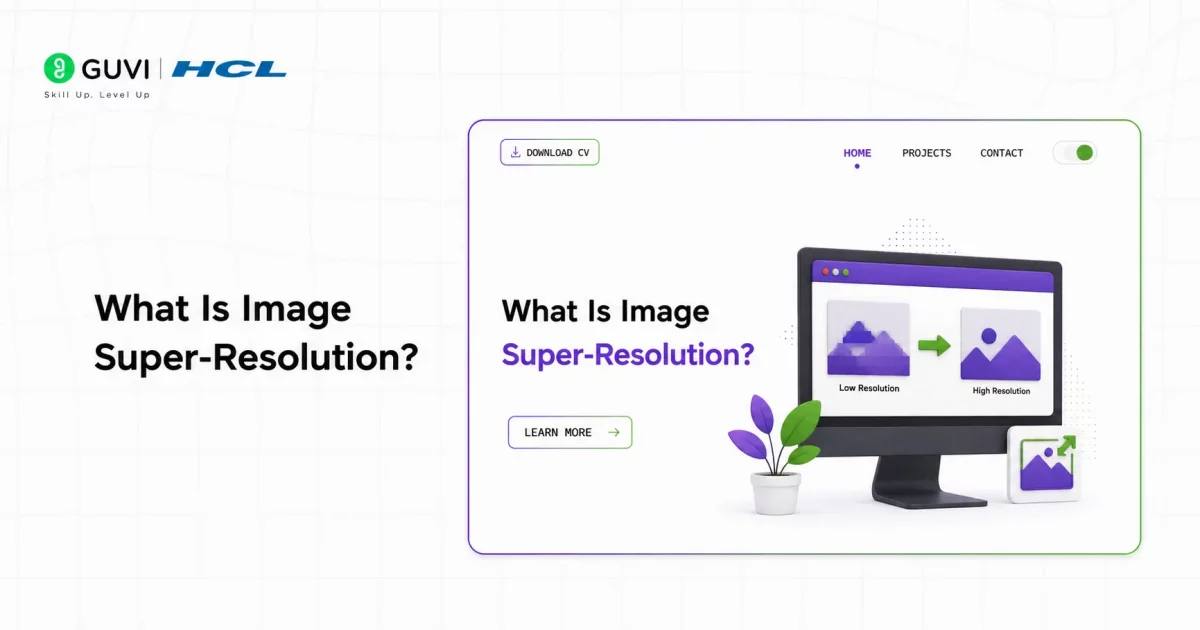
Image Super-Resolution is a computer vision technique that increases the spatial resolution of an image while attempting to preserve or reconstruct meaningful visual details.
For example, a low-resolution image can be processed to produce a larger image with sharper edges and more detailed textures.
The important distinction is that the model does more than simply enlarge the image. It learns relationships between low-resolution and high-resolution images and uses those patterns to estimate what the missing details might look like.
Read More: Best AI Tools for Designers: Achieve Design Excellence
Master AI-powered image processing with HCL GUVI’s Artificial Intelligence & Machine Learning Course. Learn deep learning, computer vision, and real-world AI applications through practical projects.
How Does AI Image Super-Resolution Work?
A typical AI super-resolution system takes a low-resolution image as input and passes it through a trained neural network.
The model learns how visual structures at low resolution correspond to their high-resolution representations.
A simplified workflow is:
- Start with a high-resolution training image.
- Create a lower-resolution version.
- Train the model to reconstruct the original image.
- Compare the generated output with the high-resolution target.
- Adjust the model to reduce reconstruction errors.
- Use the trained model on new low-resolution images.
During inference, the model receives only the low-resolution image and generates an enhanced version.
Super-resolution models can produce details that were not explicitly present in the original low-resolution image. These details are predictions generated from patterns learned during training.
Traditional Upscaling vs AI Super-Resolution
Traditional image resizing methods such as nearest-neighbor, bilinear, and bicubic interpolation estimate new pixels from existing neighboring pixels.
AI-based super-resolution takes a different approach.
| Feature | Traditional Upscaling | AI Super-Resolution |
| Main approach | Mathematical interpolation | Learned reconstruction |
| New details | Limited | Can generate plausible details |
| Computational requirements | Low | Usually higher |
| Adaptability | Fixed method | Learned from training data |
| Visual enhancement | Basic | Potentially more advanced |
Traditional methods remain useful when speed and simplicity are priorities. AI methods become more valuable when visual quality is more important.
What Models Are Used for Super-Resolution?
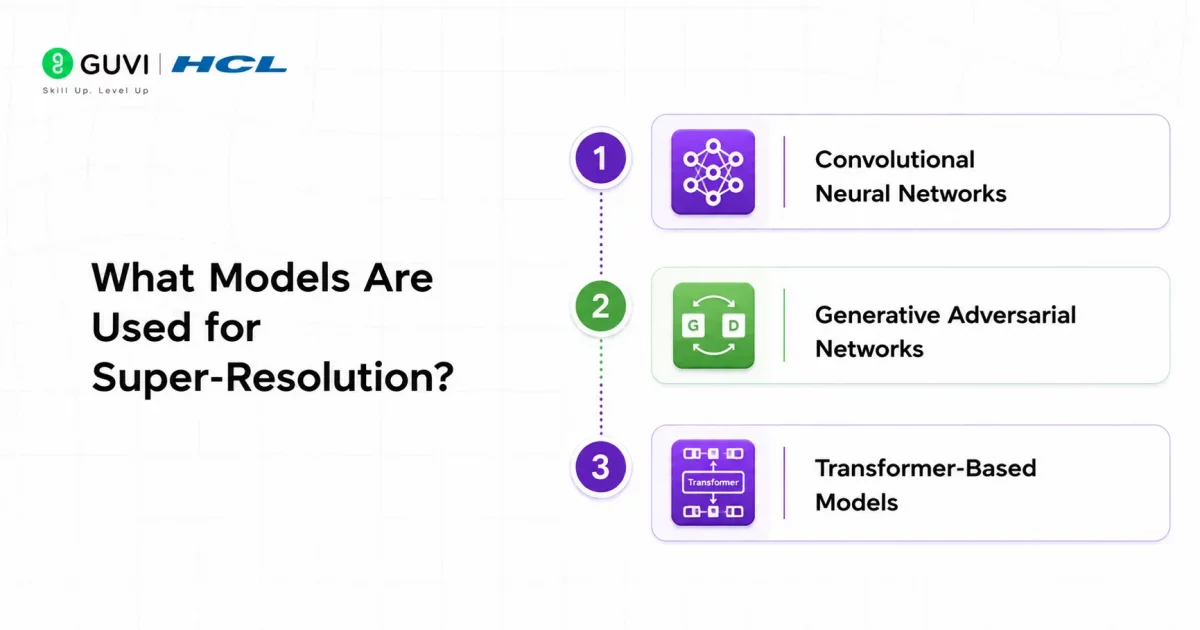
Several types of neural networks have been used for Image Super-Resolution.
- Convolutional Neural Networks
CNN-based models learn local image patterns such as edges, textures, and shapes. Early deep-learning approaches demonstrated that neural networks could outperform traditional interpolation methods for many super-resolution tasks.
- Generative Adversarial Networks
GAN-based approaches use a generator and discriminator to create visually realistic high-resolution images.
The generator attempts to produce convincing details, while the discriminator helps distinguish generated images from real high-resolution images.
- Transformer-Based Models
Transformer architectures can model broader relationships across an image. This can help capture both local details and longer-range visual dependencies.
Modern super-resolution research increasingly explores transformer and hybrid architectures for improved reconstruction quality.
Pro Tip: Choose a super-resolution model based on your actual goal. A model optimized for perceptual quality may produce more visually convincing results than one optimized purely for pixel-level accuracy.
What Is the Difference Between PSNR and Perceptual Quality?
Evaluating super-resolution is not as simple as checking whether two images have identical pixels.
Metrics such as Peak Signal-to-Noise Ratio (PSNR) and Structural Similarity Index Measure (SSIM) compare generated images with reference images.
However, a model with strong numerical scores may not always produce the most visually appealing result.
Perceptual quality considers whether the reconstructed image looks realistic and natural to humans.
This creates an important trade-off between:
- Pixel-level accuracy
- Sharpness
- Texture realism
- Visual plausibility
Where Is Image Super-Resolution Used?
Image Super-Resolution has applications across several industries.
- Photography
Super-resolution can enhance older or low-resolution photographs and improve images intended for larger displays.
- Video Enhancement
Video footage can be upscaled frame by frame to improve its apparent resolution.

- Medical Imaging
Super-resolution research can potentially improve the visual quality of certain medical images. However, medical applications require careful validation because generated details must not be mistaken for confirmed clinical information.
- Surveillance
Security footage may benefit from resolution enhancement when visual clarity is limited.
- Satellite and Remote Sensing
Super-resolution can be used to improve the spatial detail of remotely captured imagery for analysis and visualization.
Why Is Image Super-Resolution Difficult?
Increasing an image’s dimensions is easy. Reconstructing realistic missing information is much harder.
A low-resolution image may contain insufficient information to determine exactly what the original high-resolution image looked like.
For example, a small blurry region could correspond to several different textures or shapes. The model must select a plausible reconstruction based on patterns learned during training.
Warning: AI super-resolution cannot reliably recover ground-truth information that was completely lost. A visually sharper result may contain generated details rather than details that were actually captured by the original camera.
What Are the Benefits?
AI-based Image Super-Resolution can provide several advantages:
- Improves perceived image sharpness.
- Produces larger images for high-resolution displays.
- Enhances visual details.
- Supports restoration workflows.
- Can improve the usefulness of low-resolution visual data.
- Enables better image quality without requiring the original high-resolution source.
These benefits make super-resolution particularly attractive when original high-quality imagery is unavailable.
What Are the Challenges?
Despite its advantages, Image Super-Resolution has limitations.
- Hallucinated Details
Generative models may create realistic-looking textures that are not present in the source image.
- High Computational Requirements
Advanced models can require significant GPU resources, particularly when processing large images or videos.
- Model-Specific Artifacts
Some models may introduce unnatural textures, ringing, oversharpening, or other visual artifacts.
- Domain Dependence
A model trained primarily on photographs may not perform equally well on documents, medical images, satellite imagery, or other specialized content.
Best Practice: Test a super-resolution model using images that closely match your real deployment environment. Training-domain differences can significantly affect the output.
Key Takeaways
- Image Super-Resolution reconstructs higher-resolution images from lower-resolution inputs.
- AI models learn how low-resolution patterns correspond to high-resolution visual structures.
- CNNs, GANs, and transformer-based architectures have been used for super-resolution.
- AI upscaling can produce more detailed results than traditional interpolation.
- Generated details may not represent information actually captured in the original image.
- Model selection should consider both numerical accuracy and perceptual quality.
Master AI-powered image processing with HCL GUVI’s Artificial Intelligence & Machine Learning Course. Learn deep learning, computer vision, and real-world AI applications through practical projects.
Conclusion
Image Super-Resolution demonstrates how AI can improve the visual quality of low-resolution images by learning how detailed images are structured. Instead of simply enlarging pixels, neural networks attempt to reconstruct plausible textures, edges, and other visual information.
However, super-resolution should not be confused with recovering perfectly accurate missing data. The strongest results come from using the right model for the target image type, evaluating visual quality carefully, and understanding the difference between genuine information and AI-generated detail.
FAQs
What is Image Super-Resolution?
Image Super-Resolution is an AI technique that reconstructs a higher-resolution image from a lower-resolution input.
How is AI upscaling different from traditional upscaling?
Traditional methods interpolate existing pixels, while AI models learn patterns that can be used to reconstruct plausible additional visual details.
Can Image Super-Resolution recover lost details?
It can generate plausible details, but it cannot guarantee recovery of information that was completely absent from the original image.
Which AI models are used for Image Super-Resolution?
CNNs, GANs, transformer-based models, and hybrid neural architectures can be used for Image Super-Resolution.
Where is Image Super-Resolution used?
It is used in photography, video enhancement, surveillance, medical imaging research, satellite imagery, and other computer vision applications.
Success Stories

About the Author
HCL GUVI
This article was selected and published as part of the HCL GUVI AI Blogathon 2026, an initiative designed to encourage students, AI enthusiasts, and aspiring tech writers to simplify complex AI concepts through impactful technical content. The contest recognized high-quality, original, and insightful AI-focused blogs, with selected authors receiving publication opportunities on the HCL GUVI blog platform along with official author credits and recognition.
View all posts by HCL GUVI
Connect with me @




Did you enjoy this article?