


Artificial Intelligence and Machine Learning Articles
Data Analyst vs Machine Learning Engineer: Which Career Grows Faster?
Finance Manager to Data Analytics: Career Growth, Salary and Seniority
How to Evaluate LLM Outputs in Production Deployments
AI/ML Skills Gap 2026: Why Companies Can't Find Job-Ready Talent


Get In Touch For Details! Request More Information
\What is Mixture of Experts (MoE) Architecture Explained
Sep 01, 2026 5 Min Read 398 Views
(Last Updated)
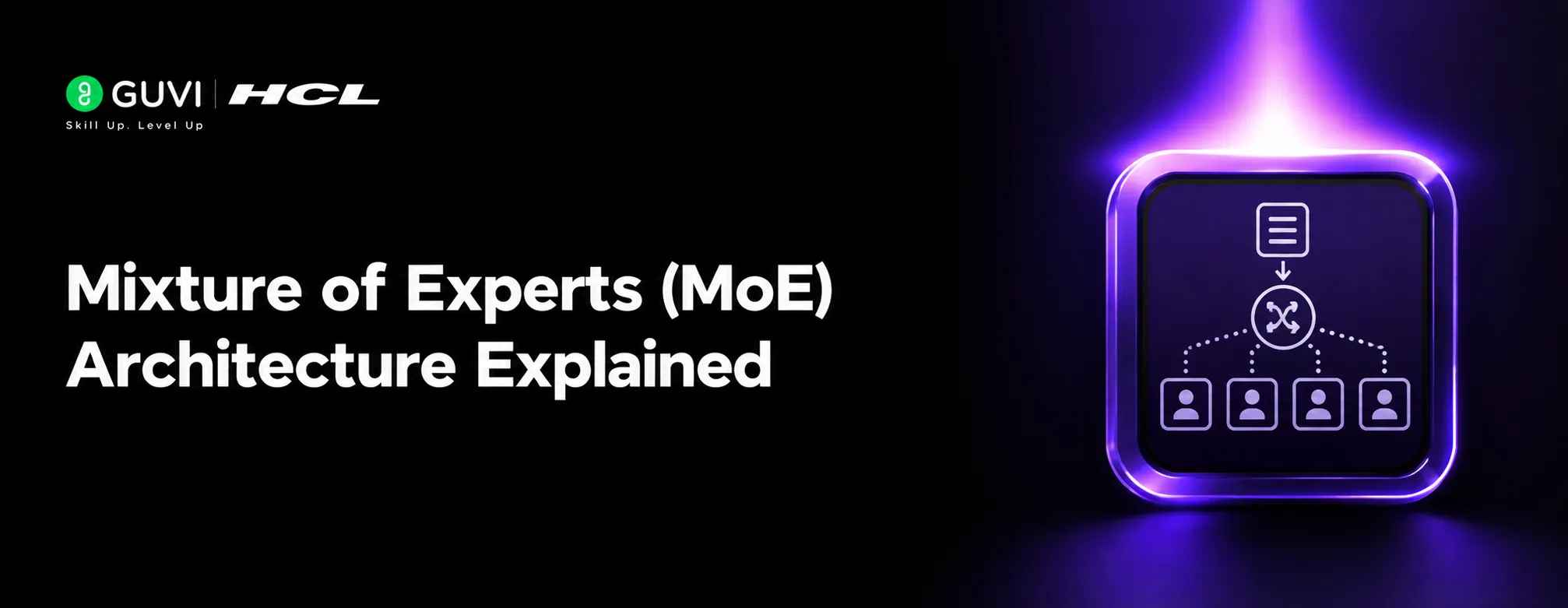
Mixture of Experts (MoE) is a neural network architecture where the model is divided into multiple specialized sub-networks called experts, and a gating network dynamically selects which experts to activate for each input. Instead of passing every input through the entire model, MoE routes each token to only a small subset of experts, allowing models to have far more total parameters than a dense model while keeping the computational cost per forward pass manageable.
Table of contents
- TL;DR Summary
- The Problem MoE Architecture Solves
- How Mixture of Experts Works
- MoE Layer vs Dense Layer
- Sparse MoE vs Dense MoE
- Expert Specialization: What Do Experts Actually Learn?
- MoE Trade-offs and Challenges
- MoE in Modern Frontier Models
- Conclusion
- FAQ
- What is Mixture of Experts (MoE) in simple terms?
- How is MoE different from a standard dense Transformer?
- What is top-k routing in MoE?
- Why does MoE need load balancing?
- Does MoE use more memory than a dense model?
- Which real models use MoE architecture?
TL;DR Summary
- Mixture of Experts (MoE) is an architecture that replaces dense feed-forward layers with multiple specialized expert networks, activating only a subset for each input
- A learned gating network called a router decides which experts process each token at each layer
- MoE allows models to scale total parameter count dramatically without proportionally increasing compute per inference step
- The two most important design decisions are the number of experts and how many experts are activated per token, called top-k routing
The Problem MoE Architecture Solves
In a standard dense Transformer, every token processed by the model activates every parameter in every layer. The feed-forward layers, which make up the majority of parameters in a Transformer, compute the same transformation for every input regardless of what that input contains.
This is computationally expensive and arguably wasteful. A token representing a mathematical expression and a token representing a piece of poetry probably do not need the same processing. A dense model has no way to route different inputs through different specialized computations because every input always goes through everything.
The core idea behind MoE is simple: instead of one large feed-forward network that every token must pass through, replace it with many smaller expert networks and a routing mechanism that sends each token to only the most relevant experts.
The total parameter count equals the number of experts multiplied by the size of each expert. The compute per token equals the size of the activated experts only. These two quantities are now decoupled.
Want to build strong deep learning foundations and understand the architectures powering modern frontier AI systems? Explore HCL GUVI’s Artificial Intelligence & Machine Learning Course, designed to help you develop the practical AI and deep learning skills modern roles demand.
How Mixture of Experts Works
- The Expert Networks
In a standard Transformer, each layer contains a multi-head attention block followed by a feed-forward network (FFN). In an MoE Transformer, the single FFN is replaced by multiple expert FFNs, typically between 8 and 128 experts per layer depending on the model.
Each expert is a separate feed-forward network with its own independent weights. Experts are identical in structure but learn different transformations because they are trained on different subsets of inputs determined by the router.
- The Router (Gating Network)
The router is a small learned network that takes the current token representation as input and outputs a probability distribution over all available experts. The top-k experts with the highest routing scores are selected to process that token.
In top-2 routing, which is the most common configuration, exactly two experts process each token per MoE layer. The outputs of the selected experts are weighted by their routing scores and summed to produce the layer’s output.
The router learns alongside the rest of the model through backpropagation, gradually specializing different experts for different types of inputs without any explicit supervision about what each expert should handle.
- Load Balancing
A critical problem with naive MoE routing is expert collapse: the router learns to always send tokens to the same small subset of experts, leaving most experts undertrained and unused. If all tokens go to expert 1 and expert 2, the other 62 experts in a 64-expert model learn nothing.
To prevent this, MoE training adds an auxiliary load balancing loss that encourages the router to distribute tokens roughly equally across all experts. This loss penalizes configurations where some experts receive far more tokens than others, ensuring all experts are trained and specialized rather than a few becoming dominant.
Read More: Top Generative AI Models 2026
MoE Layer vs Dense Layer
| Aspect | Dense FFN Layer | MoE Layer |
| Parameters per layer | Fixed size | Experts × expert size |
| Parameters activated per token | All parameters | Top-k experts only |
| Compute per token | Full layer compute | k/total experts × layer compute |
| Specialization | None, same for all inputs | Different experts for different inputs |
| Memory requirement | Lower | Higher, all experts must be loaded |
| Training complexity | Standard | Requires load balancing |
| Parallelism | Tensor parallelism | Expert parallelism across devices |
Sparse MoE vs Dense MoE
There are two broad categories of MoE architectures distinguished by how many experts are activated per token.
Dense MoE activates all experts for every token and combines their outputs. This preserves the full representational capacity of every expert but loses the computational efficiency benefit because all parameters still participate in every forward pass. Dense MoE is rarely used in practice at large scale.
Sparse MoE activates only a small number of experts, typically top-1 or top-2 per token, regardless of how many experts exist in the model. This is the dominant form used in modern production models because it decouples total parameter count from per-token compute. A sparse MoE model with 8 experts and top-2 routing uses only 25 percent of its expert parameters per token.
The trade-off is that sparse routing introduces discreteness into the computation, since only a subset of experts contribute to each output, which can make training less stable than a fully differentiable dense model. Load balancing losses and careful initialization are the primary tools for managing this instability.
Expert Specialization: What Do Experts Actually Learn?
A natural question about MoE is whether experts truly specialize in meaningful ways or whether routing is essentially arbitrary.
Research on trained MoE models has found that experts do develop meaningful specializations, though not always in ways that are immediately interpretable to humans.
Studies on Mixtral’s routing behavior found that experts show consistent preferences for different types of tokens. Some experts are preferentially routed tokens related to code syntax. Others show preferences for specific languages or domains. Some appear to specialize by token position within sentences rather than by semantic content.

Importantly, specialization is not absolute. No expert handles only one type of input exclusively. Routing is probabilistic and context-dependent, with the same token receiving different expert assignments in different surrounding contexts. The specialization is statistical rather than categorical.
This emergent specialization is one reason MoE models often outperform dense models of equivalent compute cost: different experts can develop complementary capabilities that a single shared network would have to compromise between.
The concept of Mixture of Experts was first proposed by Jacobs, Jordan, Nowlan, and Hinton in a 1991 paper, over three decades before it became central to frontier LLM architecture. The idea remained largely a theoretical curiosity until the 2017 Sparsely-Gated MoE paper by Google showed it could scale to thousands of experts in a practical language model.
MoE Trade-offs and Challenges
MoE is not a free lunch. It introduces several challenges that must be managed carefully in both training and deployment.
Memory requirements: All experts must be loaded into memory even though only a fraction activate per token. A sparse MoE model uses more memory than a dense model of equivalent per-token compute cost, which creates challenges for deployment on memory-constrained hardware.
Communication overhead: In distributed training and inference, different experts typically reside on different devices. Routing tokens to the correct device requires all-to-all communication operations that can become a bottleneck, particularly at large scale with many experts spread across many accelerators.
Training instability: The discrete routing decisions in sparse MoE introduce non-differentiabilities that make optimization harder than in dense models. Router collapse, where the router fixates on a few experts early in training, must be actively prevented through load balancing losses and careful initialization.
Inference serving complexity: Serving MoE models efficiently requires batching tokens in ways that maximize expert utilization per step. Sparse routing means different tokens in the same batch may activate different experts, complicating the parallel processing that makes GPU inference efficient.
MoE in Modern Frontier Models
MoE architecture has become central to how leading AI labs build their most capable models in 2025 and 2026.
| Model | Organization | MoE Configuration |
| Mixtral 8x7B | Mistral AI | 8 experts, top-2 routing |
| Mixtral 8x22B | Mistral AI | 8 experts, top-2 routing |
| GPT-4 | OpenAI | Reported MoE, details undisclosed |
| Gemini 1.5 Pro | MoE-based, details undisclosed | |
| DeepSeek-V2 | DeepSeek | 160 experts, top-6 routing |
| Grok-1 | xAI | 8 experts, top-2 routing |
The prevalence of MoE across organizations suggests it has become a practical necessity for building frontier-scale models efficiently. Dense models of equivalent capability would require substantially more compute per inference step, making deployment economics significantly worse.
DeepSeek-V2, released in 2024, pushed MoE scaling further than any previously published model with 160 total experts and top-6 routing per token, demonstrating that the number of experts in MoE architectures could be scaled dramatically beyond the 8 to 16 range that earlier models used without training instability overwhelming the efficiency gains.
Want to build strong deep learning foundations and understand the architectures powering modern frontier AI systems? Explore HCL GUVI’s Artificial Intelligence & Machine Learning Course, designed to help you develop the practical AI and deep learning skills modern roles demand.
Conclusion
Mixture of Experts (MoE) solves one of the fundamental tensions in scaling neural networks by decoupling total parameter count from per-token compute.
By replacing single dense feed-forward layers with multiple specialized expert networks and routing each token to only the most relevant experts, MoE allows models to develop broader and more specialized knowledge than a dense model of equivalent computational cost.
FAQ
What is Mixture of Experts (MoE) in simple terms?
MoE is an architecture where a model has many specialized sub-networks called experts and a router that sends each input to only the most relevant experts, allowing more total parameters without proportionally more compute.
How is MoE different from a standard dense Transformer?
A dense Transformer activates all parameters for every token. An MoE Transformer replaces the feed-forward layers with multiple expert networks and activates only the top-k experts per token, keeping compute per token much lower than the total parameter count would suggest.
What is top-k routing in MoE?
Top-k routing means the router selects exactly k experts to process each token, where k is a fixed hyperparameter. Top-2 routing, activating 2 experts per token, is the most common configuration in current production models.
Why does MoE need load balancing?
Without load balancing, the router tends to always select the same few experts, leaving most experts undertrained. A load balancing auxiliary loss encourages the router to distribute tokens roughly equally across all experts during training.
Does MoE use more memory than a dense model?
Yes. All experts must be loaded into memory even though only a few activate per token. An MoE model uses more memory than a dense model of equivalent per-token compute, which is a significant deployment challenge.
Which real models use MoE architecture?
Mixtral 8x7B and 8x22B, GPT-4 (reported), Gemini 1.5 Pro, DeepSeek-V2, and Grok-1 all use MoE architectures, making it the dominant approach for frontier-scale model design in 2025 and 2026.
Success Stories

About the Author
HCL GUVI
This article was selected and published as part of the HCL GUVI AI Blogathon 2026, an initiative designed to encourage students, AI enthusiasts, and aspiring tech writers to simplify complex AI concepts through impactful technical content. The contest recognized high-quality, original, and insightful AI-focused blogs, with selected authors receiving publication opportunities on the HCL GUVI blog platform along with official author credits and recognition.
View all posts by HCL GUVI
Connect with me @

















Did you enjoy this article?