


Artificial Intelligence and Machine Learning Articles
How Generative AI in Business is Changing Operations
Claude + Obsidian: AI-Powered Note-Taking Setup


Get In Touch For Details! Request More Information
What Is a Divisive Clustering in Machine Learning
Jun 04, 2026 4 Min Read 528 Views
(Last Updated)
Clustering is one of the key techniques in unsupervised machine learning for grouping similar data points. Many beginners start with K-Means clustering, but hierarchical methods offer a more organized way to analyze data relationships.
One such method is divisive clustering.
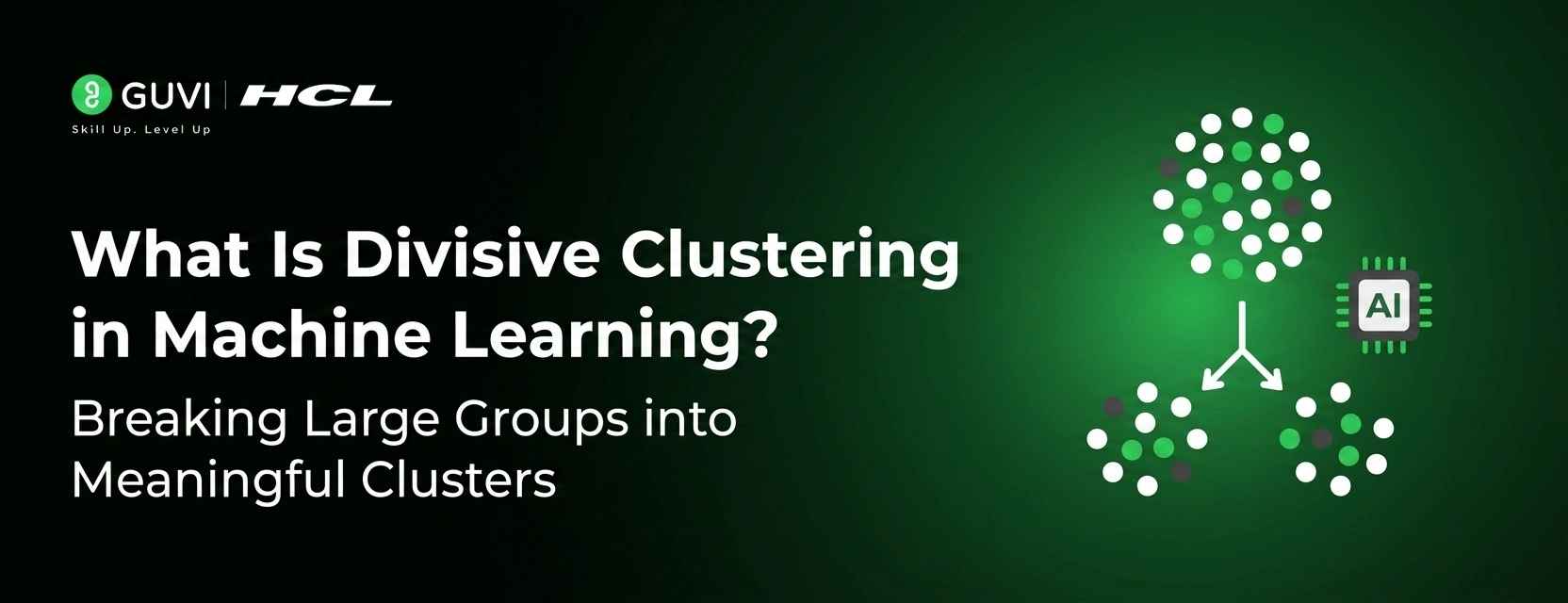
Divisive clustering uses a top-down strategy. The whole dataset starts as one cluster, which the algorithm repeatedly splits into smaller clusters until meaningful groups emerge.
This method is valuable when you want to understand hierarchical relationships within data rather than just assign labels. In this blog, you will learn how divisive clustering works and its various types.
Table of contents
- TL;DR
- What is Divisive Clustering?
- Understanding Hierarchical Clustering
- Agglomerative Clustering
- Divisive Clustering
- How Divisive Clustering Works
- Step 1: Start with a Single Cluster
- Step 2: Identify Dissimilar Data Points
- Step 3: Split the Cluster
- Step 4: Repeat Recursively
- Divisive Clustering Algorithms
- DIANA (Divisive Analysis)
- Bisecting K-Means
- Distance-Based Splitting
- DIANA Algorithm Explained
- Step 1: Initialize One Cluster
- Step 2: Find the Most Dissimilar Point
- Step 3: Create a Splinter Group
- Step 4: Reassign Similar Points
- Step 5: Repeat
- Divisive Clustering vs Agglomerative Clustering
- Advantages of Divisive Clustering
- Better Hierarchical Understanding
- Useful for Complex Data
- Flexible Cluster Analysis
- Improved Visualization
- Disadvantages of Divisive Clustering
- Computationally Expensive
- Sensitive to Distance Metrics
- Difficult to Scale
- Less Common in Libraries
- Applications of Divisive Clustering
- Customer Segmentation
- Document Clustering
- Bioinformatics
- Image Segmentation
- Anomaly Detection
- Implementing Divisive Clustering in Python
- Install Required Libraries
- Import Libraries
- Create Sample Dataset
- Apply Bisecting K Means
- Predict Clusters
- Visualize Clusters
- Best Practices
- Normalize Data Before Clustering
- Choose Distance Metrics Carefully
- Evaluate Cluster Quality
- Avoid Excessive Splitting
- Common Mistakes to Avoid
- Ignoring Feature Scaling
- Using Wrong Distance Metrics
- Overfitting Clusters
- Ignoring Computational Cost
- Real World Example of Divisive Clustering
- Why Divisive Clustering Matters in Modern Machine Learning
- Conclusion
- FAQs
- What is divisive clustering in machine learning?
- What is the difference between divisive and agglomerative clustering?
- What is the DIANA algorithm?
- Is divisive clustering computationally expensive?
- Where is divisive clustering used?
TL;DR
- Divisive clustering is a top-down hierarchical method where all data points begin in one cluster and are gradually split into smaller clusters.
- Unlike agglomerative clustering, divisive clustering splits clusters instead of merging them.
- It helps identify natural groupings in unlabeled datasets and is widely used in customer segmentation, document clustering, bioinformatics, and anomaly detection.
- Common techniques include DIANA (Divisive Analysis Clustering) and distance-based splitting methods.
- Divisive clustering provides better cluster hierarchy visualization but can become costly for large datasets.
What is Divisive Clustering?
Divisive clustering is a hierarchical technique that starts with all data points in a single cluster. The algorithm splits clusters into smaller groups based on similarity or distance measures.
The goal is to maximize similarity within clusters while increasing differences between them.
Unlike partition-based methods like K-Means, divisive clustering creates a hierarchical tree structure called a dendrogram for visualizing cluster separations at different levels.
Understanding Hierarchical Clustering
Hierarchical clustering methods build nested clusters by merging or splitting data points.
There are two main types:
1. Agglomerative Clustering
Agglomerative clustering begins with individual data points and merges them into larger clusters.
2. Divisive Clustering
Divisive clustering starts with one large cluster and divides it recursively.
The output of both methods is usually shown using a dendrogram.
A dendrogram visually represents how clusters relate across various levels of hierarchy.
How Divisive Clustering Works
You can understand the divisive clustering process step by step.
Step 1: Start with a Single Cluster
Initially, all data points are in one cluster.
Step 2: Identify Dissimilar Data Points
The algorithm detects the most dissimilar points or subgroups within the cluster.
Step 3: Split the Cluster
The dataset is divided into two or more smaller clusters.
Step 4: Repeat Recursively
The process continues until:
- The desired number of clusters is reached
- Clusters become sufficiently uniform
- Stopping criteria are met
The repeated splitting creates a hierarchical structure.
Divisive Clustering Algorithms
Several methods can be applied for divisive clustering.
1. DIANA (Divisive Analysis)
DIANA is a well-known divisive clustering algorithm.
It operates by:
- Starting with all observations in one cluster
- Selecting the most dissimilar object
- Creating a new cluster
- Reassigning points based on similarity
DIANA is commonly used in hierarchical clustering analysis.
2. Bisecting K-Means
Bisecting K-Means combines K-Means clustering with divisive hierarchical clustering.
The algorithm:
- Starts with one cluster
- Applies K-Means with K = 2
- Splits the cluster into two groups
- Repeat the process on selected clusters
This method is often faster than traditional divisive approaches.
3. Distance-Based Splitting
Some divisive clustering methods apply distance metrics directly.
Common distance measures include:
- Euclidean distance
- Manhattan distance
- Cosine similarity
The metric you choose greatly impacts clustering performance.
Before learning divisive clustering methods in depth, it is useful to explore the different types of clustering in machine learning and how hierarchical clustering differs from density-based and partition-based approaches.

DIANA Algorithm Explained
The DIANA algorithm is a key divisive clustering technique.
Here’s how it works:
Step 1: Initialize One Cluster
All data points go into a single cluster.
Step 2: Find the Most Dissimilar Point
The algorithm identifies the point with the highest average dissimilarity.
Step 3: Create a Splinter Group
This point forms a new cluster known as a splinter group.
Step 4: Reassign Similar Points
Points that are more similar to the splinter group are moved into this new cluster.
Step 5: Repeat
The process continues recursively until the clusters stabilize.
DIANA is effective for uncovering natural hierarchical relationships within data.
Divisive Clustering vs Agglomerative Clustering
| Feature | Divisive Clustering | Agglomerative Clustering |
| Approach | Top down | Bottom up |
| Starting Point | One large cluster | Individual data points |
| Process | Splitting clusters | Merging clusters |
| Complexity | Higher computational cost | Usually more efficient |
| Common Algorithm | DIANA | Ward linkage |
| Cluster Formation | Recursive division | Progressive merging |
Agglomerative clustering is more common because it typically costs less to compute.
However, divisive clustering can provide clearer cluster separation in certain datasets.
Advantages of Divisive Clustering
1. Better Hierarchical Understanding
Divisive clustering offers a complete hierarchical view of data.
2. Useful for Complex Data
It works well for datasets with nested subgroup structures.
3. Flexible Cluster Analysis
Users can choose various hierarchy levels based on their needs.
4. Improved Visualization
Dendrograms help illustrate relationships between clusters.
What Is Divisive Clustering?
Divisive clustering is a hierarchical clustering technique that follows a top-down approach. It begins with all data points grouped into a single cluster and then recursively splits them into smaller clusters based on their similarities. This process continues until the desired level of granularity is achieved. Divisive clustering is useful for discovering hidden structures and relationships in unlabeled datasets, especially when a clear hierarchical organization of data is required.
Disadvantages of Divisive Clustering
1. Computationally Expensive
Divisive clustering requires many splitting operations, which can be costly for large datasets.
2. Sensitive to Distance Metrics
Choosing inappropriate distance metrics can harm clustering quality.
3. Difficult to Scale
Large datasets may require significantly more processing time.
4. Less Common in Libraries
Compared to agglomerative clustering, divisive clustering may have limited support in some machine learning libraries.
If you want to deepen your knowledge in machine learning, clustering algorithms, and AI systems, check out HCL GUVI’s AI ebook can help you gain practical skills.
Applications of Divisive Clustering
Divisive clustering finds use across various industries.
1. Customer Segmentation
Businesses apply divisive clustering to identify customer groups based on buying behavior.
2. Document Clustering
Search engines and recommendation systems group similar documents.
3. Bioinformatics
Researchers study gene expression patterns and biological relationships.
4. Image Segmentation
Computer vision systems separate images into meaningful areas.
5. Anomaly Detection
Divisive clustering helps isolate unusual or suspicious patterns.
Divisive clustering is widely used in data mining for pattern recognition, customer segmentation, anomaly detection, and relationship discovery within large datasets.
Implementing Divisive Clustering in Python
Though Scikit Learn mainly supports agglomerative clustering, you can still implement divisive clustering concepts with custom logic or bisecting K-Means.
1. Install Required Libraries
pip install scikit-learn matplotlib
2. Import Libraries
from sklearn.datasets import make_blobs
from sklearn.cluster import BisectingKMeans
import matplotlib.pyplot as plt
3. Create Sample Dataset
X, y = make_blobs(n_samples=300,
centers=4,
cluster_std=1.0,
random_state=42)
4. Apply Bisecting K Means
model = BisectingKMeans(n_clusters=4, random_state=42)
model.fit(X)
5. Predict Clusters
labels = model.labels_
6. Visualize Clusters
plt.scatter(X[:, 0], X[:, 1], c=labels)
plt.title(“Divisive Clustering using Bisecting K Means”)
plt.show()
This example shows how to apply divisive clustering concepts using Scikit-Learn.
Best Practices
1. Normalize Data Before Clustering
Feature scaling enhances clustering performance.
2. Choose Distance Metrics Carefully
Different datasets need different similarity measures.
3. Evaluate Cluster Quality
Use silhouette scores and dendrogram analysis to verify results.
4. Avoid Excessive Splitting
Creating too many clusters can reduce interpretability.
Common Mistakes to Avoid
1. Ignoring Feature Scaling
Unscaled features can distort distance calculations.
2. Using Wrong Distance Metrics
The choice of distance metrics directly impacts cluster quality.
3. Overfitting Clusters
Creating excessive clusters can lead to meaningless subgrouping.
4. Ignoring Computational Cost
Divisive clustering may not suit very large datasets.
Real World Example of Divisive Clustering
Imagine an e-commerce company analyzing customer purchasing behavior.
At first, all customers are in one cluster.
The system then divides customers into:
- High spenders
- Moderate spenders
- Budget shoppers
Further divisions might identify:
- Frequent buyers
- Seasonal buyers
- Premium category customers
This hierarchical structure assists businesses in developing targeted marketing campaigns.
Why Divisive Clustering Matters in Modern Machine Learning
As datasets grow more complex, businesses need better methods to uncover hidden relationships.
Divisive clustering offers:
- Hierarchical insight
- Better subgroup discovery
- Improved data exploration
- Enhanced segmentation analysis
It is particularly valuable in AI-driven analytics, recommendation systems, and behavioral analysis.
Hierarchical clustering is also part of the broader machine learning ecosystem, where different machine learning algorithms solve classification, regression, clustering, and prediction problems.
You can look into HCL GUVI’s AI and Machine Learning courses for hands-on experience with clustering, supervised learning, deep learning, and real-world machine learning projects.
Conclusion
Divisive clustering is a powerful hierarchical technique that uses a top-down splitting strategy.
Unlike agglomerative clustering, it begins with one large cluster and recursively divides it into smaller groups.
Although divisive clustering can be costly to compute, it provides significant hierarchical insights and is effective for complex datasets.
Understanding divisive clustering enables machine learning practitioners to enhance data exploration, segmentation, and pattern discovery.
As machine learning continues to evolve, hierarchical techniques like divisive clustering will remain crucial for analyzing complex relationships within data.
FAQs
1. What is divisive clustering in machine learning?
Divisive clustering is a hierarchical clustering method that starts with one large cluster and recursively divides it into smaller clusters.
2. What is the difference between divisive and agglomerative clustering?
Divisive clustering uses a top-down splitting technique, while agglomerative clustering employs a bottom-up merging technique.
3. What is the DIANA algorithm?
DIANA stands for Divisive Analysis Clustering. It is a hierarchical divisive clustering algorithm that repeatedly separates dissimilar data points into new clusters.
4. Is divisive clustering computationally expensive?
Yes. Divisive clustering typically demands more computational resources than agglomerative clustering.
5. Where is divisive clustering used?
Divisive clustering is applied in customer segmentation, bioinformatics, document clustering, image processing, and anomaly detection.
Success Stories

About the Author
Vishalini Devarajan
An Aerospace Engineer turned content writer, I focus on making complex concepts easy to understand through well-structured, reader-friendly blogs. Whether it’s a technical topic or a non-technical one, I love creating content that is clear, engaging, and impactful.
View all posts by Vishalini Devarajan
Connect with me @












Did you enjoy this article?