


Artificial Intelligence and Machine Learning Articles
AI/ML Skills Gap 2026: Why Companies Can't Find Job-Ready Talent
20 AI/ML Interview Questions Recruiters Can Use Without a Tech Background - Best Guide
How Industry-Backed AI/ML Bootcamps Are Changing the AI/ML Hiring Pipeline - Best Guide 2026
From IT Support to AI Engineer: A Realistic Career Switch Guide 2026


Get In Touch For Details! Request More Information

Using Claude for UX Research Synthesis
Aug 17, 2026 3 Min Read 250 Views
(Last Updated)
Claude can simplify UX research synthesis by organizing user feedback, summarizing interviews, identifying recurring themes, and generating actionable insights. While it speeds up the analysis process, UX researchers should validate AI-generated findings against original research data to ensure accurate and user-centered design decisions.
Table of contents
- TL;DR
- What Is Claude for UX Research?
- Why Should You Use Claude for UX Research?
- How Can Claude Help with UX Research Synthesis?
- What UX Research Tasks Can Claude Support?
- Best Practices for Using Claude
- Common Mistakes to Avoid
- Key Takeaways
- Conclusion
- FAQs
- Can Claude summarize UX research interviews?
- Can Claude identify patterns in user research?
- Can Claude replace UX researchers?
- Is Claude useful for usability testing analysis?
- Should AI-generated UX insights be verified?
TL;DR
- Claude helps summarize interviews and usability testing sessions.
- AI identifies recurring themes across qualitative research data.
- It speeds up affinity mapping and insight generation.
- Human validation is essential before making design decisions.
- Claude supports research workflows without replacing UX expertise.
Want to speed up UX research synthesis with AI? Explore HCL GUVI’s UI/UX Design Course and learn user research, wireframing, prototyping, and design thinking through hands-on projects.
What Is Claude for UX Research?

Claude is an AI assistant that helps UX researchers analyze large volumes of qualitative data more efficiently. Instead of manually reviewing dozens of interview transcripts or survey responses, researchers can use Claude to summarize findings, identify patterns, and organize insights for easier decision-making.
Whether you’re conducting user interviews, usability tests, or customer feedback analysis, Claude can reduce repetitive analysis work while keeping your research organized.
Some common use cases include:
- Summarizing interview transcripts
- Organizing usability test findings
- Identifying recurring themes
- Creating research summaries
- Drafting presentation reports
Read More: Claude Tool Integrations: Build a Smarter AI Companion with Connected Workflows
A single UX research project can generate hundreds of pages of qualitative data, making synthesis one of the most time-consuming stages of the research process.
Why Should You Use Claude for UX Research?
Analyzing qualitative research takes significant time and effort. Claude helps researchers process large datasets faster while making patterns easier to identify.
Some key benefits include:
- Faster synthesis. Claude summarizes lengthy transcripts into concise findings, reducing manual effort.
- Pattern recognition. AI groups similar feedback to reveal recurring user pain points and behaviors.
- Improved organization. Research notes become easier to review and share with stakeholders.
- Better reporting. Claude helps draft clear summaries and presentation-ready insights.
Data Point: Research synthesis often takes as much time as data collection itself, making efficient analysis critical for faster product decisions.
Want to speed up UX research synthesis with AI? Explore HCL GUVI’s UI/UX Design Course and learn user research, wireframing, prototyping, and design thinking through hands-on projects.
How Can Claude Help with UX Research Synthesis?
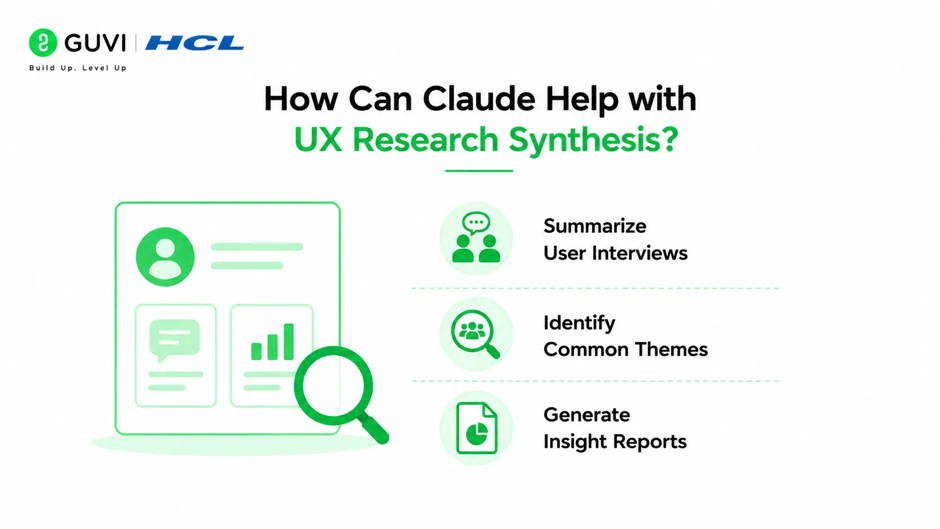
Claude works best after user research has been completed. It helps transform raw research into structured insights that teams can act upon.
- Summarize User Interviews
Claude can summarize lengthy interview transcripts by highlighting key observations, user goals, frustrations, and recurring feedback.
Researchers can quickly review the summaries before returning to the original transcripts for validation.
- Identify Common Themes
When analyzing multiple interviews, Claude can group similar responses into themes that reveal broader user behaviors and needs.
This makes it easier to prioritize usability issues and product improvements.
- Generate Insight Reports
Claude can organize findings into structured reports for stakeholders, including key observations, recommendations, and supporting evidence.
Researchers should review every insight to ensure it accurately reflects participant responses.
Pro Tip: Upload interview transcripts in smaller batches before asking Claude to identify recurring themes across all participants for more organized analysis.

What UX Research Tasks Can Claude Support?
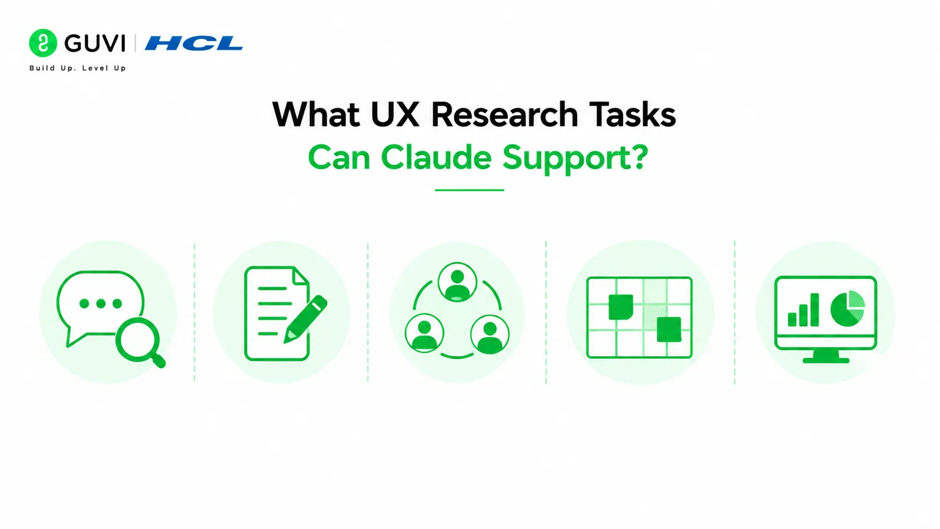
Claude can assist throughout the research synthesis process.
Popular examples include:
- Interview summaries
- Usability test analysis
- Survey response summaries
- Affinity mapping support
- Persona refinement
- Research reports
- Executive summaries
- Stakeholder presentations
Using Claude for repetitive analysis allows researchers to focus more on interpreting user behavior and making informed design decisions.
Best Practices for Using Claude
Claude performs best when paired with structured research methods and careful human review.
Some recommended practices include:
- Remove sensitive participant information.
- Upload well-organized research data.
- Verify AI-generated insights.
- Compare findings with original transcripts.
- Document final research decisions.
These practices help maintain research quality while improving efficiency.
Best Practice: Use Claude to accelerate synthesis, but validate every key insight against your original research before presenting findings to stakeholders.
Common Mistakes to Avoid
AI can simplify analysis, but relying on it without verification may lead to incomplete or misleading conclusions.
Some common mistakes include:
- Skipping transcript validation.
- Accepting every AI-generated insight without review.
- Uploading poorly organized research data.
- Ignoring conflicting participant feedback.
- Overlooking context behind user comments.
Careful validation ensures your final recommendations remain accurate and user-centered.
Warning: Avoid making product decisions based solely on AI-generated summaries—always review the original research to understand participant context.
Key Takeaways
- Claude helps researchers analyze qualitative UX data faster.
- AI simplifies interview summaries and theme identification.
- Human validation remains essential throughout the synthesis process.
- Organized research data improves AI-generated insights.
- Claude supports reporting and stakeholder communication.
- UX expertise is still required to interpret findings and recommend design improvements.
Conclusion
Claude is a valuable assistant for UX researchers who want to reduce the time spent organizing interviews, usability tests, and qualitative feedback. By summarizing transcripts, identifying recurring themes, and drafting research reports, it allows teams to move from data collection to actionable insights more efficiently.
However, successful UX research still depends on careful interpretation, participant context, and human judgment. When combined with established research methods, Claude becomes a powerful tool for accelerating synthesis while supporting better product decisions.
FAQs
1. Can Claude summarize UX research interviews?
Yes. Claude can summarize interview transcripts, highlight key findings, and organize recurring user feedback into concise summaries.
2. Can Claude identify patterns in user research?
Yes. Claude can group similar responses and identify recurring themes across interviews, surveys, and usability testing sessions.
3. Can Claude replace UX researchers?
No. Claude assists with research synthesis, but interpreting findings and making design decisions still requires human expertise.
4. Is Claude useful for usability testing analysis?
Yes. Claude can summarize usability test observations, identify usability issues, and organize participant feedback for easier review.
5. Should AI-generated UX insights be verified?
Yes. Researchers should always compare AI-generated summaries with the original research data before sharing recommendations or making product decisions.
Success Stories

About the Author
Vishalini Devarajan
An Aerospace Engineer turned content writer, I focus on making complex concepts easy to understand through well-structured, reader-friendly blogs. Whether it’s a technical topic or a non-technical one, I love creating content that is clear, engaging, and impactful.
View all posts by Vishalini Devarajan
Connect with me @












Did you enjoy this article?