

Data Science Articles
Accountant to Data Analyst: Skills, Roadmap and Career Path (2026)
SQL for customer support executives: What to Learn and How to Practice
Accounting Team Lead to Data Analytics Skills and Roadmap
Can an Insurance Professional Become a Data Analyst Early in Their Career?


Get In Touch For Details! Request More Information
Top 8 SQL Courses with Certificates in 2026 [Free + Paid]
Sep 30, 2026 7 Min Read 7485 Views
(Last Updated)
Table of contents
- TL;DR
- Introduction
- Best SQL Courses with Certificates in 2026
- Top SQL Courses with Certificates in 2026
- HCL GUVI’s SQL Course with Certificate
- Why Consider This Course?
- SQL for Data Science (Coursera – University of California, Davis)
- Why Consider This Course?
- The Complete SQL Bootcamp (Udemy)
- Why Consider This Course?
- SQL Essential Training (LinkedIn Learning)
- Why Consider This Course?
- Introduction to SQL (Microsoft via edX)
- Why Consider This Option?
- SQL Fundamentals (DataCamp)
- Why Consider This Course?
- Learn SQL (Codecademy)
- Why Consider This Course?
- Oracle Database SQL Certified Associate (Oracle University)
- Why Consider Oracle Certification?
- Best SQL Courses Based on Your Goal
- Free SQL Courses with Certificates
- What Should You Learn in SQL?
- How to Choose the Right SQL Courses with Certificates?
- What is your current level?
- Which database do you want to learn?
- Does the course include practice?
- What does the certificate actually represent?
- Does the course match your career goal?
- SQL Learning Roadmap for Beginners
- Are SQL Courses With Certificates Worth It?
- If you’re ready to turn your data curiosity into real-world skills
- Wrapping It Up
- FAQs
- Which are the best SQL courses with certificates in 2026?
- Can I learn SQL for free and get a certificate?
- Is SQL easy to learn for beginners?
- How long does it take to learn SQL?
- Do I need coding experience to learn SQL?
- Which SQL should I learn first?
- Is an SQL certificate enough to get a job?
- Can SQL help with a data analyst career?
TL;DR
- The top 8 SQL courses with certificates include HCL GUVI’s SQL Server course, SQL for Data Science by UC Davis on Coursera, The Complete SQL Bootcamp on Udemy, SQL Essential Training on LinkedIn Learning, SQL courses available through edX, DataCamp’s Introduction to SQL, Codecademy’s Learn SQL, and Oracle’s SQL certification path.
- The best choice depends on your goal. Beginners can start with an interactive SQL course, data-focused learners can choose a data science or analytics course. At the same time, professionals interested in database administration can consider a SQL Server or Oracle certification path.
Introduction
SQL is one of those skills that keeps showing up whenever you work with data. From websites and mobile apps to banking systems, e-commerce platforms, and business dashboards, databases are working behind the scenes.
SQL, or Structured Query Language, helps you store, retrieve, filter, update, and analyze data in relational databases.
It is used across data analytics, software development, business intelligence, database administration, and other data-related roles.
But learning SQL from random tutorials is not always enough. A structured SQL course can help you understand the basics, practice queries, work with databases, and earn a certificate that shows you completed the course.
If you are looking for SQL courses with certificates in 2026, plenty of free and paid options are available. The right one depends on your current level, career goal, preferred database, learning style, and budget.
Best SQL Courses with Certificates in 2026
| No. | SQL Course | Platform | Level | Certificate | Best For |
| 1 | SQL Server | HCL GUVI | Beginner–Intermediate | Yes | SQL Server and database learning |
| 2 | SQL for Data Science | Coursera – UC Davis | Beginner | Yes | Data science and analytics |
| 3 | The Complete SQL Bootcamp | Udemy | Beginner–Intermediate | Yes | Practical SQL and PostgreSQL |
| 4 | SQL Essential Training | LinkedIn Learning | Beginner | Yes | Learning SQL fundamentals quickly |
| 5 | Introduction to SQL | edX | Beginner | Varies by course | Structured SQL learning |
| 6 | Introduction to SQL | DataCamp | Beginner | Yes | Interactive SQL practice |
| 7 | Learn SQL | Codecademy | Beginner | Yes with eligible plan | Interactive learning |
| 8 | Oracle Database SQL Certification | Oracle | Intermediate–Advanced | Yes | Oracle database professionals |
Note: Course prices, durations, ratings, certificate conditions, and availability can change. Always check the official course page before enrolling.
Top SQL Courses with Certificates in 2026
Let’s take a look at some of the best SQL courses with certificates you can take online to upgrade your skills and career.
1. HCL GUVI’s SQL Course with Certificate
HCL GUVI’s SQL Course with certification is for practitioners who want a course that is based in hands-on experience with real database projects.
It covers everything from SQL basics to advanced query optimization and reporting.
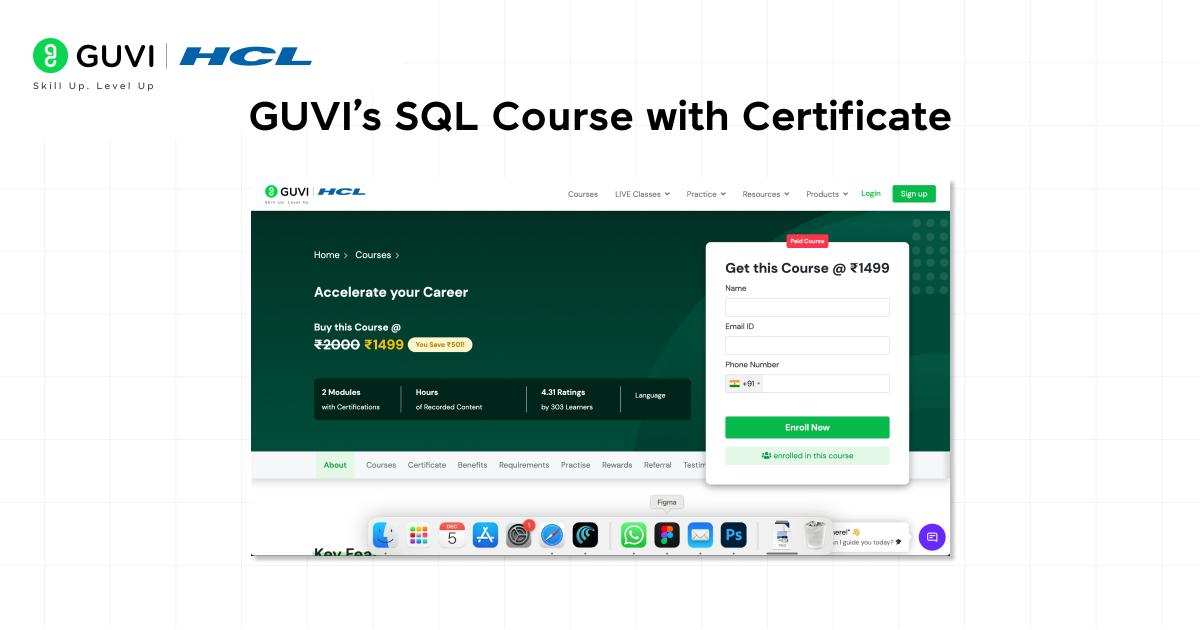
Platform: HCL GUVI
Level: Beginner to Intermediate
Certificate: Yes (HCL GUVI certificate that is recognized by the industry)
Price: Affordable (please consult the HCL GUVI website for current offers)
Duration: Self-paced
Rating: 4.7 / 5
Language: English
Highlights:
- Learn to effectively create, manage, and query databases
- Covers SQL syntax, joins, functions, and sub-queries.
- Hands-on projects after each module and quizzes after each module.
- Lifetime access to course content.
- Certification is supported by recruiters and IT Firms.
Why Consider This Course?
The course is focused specifically on SQL Server instead of only teaching general SQL concepts. This makes it useful if you want to understand Microsoft’s relational database environment along with SQL fundamentals.
Who This Course is For:
This course can be a good starting point for students, beginners, working professionals, and career switchers who want to build SQL Server skills and earn a certificate.
Link: HCL GUVI SQL course
2. SQL for Data Science (Coursera – University of California, Davis)
This beginner SQL course gives you a direct connection to data science applications. You will now be able to access, clean, and analyze data using SQL queries to place yourself in an advanced analytics role.
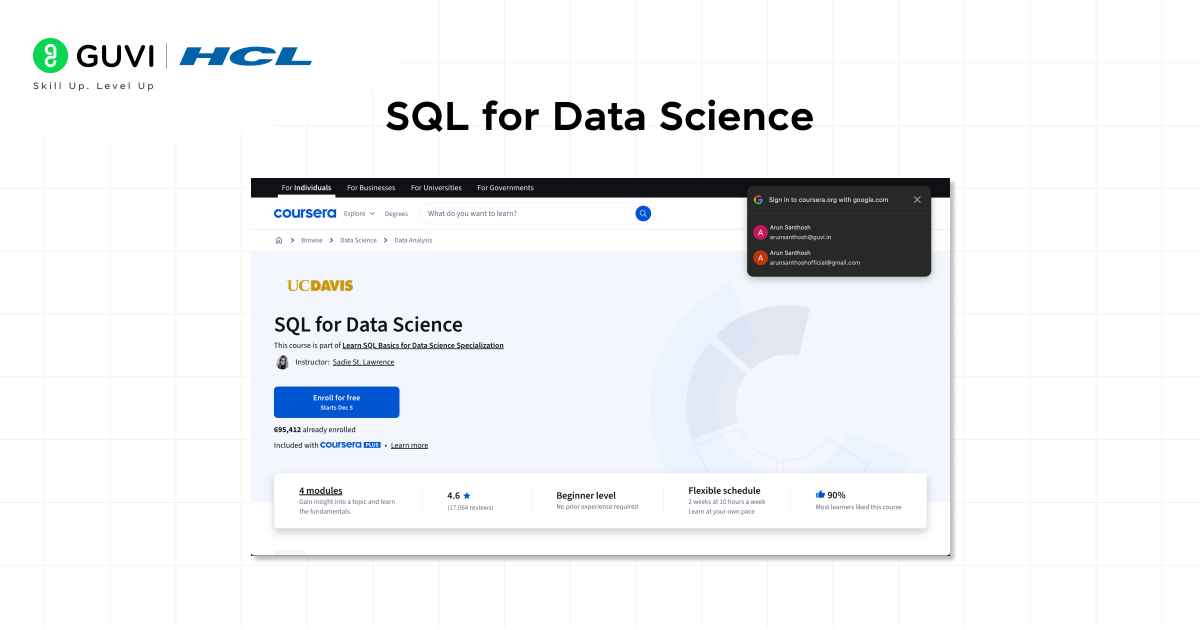
Platform: Coursera
Level: Beginner
Certificate: Yes (University of California, Davis)
Price: Free to audit / Approx. ₹3,600 for certificate.
Duration: 2 weeks, 10 hours a week
Rating: 4.6 / 5
Language: English
Highlights:
- Teaches SQL through data science use cases.
- Includes enhanced assignments and data sets to practice.
- Certificate from a ranked institution in the United States.
Why Consider This Course?
Instead of treating SQL as only a database language, the course connects SQL with data science and analysis. This can make it useful for learners who want to use SQL as part of a broader data career.
Who This Course Is For:
It is suitable for beginners who want to learn SQL for data analysis, data science, or other data-focused roles.
Link: SQL for Data Science
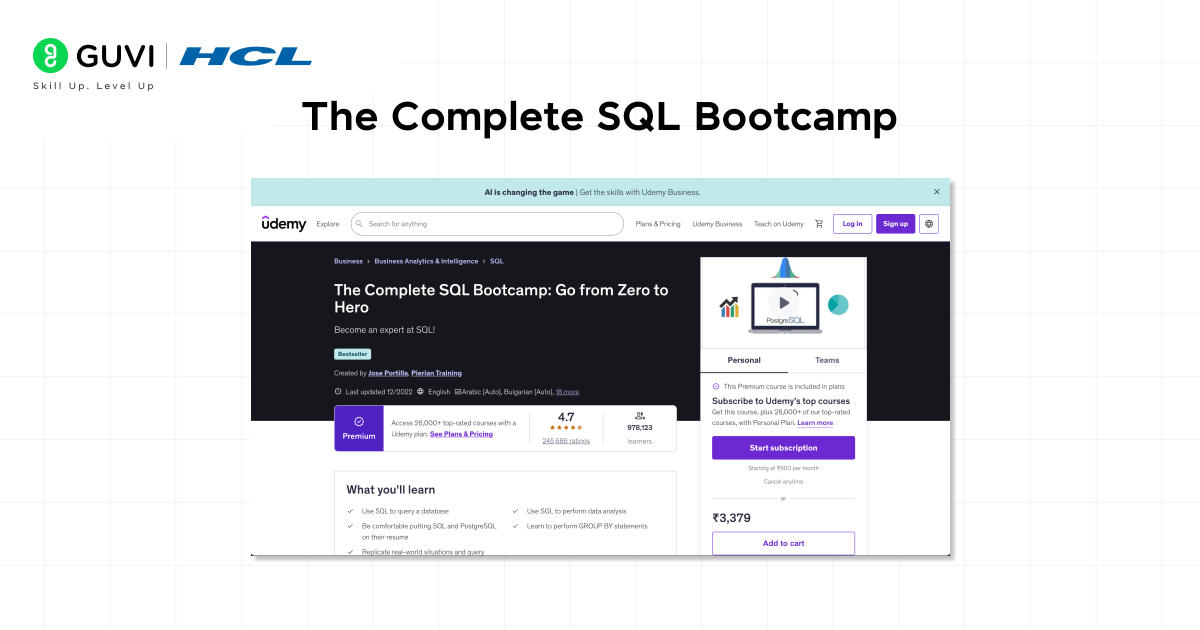
3. The Complete SQL Bootcamp (Udemy)
This SQL Course with a certificate is one of the highest-rated courses for learning SQL Step-by-Step using PostgreSQL.
It includes real-world exercises and assignments that can be done in tandem with your learning.
The course uses PostgreSQL and takes learners from basic SQL concepts to more practical querying and data analysis.
Platform: Udemy
Level: Any Level
Certificate: Yes
Price: ₹3,469 (Often sold at a lower price)
Duration: 9 Hours
Rating: 4.6 / 5
Language: English
Highlights:
- Use SQL to query a database
- Use SQL to perform data analysis
- Be comfortable putting SQL and PostgreSQL on your resume
- Learn to perform GROUP BY statements
- Replicate real-world situations and query reports
Why Consider This Course?
One useful part of this course is that you practice SQL using PostgreSQL instead of learning only the theory.
It also includes examples that simulate real-world reporting and data problems.
Who Is This Course For:
This course is suitable for beginners and learners who want to add practical SQL and PostgreSQL skills to their technical toolkit.
Link: The Complete SQL Bootcamp
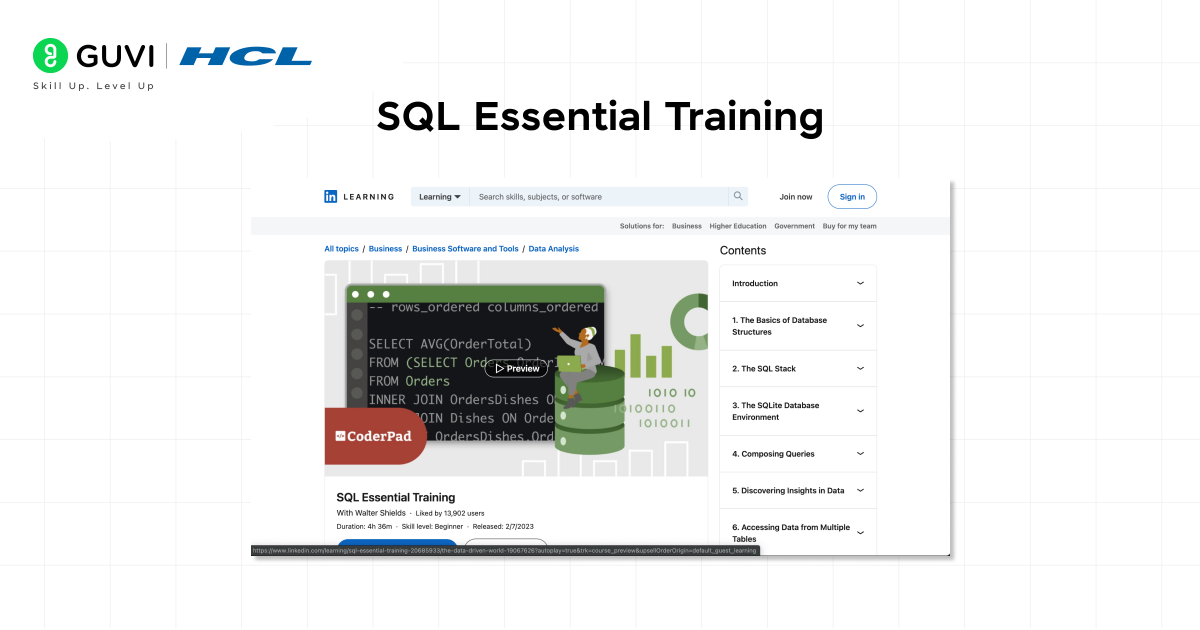
4. SQL Essential Training (LinkedIn Learning)
Short but powerful introduction to SQL, this course is for people who want to get started quickly in learning how to create, query, and manage databases. Good for people upskilling.
The course explains how relational databases work and covers important SQL query concepts. It also includes interactive coding exercises and quizzes.
Platform: LinkedIn Learning
Level: Beginner
Certificate: Yes (from LinkedIn and Microsoft)
Price: Free with LinkedIn Learning Trial/ ₹1,200 per month subscription
Duration: 4 hours 36 mins
Rating: 4.8 / 5
Language: English
Highlights:
- Covers query writing, joins, and subqueries
- Real examples to work with using relational databases
- The certificate is shareable on LinkedIn.
Why Consider This Course?
The course focuses on the SQL essentials instead of spending too much time on database theory. It also includes interactive exercises so that you can practice while learning.
Who This Course is Best For:
It is a good option for beginners who want to understand SQL fundamentals in a relatively short course.
Link: SQL Essential Training
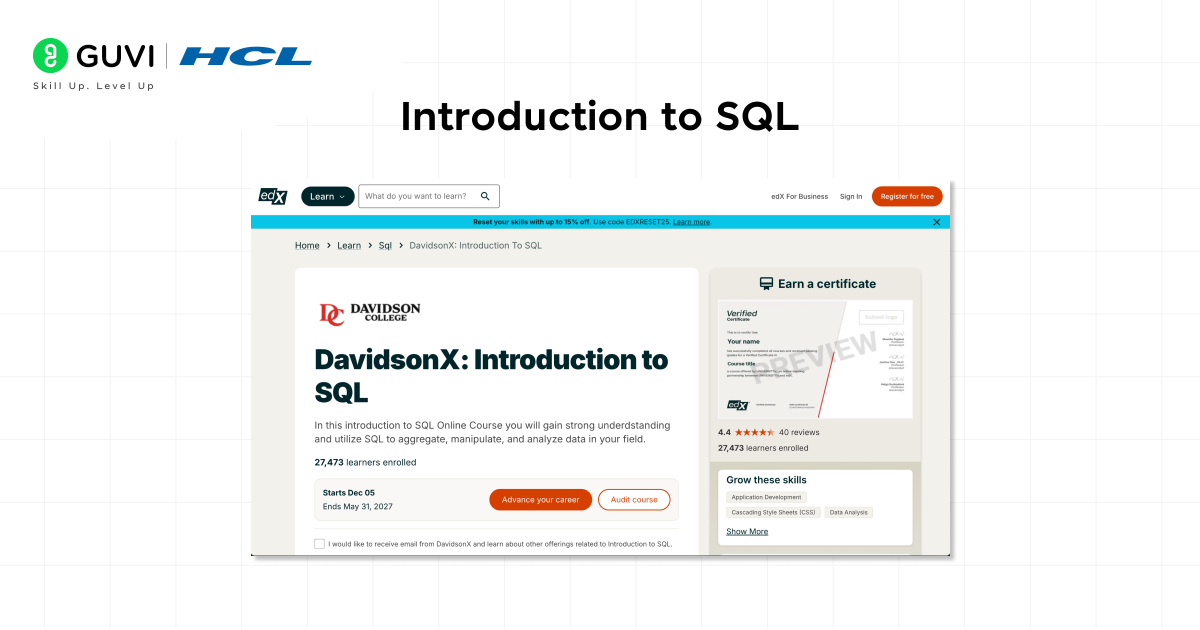
5. Introduction to SQL (Microsoft via edX)
edX offers several SQL learning options for people who want structured online learning.
SQL courses on edX can help learners understand how SQL is used to manage and manipulate relational databases. Depending on the specific course, learners can also explore SQL as part of data analytics or software development.
Platform: edX
Level: Beginner
Certificate: Yes (from Microsoft)
Price: Free to audit / ₹3,000 for certificate
Duration: 4 weeks (3-5 hours per week)
Rating: 4.4 / 5
Language: English
Highlights:
- Built and executed/scheduled by Microsoft professionals
- Real-world exploratory data manipulation exercises
- Official Microsoft certification
Why Consider This Option?
edX provides SQL courses from different institutions and learning providers. This allows learners to choose a course based on their learning goal rather than following only one SQL curriculum.
Who Is This Course Best For:
It can be useful for students and professionals who prefer structured courses and want to explore SQL as part of a wider data or technology learning path.
Link: Introduction to SQL
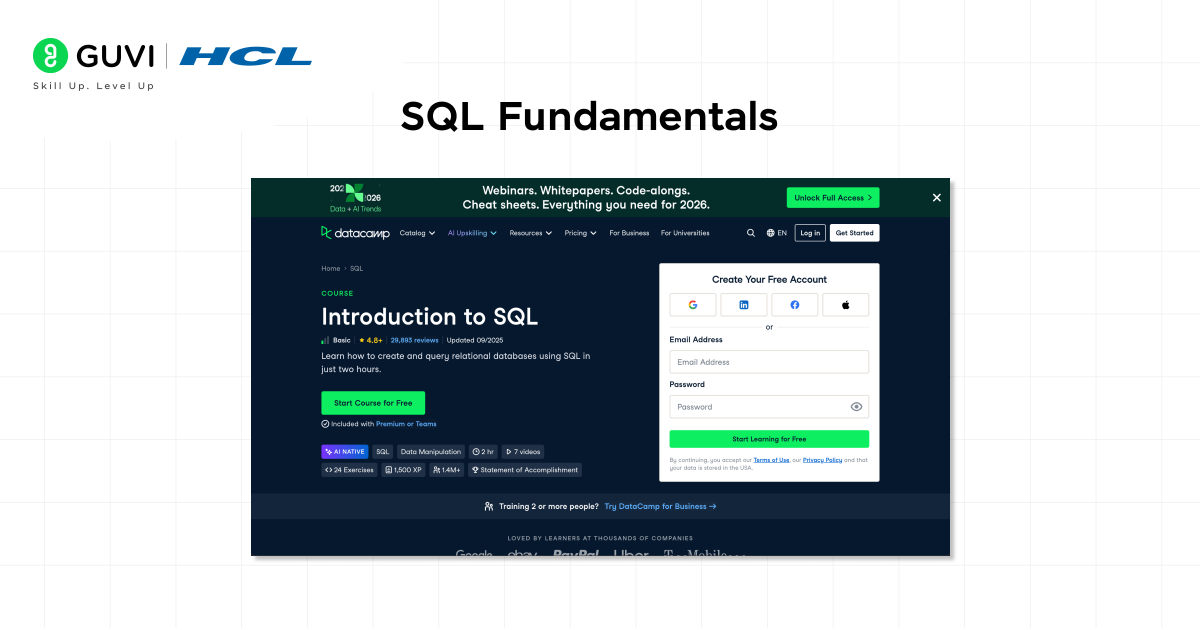
6. SQL Fundamentals (DataCamp)
DataCamp is known for interactive, practice-based learning, and its Introduction to SQL course follows the same approach.
The course introduces relational databases and gives learners opportunities to write SQL queries through interactive exercises.
Platform: DataCamp
Level: Beginner
Certificate: Yes
Price: Subscription – ₹2,000/month approx.
Duration: 30mins -1 hour
Rating: 4.8+ / 5
Language: English
Highlights:
- Interactive browser-based learning
- Short lessons and exercises
- Real feedback while coding in real time
Why Consider This Course?
Instead of watching long videos without practice, you can write queries and work through interactive exercises as you learn.
Who Is This Course Best For:
It is suitable for beginners who prefer short lessons, interactive exercises, and self-paced learning.
Link: SQL Fundamentals
7. Learn SQL (Codecademy)
Codecademy is another popular platform for beginners who want to learn SQL interactively.
Its Learn SQL course teaches learners how to manage datasets and work with SQL through lessons, quizzes, and projects.
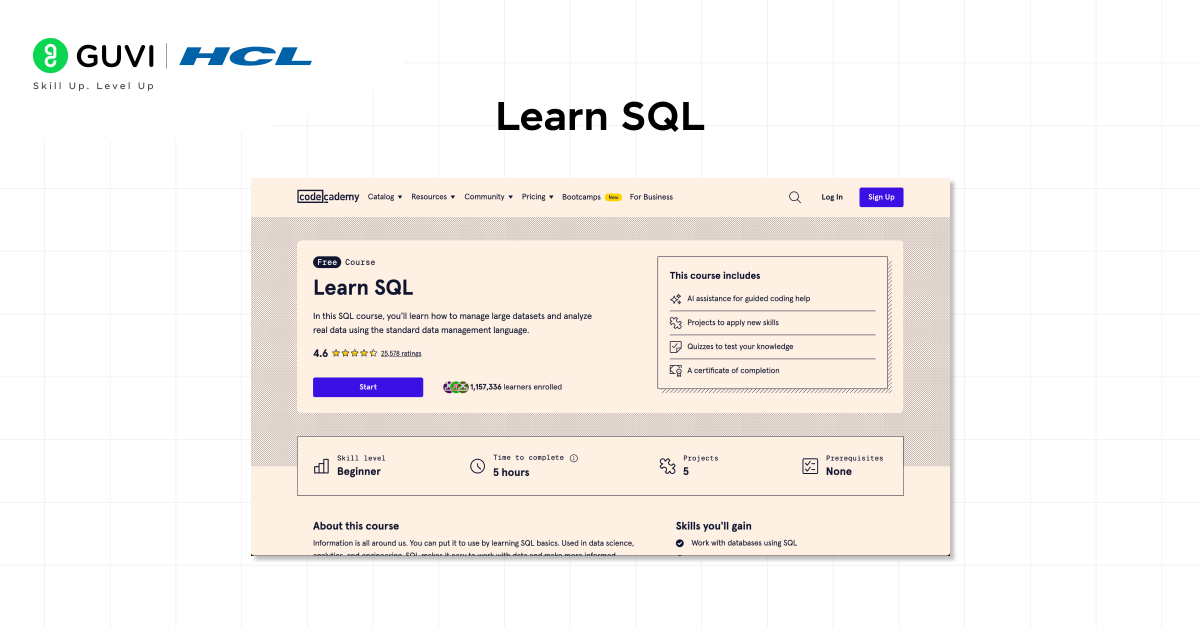
Platform: Codecademy
Level: Beginner
Certificate: Yes (Pro version)
Price: Free basic plan / ₹600 per month (Pro)
Duration: 5 hours
Rating: 4.6 / 5
Language: English
Highlights:
- Interactive learning through exercises
- Real-world SQL projects
- Certification upon completion (with Pro)
Why Consider This Course?
Codecademy allows you to practice SQL directly in the browser. You can learn a concept and immediately use it instead of only reading about it.
The course also includes projects and quizzes to reinforce your learning.
Who Is This Course Best For:
It is a good option for beginners who enjoy interactive learning and want to practice SQL while studying.
Link: Learn SQL
8. Oracle Database SQL Certified Associate (Oracle University)
If you already have some SQL knowledge and want to build skills around Oracle databases, an Oracle SQL certification path can be considered.
Oracle’s certification ecosystem includes database-focused learning and certification options that validate skills related to Oracle technologies.
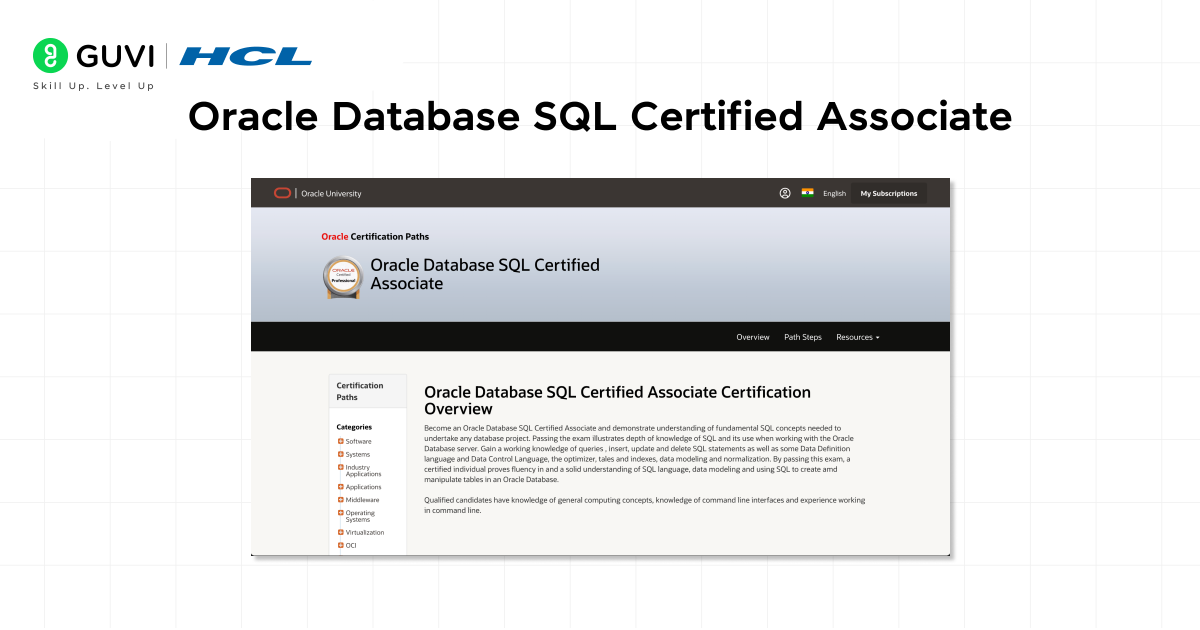
Platform: Oracle
Level: Intermediate to Advanced
Certificate: Yes (Oracle Certified Associate – Database SQL)
Price: Varies by location (~₹10,000–₹15,000 for exam costs)
Duration: Self-paced learning + certification exam
Rating: 4.8 / 5
Language: English
Highlights:
- Globally recognized Oracle certification
- Covers database design, SQL queries, and advanced data manipulation
- Validates your SQL expertise through a proctored exam
- Ideal for professionals aiming for database administration or advanced data roles

Why Consider Oracle Certification?
Oracle certifications are focused on Oracle technologies, so they can be relevant for learners who specifically want to work with Oracle databases rather than learning SQL only as a general-purpose data skill.
Who Is This Course Best For:
Intermediate learners or professionals who want an industry-recognized SQL certification from Oracle to strengthen their career in database management.
Link: Oracle Database SQL Certified Associate
Best SQL Courses Based on Your Goal
There is no single SQL course that works for everyone. Your choice should depend on what you want to do with SQL.
| Your Goal | Course Type to Consider |
| Learn SQL from scratch | Beginner SQL course |
| Learn SQL Server | HCL GUVI SQL Server |
| Use SQL for data science | UC Davis SQL for Data Science |
| Learn PostgreSQL | Complete SQL Bootcamp |
| Learn through interactive exercises | DataCamp or Codecademy |
| Learn SQL quickly | SQL Essential Training |
| Explore structured academic learning | edX SQL courses |
| Work with Oracle databases | Oracle certification path |
Free SQL Courses with Certificates
If you are not ready to spend money on a course, you can start with free SQL learning options.
One example is Kaggle’s Intro to SQL course. It teaches SQL using Google BigQuery and covers topics such as SELECT, WHERE, GROUP BY, HAVING, ORDER BY, AS, WITH, and JOIN.
The current Kaggle course estimates about three hours to earn the certificate and lists the course as having no cost.
Course: Kaggle Intro to SQL
Another option is Codecademy’s free SQL learning content, although certificate availability depends on the plan.
Remember: Free course access and a free certificate are not always the same thing. Check the certificate terms before enrolling.
What Should You Learn in SQL?
A good beginner SQL course should not stop at writing a basic SELECT query.
You should gradually learn:
- Database and relational database basics
- Tables, rows, and columns
- SELECT statements
- WHERE conditions
- ORDER BY
- GROUP BY
- Aggregate functions
- JOINs
- Subqueries
- Common SQL functions
- CTEs
- Views
- Data manipulation
- Window functions
- Query optimization
- Practical SQL problems
You do not have to learn everything on your first day.
Start with the basics and gradually move toward more complex queries as you get comfortable.
How to Choose the Right SQL Courses with Certificates?
Before enrolling in an SQL course, ask yourself a few simple questions.
1. What is your current level?
If you are completely new to SQL, start with a beginner course. If you already know SELECT, JOINs, and aggregate functions, you can move to an intermediate course.
2. Which database do you want to learn?
SQL is a standard language, but different database systems can have their own syntax and features.
You may come across:
- MySQL
- PostgreSQL
- Microsoft SQL Server
- Oracle Database
- BigQuery
- SQLite
So check which database the course uses before enrolling.
3. Does the course include practice?
Watching SQL videos is not enough.
Look for courses that include:
- Coding exercises
- Quizzes
- Assignments
- Projects
- Real datasets
- Query challenges
4. What does the certificate actually represent?
Check whether the certificate is a course completion certificate, a university-backed credential, or a professional certification earned through an exam.
These are not necessarily the same thing.
5. Does the course match your career goal?
- If you want to become a data analyst, choose a course that includes data analysis.
- If you want to work with SQL Server, learn SQL Server.
- If you want to work with Oracle databases, look at Oracle-specific learning.
- Your goal should decide the course.
SQL Learning Roadmap for Beginners
If you are starting from zero, you do not need to learn everything at once.
Follow a simple progression:
Step 1: Understand databases and tables
↓
Step 2: Learn SELECT and WHERE
↓
Step 3: Practice filtering and sorting
↓
Step 4: Learn GROUP BY and aggregate functions
↓
Step 5: Understand JOINs
↓
Step 6: Learn subqueries and CTEs
↓
Step 7: Practice advanced SQL functions
↓
Step 8: Work with real datasets
↓
Step 9: Build SQL projects
↓
Step 10: Add your projects and certificate to your resume
The important part is practice. Even 30–60 minutes of SQL practice regularly can help you become more comfortable with writing queries.
Are SQL Courses With Certificates Worth It?
SQL Courses with Certificates can be useful because it shows that you completed a structured course or certification program.
However, a certificate by itself does not prove that you can solve every SQL problem.
If you want to use SQL professionally, combine your certificate with:
- Regular query practice
- SQL projects
- Real datasets
- SQL interview questions
- Data analysis exercises
- A portfolio or GitHub projects where relevant
For example, instead of simply writing “Completed an SQL course” on your resume, you can demonstrate your skills through a project where you used SQL to analyze sales, customer, employee, or product data.
This gives recruiters something practical to evaluate.
Kaggle’s Intro to SQL course uses Google BigQuery and estimates about three hours to earn its certificate. The course covers practical SQL concepts including filtering, grouping, ordering, CTEs, and joining data.
If you’re ready to turn your data curiosity into real-world skills
Now’s the time to act! Enroll in HCL GUVI’s SQL Courses with Certificates designed by industry experts and trusted by learners across India.
Gain hands-on experience with live projects, master database management, and earn a certificate that adds instant value to your resume.
Wrapping It Up
SQL continues to be a useful skill for people working with databases, software, analytics, and data.
The good thing is that you do not need to become an expert before you start using it. Begin with basic queries, practice regularly, and slowly move toward joins, subqueries, CTEs, window functions, and real-world projects.
If you are a complete beginner, start with sql courses with certificates that explains the fundamentals clearly and gives you enough practice. If you already know SQL basics, choose a course that matches your target database or career path.
Most importantly, don’t choose an SQL courses with certificates only because it gives you a certificate. Look at what you will actually learn, how much practice you get, which database you will work with, and how closely the course matches your career goal.
FAQs
1. Which are the best SQL courses with certificates in 2026?
The right SQL course depends on your learning goal and current skill level. Beginners can choose an introductory course, while learners interested in data science, SQL Server, PostgreSQL, or Oracle can choose a course focused on that area.
2. Can I learn SQL for free and get a certificate?
Yes. Some platforms provide free SQL courses with certificates, while others offer free learning but charge for the certificate. Kaggle’s Intro to SQL course is one current example that lists both learning and certification at no cost.
3. Is SQL easy to learn for beginners?
Yes, SQL is generally beginner-friendly because its basic commands are relatively easy to understand. However, becoming comfortable with complex queries, joins, subqueries, and advanced SQL requires regular practice.
4. How long does it take to learn SQL?
You can learn the basic SQL commands in a few weeks with regular practice. Becoming comfortable enough to use SQL for professional data analysis, development, or database work can take longer depending on your goal and the amount of practice you do.
5. Do I need coding experience to learn SQL?
No. You do not need to be an experienced programmer to start learning SQL. Beginners can start with basic queries and gradually learn more advanced concepts.
6. Which SQL should I learn first?
Start with standard SQL fundamentals such as SELECT, WHERE, ORDER BY, GROUP BY, aggregate functions, and JOINs. Once you understand the basics, you can specialize in systems such as MySQL, PostgreSQL, SQL Server, Oracle, or BigQuery.
7. Is an SQL certificate enough to get a job?
No. A certificate can show that you completed a course, but employers may also look at your practical SQL skills, problem-solving ability, projects, and knowledge related to the role.
8. Can SQL help with a data analyst career?
Yes. SQL is commonly used to retrieve, filter, transform, and analyze data. If you are preparing for a data analyst role, combine SQL learning with spreadsheets, data visualization, statistics, and projects.
Success Stories

About the Author
Hashmithaa
Hi, I’m Hashmithaa — a content writer with a love for words. Writing isn’t just what I do; it’s how I connect, communicate, and create meaning in a noisy digital world. And if my words help someone make a better decision, learn something new, or feel more confident, then I’ve done my job well.
View all posts by Hashmithaa
Connect with me @










Did you enjoy this article?