


Python Articles
Excel SQL Python for BPO Professionals Best Guide to Move Into Data Science
Go vs Python for Forward Deployed Engineering Workloads
Python for Forward Deployed Engineers: What You Actually Need to Know
Freelancing as a Python Developer: Getting Your First Client


Get In Touch For Details! Request More Information
Semantic Search with Python, Sentence Transformers & FAISS
Aug 13, 2026 4 Min Read 717 Views
(Last Updated)
Type “affordable laptop for students” into a keyword search engine, and it’ll miss every product listed as “budget-friendly notebook for college.” That’s the core limitation of keyword search — it matches words, not meaning. Semantic search in Python fixes exactly that problem.
In this guide, you’ll build a working semantic search engine using two tools: Sentence Transformers to understand meaning, and FAISS to search fast. No machine learning background required.
Table of contents
- TL;DR Summary
- What Is Semantic Search and How Is It Different?
- Why Keyword Search Falls Short
- Understanding Sentence Transformers
- What FAISS Does and Why You Need It
- How to Build Semantic Search in Python (Step-by-Step)
- Step 1: Prepare Your Documents
- Step 2: Generate Embeddings
- Step 3: Build the FAISS Index
- Step 4: Search
- Key Takeaways
- What to Do Next
- Wrapping Up
- Frequently Asked Questions
- What is semantic search in Python?
- Do I need a GPU to build semantic search?
- What's the difference between Sentence Transformers and FAISS?
- Can semantic search handle millions of documents?
- Is semantic search the same as RAG?
- What embedding model should beginners start with?
TL;DR Summary
- Semantic search in Python finds results based on meaning, not just matching keywords.
- Sentence Transformers turns text into vectors that capture meaning — it’s the engine behind semantic search.
- FAISS is the library that searches through those vectors fast, even across millions of documents.
- You can build a working semantic search engine in under 40 lines of Python.
- Semantic search beats keyword search whenever users phrase things differently than your documents do.
What Is Semantic Search in Python?
Semantic search in Python is a search technique that retrieves results based on meaning and context rather than exact keyword matches. It works by converting text into numerical vector representations, known as embeddings, using models such as Sentence Transformers. These vectors are then indexed and searched using similarity search libraries like FAISS to identify the most semantically relevant matches. As a result, semantic search can understand that phrases such as “affordable laptop” and “budget-friendly notebook” have similar meanings, delivering more accurate and context-aware search results than traditional keyword-based approaches.
Ready to go beyond search and build real AI applications — from Python fundamentals to NLP and deep learning? Explore HCL GUVI’s Artificial Intelligence & Machine Learning Course — structured learning, hands-on projects, mentorship, and placement support included.
What Is Semantic Search and How Is It Different?
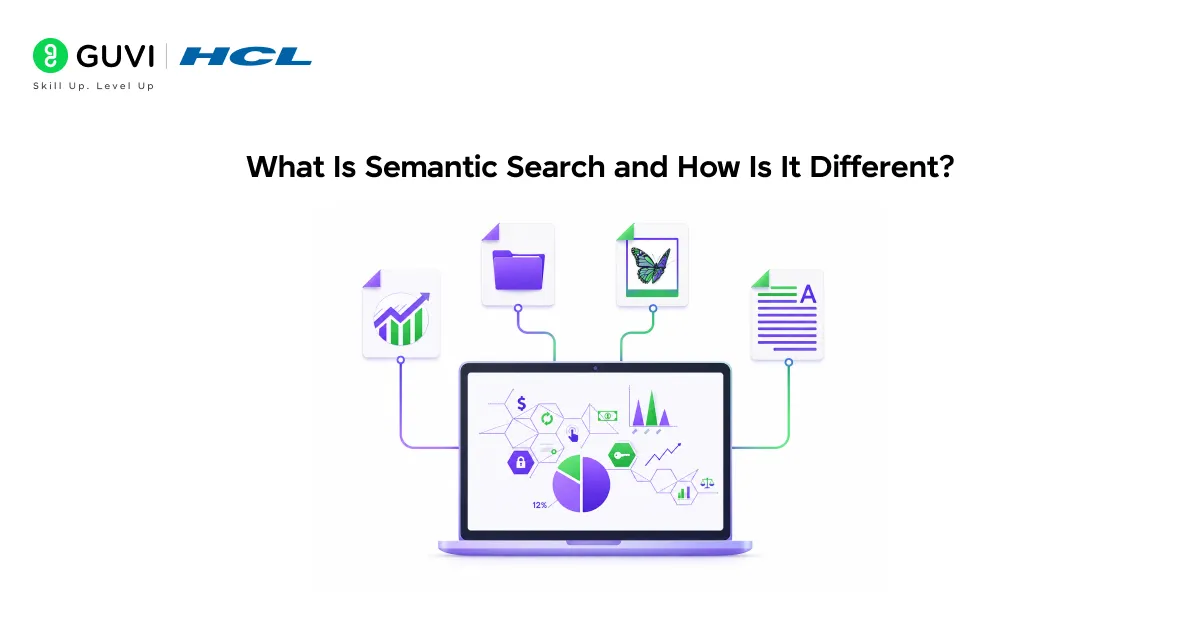
Semantic search understands what you mean, not just what you typed. Instead of matching exact words, it converts both your query and your documents into vectors — long lists of numbers that capture meaning — and finds the documents whose vectors are closest to your query’s vector.
Here’s the simplest way to picture it: imagine every sentence as a point in space. Sentences with similar meanings land near each other, even if they don’t share a single word. “I love hiking” and “Trekking is my favorite hobby” end up close together. “I love hiking” and “I hate vegetables” end up far apart.
Pro Tip: This “closeness in space” idea is called cosine similarity. It measures the angle between two vectors — smaller angle means more similar meaning. You don’t need to calculate it by hand; the libraries do it for you.
That’s the whole trick behind semantic search in Python — turn text into points in space, then find the nearest neighbors.
Read More: What is Semantic Segmentation?
Why Keyword Search Falls Short
Traditional keyword search the kind built on TF-IDF or basic string matching only works when your query uses the same words as your documents. The moment users phrase things differently, it breaks down.
| Keyword Search | Semantic Search | |
| Matches synonyms | No | Yes |
| Understands context | No | Yes |
| Handles typos/rephrasing | Poorly | Well |
| Setup complexity | Low | Moderate |
| Best for | Exact term lookup, logs | Natural language queries |
Data Point: A 2021 Google Research study found that semantic search systems improved relevant result retrieval by up to 18% over traditional keyword-based systems on natural language queries. [Source: Karpukhin et al., Dense Passage Retrieval]
If your users type real questions instead of exact keywords, semantic search in Python is the better fit almost every time.
Ready to go beyond search and build real AI applications from Python fundamentals to NLP and deep learning? Explore HCL GUVI’s Artificial Intelligence & Machine Learning Course — structured learning, hands-on projects, mentorship, and placement support included.
Understanding Sentence Transformers
Sentence Transformers is the Python library that does the heavy lifting converting text into meaningful vectors (called embeddings).
- Installation
pip install sentence-transformers- Generating Your First Embedding
from sentence_transformers import SentenceTransformer

model = SentenceTransformer('all-MiniLM-L6-v2')

embedding = model.encode("Semantic search finds results by meaning.")

print(embedding.shape)
That single line model.encode() turns your sentence into a 384-dimensional vector. Every sentence you encode lands somewhere in that same 384-dimensional space, ready to be compared.
Best Practice: Start with all-MiniLM-L6-v2. It’s small (80MB), fast, and gets you 90%+ of the quality of larger models. Only move to bigger models like all-mpnet-base-v2 if you need extra accuracy and can afford the slower speed.
What FAISS Does and Why You Need It
Once you have embeddings, you need a way to search through them fast. Comparing your query to every document one by one works fine for 100 documents — but falls apart at 1 million.
That’s where FAISS comes in. Built by Meta AI, FAISS (Facebook AI Similarity Search) indexes your vectors so it can find the closest matches in milliseconds, even across millions of entries.
pip install faiss-cpu
Warning: Use faiss-cpu unless you specifically need GPU acceleration for very large datasets (millions+ of vectors). faiss-gpu requires CUDA setup that beginners rarely need.

How to Build Semantic Search in Python (Step-by-Step)
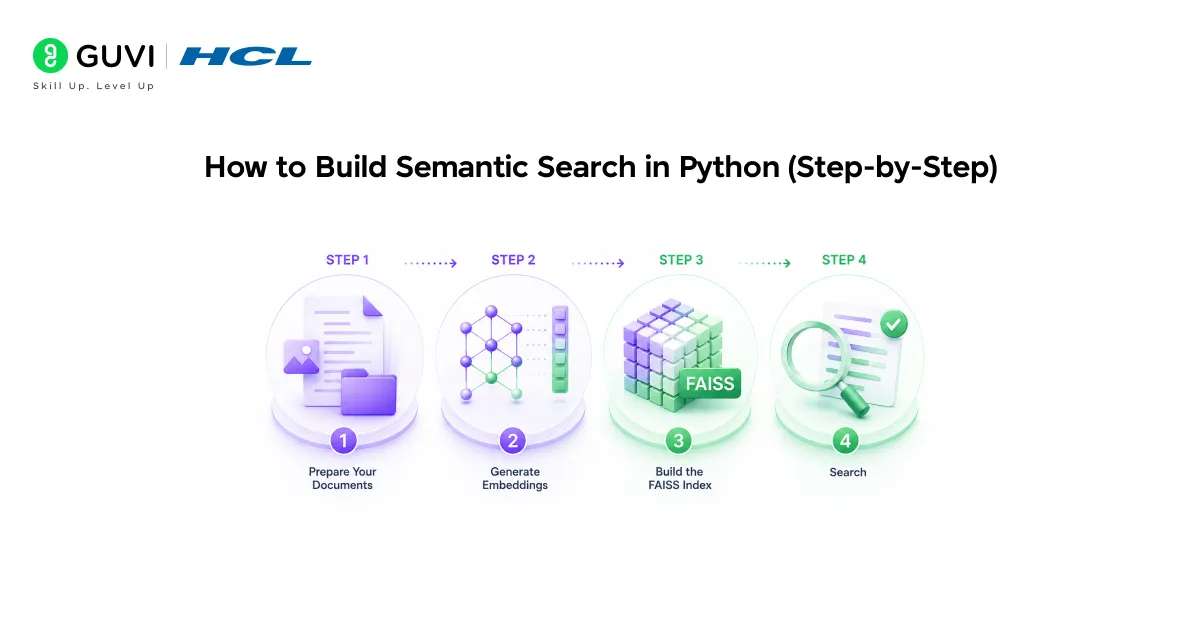
Let’s build a working semantic search engine over a small set of documents.
Step 1: Prepare Your Documents
documents = [

    "The cat sat on the mat.",

    "Dogs are loyal companions.",

    "Python is a popular programming language.",

    "Machine learning models learn from data.",

    "Cats and dogs are common household pets."

]
Step 2: Generate Embeddings
from sentence_transformers import SentenceTransformer

model = SentenceTransformer('all-MiniLM-L6-v2')

doc_embeddings = model.encode(documents)
Step 3: Build the FAISS Index
import faiss

import numpy as np

dimension = doc_embeddings.shape[1]

index = faiss.IndexFlatL2(dimension)

index.add(np.array(doc_embeddings))
IndexFlatL2 does an exact nearest-neighbor search using Euclidean distance. It’s simple and accurate — perfect for getting started.
Step 4: Search
query = "What language do programmers use?"

query_embedding = model.encode([query])

k = 2

distances, indices = index.search(np.array(query_embedding), k)

for i in indices[0]:

    print(documents[i])
Run this, and you’ll get “Python is a popular programming language” back — even though the query never used the word “Python.”
Pro Tip: That’s the whole point. The query said “language” and “programmers” — words that don’t appear together in the matching document. Semantic search found it anyway because it understands the meaning, not just the words.
Warning: Don’t skip evaluating your search results on real queries before shipping. Semantic search can confidently return wrong results when your documents are very similar to each other — always sanity-check with queries your actual users would type.
Key Takeaways
- Semantic search in Python finds results by meaning, not exact word matches.
- Sentence Transformers converts text into vectors that capture meaning.
- FAISS searches through those vectors fast, even at massive scale.
- The full pipeline — embed, index, search — takes under 40 lines of Python.
- Watch out for re-encoding documents repeatedly and skipping normalization — two common beginner mistakes.
What to Do Next
- Run the 4-step example above with your own set of documents.
- Swap IndexFlatL2 for IndexIVFFlat and test on a larger dataset.
- Try a different model like all-mpnet-base-v2 and compare result quality.
- Explore combining semantic search with keyword search (hybrid search).
- Look into Retrieval-Augmented Generation (RAG) — semantic search is the foundation.
Wrapping Up
Semantic search in Python used to require a dedicated ML team and serious infrastructure. Sentence Transformers and FAISS changed that. Today, you can build a working semantic search engine in an afternoon, using free, open-source tools and code that fits on a single page.
The best way to learn this is to build it. Take the four-step example above, swap in your own documents, and see what it surfaces. Then try queries that share no words with your documents at all — that’s where semantic search proves its worth.
Frequently Asked Questions
What is semantic search in Python?
Semantic search in Python is a technique that finds results based on meaning rather than exact keyword matches. It uses models like Sentence Transformers to convert text into vectors, then searches for the closest matching vectors using a library like FAISS.
Do I need a GPU to build semantic search?
No. Small models like all-MiniLM-L6-v2 run comfortably on CPU for most use cases. You’d only need a GPU for encoding very large document sets quickly or using larger embedding models.
What’s the difference between Sentence Transformers and FAISS?
Sentence Transformers converts text into vectors (embeddings) that capture meaning. FAISS searches through those vectors to find the closest matches fast. They work together — one creates the data, the other searches it.
Can semantic search handle millions of documents?
Yes. FAISS is built for exactly this. For very large datasets, use an approximate index like IndexIVFFlat instead of IndexFlatL2 to keep search times fast.
Is semantic search the same as RAG?
No, but they’re closely related. Semantic search is the retrieval step — finding relevant documents. RAG (Retrieval-Augmented Generation) adds a generation step on top, where an LLM uses those retrieved documents to write an answer.
What embedding model should beginners start with?
Start with all-MiniLM-L6-v2 from Sentence Transformers. It’s small, fast, free, and delivers strong results for most semantic search projects.
Success Stories

About the Author
Vishalini Devarajan
An Aerospace Engineer turned content writer, I focus on making complex concepts easy to understand through well-structured, reader-friendly blogs. Whether it’s a technical topic or a non-technical one, I love creating content that is clear, engaging, and impactful.
View all posts by Vishalini Devarajan
Connect with me @












Did you enjoy this article?