


Data Analysis Articles
Accountant vs Data Analyst Salary in India After Switching Careers - Best Guide
Insurance Claims Executive to Data Analyst: Is It a Good Switch?
Banking Executive (Loans, KYC) to Data Analyst: Skills and Career Path
BPO Fresher: Switch to Data Analytics Now or Gain More Experience First?


Get In Touch For Details! Request More Information

Top 8 Roles and Responsibilities of a Business Analyst
Jun 03, 2026 5 Min Read 7850 Views
(Last Updated)
Have you ever wondered who connects a company’s big ideas to the people who actually build them? Most projects fail not because of bad technology, but because of poor communication between business teams and tech teams. That’s exactly the gap a Business Analyst fills.
In 2026, with companies relying more on data and faster decision-making, the role of a Business Analyst has become more critical than ever. Whether you’re exploring this career or trying to understand what a BA actually does day to day, this article covers everything you need to know. So, without further ado, let us get started!
Table of contents
- TL;DR Summary
- Who is a Business Analyst?
- Top Roles and Responsibilities of a Business Analyst
- Requirement Gathering and Analysis
- Stakeholder Management
- Process Mapping and Optimization
- Data Analysis and Reporting
- Solution Design and Validation
- Risk Assessment and Mitigation
- Implementation and Support
- Functional Specifications and Documentation
- Skills Needed for a Business Analyst
- Business Analyst Career Scope in 2026
- Conclusion
- FAQs
- What are the daily tasks of a Business Analyst?
- Is coding required for a Business Analyst role?
- What industries hire Business Analysts?
- Which tools should a Business Analyst learn?
- Is a certification important to become a Business Analyst?
TL;DR Summary
- A Business Analyst bridges the gap between business needs and technical solutions.
- Core responsibilities include requirement gathering, stakeholder management, process optimization, data analysis, and documentation.
- Key tools include SQL, Excel, Power BI, Tableau, JIRA, and Lucidchart.
- BAs are in demand across IT, finance, healthcare, e-commerce, and consulting.
- You don’t need coding skills to start, but SQL knowledge gives you a strong edge.
- Entry-level BAs in India earn ₹4–6 LPA; experienced professionals can earn ₹10–20 LPA or more.
Who is a Business Analyst?
A Business Analyst (BA) studies how a company operates, identifies what isn’t working, and figures out how to fix it. This could mean improving an internal process, addressing a communication gap, or recommending a technology solution that helps teams work faster.
Depending on the organization, a BA might be called a systems analyst, requirements manager, or product owner. But the core work stays the same: translating business needs into practical solutions that actually work.
Whether it’s streamlining internal workflows, gathering stakeholder requirements, or supporting a product launch, the roles of a Business Analyst touch almost every department in an organization.
Top Roles and Responsibilities of a Business Analyst
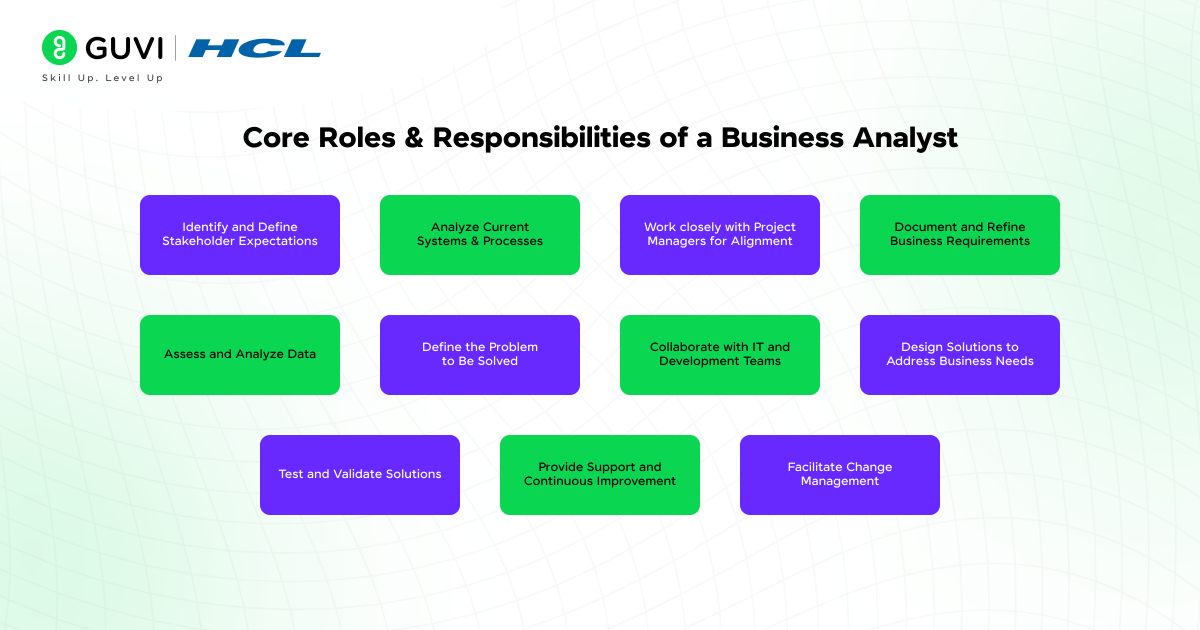
The day-to-day work of a BA varies by industry and project. But certain responsibilities stay consistent across most roles. Here’s a detailed breakdown of what you can expect.
1. Requirement Gathering and Analysis
This is where every project begins. A Business Analyst works with stakeholders through interviews, workshops, and surveys to understand what the business actually needs. The goal isn’t just to note down what people say but to uncover the underlying problem they’re trying to solve.
These findings are then documented in user stories, functional specs, or process diagrams. This step sets the entire direction of the project.
Key tasks include:
- Conducting stakeholder interviews and workshops to gather business requirements
- Documenting both functional and non-functional requirements clearly
- Revisiting and validating requirements as the project evolves
Studies show that poor requirements management is one of the top reasons IT projects fail. A skilled Business Analyst can reduce that risk significantly by ensuring clarity from day one.
2. Stakeholder Management
One of the most critical roles of a Business Analyst is acting as the bridge between business teams, technical teams, and end-users. You’re not just attending meetings; you’re ensuring everyone is aligned on goals, timelines, and expectations.
A BA manages feedback loops, handles conflicts, and keeps communication flowing. In cross-functional teams, this skill alone can make or break a project.
Key tasks include:
- Facilitating discussions between business users, developers, and leadership
- Managing expectations and resolving conflicting priorities
- Ensuring all teams remain aligned throughout the project lifecycle
3. Process Mapping and Optimization
Before building something new, a BA needs to understand how things currently work. This involves reviewing existing workflows to identify bottlenecks, redundancies, or steps that slow teams down.
Using tools like flowcharts, swimlane diagrams, or process maps, a BA visualizes the problem clearly and recommends improvements. This might mean recommending automation, restructuring a workflow, or simply removing unnecessary steps.
Key tasks include:
- Mapping current business processes using flowcharts or swimlane diagrams
- Identifying inefficiencies and recommending practical improvements
- Supporting automation initiatives to boost team productivity
According to McKinsey, businesses that actively optimize their processes are significantly more likely to report above-average profitability compared to competitors who don’t.
4. Data Analysis and Reporting
Business Analysts turn raw data into something actionable. They collect data from different sources, analyze it, and surface trends or patterns that inform better decisions.
Using tools like Excel, SQL, Power BI, or Tableau, they build dashboards and reports that give stakeholders a clear picture. This isn’t just number-crunching; it’s turning data into evidence that drives strategy.
Key tasks include:
- Collecting and analyzing operational, financial, or customer data
- Building reports and dashboards using tools like Power BI or Tableau
- Presenting insights in a clear and visual format to non-technical teams
5. Solution Design and Validation
Once requirements are locked in, a BA works with technical teams to shape a solution that meets the business need. This could involve creating wireframes, drafting process flows, or collaborating on prototypes.
Validation is just as important. The BA ensures the final product goes through proper testing and actually solves the right problem before it’s rolled out.
Key tasks include:
- Collaborating with developers to define solutions that match business requirements
- Creating wireframes, mockups, or process flows to visualize the solution
- Conducting user acceptance testing (UAT) to validate the final output
6. Risk Assessment and Mitigation
Every project comes with risks: scope creep, missed deadlines, and budget overruns. A Business Analyst helps spot these risks early and prepares strategies to manage them.
This proactive mindset is especially valuable in complex projects where one missed detail can cause major setbacks down the line.
Key tasks include:
- Identifying risks across project scope, budget, and timelines
- Developing contingency plans and mitigation strategies
- Monitoring risk factors throughout the project and adjusting plans when needed
7. Implementation and Support
A BA’s work doesn’t end when development is done. During implementation, they coordinate with teams, answer questions, and make sure the rollout goes smoothly. They also support training efforts so end-users actually know how to use the new system.

Even after launch, gathering feedback and helping teams adapt to changes is part of the job.
Key tasks include:
- Coordinating deployment activities with technical and business teams
- Supporting user training and onboarding
- Collecting post-launch feedback and helping improve the solution over time
8. Functional Specifications and Documentation
Clear documentation keeps everyone aligned and prevents confusion later. A BA creates detailed specs that outline what the system should do, how it should behave, and what’s expected from development teams.
This part of the job might not be glamorous, but it’s one of the most practical things a BA does. Good documentation saves hours of back-and-forth later.
Key tasks include:
- Writing detailed functional specifications for developers and QA teams
- Documenting scope, business rules, and any changes made during the project
- Maintaining documentation as a reference point for all stakeholders
Also Read: Business Analyst Job Description: Key Skills & Tools
Skills Needed for a Business Analyst
A successful Business Analyst blends analytical thinking, technical know-how, and strong communication to turn business needs into workable solutions.
Below are the core skills that support the roles and responsibilities of a business analyst across industries.
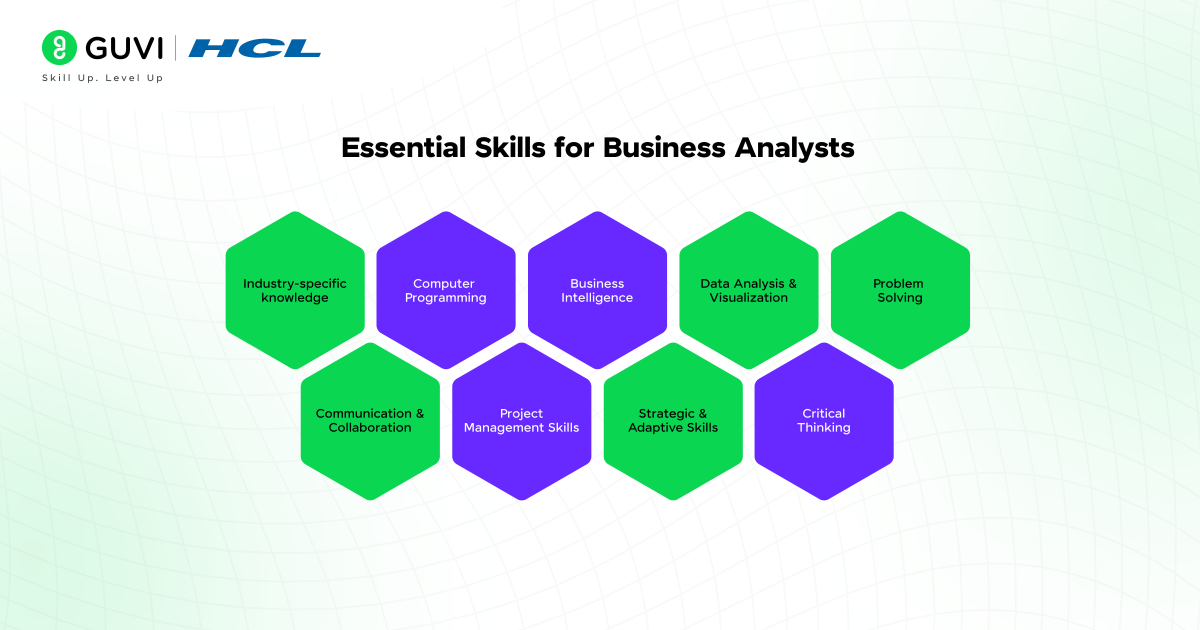
Understanding the responsibilities is one thing. Building the skills to handle them is another. Here are the core skills that make a Business Analyst effective across industries.
Analytical Thinking: You need to break down complex problems, spot patterns, and connect the dots between data and decisions. This is the foundation of the entire role.
Technical Proficiency: You don’t need to code, but knowing your way around SQL, Excel, Tableau, or Power BI gives you a massive advantage, especially in data-heavy environments.
Communication Skills: You’ll spend a lot of time explaining technical concepts to non-technical stakeholders and business needs to developers. The ability to translate between both worlds is invaluable.
Problem-Solving Ability: Things go wrong in every project. A BA needs to think on their feet, balance what’s ideal with what’s realistic, and keep the project moving forward.
Collaboration: You’ll work with designers, developers, product managers, and executives. Your ability to bring different teams together and keep them aligned determines how successful the project is.
Documentation Skills: Writing clear requirement specs, process maps, and change logs is a daily task. The cleaner your documentation, the fewer problems your team will face down the line.
Business Analyst Career Scope in 2026
If you’re wondering whether this career is worth pursuing, the short answer is yes. Business Analysts are in demand across IT, finance, healthcare, e-commerce, manufacturing, and consulting. As companies generate more data and face more complex decisions, the need for professionals who can bridge business and technology only grows.
Salary overview (India):
- Entry-level (0–2 years): ₹4–6 LPA
- Mid-level (3–6 years): ₹8–12 LPA
- Senior/Lead (7+ years): ₹15–25 LPA or more
Many organizations also offer remote and hybrid roles for BAs, making it one of the more flexible career paths in tech-adjacent fields.
If you are interested in learning more about Business Analytics in a more structured and through a mentored course, then consider enrolling in HCL GUVI’s AI-Powered Business Analytics Course and build hands-on skills in Excel, SQL, Power BI, Tableau, Python, and Generative AI to analyze business data, create dashboards, automate insights, and solve real business problems across industries.
Conclusion
The roles and responsibilities of a Business Analyst go well beyond writing requirements or sitting in meetings. It’s a career built on asking the right questions, understanding people as much as data, and turning ambiguous problems into clear solutions.
If you enjoy working at the intersection of business strategy and technology, and if you like making sense of messy situations, a BA role could be a great fit for you. The demand is strong, the career path is flexible, and the work is genuinely impactful.
Start building the right skills today, stay curious, and focus on understanding problems deeply before jumping to solutions.
FAQs
What are the daily tasks of a Business Analyst?
Daily tasks typically include gathering requirements, updating documentation, meeting with stakeholders, analyzing data, reviewing test cases, and supporting development or implementation teams.
Is coding required for a Business Analyst role?
No, coding is not mandatory. However, knowing SQL or basic scripting can be a strong advantage, especially in data-focused BA roles.
What industries hire Business Analysts?
BAs are in demand across IT, banking and finance, healthcare, e-commerce, telecom, logistics, and management consulting firms.
Which tools should a Business Analyst learn?
Focus on Excel, SQL, Power BI, Tableau, JIRA, Confluence, and process modeling tools like Lucidchart or Draw.io.
Is a certification important to become a Business Analyst?
It’s not mandatory but can boost your profile. Look for recognized BA certifications or structured courses that include real-world projects.
Success Stories















Did you enjoy this article?