


Artificial Intelligence and Machine Learning Articles
AI/ML Skills Gap 2026: Why Companies Can't Find Job-Ready Talent
20 AI/ML Interview Questions Recruiters Can Use Without a Tech Background - Best Guide
How Industry-Backed AI/ML Bootcamps Are Changing the AI/ML Hiring Pipeline - Best Guide 2026
From IT Support to AI Engineer: A Realistic Career Switch Guide 2026


Get In Touch For Details! Request More Information

Red-Black Trees: Efficient Balanced Data Structures
Jul 15, 2026 7 Min Read 604 Views
(Last Updated)
Imagine you are organizing a library with thousands of books. You could just stack them randomly, but finding a specific book would take forever. You could arrange them alphabetically, but adding new books in the right order would be painful. What if you could organize them in a way that makes both searching and adding books fast?
This is exactly what a Red-Black Tree does for data. It is a special type of binary search tree that stays balanced automatically. Every time you add or remove data, the tree reorganizes itself to keep operations fast.
This guide explains what Red Black Trees are, how they maintain balance, and why they are used in so many production systems.
Table of contents
- Quick TL;DR Summary
- Understanding Binary Search Trees First
- The Five Properties of Red-Black Trees
- Property 1: Every node is either red or black
- Property 2: The root is always black
- Property 3: All leaves (null nodes) are black
- Property 4: Red nodes have black children
- Property 5: All paths have the same black height
- Why these properties guarantee balance
- How Red Black Trees Maintain Balance
- Searching in a Red-Black Tree
- Inserting into a Red-Black Tree
- Step 1: Insert as in a regular BST
- Step 2: Check for violations
- Step 3: Fix violations with rotations and recoloring
- Step 4: Ensure root is black
- Deleting from a Red-Black Tree
- Step 1: Delete as in a regular BST
- Step 2: Identify if a fix is needed
- Step 3: Fix black height violation
- Step 4: Restore all properties
- Real-World Applications of Red-Black Trees
- Advantages of Red-Black Trees
- Disadvantages and Limitations
- Conclusion
- FAQs
- What is the difference between Red-Black Trees and AVL Trees?
- Why are the colors called red and black?
- What is the time complexity of Red-Black Tree operations?
- Can I implement a Red-Black Tree myself?
- When should I use a Red-Black Tree instead of a hash table?
Quick TL;DR Summary
- This guide explains Red-Black Trees, a self-balancing binary search tree that guarantees efficient operations by maintaining balance through color-coded nodes and rotation operations.
- You will learn the five essential properties that define Red-Black Trees, including how red and black node coloring ensures the tree never becomes too unbalanced.
- The guide covers the fundamental operations including insertion, deletion, and search, showing how the tree automatically rebalances itself through rotations and recoloring.
- Step-by-step examples show you how Red-Black Trees work in practice, from understanding basic tree structure to seeing how balance is maintained during modifications.
- You will understand when to use Red-Black Trees versus other data structures, their performance guarantees, and how they compare to AVL trees and other balanced tree structures.
What Is a Red-Black Tree?
A Red-Black Tree is a self-balancing binary search tree in which each node is assigned one of two colors: red or black. The tree follows a set of balancing rules based on these colors to maintain a roughly balanced structure after insertions and deletions. By preventing the tree from becoming excessively skewed, Red-Black Trees ensure that search, insertion, and deletion operations can be performed efficiently, typically in O(log n) time. They are widely used in databases, operating systems, and programming language libraries to manage sorted data efficiently.
Unlike a regular binary search tree that can become unbalanced and slow, a Red-Black Tree guarantees that the longest path from root to leaf is never more than twice the length of the shortest path. This ensures predictable performance.
The tree is called “Red-Black” because nodes are colored red or black, and these colors determine how the tree maintains balance.
Read More: Introduction to Tree Data Structure
Understanding Binary Search Trees First

- What is a binary search tree?
A binary search tree is a tree structure where each node has at most two children, called left and right. The key rule is: all values in the left subtree are smaller than the node, and all values in the right subtree are larger. This organization makes searching efficient.
- The problem with unbalanced trees
If you insert data in sorted order into a regular binary search tree, it becomes a long chain instead of a balanced tree. Searching through a chain takes as long as searching through a list. A tree with 1000 nodes might require 1000 steps instead of just 10 steps if it were balanced.
- Why balance matters
A balanced tree keeps the height small relative to the number of nodes. With N nodes, a balanced tree has height approximately log(N). This means 1000 nodes only need about 10 levels. Operations take log(N) time instead of N time, which is dramatically faster for large datasets.
- Self-balancing is the solution
Self-balancing trees automatically reorganize themselves after insertions and deletions to maintain balance. Red-Black Trees are one type of self-balancing tree. They use simple rules and operations to ensure the tree never becomes too unbalanced.
Red-Black Trees trace their origins to Rudolf Bayer, who introduced the underlying concept in 1972 under the name “symmetric binary B-trees”. The familiar red-and-black coloring scheme was later developed by Leo Guibas and Robert Sedgewick in 1978. Interestingly, the choice of red and black is completely arbitrary—the colors have no special mathematical meaning. They simply provide an easy way to label nodes and enforce balancing rules that keep tree operations such as search, insertion, and deletion efficient, typically running in O(log n) time.
The Five Properties of Red-Black Trees
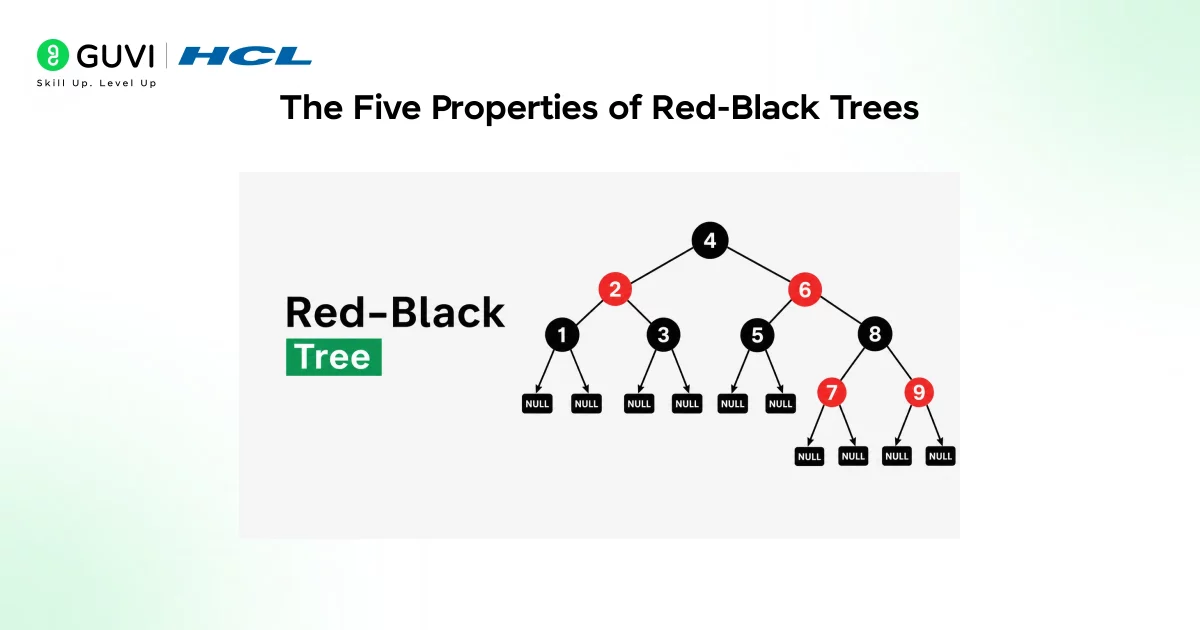
Property 1: Every node is either red or black
Each node in the tree is assigned a color, red or black. There are no other color options. This binary choice makes the rules simple and the implementation efficient. The color is typically stored as a single bit or boolean value.
Property 2: The root is always black
The root node of the tree must be black. This is a simple rule that provides a consistent starting point. If an operation would make the root red, you just recolor it black. This rule simplifies many of the balancing cases.
Property 3: All leaves (null nodes) are black
The leaves of the tree are not the last data nodes, but rather the null pointers beyond them. These null nodes are considered to exist and are all black. This might seem strange, but treating null as black nodes makes the other rules work smoothly.
Property 4: Red nodes have black children
If a node is red, both of its children must be black. This means you cannot have two red nodes in a row along any path. This rule prevents long chains of red nodes and helps maintain balance. You can have black nodes with black children, but red nodes must have black children.
Property 5: All paths have the same black height
For any node, all paths from that node down to leaves must contain the same number of black nodes. This is called the black height. It does not matter how many red nodes are on a path, but the number of black nodes must be the same. This property ensures balance.
Why these properties guarantee balance
Property 5 ensures all paths have the same number of black nodes. Property 4 ensures you cannot have consecutive red nodes. Together, these mean the longest path (alternating red and black) is at most twice the shortest path (all black). This guarantees the tree is approximately balanced.
How Red Black Trees Maintain Balance
- Rotations: Restructuring the tree
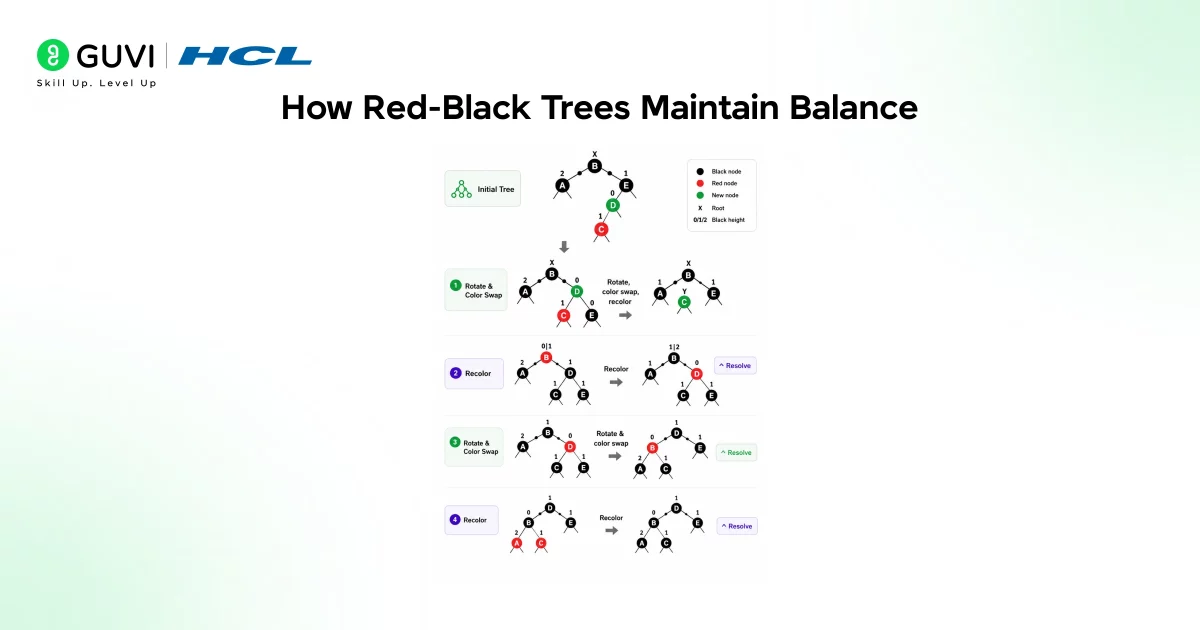
Rotations are operations that reorganize the tree structure while maintaining the binary search tree property. A left rotation moves a node down and to the left, promoting its right child. A right rotation is the opposite. Rotations change the shape but not the order of elements.
- Recoloring: Changing node colors
Recoloring changes a node from red to black or black to red. After an insertion or deletion, you might recolor nodes to restore the Red-Black properties. Recoloring is often combined with rotations to fix violations.
- Insertion requires rebalancing
When you insert a new node, you color it red and place it in the correct position according to binary search tree rules. This might violate Property 4 if the parent is also red. You then perform rotations and recoloring based on the structure around the violation to restore all properties.
- Deletion is more complex
Deletion is the trickiest operation. After removing a node, you might create a black height violation. The tree uses a series of cases involving rotations and recoloring to fix the violation. The algorithm handles different configurations of red and black nodes around the deletion point.
- Cases based on sibling and parent colors
Both insertion and deletion have multiple cases based on the colors of nearby nodes like parent, sibling, and uncle. Each case has a specific fix involving rotations, recoloring, or both. The cases ensure that after the fix, all five properties are satisfied.
Red-Black Trees are not just academic data structures—they power many of the software systems developers use every day. Java’s TreeMap and TreeSet are implemented using Red-Black Trees, while the C++ Standard Template Library (STL) typically uses them behind std::map and std::set. The Linux kernel also employs Red-Black Trees in areas such as memory management, timers, and process-related scheduling structures. Their popularity comes from a key guarantee: operations like search, insertion, and deletion consistently run in O(log n) time, making them efficient and reliable even when handling millions of records or operations.
Searching in a Red-Black Tree
- Search ignores colors completely
Searching in a Red-Black Tree is exactly like searching in a regular binary search tree. Start at the root. If the value you seek is smaller, go left. If larger, go right. If equal, you found it. The colors do not affect search at all.
- Time complexity is logarithmic
Because the tree is balanced, the height is O(log N) where N is the number of nodes. Searching requires at most height steps, so search time is O(log N). With a million nodes, you need at most about 20 comparisons.
- Balance guarantees performance
Unlike a regular binary search tree that might degrade to O(N) search time if unbalanced, Red-Black Trees always maintain O(log N) search time. The balancing rules guarantee this performance regardless of insertion or deletion order.

Inserting into a Red-Black Tree
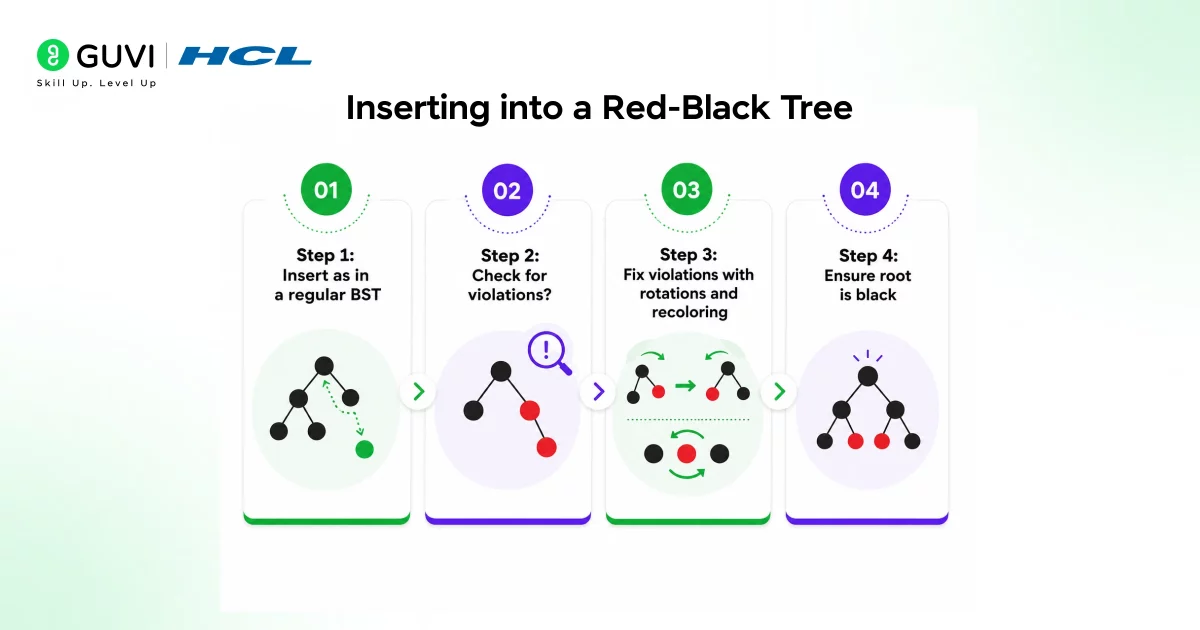
Step 1: Insert as in a regular BST
Find the correct position for the new value using binary search tree rules. Insert the new node at that position. Color the new node red. This preserves Property 5 (black height) because you have not added any black nodes.
Step 2: Check for violations
If the parent of the new red node is black, you are done. All properties are satisfied. If the parent is also red, you have violated Property 4 (red nodes must have black children). You need to fix this violation.
Step 3: Fix violations with rotations and recoloring
There are several cases depending on the color of the uncle (parent’s sibling). If the uncle is red, recolor the parent, uncle, and grandparent. If the uncle is black, perform rotations to restructure the tree and recolor nodes. The specific rotations depend on whether the new node is a left or right child.
Step 4: Ensure root is black
After all fixes, make sure the root is black. If your recoloring made the root red, just color it black. This might increase the black height of the tree by one, but that is fine and affects all paths equally.
Deleting from a Red-Black Tree
Step 1: Delete as in a regular BST
Find the node to delete. If it has two children, swap it with its successor (the smallest node in its right subtree) and then delete the successor. Now you are deleting a node with at most one child. Remove the node and replace it with its child if it exists.
Step 2: Identify if a fix is needed
If the deleted node was red, you are done. Removing a red node does not violate any properties. If the deleted node was black, you have reduced the black height on that path, violating Property 5. You need to fix this.
Step 3: Fix black height violation
This is the most complex part. You consider the sibling of the deleted node and its children. Depending on their colors, you perform specific rotations and recoloring. There are multiple cases, and you might need to propagate the fix up the tree toward the root.
Step 4: Restore all properties
The fix operations ensure that by the time you finish, all five Red-Black properties are satisfied. The tree is balanced again and ready for more operations.
Real-World Applications of Red-Black Trees
- Standard library implementations
Java’s TreeMap and TreeSet, C++ STL’s map and set, and many other language standard libraries use Red-Black Trees. These provide sorted key-value storage with guaranteed logarithmic time operations. Developers use these data structures daily without knowing Red-Black Trees power them.
- Operating system schedulers
Linux completely fair scheduler uses Red-Black Trees to manage process scheduling. Each running process is a node, and the tree organizes them by how much CPU time they have received. This allows the scheduler to quickly find the process that should run next.
- Memory management
Operating systems use Red-Black Trees to track free memory blocks. The tree allows fast lookup of available memory regions of specific sizes. This makes memory allocation and deallocation efficient even with thousands of allocations.
Advantages of Red-Black Trees
- Guaranteed logarithmic performance
All operations (search, insert, delete) are guaranteed O(log N) time in the worst case. You never experience the O(N) worst case that unbalanced binary search trees can suffer. This predictability is crucial for production systems.
- Faster modifications than AVL trees
Red-Black Trees require fewer rotations on average during insertions and deletions compared to AVL trees. This makes them faster for workloads involving frequent modifications.
- Simpler implementation than other balanced trees
While Red-Black Trees are not trivial to implement, they are simpler than some other balanced tree structures. The five properties are straightforward, and the fix-up cases, while numerous, follow clear patterns.
- Space efficient
Red-Black Trees only need one extra bit per node to store the color. This is minimal overhead compared to the value and child pointers you need anyway. The space efficiency makes them practical for large datasets.
- Well-tested and proven
Decades of use in production systems means Red-Black Tree implementations are mature and reliable. Libraries provide thoroughly tested implementations you can use directly.
Disadvantages and Limitations
- Complex implementation
Implementing a Red-Black Tree correctly is not trivial. The deletion operation has many cases. Getting all the cases right requires careful coding and testing. Most developers use existing library implementations rather than writing their own.
- Not the fastest for read-heavy workloads
If you mainly search and rarely modify the tree, AVL trees or even simpler structures might be faster. Red-Black Trees optimize for a balance of operations, not pure search speed.
- Not optimal for sequential access
If you need to process all elements in order frequently, a simple sorted array might be better. Red-Black Trees excel at mixed operations (search, insert, delete), not sequential traversal.
- Memory overhead for small datasets
For very small datasets (dozens of elements), the overhead of maintaining tree structure and colors might not be worth it. Simple arrays or linked lists could be more efficient.
To learn more about Gaussian Mixture Model, do not miss the chance to enroll in this HCL GUVI’s AI and Machine Learning course covering machine learning fundamentals, feature engineering, deep learning, and practical implementation through hands-on projects and expert guidance with certification.
Conclusion
Red-Black Trees are self-balancing binary search trees that use color-coded nodes to maintain balance. They guarantee O(log N) time for search, insertion, and deletion operations.
The five properties ensure the tree never becomes too unbalanced. The longest path is at most twice the shortest path, providing the logarithmic performance guarantee.
Insertions and deletions might temporarily violate properties, but rotations and recoloring restore balance. The fix-up algorithms follow clear patterns based on node colors.
Red-Black Trees are widely used in language libraries, operating systems, and databases. Their balanced performance makes them ideal for sorted data structures.
For applications requiring sorted data with frequent modifications, Red-Black Trees are an excellent choice. Use library implementations when available.
FAQs
1. What is the difference between Red-Black Trees and AVL Trees?
Both are self-balancing binary search trees with O(log N) operations. AVL trees are more strictly balanced and have slightly faster searches. Red-Black Trees allow more imbalance but require fewer rotations, making insertions and deletions faster. Red-Black Trees are more common in practice.
2. Why are the colors called red and black?
The names are arbitrary. They just provide a way to mark two different types of nodes. The inventors could have used any two names. The important part is having two distinct states to enforce the balancing rules.
3. What is the time complexity of Red-Black Tree operations?
Search, insertion, and deletion all take O(log N) time in the worst case, where N is the number of nodes. This is guaranteed by the balancing properties. Space complexity is O(N) for storing the tree.
4. Can I implement a Red-Black Tree myself?
You can, but it is complex. The deletion operation has many cases. Most developers use existing library implementations like TreeMap in Java or map in C++. Implement your own only if you have specific requirements that libraries do not meet.
5. When should I use a Red-Black Tree instead of a hash table?
Use Red-Black Trees when you need sorted order, range queries, or ordered iteration. Use hash tables when you only need lookup, insert, and delete with no ordering requirements. Hash tables average O(1) time but provide no ordering. Red-Black Trees guarantee O(log N) time with sorted order.
Success Stories

About the Author
Vishalini Devarajan
An Aerospace Engineer turned content writer, I focus on making complex concepts easy to understand through well-structured, reader-friendly blogs. Whether it’s a technical topic or a non-technical one, I love creating content that is clear, engaging, and impactful.
View all posts by Vishalini Devarajan
Connect with me @













Did you enjoy this article?