


Academics Articles
Is the HCL GUVI AI/ML Program Right for You? A Quick Self-Assessment
Inside the HCL GUVI AI/ML Curriculum: What You’ll Actually Build
Wipro Elite NTH Eligibility Criteria 2026: CGPA, Branch & Backlog Rules Explained
What is Wipro Elite NTH? Complete Overview for 2026 Graduates


Get In Touch For Details! Request More Information
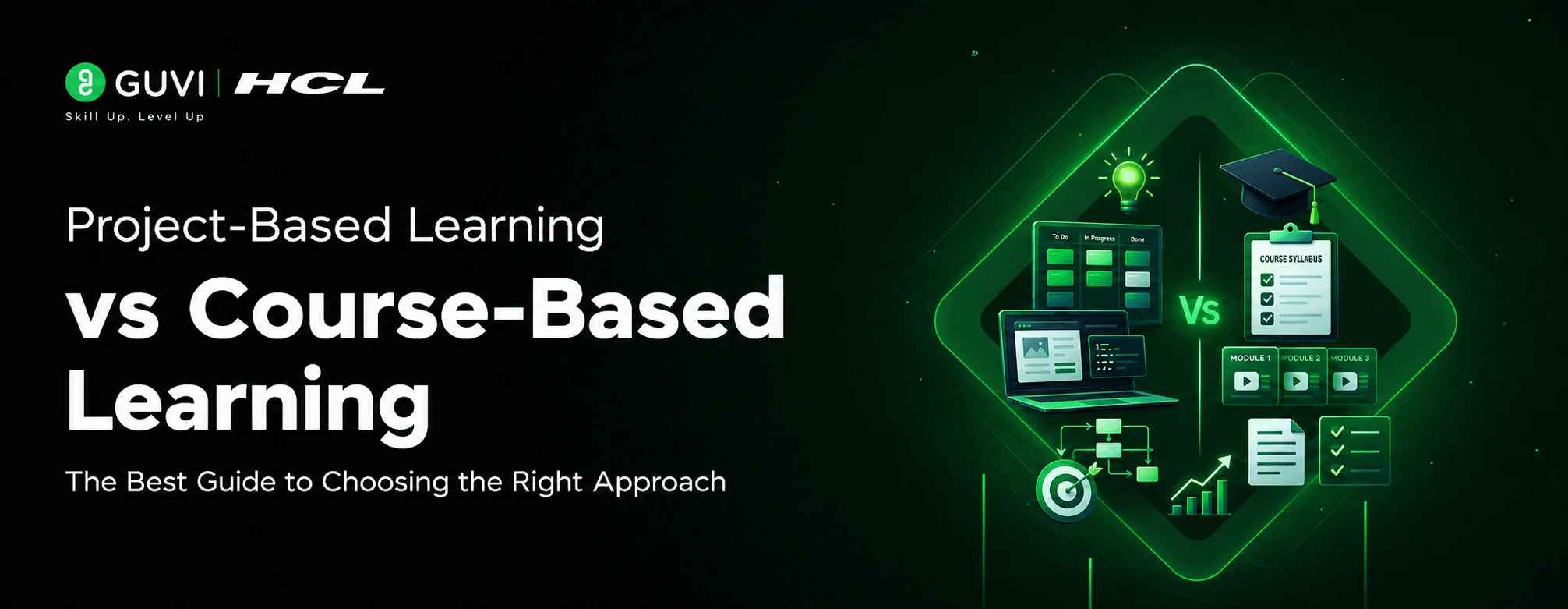
Project-Based Learning vs Course-Based Learning: The Best Guide to Choosing the Right Approach
Jul 22, 2026 9 Min Read 423 Views
(Last Updated)
Table of contents
- TL;DR
- Project-Based vs Course-Based Learning: What Is the Main Difference?
- What Is Project-Based Learning?
- What Is Not Project-Based Learning?
- What Is Course-Based Learning?
- Why Choose Project-Based Learning Over Course-Based Learning?
- It Converts Knowledge Into Performance
- It Reveals Your Real Skill Gaps
- It Builds Portfolio Evidence
- It Develops Transferable Skills
- It Makes Learning More Memorable
- When Is Course-Based Learning the Better Choice?
- What Is the Best Learning Model for Career Skills?
- How Much Course Learning Should You Use?
- How Can You Start Learning Through Projects?
- Step 1: Define the Skill Outcome
- Step 2: Choose a Realistic Problem
- Step 3: Define the Minimum Working Version
- Step 4: Map the Required Skills
- Step 5: Build in Milestones
- Step 6: Ask for Feedback
- Step 7: Reflect and Document
- How Do You Choose the Right Project?
- Use the 70% Rule
- Prefer Role-Aligned Projects
- What Does Effective Project Work Look Like?
- A Clear Question
- Authentic Constraints
- Independent Decisions
- Iteration
- Evidence
- Public Documentation
- How Does This Approach Work in Software Development?
- Example 1: GenAI Customer-Support Assistant
- Example 2: SaaS Issue-Tracking Platform
- Why GenAI Makes Building More Important
- How Do Employers Evaluate Project Evidence?
- How Should You Explain a Project in an Interview?
- What Are the Challenges of Learning Through Projects?
- Knowledge Gaps
- Poor Project Sizing
- Frustration and Uncertainty
- Unequal Team Contribution
- Weak Assessment
- Common Mistakes to Avoid
- Copying Tutorial Projects
- Starting With an Oversized Idea
- Ignoring Foundations
- Building Without Feedback
- Showing Only the Final Output
- Build Practical GenAI Software Skills With HCL GUVI
- Conclusion
- FAQs
- Is project-based learning better than course-based learning?
- Can a complete beginner learn only through projects?
- How many projects should I build before applying for jobs?
- Do employers value projects more than certificates?
- What makes a project portfolio-ready?
- Is following a project tutorial useful?
- How long should a beginner project take?
- Can project work replace a degree or professional certification?
- How can I avoid knowledge gaps while learning through projects?
- What is the best project-led approach for GenAI development?
TL;DR
Project-based learning is usually the better choice when your goal is to apply knowledge, solve realistic problems, create portfolio evidence, and prepare for job tasks. Course-based learning is more useful when you need structured foundations, expert sequencing, guided explanations, or certification. You do not need to reject courses completely. The strongest approach is often project-led and course-supported: choose a meaningful project, learn the required concepts as they arise, build in small stages, seek feedback, and document the result. This makes project-based learning practical without leaving gaps in your fundamentals.
Project-based learning is often recommended to learners who understand concepts in theory but struggle to use them independently.
A course can teach you syntax, tools, frameworks, and workflows in a planned sequence. A project forces you to decide what to build, identify what you do not know, solve errors, make trade-offs, and complete a working outcome.
That difference matters when your goal is career preparation rather than course completion.
This guide explains when to choose projects, when structured courses remain useful, and how to combine both without becoming stuck in tutorials or building projects beyond your current level.
Project-Based vs Course-Based Learning: What Is the Main Difference?
The main difference is where learning begins.
Course-based learning usually begins with a predefined curriculum. You complete lessons, exercises, and assessments in an order chosen by an instructor or learning platform.
Project-based learning begins with a meaningful problem or outcome. You acquire and apply knowledge while working towards a product, solution, analysis, or presentation.
| Factor | Project-Based Approach | Course-Based Approach |
| Starting point | A problem, goal, or product to build | A structured syllabus or subject sequence |
| Learner role | Makes decisions and investigates solutions | Follows guided lessons and exercises |
| Knowledge use | Applied immediately within context | Usually practised after explanation |
| Learning path | Flexible and driven by project needs | Predetermined and sequential |
| Feedback | Based on process, decisions, revisions, and outcome | Based on quizzes, exercises, and assessments |
| Main output | Working product, case study, report, or portfolio item | Course completion, grade, or certificate |
| Strength developed | Application, problem-solving, judgement, and independence | Foundations, subject coverage, clarity, and progression |
| Common risk | Choosing an oversized project or leaving knowledge gaps | Passive watching, shallow practice, and tutorial dependence |
| Best for | Applying skills and creating evidence | Learning unfamiliar foundations systematically |
| Ideal use | Career readiness, portfolios, and skill integration | Beginner guidance, complex theory, and certification |
The two approaches are not enemies.
The real decision is whether the course supports a useful outcome or becomes the outcome itself.
What Is Project-Based Learning?
Project-based learning is an active approach in which you gain knowledge and skills by investigating and responding to an authentic problem, question, or challenge.
The project is not simply an assignment added after the learning is complete. The project becomes the environment through which the learning happens.
A strong project usually includes:
- A clear problem or user need
- A defined but flexible outcome
- Research and decision-making
- Application of several related skills
- Feedback and revision
- Reflection on what worked
- A final product that can be demonstrated
The key difference is that a normal course project usually checks what you have already learned, while project-based learning helps you gain new skills while solving the problem. You make decisions, test different approaches, receive feedback, correct mistakes, and improve the final outcome.
What Is Not Project-Based Learning?
Copying a tutorial line by line is not meaningful project-based learning because the important decisions have already been made for you.
The same is true when you:
- Replace only the colours or title in a tutorial project
- Follow a solution without understanding it
- Build a product with no clear user or problem
- Use generated code you cannot explain
- Submit the first version without testing or revision
- Focus only on appearance instead of the learning objective
A tutorial can help you begin. It should gradually release control so that you make the architecture, feature, data, debugging, and deployment decisions yourself.
What Is Course-Based Learning?
Course-based learning organises a subject into planned modules, lessons, demonstrations, exercises, and assessments.
It is useful because beginners do not always know:
- Which concepts are foundational
- What order to learn them in
- Which details can be postponed
- Which practices are unsafe or outdated
- How different ideas connect
- How to assess their own understanding
A well-designed course reduces this uncertainty.
It can provide:
- A logical learning sequence
- Expert explanations
- Curated practice
- Mentor or instructor support
- Deadlines and accountability
- Peer discussion
- Assessments
- Certification
The limitation appears when watching lessons feels like progress but does not lead to independent performance.
You may understand an instructor’s solution and still struggle when the problem, data, requirements, or tools change.
Why Choose Project-Based Learning Over Course-Based Learning?
Choose project-based learning when you need to turn separate concepts into usable capability.
A project creates situations that ordinary exercises rarely reproduce. Requirements may be incomplete. Tools may not work together. Your first approach may fail. The result may be technically correct but difficult for another person to use.
Working through these situations builds stronger professional judgement.
It Converts Knowledge Into Performance
Knowing what an API is differs from designing one for a real application.
Knowing SQL syntax differs from choosing a data model, cleaning inconsistent records, writing queries, and explaining the result to a stakeholder.
Learning through projects forces you to move from recognising a concept to using it independently.
It Reveals Your Real Skill Gaps
Courses can make concepts feel easier because examples are prepared and the correct tools are already selected.
A project quickly reveals whether you can:
- Break a problem into smaller tasks
- Select an appropriate method
- Find reliable information
- Debug unexpected behaviour
- Explain your decisions
- Finish within a reasonable scope
These gaps are useful. They tell you what to study next.
It Builds Portfolio Evidence
Certificates tell an employer what you completed.
Portfolio projects show what you can produce, how you think, and whether you can explain your work.
A useful portfolio project can demonstrate:
- Technical skills
- Problem selection
- Design decisions
- Testing
- Documentation
- Communication
- Iteration
- Ownership
Project-based learning gives you hands-on experience by making you apply concepts to realistic problems. Instead of only understanding how something works, you practise planning, building, testing, correcting mistakes, and improving the final result.
It Develops Transferable Skills
Project-based learning rarely develops only one technical ability.
A team project may also require:
- Planning
- Communication
- Research
- Time management
- Negotiation
- Presentation
- Feedback handling
- Documentation
- Decision-making
These abilities matter because workplace problems rarely arrive as isolated textbook questions.
It Makes Learning More Memorable
When knowledge is connected with a decision, error, experiment, or outcome, it becomes easier to retrieve later.
You remember why a database index matters after a slow query affects your application. You understand input validation more clearly after incorrect data breaks a workflow.
The context gives the concept meaning.
When Is Course-Based Learning the Better Choice?
Choosing projects does not mean abandoning structured instruction.
Course-based learning may be the better starting point when:
- You are completely new to the subject
- The subject has important prerequisites
- Incorrect practice can create safety or security risks
- You need recognised certification
- You require instructor feedback
- The field involves complex mathematics or theory
- You struggle to identify trustworthy resources
- You need a fixed schedule for consistency
For example, a beginner should not attempt to build a secure payment system without first learning authentication, encryption basics, data handling, API security, and testing.
Similarly, someone learning machine learning needs foundations in data preparation, statistics, model evaluation, and responsible use before building an impressive-looking prediction application.
The problem is not the course.
The problem is remaining inside courses so long that you never test whether you can perform without them.
What Is the Best Learning Model for Career Skills?
The strongest model is usually project-based learning supported by targeted courses, documentation, mentorship, and deliberate practice.
This can be called a project-led learning loop:
- Choose a realistic outcome.
- Identify the skills required.
- Assess what you already know.
- Learn the minimum concepts needed for the next step.
- Apply them immediately.
- Test the result.
- Seek feedback.
- Improve the work.
- Document the process.
- Select the next gap.
This approach gives the project direction while allowing structured learning to fill specific gaps.
How Much Course Learning Should You Use?
There is no universal ratio.
Use more structure when you are learning foundations. Shift more time towards building as you become capable of making independent decisions.
A practical progression is:
- Beginner: 60% guided learning and 40% project work
- Intermediate: 30% guided learning and 70% project work
- Advanced: 10% targeted learning and 90% project execution, review, and refinement
Working professionals can learn new skills while working full-time by setting a weekly schedule, using small blocks of available time, applying concepts immediately, and tracking steady progress instead of waiting for long, uninterrupted study sessions.
These percentages are planning examples, not research-based rules.
How Can You Start Learning Through Projects?
Moving into project-based learning becomes easier when you follow a clear process.
Step 1: Define the Skill Outcome
Do not begin with “I want to learn Python” or “I want to learn GenAI.”
Define what you want to be able to do.
Examples include:
- Build and deploy a REST API
- Analyse customer churn data
- Create a responsive e-commerce interface
- Develop a retrieval-augmented question-answering assistant
- Automate invoice extraction
- Design a mobile onboarding flow
The outcome gives your learning a boundary.
Step 2: Choose a Realistic Problem
A useful problem should be:
- Relevant to your target role
- Small enough to complete
- Complex enough to require decisions
- Possible with your current resources
- Easy to explain to another person
If you know Python but are unsure what to build, reviewing real-world applications of Python can help you identify project directions in web development, automation, data science, AI, computer vision, robotics, business software, and web scraping.
Avoid creating a complete social network, banking platform, or enterprise AI system as your first project.
Step 3: Define the Minimum Working Version
List only the features required to prove the main idea.
For a support-document assistant, the first version may need to:
- Accept a small set of documents
- Split and store their content
- Retrieve relevant passages
- Generate an answer
- Show the supporting source
- Handle an unanswered question
User accounts, billing, dashboards, multilingual support, and advanced analytics can wait.
Step 4: Map the Required Skills
Create three columns:
| Already Know | Need to Review | Need to Learn |
| Basic Python | API requests | Embeddings |
| Git basics | Environment variables | Vector database |
| Simple functions | Error handling | Retrieval pipeline |
This turns a large project into a learning plan.
Step 5: Build in Milestones
Break the work into outcomes you can test.
For example:
- Load one document
- Extract its text
- Split the content
- Create embeddings
- Store and retrieve chunks
- Generate a grounded answer
- Add source citations
- Build a simple interface
- Test failure cases
- Deploy and document
Each milestone should produce visible progress.
Step 6: Ask for Feedback
Feedback can come from:
- A mentor
- A working professional
- A peer
- A code review
- A potential user
- An open-source community
- Automated tests
Ask specific questions. “Is this good?” rarely produces useful guidance.
Step 7: Reflect and Document
At the end, record:
- The problem
- Your proposed solution
- Important decisions
- Tools used
- Challenges
- Changes made after feedback
- Testing approach
- Limitations
- Next improvements
Reflection turns an activity into a reusable learning experience.
How Do You Choose the Right Project?
A successful project-based learning experience begins with the correct difficulty.
| Learner Level | Suitable Project Type | Example |
| Complete beginner | One concept with a visible output | Command-line expense tracker |
| Beginner | Small application using two or three concepts | Weather dashboard using an API |
| Early intermediate | Multi-feature application with storage | Task manager with authentication |
| Intermediate | Realistic workflow with deployment | Customer-support ticket classifier |
| Advanced | Performance, architecture, security, or scale problem | Multi-tenant SaaS platform |
| Career switcher | Project combining existing domain knowledge with a new skill | Finance dashboard for small businesses |
| Job seeker | Role-aligned project with measurable decisions | GenAI assistant with evaluation and guardrails |
Professionals planning to restart their professional journey after a career gap can use one current, role-aligned project to refresh their skills, rebuild confidence, update their portfolio, and demonstrate recent practical experience

Use the 70% Rule
Choose a project for which you understand roughly 70% of the required foundation and need to learn the remaining 30%.
This is a planning heuristic, not a scientific formula.
A project becomes frustrating when almost every step is unfamiliar. It becomes unhelpful when nothing requires you to think.
Prefer Role-Aligned Projects
A future backend developer should show APIs, databases, authentication, testing, and deployment.
A future data analyst should show data cleaning, analysis, visualisation, business reasoning, and communication.
A future GenAI developer should show model integration, retrieval, evaluation, safety, cost awareness, and deployment.
The best portfolio is not the one with the largest number of projects. It is the one that provides the clearest evidence for the role you want.
Machine learning learners can explore real-world machine learning applications in healthcare, finance, e-commerce, manufacturing, natural language processing, and autonomous systems before selecting a problem for their portfolio.
What Does Effective Project Work Look Like?
Effective project-based learning includes more than producing a final application.
A strong project process contains the following elements.
A Clear Question
What problem are you trying to solve, and for whom?
Authentic Constraints
Consider time, data quality, performance, privacy, accessibility, cost, and user behaviour.
Independent Decisions
Explain why you selected a tool, architecture, model, design, or metric.
Iteration
Show what changed after testing or feedback.
Evidence
Include tests, evaluation results, user feedback, performance observations, or before-and-after outcomes.
Technical portfolio work should also follow recognised software development best practices for clean code, reviews, testing, security, documentation, version control, deployment, and long-term maintainability.
Public Documentation
Publish a repository, case study, demo, or technical explanation when the project can be shared safely.
This is what separates a project that proves learning from one that merely looks complete.
How Does This Approach Work in Software Development?
Software development is especially suitable for project-based learning because the work produces testable outputs and exposes learners to interconnected decisions.
Understanding common software development methodologies can also help you organise requirements, design, implementation, testing, feedback, deployment, and maintenance instead of building the entire project without a clear process.
Example 1: GenAI Customer-Support Assistant
A learner targeting GenAI software development could build an assistant for a fictional e-commerce company.
The project may include:
- Product and policy documents
- Retrieval-augmented generation
- Source citation
- Unanswered-query handling
- Prompt-injection testing
- Response evaluation
- Basic monitoring
- Deployment
The project combines Python, APIs, LLMs, retrieval, testing, user experience, and responsible AI decisions.
Example 2: SaaS Issue-Tracking Platform
A full-stack learner could build a simplified issue tracker for a small software team.
The project may include:
- User authentication
- Project workspaces
- Issue creation
- Status and priority
- Search and filters
- Role-based access
- API tests
- Deployment documentation
The value is not the originality of the idea. The value comes from the quality of decisions, implementation, testing, and explanation.
Intermediate backend learners who want a more challenging project can build a reliable workflow project with Temporal and practise coordinating long-running processes, activities, workers, retries, and failure recovery.
If API development is still new to you, first understand how a REST API works before designing endpoints for users, workspaces, issues, search, authentication, and status updates.
Why GenAI Makes Building More Important
AI tools can help you generate code quickly. They do not remove the need to understand requirements, evaluate outputs, test failure cases, protect data, control cost, and maintain a working system.
How Do Employers Evaluate Project Evidence?
Employers do not evaluate every project only by visual polish.
They may look for:
- Relevance to the role
- Personal contribution
- Understanding of fundamentals
- Problem-solving process
- Code or output quality
- Testing and validation
- Communication
- Documentation
- Ability to discuss limitations
- Response to feedback
If you want to move from individual execution towards planning and delivery roles, exploring project-management opportunities in product-based companies can help you understand how project planning, stakeholder coordination, risk management, and timely delivery are applied professionally.
The India Skills Report 2026 found that project-based hiring in India increased by 38% during FY25. This growing preference for skill-focused, outcome-based work highlights why learners should build practical projects that demonstrate what they can create, solve, and deliver—not just list completed courses.
How Should You Explain a Project in an Interview?
Use this structure:
- Problem: What needed to be solved?
- User: Who needed the solution?
- Role: What did you personally own?
- Approach: How did you plan and build it?
- Decision: Which important trade-off did you make?
- Challenge: What failed or changed?
- Evidence: How did you test the result?
- Learning: What would you improve next?
A smaller project explained deeply is more convincing than a large project you cannot defend.
What Are the Challenges of Learning Through Projects?
Project-based learning is valuable, but it is not automatically effective.
Knowledge Gaps
Learners may build around missing fundamentals without realising it.
Response: Use a checklist, mentor review, or structured curriculum to identify prerequisites.
Poor Project Sizing
An oversized project can remain unfinished for months.
Response: Define one user, one primary outcome, and a minimum working version.
Frustration and Uncertainty
Open-ended work can feel uncomfortable because there is no single correct path.
Response: Use milestones, examples, documentation, and scheduled feedback without copying a complete solution.
Unequal Team Contribution
One person may complete most of the technical work while others receive the same credit.
Response: Define ownership, use version control, review contributions, and require individual reflection.
Weak Assessment
A polished interface can hide weak understanding.
Response: Assess decisions, process, testing, explanation, and revision as well as the final output.
These challenges are why the best project-based learning programmes provide structure instead of asking learners to “just build something.”
Common Mistakes to Avoid
1. Copying Tutorial Projects
Following every instruction creates familiarity but not independence.
Fix: Change the user, data, features, constraints, or architecture and explain your decisions.
2. Starting With an Oversized Idea
Large applications create too many unknowns at once.
Fix: Build the smallest version that proves one meaningful outcome.
3. Ignoring Foundations
Trying to learn only through errors can create fragile knowledge.
Fix: Use structured lessons for concepts that repeatedly block your progress.
4. Building Without Feedback
You may repeat poor practices without noticing them.
Fix: Schedule code reviews, usability feedback, mentor discussions, or peer evaluation.
5. Showing Only the Final Output
Recruiters cannot see what you learned or owned.
Fix: Document the problem, decisions, tests, revisions, and limitations.
Build Practical GenAI Software Skills With HCL GUVI
Choosing project-based learning is especially useful when you want to become a software developer who can build with generative AI rather than only describe how AI tools work.
The HCL GUVI Gen AI Software Development Program combines structured software-development learning with practical implementation. The official programme page lists more than 300 hours of live and recorded learning, 15 hands-on projects, and over three AI capstones, including retrieval-augmented generation work.
This format supports the project-led, course-supported model discussed in this guide. You learn the required foundations, apply them in increasingly complex work, and build evidence that can be reviewed, improved, and presented.
Conclusion
Project-based learning is the stronger choice when you need to apply concepts, develop problem-solving ability, and create visible proof of your skills. Course-based learning remains useful for foundations, sequencing, expert guidance, and subjects where missing knowledge can create serious gaps. The most effective strategy is not to choose one approach permanently. Begin with enough structured learning to understand the basics, then make a real project the centre of your progress. Build in small milestones, seek feedback, test your work, and document your decisions. A completed, well-explained project can turn knowledge into career-relevant capability.
FAQs
1. Is project-based learning better than course-based learning?
Project-based learning is better for applying knowledge, solving realistic problems, and building portfolio proof. Course-based learning is better for structured foundations and guided progression, so combining both is often most effective.
2. Can a complete beginner learn only through projects?
A complete beginner may struggle without foundational guidance. Start with a short structured introduction, then apply each major concept through a small project.
3. How many projects should I build before applying for jobs?
There is no fixed number. Two or three relevant, complete, tested, and well-documented projects are generally more useful than many copied or unfinished projects.
4. Do employers value projects more than certificates?
Employers evaluate them differently. Certificates show completed learning, while projects provide evidence of application, ownership, problem-solving, and communication.
5. What makes a project portfolio-ready?
A portfolio-ready project has a clear problem, working outcome, original decisions, testing, documentation, and an explanation of your contribution and learning.
6. Is following a project tutorial useful?
Yes, as an introduction. To develop independent ability, modify the requirements and rebuild important parts without following the exact sequence.
7. How long should a beginner project take?
A first project should usually be small enough to complete within one to four weeks of part-time learning. The right duration depends on the subject, scope, and available time.
8. Can project work replace a degree or professional certification?
Not in every field. Regulated roles and some employers may require formal qualifications, while project evidence can strengthen your practical profile alongside them.
9. How can I avoid knowledge gaps while learning through projects?
Map the project requirements, use a structured curriculum for prerequisites, keep a learning log, and ask an experienced reviewer to identify missing fundamentals.
10. What is the best project-led approach for GenAI development?
Begin with Python, APIs, data handling, and software fundamentals. Then build a small GenAI application that includes retrieval, evaluation, source grounding, failure handling, safety checks, and deployment.
Success Stories

About the Author
Reemsha Khan
Always been a storyteller at heart. Now, I turn complex topics into simple, easy-to-understand stories through content. Hope you find it helpful.
View all posts by Reemsha Khan
Connect with me @








Did you enjoy this article?