


Artificial Intelligence and Machine Learning Articles
AI/ML Skills Gap 2026: Why Companies Can't Find Job-Ready Talent
20 AI/ML Interview Questions Recruiters Can Use Without a Tech Background - Best Guide
How Industry-Backed AI/ML Bootcamps Are Changing the AI/ML Hiring Pipeline - Best Guide 2026
From IT Support to AI Engineer: A Realistic Career Switch Guide 2026


Get In Touch For Details! Request More Information
Problem-Solving Agents in Artificial Intelligence: 2026 Beginner’s Guide With Types, Steps & Examples
Aug 19, 2026 7 Min Read 4597 Views
(Last Updated)
Problem solving agents in artificial intelligence are revolutionizing how machines approach complex challenges in our increasingly digital world. These intelligent systems are fundamental to the advancement of AI technology, designed to tackle specific goals in dynamic environments. Furthermore, problem-solving in artificial intelligence has evolved significantly over time.
While early systems could only handle basic logical problems, today’s artificial intelligence problem-solving capabilities extend to unpredictable, real-world challenges. From simple algorithms solving straightforward puzzles to sophisticated systems addressing complex problems, these agents have become essential components in various applications, including game-playing algorithms, robotics, and decision-making systems.
Throughout this beginner’s guide, you’ll discover how problem solving agents work, explore different types of AI agents, and see practical examples of how they’re transforming industries. Let’s begin!
Quick Answer
Problem-solving agents in artificial intelligence are goal-based systems that identify a problem and search for a sequence of actions that moves them from an initial state to a desired goal. They use problem formulation, search strategies, decision-making, and action execution to solve tasks such as navigation, planning, scheduling, and automated decision-making.
Table of contents
- What Are Problem-Solving Agents in AI?
- Problem-Solving Agents in AI at a Glance
- Why Problem-Solving AI Agents Matter in 2026
- Types of AI Problem-Solving Agents
- 1) Simple reflex agents
- 2) Model-based reflex agents
- 3) Goal-based agents
- 4) Utility-based agents
- 5) Learning agents
- 6) Hierarchical agents
- Complete Guide to Problem-Solving Agents in Artificial Intelligence in India 2026
- Components of a Problem-Solving Agent in AI
- Initial State
- Actions
- Transition Model
- Goal Test
- Path Cost
- How AI Agents Solve Problems Step-by-Step
- 1) Setting goals and planning actions
- 2) Collecting and interpreting data
- 3) Making decisions using AI models
- 4) Executing actions and adapting in real time
- 5) Learning from feedback and improving
- Search Strategies Used by Problem-Solving Agents
- Breadth-First Search
- Depth-First Search
- Uniform Cost Search
- Greedy Best-First Search
- A* Search
- Problem-Solving Agents vs Learning Agents
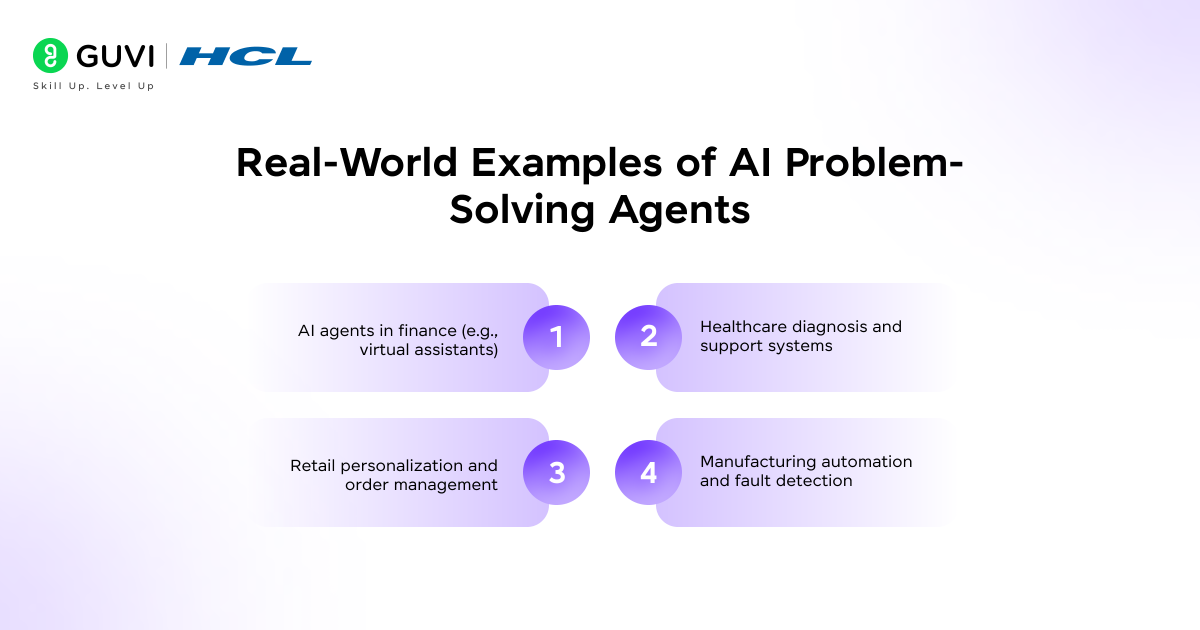
- Real-World Examples of AI Problem-Solving Agents
- 1) AI agents in finance (e.g., virtual assistants)
- 2) Healthcare diagnosis and support systems
- 3) Retail personalization and order management
- 4) Manufacturing automation and fault detection
- Concluding Thoughts…
- FAQs
- What is a problem-solving agent in artificial intelligence?
- What are the steps of a problem-solving agent in AI?
- What are the components of a problem in artificial intelligence?
- What is an example of a problem-solving agent in AI?
- What is the difference between a problem-solving agent and a learning agent?
What Are Problem-Solving Agents in AI?
Problem-solving agents in AI are autonomous software programs created to tackle challenges by taking actions that lead to solutions. Unlike basic tools, these agents don’t simply follow preset instructions—they analyze situations, evaluate options, and choose optimal actions based on data and algorithms.
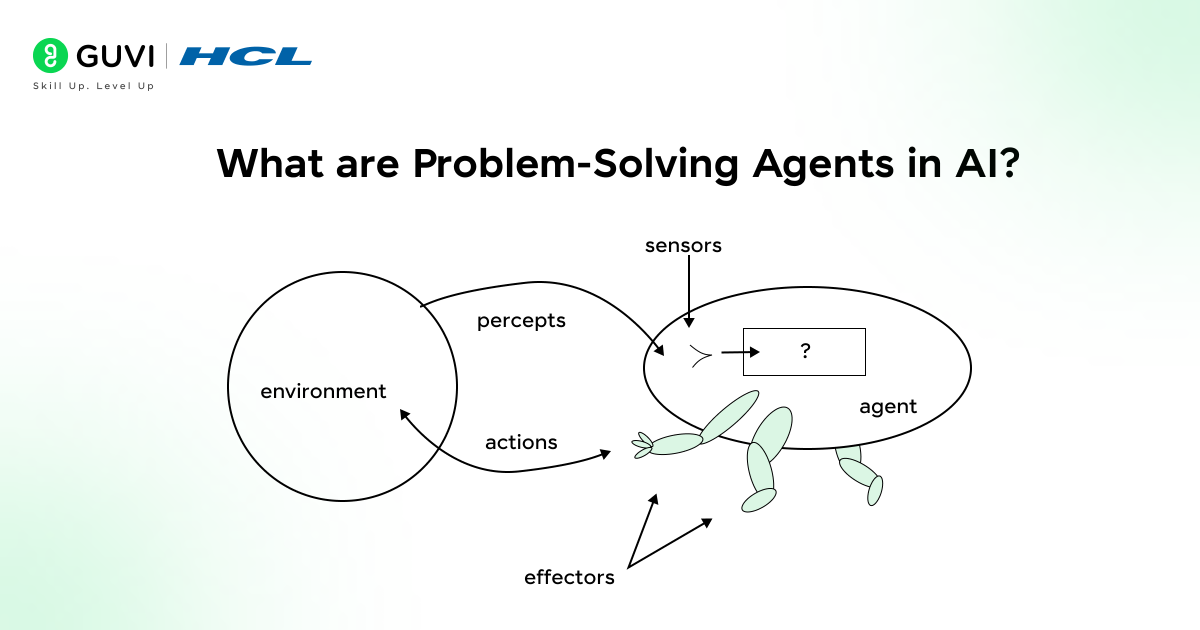
These agents operate through a systematic process:
- They collect data about their surroundings through various inputs
- They clearly understand the problem, including starting points and goals
- They evaluate different approaches and select the most promising solution
- They take action based on their analysis and adapt as needed
Essentially, AI agents serve as digital problem-solvers that can perceive, reason, and act within their environments to accomplish specific objectives. Moreover, many can learn from past experiences, continuously improving their decision-making abilities over time.
Problem-Solving Agents in AI at a Glance
| Agent Type | How It Works | Uses Memory? | Best For | Example |
|---|---|---|---|---|
| Simple Reflex Agent | Responds using predefined rules | No | Simple predictable tasks | Thermostat |
| Model-Based Reflex Agent | Uses current input and an internal model | Yes | Partially observable environments | Robot navigation |
| Goal-Based Agent | Selects actions that lead to a goal | Yes | Planning and search | Route planner |
| Utility-Based Agent | Compares outcomes using utility values | Yes | Problems with trade-offs | Resource allocation |
| Learning Agent | Improves through experience and feedback | Yes | Dynamic environments | Recommendation system |
| Hierarchical Agent | Breaks complex tasks into smaller levels | Yes | Multi-step problems | Workflow automation |
The five core agent architectures commonly recognized in AI are simple reflex, model-based reflex, goal-based, utility-based, and learning agents.
Why Problem-Solving AI Agents Matter in 2026
AI agents have moved beyond experimental demonstrations and are increasingly being incorporated into real business workflows. IBM reported in May 2026 that 55% of organizations are actively developing or deploying an agentic AI operating model.
Microsoft also reports that more than 80% of Fortune 500 companies are deploying active AI agents built with low-code or no-code tools. These systems are being used across functions such as sales, finance, security, customer service, and product development.
Problem-solving agents are becoming important because they can:
- Break complex objectives into smaller tasks.
- Search for possible solutions before taking action.
- Automate multi-step workflows.
- Respond when conditions or available information change.
- Combine reasoning with tools, data, and external systems.
- Reduce the need for human intervention in repetitive decision workflows.
The major shift in 2026 is from AI systems that primarily generate responses to agentic systems that can reason about goals and take actions to complete tasks.
Types of AI Problem-Solving Agents
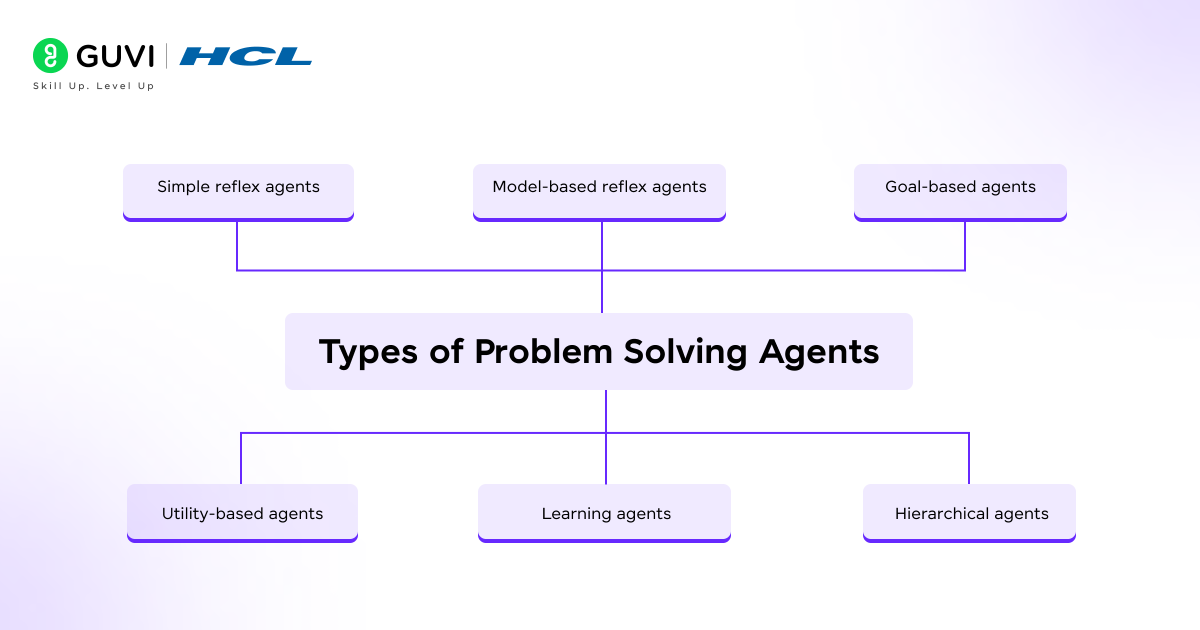
The world of artificial intelligence features various types of problem-solving agents, each with distinct capabilities and applications. These agents form a spectrum from simple reactive systems to complex learning entities.
1) Simple reflex agents
Simple reflex agents respond directly to current percepts using predefined condition-action rules without storing any history. They excel in fully observable, stable environments with clear rules but struggle with dynamic situations due to their lack of memory. These agents are ideal for basic automation tasks like traffic light controls or thermostat systems.
2) Model-based reflex agents
Model-based reflex agents maintain an internal representation of the world that tracks aspects not directly observable. Unlike simple reflex agents, they can handle partial observability by updating their internal model based on new information. These agents are particularly useful in robotics, where they help machines navigate complex environments by tracking previous movements.
3) Goal-based agents
Goal-based agents select actions by considering how they align with specific objectives. They use planning algorithms to explore multiple possible actions, finding the most effective sequence to reach their goals. Specifically, these agents can re-plan when conditions change, making them suitable for pathfinding, task scheduling, and strategic decision-making.
4) Utility-based agents
Utility-based agents evaluate multiple factors to determine the best course of action. They use a utility function that assigns numerical values to different outcomes based on desirability. Subsequently, they select actions that maximize overall benefit, balancing competing objectives like cost, time, and quality.
5) Learning agents
Learning agents improve performance over time by adapting to new experiences. They typically consist of four components: performance element, learning element, critic, and problem generator. Consequently, they can handle complex, changing environments through continuous improvement.
6) Hierarchical agents
Hierarchical agents organize behavior into multiple layers. Higher-level agents decompose complex tasks and delegate to specialized lower-level agents. This structure improves scalability and management of complex tasks across multiple domains.
Complete Guide to Problem-Solving Agents in Artificial Intelligence in India 2026
India’s AI ecosystem is increasingly moving from experimentation toward practical deployment.
Microsoft reported in May 2026 that 47% of Indian enterprises had multiple generative AI use cases live in production, while another 23% were running pilots, based on an EY-CII report cited by Microsoft.
This shift increases the importance of understanding how intelligent systems plan, reason, search, use tools, and make decisions.
For students and professionals in India, problem-solving agents provide useful foundations for fields such as:
- Artificial intelligence
- Agentic AI
- Machine learning
- Robotics
- Intelligent automation
- Search algorithms
- Generative AI applications
- Workflow orchestration
A good learning progression is:
AI fundamentals → intelligent agents → state-space representation → search algorithms → goal-based agents → learning agents → modern agentic AI
Students interested in modern systems can also study the difference between traditional agents and agentic AI. Current agentic systems can combine reasoning models with planning, memory, tools, and external integrations.
Components of a Problem-Solving Agent in AI
Before an agent can search for a solution, the problem must be represented clearly.
Five concepts are particularly important.
1. Initial State
The initial state describes where the agent begins.
For a navigation problem:
Initial state = Delhi
For a puzzle:
Initial state = current arrangement of pieces
2. Actions
Actions represent what the agent is allowed to do.
In a navigation system, actions could include:
- Move north.
- Turn right.
- Take another road.
- Stop.
3. Transition Model
The transition model describes what happens after the agent performs an action.
If the current state is A and the agent performs action X, the transition model predicts the resulting state.
4. Goal Test
The goal test determines whether the agent has successfully reached its objective.
For navigation:
Current location = destination?
If yes, the problem has been solved.
5. Path Cost
Several solutions may reach the same goal.
Path cost allows the agent to compare them.
A cost function might measure:
- Distance
- Time
- Money
- Energy
- Risk
The preferred path is often the one that satisfies the goal while minimizing the relevant cost.
How AI Agents Solve Problems Step-by-Step
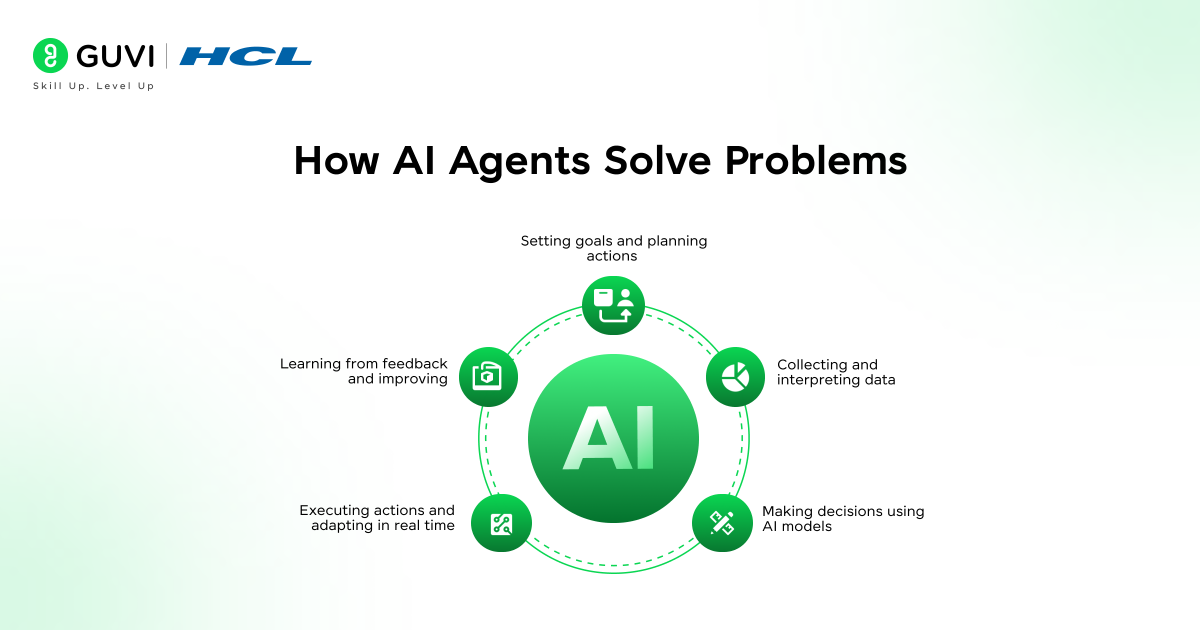
Problem solving agents in artificial intelligence operate through a structured, methodical process that mimics human problem-solving capabilities. These intelligent systems follow a step-by-step approach to tackle complex challenges autonomously. Let’s explore how they work through each phase of their problem-solving journey.
1) Setting goals and planning actions
The cornerstone of AI problem-solving begins with clear goal definition. The agent first formulates what it aims to achieve, which serves as the guiding principle for all subsequent actions. For complex objectives, AI agents break these down into smaller, more manageable sub-goals through task decomposition.
Once goals are established, the agent develops a strategic plan by:
- Identifying necessary steps to achieve the goal
- Evaluating potential actions based on available information
- Choosing the optimal course of action while considering constraints
- Anticipating potential obstacles and future states
2) Collecting and interpreting data
AI agents gather essential information about their environment through various means. They utilize perception capabilities to collect data from sensor inputs, observations, or digital sources. This process enables them to build an accurate understanding of their surroundings and context.
The state representation they create models current conditions and constraints, directly impacting how well they can predict action outcomes. Furthermore, AI agents can process multiple types of information simultaneously—including text, voice, video, and code—thanks to their multimodal capabilities.
3) Making decisions using AI models
After collecting data, AI agents analyze it through sophisticated reasoning processes. They identify patterns, make inferences, and solve problems using logic and available information. This analysis leads to informed decisions about which actions will most effectively achieve their goals.
Decision engines weigh options, consider constraints, and select optimal paths forward using techniques like reinforcement learning, heuristics, and logic-based systems. Through this process, AI agents can evaluate different scenarios and choose the most promising solution.
4) Executing actions and adapting in real time
During execution, AI agents implement their chosen strategy while continuously monitoring its effectiveness. If they encounter unexpected obstacles or changes, they dynamically adjust their approach. This real-time adaptability allows them to handle unpredictable environments effectively.
AI agents can accelerate execution by eliminating delays between tasks and enabling parallel processing of multiple steps simultaneously. When disruptions occur, they can reroute operations and escalate only when necessary, maintaining workflow continuity despite challenges.

5) Learning from feedback and improving
The final crucial step in AI problem-solving involves learning from experiences. Through feedback mechanisms, agents receive information about their actions’ results, helping them assess accuracy and effectiveness. This feedback comes in various forms, including rewards, penalties, or direct user input.
Over time, AI agents refine their decision-making capabilities through repeated interactions, gradually improving performance on complex tasks. Their ability to continuously learn enables them to adapt to changing conditions, align with user needs, and maintain relevance as environments evolve.
To break the technical flow, here are some surprising facts about AI problem-solving agents:
The First AI Problem Solver (1950s): One of the earliest AI problem-solving systems was the Logic Theorist (1956), built by Allen Newell and Herbert Simon. It was able to prove 38 of the first 52 theorems in Principia Mathematica, even discovering shorter proofs than the original authors!
Chess as a Benchmark for AI: Problem-solving agents were famously tested through chess programs. IBM’s Deep Blue, powered by such agents, defeated world champion Garry Kasparov in 1997—marking a milestone in AI’s ability to solve complex, strategic problems.
These facts show how problem-solving agents, from proving theorems to beating chess champions, have been central to AI’s history and progress.
Search Strategies Used by Problem-Solving Agents
Search is a central part of classical AI problem solving.
Different algorithms explore the state space differently.
| Search Algorithm | Main Approach | Advantage | Limitation |
| Breadth-First Search | Explores level by level | Can find shortest path with equal step costs | Uses significant memory |
| Depth-First Search | Explores one path deeply | Requires less memory | May follow an unhelpful path |
| Uniform Cost Search | Expands lowest-cost path | Handles different path costs | Can explore many nodes |
| Greedy Best-First Search | Chooses state closest to goal using heuristic | Can be fast | May not find optimal solution |
| A* Search | Combines path cost and heuristic estimate | Efficient and optimal under suitable conditions | Depends on heuristic quality |
Breadth-First Search
Breadth-First Search or BFS explores all states at one depth before moving to the next.
It is useful when all actions have similar costs and the shallowest solution is desirable.
Depth-First Search
Depth-First Search or DFS follows one path as deeply as possible before backtracking.
It can require less memory than BFS but may spend significant time exploring an unproductive branch.
Uniform Cost Search
Uniform Cost Search expands the path with the lowest accumulated cost.
This makes it useful when actions have different costs.
Greedy Best-First Search
Greedy search uses a heuristic to estimate which state appears closest to the goal.
It may reach a solution quickly but does not always choose the best path.
A* Search
A* combines:
Actual cost so far + estimated remaining cost
This is commonly written as:
f(n) = g(n) + h(n)
Where:
- g(n) = cost already incurred.
- h(n) = estimated cost to the goal.
- f(n) = estimated total solution cost.
A good heuristic can significantly reduce unnecessary exploration.
Problem-Solving Agents vs Learning Agents
These terms are related but not identical.
| Factor | Problem-Solving Agent | Learning Agent |
| Primary Purpose | Find actions that reach a goal | Improve behavior using experience |
| Main Mechanism | Search and planning | Feedback and learning |
| Existing Knowledge | Often works with a defined model | Can improve its model over time |
| Adaptability | Depends on design | Generally higher |
| Example | Route-search system | Adaptive recommendation system |
The categories can overlap.
A modern AI system may learn from previous interactions and still use search or planning to solve a new problem.
Real-World Examples of AI Problem-Solving Agents
Across diverse industries, problem-solving agents in artificial intelligence are tackling real-world challenges through data analysis and autonomous decision-making. These practical applications showcase how AI agents deliver tangible benefits in various sectors.
1) AI agents in finance (e.g., virtual assistants)
Financial institutions employ AI agents to enhance security and customer experience. These systems monitor transactions continuously, detecting unusual patterns that may indicate fraud in real-time. Beyond security, AI-powered assistants analyze individual financial data to provide personalized advice on investments based on risk tolerance and spending habits.
AI agents in banking also streamline operations by:
- Automating routine tasks like balance inquiries and loan applications
- Providing 24/7 customer support
- Ensuring regulatory compliance through consistent monitoring
An AI voice agent, for example, can handle inbound customer calls 24/7, routing queries and resolving common issues without any human involvement.
2) Healthcare diagnosis and support systems
Healthcare has witnessed remarkable advancements through AI problem-solving. Medical diagnostic AI systems analyze vast amounts of patient data—including medical images, bio-signals, and laboratory results—to support clinical decision-making. In fact, AI-based breast cancer diagnosis tools have shown an absolute reduction in false positives by 5.7% and false negatives by 9.4%.
AI agents also assist healthcare providers by automating administrative tasks, enabling them to focus on patient care. Furthermore, these systems help with early detection of potential health problems before they become serious.
3) Retail personalization and order management
In retail, AI agents create hyper-personalized shopping experiences by analyzing customer data. Top retailers using AI-powered personalization have seen a 10% to 25% increase in return on ad spend for targeted campaigns. AI systems analyze purchasing patterns, browsing histories, and social media activity to create tailored recommendations.
For order management, AI agents optimize the entire process from placement to delivery. They forecast demand, manage inventory levels, and determine the most efficient shipping routes.
4) Manufacturing automation and fault detection
Manufacturing facilities benefit from AI agents that predict equipment failures before they occur. Through IoT sensors fitted on machinery parts, these systems detect abnormal behavior patterns and recommend maintenance actions. This predictive approach minimizes unplanned downtime and extends equipment lifespan.
Additionally, AI quality control systems use advanced imaging and machine learning to identify defects in real-time. One study found that supervised machine learning methods achieved high accuracy in predicting faults in machine parts.
Discover HCL GUVI’s IITM Pravartak and Intel Certified AI & ML Course—a 6-month weekend bootcamp (in English, Hindi, and Tamil) designed to equip beginners with hands-on expertise in Generative AI, Agentic AI (including problem-solving agents), Deep Learning, and MLOps.
Concluding Thoughts…
Problem-solving agents have transformed from simple rule-based systems to sophisticated learning entities capable of handling complex real-world challenges. These AI systems now serve as digital teammates rather than mere tools, working alongside humans across industries like finance, healthcare, retail, and manufacturing.
Throughout this guide, you’ve learned how AI agents perceive their environment, make decisions, execute actions, and continuously improve through feedback. If you have any doubts, reach out to me through the comments section below. Good Luck!
FAQs
What is a problem-solving agent in artificial intelligence?
A problem-solving agent is a goal-based AI agent that determines what to do by searching for a sequence of actions that leads from an initial state to a goal state. Unlike a simple reactive system, it considers possible future states before deciding which action to take.
What are the steps of a problem-solving agent in AI?
A problem-solving agent generally follows four core stages:
Goal formulation: Decide what must be achieved.
Problem formulation: Define the initial state, possible actions, goal, and costs.
Search: Explore possible sequences of actions.
Execution: Carry out the selected solution.
More advanced systems can also monitor outcomes and revise their plan when circumstances change.
What are the components of a problem in artificial intelligence?
A well-defined AI search problem normally includes:
Initial state: Where the agent starts.
Actions: Choices available to the agent.
Transition model: How each action changes the state.
Goal test: Determines whether the target has been reached.
Path cost: Measures the cost of reaching the goal.
These components allow the agent to represent the problem as a state space that can be searched.
What is an example of a problem-solving agent in AI?
A route-planning system is a simple example. The starting location forms the initial state and the destination becomes the goal. Available roads represent actions while distance or travel time can represent path cost.
The agent searches possible routes and chooses a suitable sequence of actions that leads to the destination.
What is the difference between a problem-solving agent and a learning agent?
A problem-solving agent focuses on finding a sequence of actions that achieves a defined goal. It typically relies on problem formulation, planning, and search.
A learning agent improves its behavior based on experience or feedback. The two approaches can also work together. A modern AI system may learn from previous interactions while using planning and problem-solving techniques to complete new tasks.
Success Stories

About the Author
Vaishali
I'm a seasoned writer with four years of experience across technical, non-technical, and just about every genre or niche you can imagine. Adaptable and curious, I enjoy exploring new topics and making information engaging and easy to understand. Fueled by a steady stream of tea, I approach each project with creativity, reliability, and genuine enthusiasm for storytelling.
View all posts by Vaishali
Connect with me @











Did you enjoy this article?