


Artificial Intelligence and Machine Learning Articles
Finance Manager to Data Analytics: Career Growth, Salary and Seniority
How to Evaluate LLM Outputs in Production Deployments
AI/ML Skills Gap 2026: Why Companies Can't Find Job-Ready Talent
20 AI/ML Interview Questions Recruiters Can Use Without a Tech Background - Best Guide

Get In Touch For Details! Request More Information
Multimodal AI: Machines Learning to See and Understand
Aug 18, 2026 5 Min Read 954 Views
(Last Updated)
Human communication is inherently multimodal. We read text, listen to audio, watch video, and interpret images, often all at once. For decades, artificial intelligence could only handle one type of data at a time. A model that understood text knew nothing about images. A model trained on audio had no concept of language.
That is changing fast.
Multimodal AI brings together multiple data modalities, text, images, audio, video, and more into a single, unified framework. Instead of building separate models for each type of data, multimodal learning trains systems to understand and generate content across all of them.
The result is AI that feels more natural, more capable, and far closer to how humans actually perceive the world.
Table of contents
- TL;DR
- What Is Multimodal AI?
- Common Data Modalities in AI
- Why Single-Modality AI Falls Short
- How Multimodal Learning Works
- The Three Stages of Multimodal Processing
- Key Architectures Used in Multimodal Models
- Cross-Modal Learning: Teaching AI to Connect the Dots
- Real-World Applications of Multimodal AI
- Healthcare and Medical Imaging
- Autonomous Driving
- Education and Accessibility
- Creative and Generative AI
- Customer Service and Virtual Assistants
- The Role of Deep Learning in Multimodal Models
- Challenges in Building Multimodal AI Systems
- Conclusion
- FAQs
- What is multimodal AI in simple terms?
- What is the difference between multimodal learning and transfer learning?
- Which multimodal AI models are most widely used today?
- Is multimodal AI the same as general AI?
- What industries benefit most from multimodal AI?
TL;DR
- Multimodal AI processes multiple data types — text, images, audio, and video — within a single model.
- It moves beyond single-modality limitations through cross-modal learning and data fusion.
- Key architectures include transformers, contrastive learning, and encoder-decoder models.
- Real-world applications span healthcare, education, autonomous driving, and creative tools.
- Understanding multimodal AI is essential for building the next generation of intelligent systems.
What Is Multimodal AI?
Multimodal AI refers to machine learning models that can process and combine information from multiple types of data, known as modalities. These modalities can include text, images, audio, video, and other forms of sensory input. Unlike traditional AI systems that work with only one data type, multimodal AI integrates different inputs to develop a more complete understanding and generate more accurate, context-aware outputs.
What Is Multimodal AI?
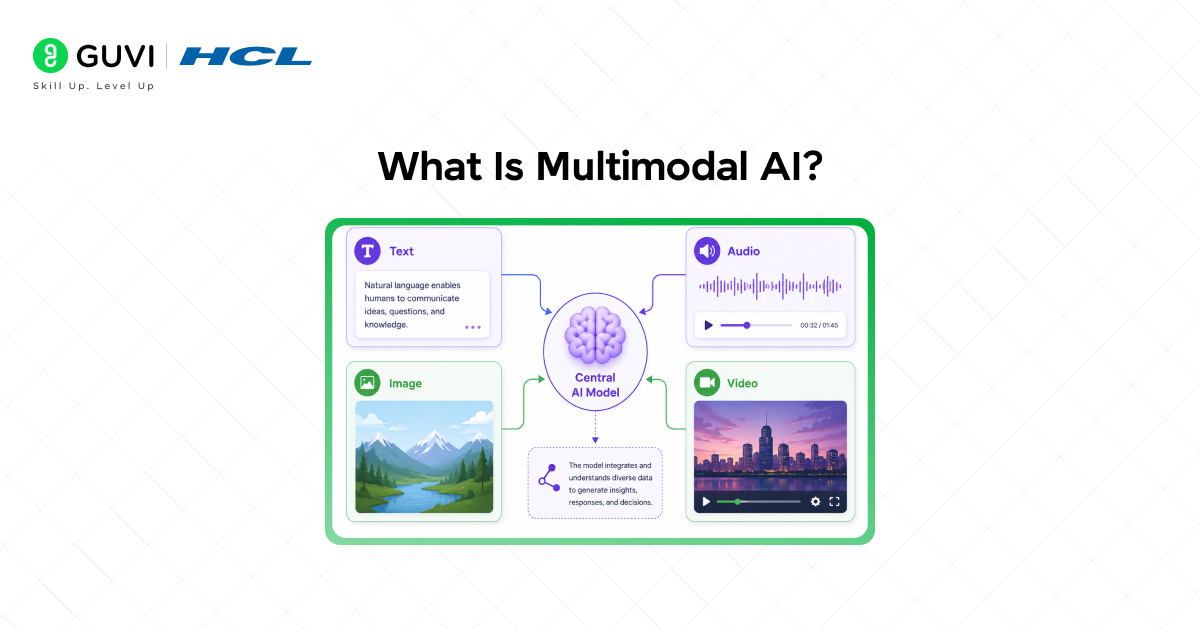
Multimodal AI refers to artificial intelligence systems that can process, understand, and generate information from more than one type of data or modality. Rather than being trained exclusively on text or only on images, these models learn from combinations of inputs that mirror how humans experience the world.
The core idea is simple: the world does not communicate in one format. A doctor’s diagnosis involves reading patient notes, studying X-ray scans, and listening to a patient describe their symptoms. A self-driving car must process road signs, spoken instructions from passengers, and real-time sensor data all at once. Multimodal AI is designed to handle exactly that kind of complexity.
Common Data Modalities in AI
• Text: Natural language articles, conversations, documents, code.
• Images: Photographs, diagrams, medical scans, charts.
• Audio: Speech, music, environmental sounds, voice commands.
• Video: Motion sequences combining visual frames and audio tracks.
• Structured data: Tables, sensor readings, numerical datasets.
• 3D/spatial data: Point clouds, depth maps, LiDAR data.
Why Single-Modality AI Falls Short
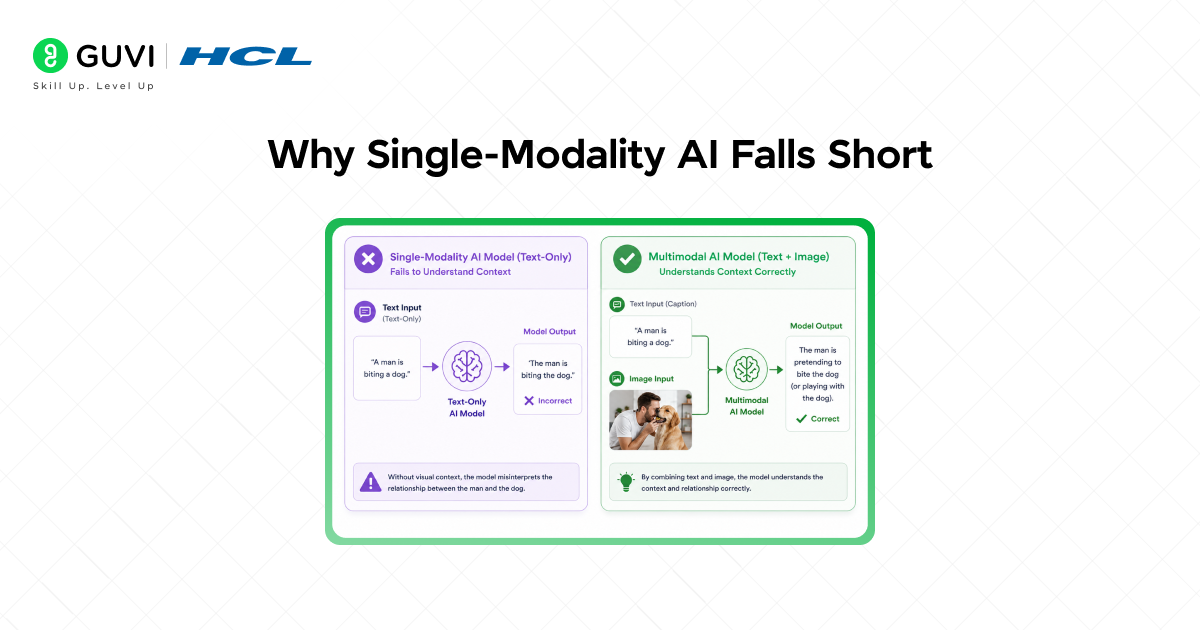
Traditional AI models are built with one modality in mind. Language models understand text but cannot see. Image classifiers identify objects but cannot explain them in language. Audio models transcribe speech but cannot connect it to what is happening visually.
This creates a fundamental bottleneck. Real-world problems rarely exist in a single data format. When AI systems can only process one type of input, they miss critical context, and that gap leads to poor decisions, incomplete outputs, and limited usefulness.
Consider a customer service system powered only by text. It can read a complaint, but it cannot hear frustration in the customer’s voice or see the screenshot they have attached. The model has access to only a fraction of the information it needs.
Multimodal learning solves this by enabling the model to pull meaning from all available inputs simultaneously.
How Multimodal Learning Works
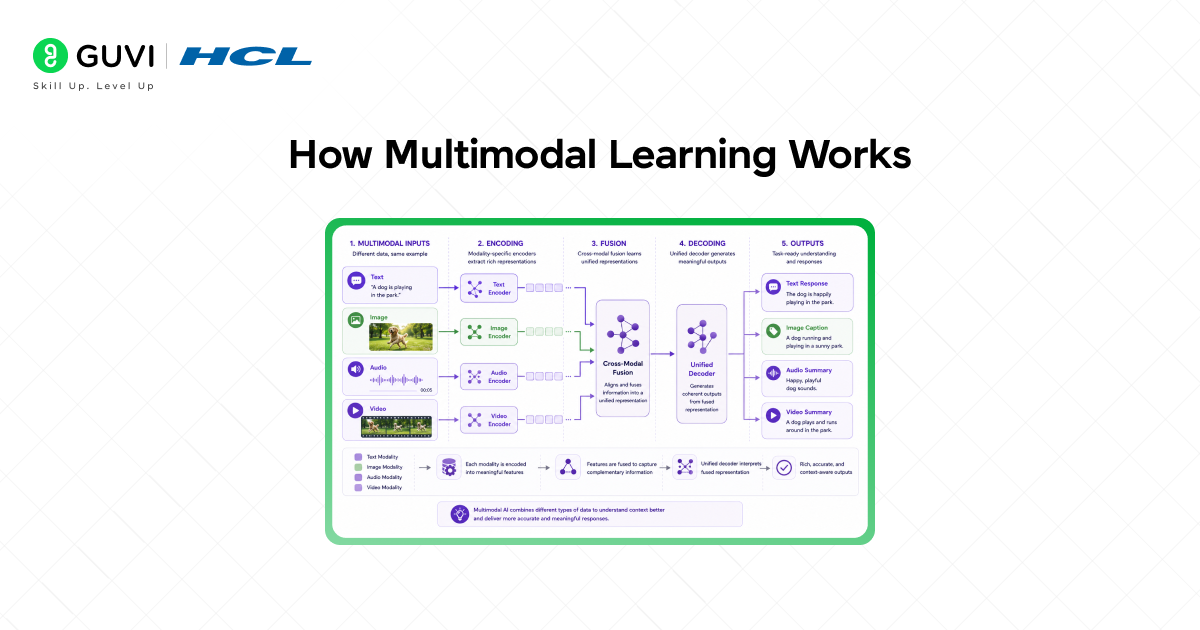
At its core, multimodal learning requires solving two technical challenges: how to represent different data types in a shared format, and how to combine them meaningfully. This is known as data fusion.
The Three Stages of Multimodal Processing
- Encoding: Each modality is converted into a numerical representation (an embedding or feature vector) using a dedicated encoder. A vision encoder handles images; a text encoder handles language; an audio encoder handles sound.
- Fusion: The separate representations are combined either early in the pipeline (early fusion), late after processing (late fusion), or at multiple intermediate stages (hybrid fusion). The goal is to create a shared representation that captures relationships across modalities.
- Decoding: The fused representation is used to generate the output, whether that is a text answer, a generated image, a classification label, or a translated audio clip.
Key Architectures Used in Multimodal Models
- Transformers: The attention mechanism that powers GPT and BERT extends naturally to multiple modalities. Vision Transformers (ViT) apply the same approach to images, and unified models like GPT-4 combine both.
- Contrastive learning: Models like CLIP (Contrastive Language-Image Pretraining) learn by matching images and text descriptions, aligning their representations in shared space.
- Encoder-decoder architectures: Used in models like Flamingo and DALL-E, these handle translation between modalities from text to image, or from image to text.
- Cross-attention: Allows one modality to attend to features in another, enabling models to ground language in visual content and vice versa.
Cross-Modal Learning: Teaching AI to Connect the Dots
Cross-modal learning is a specific branch of multimodal AI where a model learns associations between different types of data. It does not simply process each modality separately; it actively finds relationships across them.
A well-known example is image captioning. The model must understand what is happening in an image and describe it in natural language. To do that, it must have learned that certain visual features, such as a dog, a park, and a leash, correspond to specific words and sentence structures.
The same principle applies in the other direction. Text-to-image generation systems like DALL-E and Stable Diffusion learn to translate language descriptions into corresponding visuals. Audio-visual models learn that speech patterns correlate with specific facial movements, enabling applications like lip-sync generation and speech enhancement.
OpenAI’s CLIP model was trained on approximately 400 million image–text pairs collected from the internet. Instead of being explicitly taught what objects were, CLIP learned to connect visual concepts with language purely through large-scale exposure to paired examples. This approach allowed the model to develop powerful zero-shot recognition capabilities, identifying and describing images it was never directly trained on.
Real-World Applications of Multimodal AI
Multimodal AI is not a theoretical concept. It is already deployed across industries, solving problems that were previously impossible for machines to handle.
Healthcare and Medical Imaging
Medical diagnosis combines visual evidence with clinical notes, patient history, and sometimes audio recordings of symptoms. Multimodal AI systems can analyse X-rays alongside written radiology reports to produce more accurate diagnoses. Models that fuse pathology images with genomic data have demonstrated improved cancer detection rates compared to single-modality approaches.

Autonomous Driving
Self-driving vehicles are perhaps the most demanding multimodal systems in existence. They fuse data from cameras (visual), LiDAR (spatial), radar (distance and speed), and GPS (positional), while simultaneously processing spoken commands from passengers. No single modality can provide the full picture required for safe navigation.
Education and Accessibility
Multimodal models power tools that convert lecture videos into searchable transcripts, generate alt-text descriptions for images, and build interactive learning environments that respond to both voice and text input. These capabilities make education more accessible for users with visual or hearing impairments.
Creative and Generative AI
Tools like DALL-E, Midjourney, and Sora are built on multimodal foundations. They take text descriptions and generate images or video sequences. Emerging tools now accept image sketches as input and produce refined visual outputs, or take a hummed melody and generate full musical arrangements, enabling entirely new creative workflows.
Customer Service and Virtual Assistants
Modern AI assistants increasingly operate across text, voice, and image inputs. A customer can photograph a faulty product and describe the problem in spoken language. The assistant can process both to identify the issue and recommend a solution, a level of intelligence that single-modality systems simply cannot match.
The Role of Deep Learning in Multimodal Models
Deep learning is the engine that makes multimodal AI possible. Its layered neural network architecture is well-suited to learning hierarchical representations of low-level features like edges and phonemes at early layers, and high-level semantic concepts like objects and intentions at deeper layers.
What makes deep learning especially powerful for multimodal tasks is the transformer architecture. Originally developed for language, transformers apply a mechanism called self-attention, which allows every part of an input sequence to relate to every other part. This generalises remarkably well to images (treated as sequences of patches), audio (as time-series tokens), and multi-input combinations.
Large-scale pretraining on diverse, paired datasets enables these models to learn rich cross-modal associations before being fine-tuned for specific applications. The result is general-purpose multimodal intelligence that can be rapidly adapted.
Challenges in Building Multimodal AI Systems
Building reliable multimodal systems introduces challenges that single-modality models do not face.
- Data alignment: Paired training data, for example, images with matching text captions, or videos with transcripts, is expensive and difficult to curate at scale. Misaligned data leads to models that learn spurious correlations rather than meaningful relationships.
- Computational cost: Processing multiple modalities simultaneously requires significantly more memory and processing power than single-modality training. Efficient architectures and hardware advances (such as GPU clusters and specialised AI chips) are making this more tractable, but cost remains a barrier.
- Interpretability: Understanding why a multimodal model made a particular decision is harder than for simpler models. When a system combines visual and linguistic inputs, tracing the reasoning path back to specific features requires specialised interpretability tools.
- Modality imbalance: If one modality dominates the training signal, the model may learn to rely on it and underuse the others. Careful balancing during training is required to ensure genuine multi-input reasoning.
If you want to learn more about building skills for Claude Code and automating your procedural knowledge, do not miss the chance to enrol in HCL GUVI’s Intel & IITM Pravartak Certified Artificial Intelligence & Machine Learning courses. Endorsed with Intel certification, this course adds a globally recognised credential to your resume, a powerful edge that sets you apart in the competitive AI job market.
Conclusion
Multimodal AI represents one of the most significant leaps in the history of artificial intelligence. By moving beyond single data types and embracing the full richness of how information exists in the world as text, images, audio, video, and more, these systems are becoming genuinely capable partners in complex, real-world tasks.
The progress is not just technical. Multimodal models are already reshaping medicine, transportation, education, and creative work. As training data improves, architectures become more efficient, and cross-modal learning deepens, the gap between machine perception and human perception will continue to close.
For developers, researchers, and anyone building with AI today, understanding multimodal learning is no longer optional. It is the foundation of what intelligent systems will become.
FAQs
1. What is multimodal AI in simple terms?
Multimodal AI is an artificial intelligence system that can process and understand more than one type of data, such as text and images, together, rather than being limited to a single format.
2. What is the difference between multimodal learning and transfer learning?
Transfer learning involves applying knowledge from one task to another within the same modality. Multimodal learning specifically involves integrating and reasoning across multiple types of data, such as combining visual and language understanding in a single model.
3. Which multimodal AI models are most widely used today?
Widely used multimodal models include GPT-4 (text and image), CLIP (image-text alignment), DALL-E (text-to-image generation), Flamingo (visual language model), and Whisper (speech and text). Each represents a different approach to combining modalities.
4. Is multimodal AI the same as general AI?
Not exactly. Multimodal AI refers to systems that handle multiple data types. General AI (AGI) is a broader concept referring to AI with human-level reasoning across all domains. Multimodal capability is an important step toward AGI, but the two terms are not interchangeable.
5. What industries benefit most from multimodal AI?
Healthcare (diagnostic imaging combined with patient records), autonomous vehicles (sensor fusion), education (interactive and accessible learning tools), media and creative industries (generative AI), and customer service (voice and image-enabled support) are among the biggest beneficiaries today.
Success Stories

About the Author
Vishalini Devarajan
An Aerospace Engineer turned content writer, I focus on making complex concepts easy to understand through well-structured, reader-friendly blogs. Whether it’s a technical topic or a non-technical one, I love creating content that is clear, engaging, and impactful.
View all posts by Vishalini Devarajan
Connect with me @









Did you enjoy this article?