


Digital Marketing Articles
What is Performance Marketing? Complete Guide for 2026
What is the Voice of the Customer and Why Does it Matter
What is A/B Testing in Marketing? A Beginner’s Guide to Smarter Campaign Optimization
What is Lead Nurturing in Marketing? A Practical Guide for Beginners


Get In Touch For Details! Request More Information
What Is Marketing Mix Modeling (MMM)? – Best Guide
Aug 03, 2026 9 Min Read 331 Views
(Last Updated)
Table of contents
- TL;DR
- What Is Marketing Mix Modeling (MMM)?
- Marketing Mix Modeling Meaning
- Why Is It Called "Marketing Mix Modeling"?
- Why Is Marketing Mix Modeling Important?
- Marketing Mix Modeling vs Marketing Attribution
- Which One Should You Use?
- What Are the Key Components of Marketing Mix Modeling?
- Marketing Variables
- Business Variables
- External Variables
- How Does Marketing Mix Modeling Work?
- The Marketing Mix Modeling Process: Step by Step
- Step 1: Define the Business Objective
- Step 2: Collect Historical Data
- Step 3: Clean and Prepare the Data
- Step 4: Build the Statistical Model
- Step 5: Validate the Model
- Step 6: Generate Actionable Insights
- Understanding the Statistical Side (Without the Math)
- A Simple Marketing Mix Modeling Example
- Real-World Examples of Marketing Mix Modeling
- Coca-Cola
- Procter & Gamble (P&G)
- Retail Industry Example
- Benefits of Marketing Mix Modeling
- Limitations of Marketing Mix Modeling
- Requires Historical Data
- Results Are Not Real-Time
- Statistical Expertise Is Required
- Data Quality Matters
- Why Marketing Mix Modeling Is Becoming More Important
- Marketing Mix Modeling Best Practices
- Define Clear Business Objectives
- Collect Comprehensive Historical Data
- Include External Factors
- Combine MMM with Marketing Attribution
- Refresh Models Regularly
- Best Tools Used for Marketing Mix Modeling
- Common Mistakes in Marketing Mix Modeling
- Using Too Little Historical Data
- Ignoring External Variables
- Measuring Only Digital Channels
- Treating the Model as Permanent
- Confusing Correlation with Causation
- Future Trends in Marketing Mix Modeling (2026 & Beyond)
- AI-Assisted Modeling
- Google's Meridian Framework
- Greater Focus on Incrementality
- Unified Marketing Measurement
- Skills Required to Learn Marketing Mix Modeling
- Technical Skills
- Business Skills
- Career Opportunities After Learning Marketing Mix Modeling
- Build Marketing Analytics Skills with HCL GUVI
- Conclusion
- FAQs
- What is marketing mix modeling?
- What does MMM stand for?
- How is marketing mix modeling different from marketing attribution?
- Which industries use marketing mix modeling?
- Why is marketing mix modeling becoming more important?
- Does marketing mix modeling require coding?
- Is marketing mix modeling suitable for small businesses?
- What skills should I learn before studying marketing mix modeling?
TL;DR
Marketing mix modeling is a statistical technique that helps businesses understand how different marketing activities, such as TV advertising, digital campaigns, social media, search ads, pricing, and promotions, contribute to sales or other business outcomes. Also known as MMM or media mix modeling, it uses historical data to estimate the impact of each marketing channel, enabling smarter budget optimization and improved marketing ROI. Unlike user-level tracking, marketing mix modeling relies on aggregated data, making it increasingly valuable in a privacy-first marketing landscape.
Marketing mix modeling has become one of the most important techniques for measuring the effectiveness of marketing campaigns, especially as businesses adapt to stricter privacy regulations and reduced access to third-party cookies. Instead of relying on individual user tracking, marketing mix modeling analyzes historical data to estimate how different marketing activities influence business outcomes.
Whether you’re a marketing professional, business analyst, or student exploring marketing analytics, understanding marketing mix modeling can help you make better decisions about campaign performance, budget allocation, and long-term growth. This guide explains the concept in simple terms, how it works, and why it remains highly relevant in 2026.
What Is Marketing Mix Modeling (MMM)?
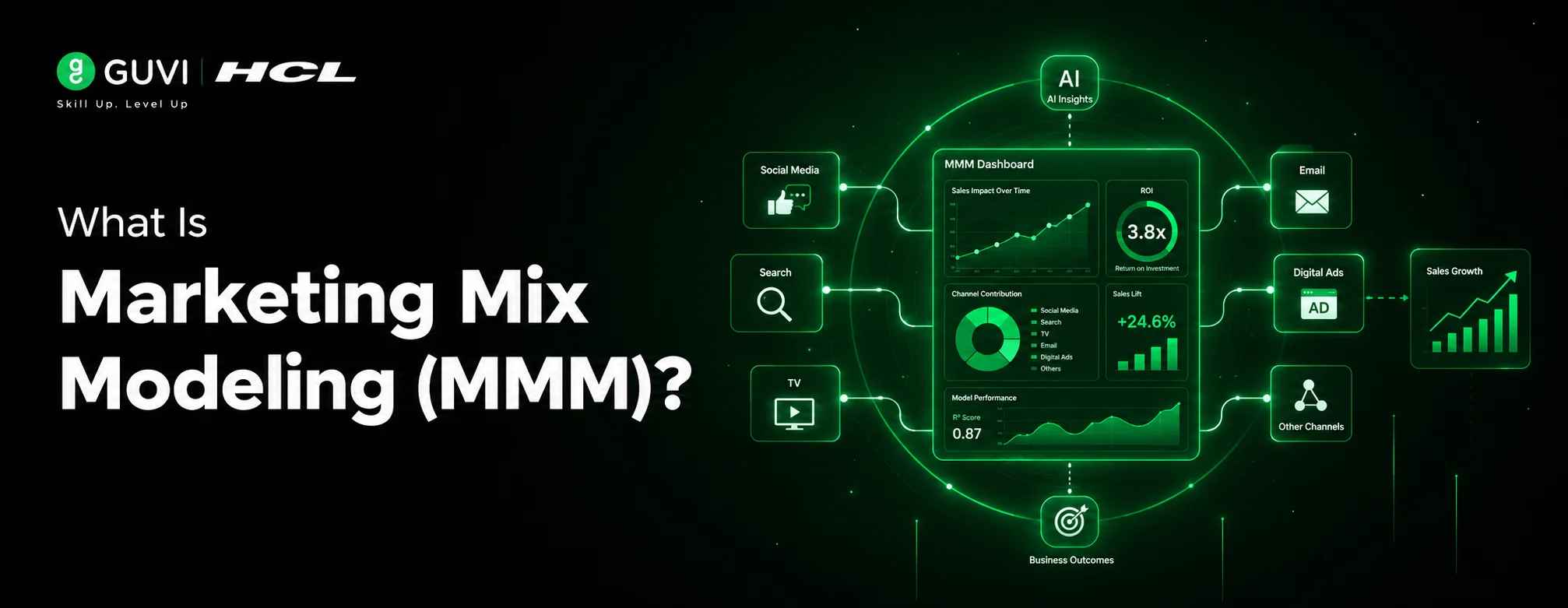
Marketing mix modeling is a statistical analysis technique that estimates how different marketing channels and external business factors contribute to a desired outcome, such as sales, revenue, leads, or customer acquisitions.
Rather than asking, “Which individual customer clicked an ad?”, marketing mix modeling answers a broader business question:
How much did each marketing channel contribute to overall business performance?
This makes it especially useful for organizations running campaigns across multiple channels, including television, search engines, social media, email, print media, radio, and outdoor advertising.
Marketing Mix Modeling Meaning
A concise definition suitable for Google AI Overview:
Marketing mix modeling (MMM) is a statistical method that analyzes historical marketing and sales data to estimate the contribution of different marketing channels and external factors, helping businesses improve marketing ROI and optimize budget allocation.
Unlike user-level attribution methods, marketing mix modeling works with aggregated data collected over weeks, months, or years, making it more resilient in privacy-conscious environments.
Why Is It Called “Marketing Mix Modeling”?
The term comes from the traditional marketing mix, often referred to as the 4Ps of marketing:
- Product
- Price
- Place
- Promotion
Modern marketing mix modeling expands beyond these elements by also considering additional variables such as:
- Advertising spend
- Seasonality
- Competitor activity
- Economic conditions
- Promotions
- Holidays
- Pricing changes
- Distribution
- Brand awareness
The “modeling” part refers to the use of statistical techniques, most commonly regression analysis, to estimate how these variables influence business outcomes.
As digital advertising shifts toward more privacy-conscious measurement, Marketing Mix Modeling (MMM) has gained renewed attention because it relies on aggregated data instead of individual user tracking. Google has highlighted MMM as a key component of modern, privacy-durable measurement and introduced Meridian, its open-source MMM framework, to help advertisers make better budget decisions.
Why Is Marketing Mix Modeling Important?
Marketing Mix Modeling combines business analytics with statistical modeling to improve marketing decisions.
As consumers interact with brands across multiple online and offline channels, accurately measuring marketing performance has become increasingly challenging.
Traditional tracking methods often struggle with:
- Cross-device customer journeys
- Privacy regulations
- Cookie restrictions
- Offline advertising
- TV and radio campaigns
- Long buying cycles
This is where marketing mix modeling provides a significant advantage.
Instead of depending on individual customer tracking, it evaluates the overall impact of marketing investments using historical business data. This makes it particularly valuable for organizations that invest in both digital and traditional advertising.
Some of the biggest benefits include:
- Better marketing ROI measurement
- Smarter budget optimization
- Improved campaign planning
- More reliable long-term forecasting
- Better understanding of channel effectiveness
- Data-driven marketing decisions
Marketing Mix Modeling vs Marketing Attribution
If you’re working in performance marketing, Marketing Mix Modeling provides strategic insights that complement campaign-level attribution.
Although both approaches measure marketing effectiveness, they answer different business questions.
| Feature | Marketing Mix Modeling | Marketing Attribution |
| Data Type | Aggregated historical data | User-level interaction data |
| Primary Goal | Measure overall channel contribution | Credit individual touchpoints |
| Best For | Strategic planning and budget allocation | Campaign optimization |
| Time Horizon | Long-term | Short-term |
| Offline Channels | Excellent support | Limited support |
| Privacy Friendly | Yes | Increasingly challenging |
| Statistical Complexity | Higher | Lower to moderate |
Which One Should You Use?
The answer is often both.
Marketing attribution helps optimize individual digital campaigns by understanding customer touchpoints, while marketing mix modeling provides a broader view of how all marketing investments contribute to business outcomes.
Many large organizations combine the two approaches to make both tactical and strategic decisions.
What Are the Key Components of Marketing Mix Modeling?
A successful marketing mix modeling project considers several variables that may influence business performance.
Marketing Variables
These include paid and owned marketing activities such as:
- Television advertising
- Search advertising
- Social media campaigns
- Display advertising
- Email marketing
- Influencer marketing
- Outdoor advertising
- Print media
Business Variables
Marketing performance is also affected by internal business decisions, including:
- Product pricing
- Promotions
- Distribution
- New product launches
External Variables
External factors outside a company’s control can significantly impact results.
Common examples include:
- Seasonal demand
- Economic conditions
- Inflation
- Competitor campaigns
- Public holidays
- Weather (for specific industries)
Accounting for these variables helps produce a more accurate marketing mix modeling analysis.
How Does Marketing Mix Modeling Work?
Understanding marketing mix modeling becomes much easier once you look at it as a structured decision-making process rather than a complex statistical exercise.
Imagine a company spends money on television commercials, Google Ads, Instagram campaigns, influencer marketing, and email marketing. Sales increase over the next few months, but one important question remains:
Which marketing activities actually drove the growth?
This is exactly what marketing mix modeling aims to answer.
Instead of tracking individual customers, MMM analyzes historical business data to estimate how much each marketing activity contributed to overall business results. It also considers external influences such as seasonality, pricing changes, holidays, competitor campaigns, and economic conditions to ensure the analysis is as accurate as possible.
The result is a data-driven model that helps marketers understand which channels deserve more investment and which ones may be underperforming.
The Marketing Mix Modeling Process: Step by Step
Most marketing mix modeling projects follow a structured workflow. While the statistical techniques can become sophisticated, the overall process remains straightforward.
Step 1: Define the Business Objective
Every marketing mix modeling project starts with a clear business question.
Examples include:
- Which marketing channel generates the highest sales?
- Are television advertisements still delivering value?
- Should we invest more in paid search or social media?
- How much revenue comes from seasonal campaigns?
- Which marketing channels deserve a larger budget next quarter?
Defining the objective helps determine what data needs to be collected and how the results will be interpreted.
Step 2: Collect Historical Data
The next step is gathering historical marketing and business data.
Most organizations collect data from multiple sources, including:
Marketing Data
- TV advertising spend
- Google Ads spend
- Facebook and Instagram campaigns
- YouTube advertising
- Email marketing performance
- Influencer campaigns
- Display advertising
- Offline advertising
Business Data
- Weekly or monthly sales
- Revenue
- Lead generation
- Customer acquisitions
- Website traffic
- Product pricing
External Factors
- Public holidays
- Seasonal trends
- Competitor promotions
- Weather
- Inflation
- Economic indicators
A high-quality marketing mix modeling project depends heavily on clean and reliable historical data.
Step 3: Clean and Prepare the Data
Raw marketing data is rarely ready for analysis.
Before building the model, analysts typically:
- Remove duplicate records
- Handle missing values
- Standardize time periods
- Align marketing spend with sales periods
- Correct reporting inconsistencies
This preprocessing step ensures that the model learns from accurate information rather than noisy or incomplete data.
Step 4: Build the Statistical Model
This is where the “modeling” begins.
Most traditional marketing mix modeling approaches use multiple linear regression, although more advanced methods now include Bayesian models and machine learning techniques.
The model estimates how strongly each variable influences the final business outcome.
For example, instead of saying:
“Instagram caused ₹50 lakh in sales.”
The model estimates something closer to:
“Instagram advertising contributed approximately 18% of incremental sales after accounting for seasonality, pricing, and other marketing channels.”
This makes the analysis much more realistic because real-world marketing channels rarely work in isolation.
Step 5: Validate the Model
Once the model is created, analysts test whether its predictions closely match historical business performance.
Common validation techniques include:
- Comparing predicted sales with actual sales
- Measuring forecasting accuracy
- Checking statistical significance
- Identifying unusually influential variables
- Testing different model assumptions
If accuracy is poor, analysts revisit the data, variables, or modeling approach.
Step 6: Generate Actionable Insights
The final output is not just charts or regression coefficients.
A good marketing mix modeling project answers practical business questions such as:
- Which channels generate the highest return?
- Which campaigns are overspending?
- Which channels should receive additional investment?
- What happens if TV spending decreases by 20%?
- How much additional revenue could be generated with a larger digital advertising budget?
These insights directly support strategic decision-making and budget optimization.
Understanding the Statistical Side (Without the Math)
One reason many beginners find marketing mix modeling intimidating is the mention of regression analysis.
Fortunately, you don’t need to be a statistician to understand the concept.
Imagine you’re trying to understand why your monthly electricity bill changes.
Several factors may influence it:
- Number of people at home
- Weather
- Air-conditioner usage
- Working from home
- Appliance usage
You wouldn’t assume only one factor caused the increase.
Similarly, businesses don’t assume only one marketing campaign drives sales.
Instead, marketing mix modeling estimates how much each variable contributes while accounting for all the others.
Regression analysis is simply the mathematical technique used to estimate these relationships.
A Simple Marketing Mix Modeling Example
Suppose an online clothing retailer spends its monthly marketing budget like this:
| Channel | Monthly Spend |
| Google Ads | ₹15,00,000 |
| Instagram Ads | ₹8,00,000 |
| Television | ₹20,00,000 |
| Email Marketing | ₹2,00,000 |
| Influencer Marketing | ₹5,00,000 |
After analyzing two years of historical data, the marketing mix modeling results might reveal:
- Google Ads consistently generate high conversions.
- Television builds long-term brand awareness but has a delayed impact.
- Email marketing produces one of the highest ROIs despite its small budget.
- Influencer campaigns perform best during festive seasons.
- Instagram delivers stronger results for new product launches.
Instead of cutting television entirely, the company now understands the unique role each channel plays and reallocates budgets more effectively.
This illustrates why marketing mix modeling supports smarter strategic decisions rather than simply rewarding the last-click interaction.
Real-World Examples of Marketing Mix Modeling
Coca-Cola
Global consumer brands like Coca-Cola invest across television, outdoor advertising, digital media, sponsorships, and retail promotions.
Using marketing mix modeling, analysts can estimate how each marketing activity contributes to beverage sales across different markets while accounting for seasonal demand, pricing changes, and regional factors.
This helps optimize media investments without relying solely on digital tracking.
Procter & Gamble (P&G)
P&G manages hundreds of brands across multiple countries.
The company uses advanced marketing measurement techniques, including MMM, to evaluate advertising effectiveness across television, retail promotions, digital channels, and emerging media.
These insights support long-term budget allocation decisions across product categories.
Retail Industry Example
A nationwide retail chain advertises through:
- Google Search
- Television
- Newspapers
- SMS campaigns
- Holiday discounts
Sales increase significantly during the festive season.
Without marketing mix modeling, marketers might incorrectly credit the increase entirely to digital advertising.
The model instead shows that seasonal demand, television awareness, promotional pricing, and paid search all contributed to the overall sales lift.
This provides a far more accurate picture of marketing performance.
Benefits of Marketing Mix Modeling
Businesses continue adopting marketing mix modeling because it supports better strategic planning and long-term decision-making.

Some of its biggest advantages include:
- Measures both online and offline marketing performance
- Improves marketing ROI
- Supports smarter budget optimization
- Works well in privacy-first environments
- Accounts for seasonality and external influences
- Helps forecast future campaign performance
- Supports executive-level marketing decisions
- Reduces dependence on cookies and user-level tracking
The insights from Marketing Mix Modeling help businesses build a more effective digital marketing plan by allocating budgets based on historical performance.
These benefits make marketing mix modeling particularly valuable for organizations managing large, multi-channel advertising budgets.
Limitations of Marketing Mix Modeling
Although powerful, marketing mix modeling is not perfect.
Some common limitations include:
Requires Historical Data
Reliable models usually need at least one to three years of consistent marketing and business data.
Results Are Not Real-Time
Unlike digital attribution tools, MMM focuses on long-term trends rather than daily campaign optimization.
Statistical Expertise Is Required
Building accurate models often requires expertise in statistics, econometrics, or advanced marketing analytics.
Data Quality Matters
Poor-quality data leads to unreliable insights.
Even sophisticated models cannot compensate for inaccurate or incomplete datasets.
Google introduced Meridian, its open-source Marketing Mix Modeling (MMM) framework, to help advertisers build more transparent and privacy-conscious measurement models. Meridian uses Bayesian causal inference and is designed to support smarter budget allocation and cross-channel marketing measurement.
Why Marketing Mix Modeling Is Becoming More Important
As digital privacy regulations continue to evolve and user-level tracking becomes more limited, organizations are looking for measurement methods that don’t depend on individual identifiers.
This is one of the biggest reasons marketing mix modeling has seen renewed interest in recent years. Rather than replacing attribution models entirely, it complements them by providing a broader, long-term view of marketing effectiveness.
For businesses investing across television, digital advertising, retail promotions, and emerging media, marketing mix modeling remains one of the most reliable approaches for understanding how marketing investments translate into business outcomes.
Marketing Mix Modeling Best Practices
Marketing Mix Modeling works best when combined with strong digital marketing best practices, accurate campaign tracking, and consistent performance measurement.
A successful marketing mix modeling project depends on more than just choosing the right statistical model. High-quality data, clear business objectives, and continuous refinement are equally important.
Whether you’re a marketing analyst or a business leader, following these best practices will help you generate insights that are both accurate and actionable.
1. Define Clear Business Objectives
Before building a model, identify the questions you want answered.
Examples include:
- Which marketing channels drive the highest sales?
- Which campaigns deliver the best marketing ROI?
- How should next quarter’s marketing budget be allocated?
- Which channels should receive additional investment?
A focused objective ensures your analysis stays aligned with business goals.
2. Collect Comprehensive Historical Data
The accuracy of marketing mix modeling depends heavily on data quality.
Include data such as:
- Media spend
- Sales
- Website traffic
- Pricing
- Promotions
- Seasonal events
- Competitor activity
- Macroeconomic indicators
Missing important variables can lead to misleading conclusions.
3. Include External Factors
Marketing isn’t the only factor influencing sales.
A strong marketing mix modeling approach should account for:
- Inflation
- Holidays
- Weather
- Economic trends
- Competitor launches
- Supply chain disruptions
Including these variables helps isolate the true contribution of marketing activities.
4. Combine MMM with Marketing Attribution
Many organizations assume they must choose between MMM and marketing attribution.
In reality, they complement each other.
- Marketing attribution helps optimize individual campaigns and customer touchpoints.
- Marketing mix modeling supports strategic planning and long-term investment decisions.
Using both approaches provides a more complete understanding of marketing performance.
5. Refresh Models Regularly
Consumer behavior changes constantly.
Update your models periodically to reflect:
- New marketing channels
- Pricing changes
- Consumer preferences
- Market competition
- Economic conditions
A model built several years ago may no longer represent current customer behavior.
Best Tools Used for Marketing Mix Modeling
Modern marketing analytics teams use a variety of tools to build and analyze marketing mix models.
| Tool | Primary Use |
| Google Meridian | Open-source MMM framework |
| Meta Robyn | Open-source marketing mix modeling package |
| Python | Statistical modeling and machine learning |
| R | Econometrics and regression analysis |
| Google BigQuery | Data warehousing |
| Snowflake | Cloud analytics platform |
| Tableau | Data visualization |
| Power BI | Business intelligence dashboards |
Many organizations combine multiple tools depending on their data infrastructure and analytical requirements.
Common Mistakes in Marketing Mix Modeling
Even experienced marketers can make mistakes that reduce the accuracy of their models.
1. Using Too Little Historical Data
Short time periods often fail to capture seasonal trends and long-term marketing effects.
Fix: Whenever possible, analyze at least one to three years of consistent historical data.
2. Ignoring External Variables
Assuming that every sales increase comes from marketing is a common mistake.
Fix: Include pricing, holidays, competitor activity, economic conditions, and seasonality in the model.
3. Measuring Only Digital Channels
Some organizations exclude offline marketing from their analysis.
Fix: Include television, radio, outdoor advertising, retail promotions, and print campaigns whenever relevant.
4. Treating the Model as Permanent
Markets evolve rapidly.
Fix: Rebuild and validate your model regularly to keep recommendations accurate.
5. Confusing Correlation with Causation
Two variables moving together doesn’t automatically mean one caused the other.
Fix: Validate findings with experiments, incrementality testing, and business expertise before making major investment decisions.
Future Trends in Marketing Mix Modeling (2026 & Beyond)
The future of marketing mix modeling is closely tied to artificial intelligence, privacy-first measurement, and cloud-based analytics.
Several trends are reshaping the field.
AI-Assisted Modeling
Machine learning is making it easier to automate variable selection, improve forecasting accuracy, and detect complex relationships within marketing data.
Rather than replacing analysts, AI helps them build more reliable models faster.
Google’s Meridian Framework
Google’s open-source Meridian framework represents the next generation of marketing mix modeling.
It focuses on:
- Privacy-friendly measurement
- Bayesian statistical methods
- Greater transparency
- Flexible model customization
Meridian is expected to become increasingly popular among enterprise marketing teams.
Greater Focus on Incrementality
Businesses are moving beyond simply measuring correlations.
Incrementality testing helps determine whether marketing activities actually caused additional business outcomes rather than merely coinciding with them.
Many organizations now combine incrementality experiments with marketing mix modeling for stronger decision-making.
Unified Marketing Measurement
The future isn’t about replacing existing measurement methods.
Instead, businesses are combining:
- Marketing attribution
- Marketing mix modeling
- Incrementality testing
- Customer analytics
- First-party data
This integrated approach provides a more complete view of marketing effectiveness.
Skills Required to Learn Marketing Mix Modeling
If you’re interested in becoming a marketing analyst or marketing data scientist, learning marketing mix modeling can be a valuable addition to your skill set.
Some essential skills include:
Technical Skills
- Statistics
- Probability
- Regression analysis
- SQL
- Python or R
- Data visualization
- Excel
- Marketing analytics
Business Skills
- Marketing strategy
- Consumer behavior
- Business communication
- Data storytelling
- Decision-making
- Budget planning
A combination of analytical and business knowledge allows professionals to translate statistical findings into actionable marketing recommendations.
If you’re interested in becoming a marketing data analyst, understanding Marketing Mix Modeling is an important skill alongside SQL, Python, statistics, and marketing analytics.
Career Opportunities After Learning Marketing Mix Modeling
As companies increasingly rely on data-driven decision-making, professionals with expertise in marketing mix modeling are becoming more valuable.
Career paths include:
- Marketing Analyst
- Marketing Data Analyst
- Growth Analyst
- Media Planning Analyst
- Business Analyst
- Digital Marketing Analyst
- Marketing Science Analyst
- Marketing Analytics Consultant
Industries hiring these professionals include:
- Retail
- E-commerce
- FMCG
- Banking
- Telecommunications
- Healthcare
- Consumer Goods
- Technology
- Advertising Agencies
Build Marketing Analytics Skills with HCL GUVI
Understanding marketing mix modeling is only one part of becoming an effective marketing analyst. To apply these concepts in real-world business scenarios, you also need a solid foundation in data analysis, visualization, statistics, and business decision-making.
HCL GUVI’s Business & Marketing Analytics Program is designed to help learners develop these practical skills through hands-on projects, industry-relevant case studies, and mentor-guided learning. Whether you’re a student, working professional, or aspiring analyst, the program can help you build the expertise needed for modern marketing analytics roles.
Conclusion
Marketing mix modeling has become one of the most valuable techniques for measuring marketing effectiveness in a privacy-first world. By analyzing historical data and considering both marketing activities and external factors, businesses can make smarter decisions about marketing ROI, campaign performance, and budget optimization.
While it doesn’t replace marketing attribution, it complements it by providing a broader, long-term perspective on marketing performance. As AI-powered analytics, Bayesian modeling, and frameworks like Google’s Meridian continue to evolve, understanding marketing mix modeling will become an increasingly important skill for marketers, analysts, and business leaders looking to maximize the impact of their marketing investments.
FAQs
1. What is marketing mix modeling?
Marketing mix modeling is a statistical technique that estimates how different marketing activities and external factors contribute to business outcomes such as sales, revenue, or customer acquisition.
2. What does MMM stand for?
MMM stands for Marketing Mix Modeling, a data-driven approach used to measure the effectiveness of multiple marketing channels and optimize marketing budgets.
3. How is marketing mix modeling different from marketing attribution?
Marketing attribution assigns credit to individual customer touchpoints, while marketing mix modeling measures the overall contribution of marketing channels using aggregated historical data.
4. Which industries use marketing mix modeling?
Retail, FMCG, e-commerce, telecommunications, healthcare, automotive, banking, and consumer goods companies commonly use marketing mix modeling to evaluate marketing performance.
5. Why is marketing mix modeling becoming more important?
With increasing privacy regulations and reduced reliance on third-party cookies, businesses need privacy-friendly measurement techniques. Marketing mix modeling provides valuable insights without depending on individual user tracking.
6. Does marketing mix modeling require coding?
Not always. While advanced implementations often use Python or R, many organizations use specialized platforms and analytics tools that simplify the modeling process.
7. Is marketing mix modeling suitable for small businesses?
Yes. Although large enterprises have traditionally used MMM, modern cloud-based tools and open-source frameworks have made it more accessible to small and medium-sized businesses.
8. What skills should I learn before studying marketing mix modeling?
A basic understanding of statistics, Excel, SQL, marketing analytics, and data visualization provides a strong foundation before learning advanced marketing mix modeling techniques.
Success Stories

About the Author
Reemsha Khan
Always been a storyteller at heart. Now, I turn complex topics into simple, easy-to-understand stories through content. Hope you find it helpful.
View all posts by Reemsha Khan
Connect with me @












Did you enjoy this article?