


Digital Marketing Articles
What is the Voice of the Customer and Why Does it Matter
What is A/B Testing in Marketing? A Beginner’s Guide to Smarter Campaign Optimization
What is Lead Nurturing in Marketing? A Practical Guide for Beginners
What is Marketing Analytics? A Beginner’s Guide to Metrics, Tools, and Career Scope


Get In Touch For Details! Request More Information
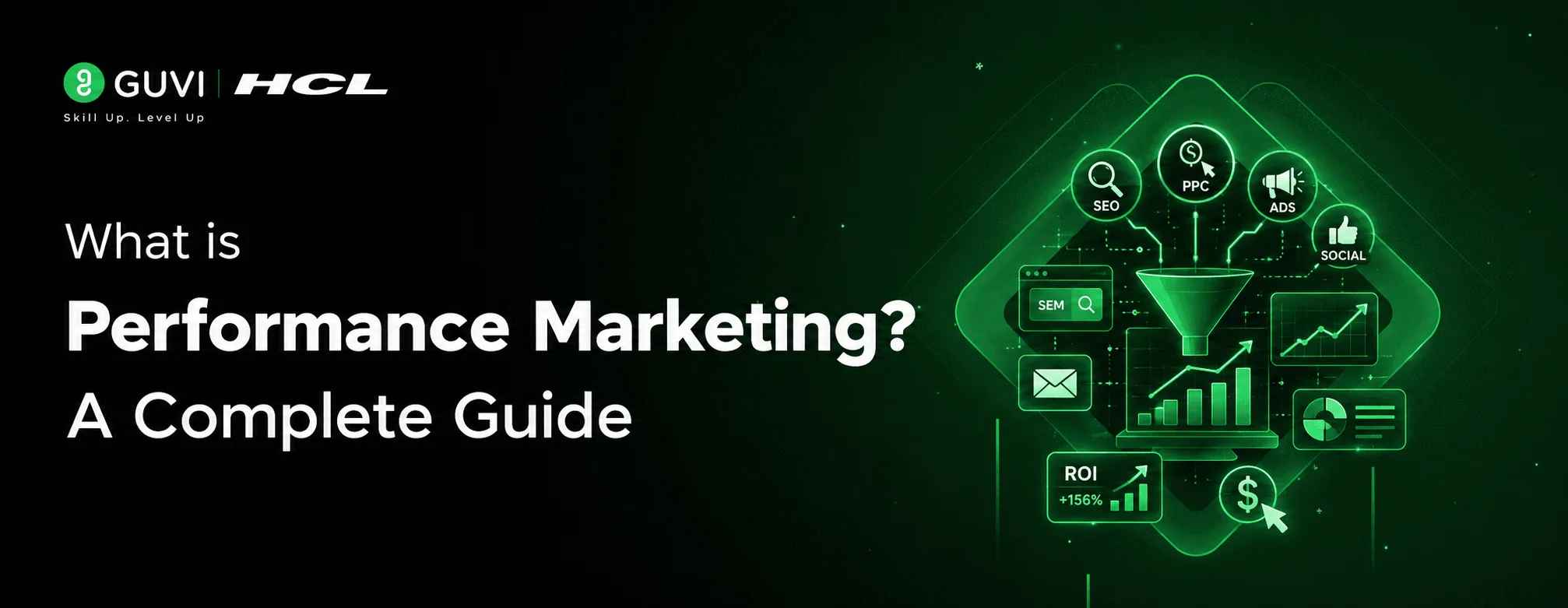
What is Performance Marketing? Complete Guide for 2026
Sep 09, 2026 6 Min Read 475 Views
(Last Updated)
Table of contents
- TL;DR Summary
- Introduction
- What is Performance Marketing?
- Simple Definition
- Performance Marketing Example
- Why Performance Marketing Is Different?
- How Does Performance Marketing Work?
- The Transaction Process
- Key Components
- Core Models of Performance Marketing
- Payment Models
- Key Platforms and Channels in 2026
- Search Engine Marketing
- Social Media Platforms
- Affiliate Marketing Networks
- Display Advertising Networks
- Emerging Channels
- Benefits of Performance Marketing
- Measurable ROI
- Risk Reduction
- Budget Control
- Data-Driven Decisions
- Scalability
- Performance vs Traditional Marketing
- Setting Up Your First Performance Marketing Campaign
- Step 1: Define Clear Objectives
- Step 2: Identify Your Target Audience
- Step 3: Select Appropriate Platforms
- Step 4: Create Compelling Creative Assets
- Step 5: Set Budget and Bidding Strategy
- Step 6: Implement Tracking and Analytics
- Measuring Success: Key Performance Indicators
- Core Metrics
- Advanced Metrics
- Advanced Strategies and Optimization Techniques
- Audience Segmentation and Personalization
- A/B Testing Framework
- Retargeting and Remarketing
- Cross-Channel Attribution and Integration
- Real-World Example of Performance Marketing
- E-Commerce Sector
- Financial Services
- Education Technology
- Travel and Hospitality
- Technology and Tools for Performance Marketing
- Essential Software Categories
- Emerging Technologies
- Privacy-Preserving Technologies:
- Common Mistakes to Avoid in Performance Marketing
- Neglecting Quality Score
- Ignoring Negative Keywords
- Setting Unrealistic Expectations
- Overlooking Attribution Models
- Failing to Test Creatives
- Why Learn Performance Marketing in 2026?
- Career Roadmap of a Performance Marketing Executive
- Salary Progression of Performance Marketers
- Want to become a Performance Marketing Specialist in 90 days?
- Conclusion
- Frequently Asked Questions (FAQS)
- What is the difference between performance marketing and digital marketing?
- How does performance marketing improve ROI?
- Which industries benefit most from performance marketing?
- What skills are needed for a career in performance marketing?
- How quickly can I see results from performance marketing campaigns?
- Is performance marketing suitable for small businesses?
TL;DR Summary
- Performance marketing is a data-driven approach where advertisers pay only when specific actions are completed, such as clicks, leads, or sales.
- Unlike traditional advertising, it focuses on measurable outcomes and ROI.
- With the rise of digital platforms, performance marketing has become essential for businesses looking to optimize their advertising spend and achieve tangible results.
- Careers in this field are growing rapidly, especially with demand for analytics skills.
Introduction
Did you know that businesses typically waste 37% of their digital advertising budget on ineffective campaigns?
This kind of wasteful spending is simply unacceptable. Enter performance marketing, a revolutionary approach that’s transforming how businesses invest in advertising by ensuring every rupee spent delivers measurable results.
So what exactly is performance marketing? Simply put, it’s a form of digital marketing where advertisers compensate publishers or platforms only when a desired outcome occurs, such as a click, lead generation, or sale. This model stands in stark contrast to traditional brand advertising, where payment is made for ad placement regardless of results.
This comprehensive guide will walk you through everything you need to know about performance marketing: from core mechanisms and payment models to real-world applications and career opportunities. With this guide, you’ll discover actionable insights to drive tangible ROI from your marketing efforts.
What is Performance Marketing?
At its core, performance marketing is a digital marketing strategy where advertisers pay only when a specific action is completed. These actions can include a user clicking an ad, filling out a lead form, installing an app, subscribing to a newsletter, or making a purchase.
Unlike traditional advertising, where businesses pay for ad placements regardless of the outcome, performance marketing focuses on measurable business results. Every campaign is tracked, analyzed, and optimized to maximize return on investment (ROI).
Simple Definition
Performance marketing is a results-based digital marketing strategy where advertisers pay only for measurable actions such as clicks, leads, conversions, or sales.
This model makes marketing more accountable because every rupee spent can be linked to a specific outcome.
New to online marketing? Before diving into performance marketing, it’s helpful to understand the broader digital marketing ecosystem. Read our What is Digital Marketing? Complete Beginner’s Guide to learn how SEO, social media, email marketing, and paid advertising work together.
Performance Marketing Example
Suppose an online learning platform launches a campaign to promote a Data Analytics course.
The company spends ₹1,00,000 on Google Ads.
After one month, the campaign delivers:
- 45,000 ad impressions
- 3,200 clicks
- 420 course enquiries
- 96 enrollments
Because every interaction is measurable, the marketing team can answer questions such as:
- Which keyword generated the most enrollments?
- Which advertisement had the highest click-through rate?
- Which audience converted the best?
- What was the cost of acquiring each student?
- Which campaign delivered the highest Return on Ad Spend (ROAS)?
Instead of relying on assumptions, marketers make decisions based on real data.
Performance marketing accounts for over 70% of total digital advertising spend in 2026, making it the dominant model for online advertising investments.
Why Performance Marketing Is Different?
Performance marketing isn’t just another digital marketing tactic; it represents a shift in how businesses approach advertising.
Rather than asking:
“How many people saw my ad?”
Businesses now ask:
- How many qualified leads did we generate?
- How many customers completed a purchase?
- Which campaign delivered the best ROI?
- How can we improve campaign performance next month?
This data-driven mindset enables continuous improvement, making campaigns more efficient over time.
How Does Performance Marketing Work?
Every successful performance marketing campaign follows a structured process. While platforms and strategies may vary, the overall workflow remains largely the same.
The Transaction Process
Performance marketing operates through a straightforward yet powerful mechanism:
- Goal Definition: Advertisers establish specific, measurable objectives (clicks, leads, sales, etc.)
- Partner Selection: Advertisers choose platforms or publishers to promote their offers
- Campaign Launch: Ads are deployed across selected channels with tracking mechanisms
- User Interaction: Potential customers engage with ads based on interest and relevance
- Action Completion: Users complete the predefined desired action
- Verification and Attribution: Systems verify the action and determine which partner deserves credit
- Compensation: Advertisers pay only for verified, completed actions
- Analysis and Optimization: Performance data informs strategy refinements
Key Components
- Advertisers: Businesses or brands seeking to promote products or services
- Publishers/Partners: Platforms or individuals who display ads and drive actions
- Tracking Technology: Systems that monitor user actions and attribute conversions
- Performance Metrics: Predefined KPIs that trigger payments
- Attribution Models: Methods for determining which touchpoints deserve credit
Core Models of Performance Marketing
Payment Models
Various payment structures exist within performance marketing, each suited to different campaign objectives:
| Model | Description | Best For |
| CPC (Cost Per Click) | Payment for each click on the advertisement | Driving traffic to websites, E-commerce sites, content platforms, lead generation with strong landing pages |
| CPA (Cost Per Acquisition) | Payment for each completed action (signup, purchase, etc.) | Lead generation and sales campaigns, app installations, free trial signups |
| CPM (Cost Per Thousand Impressions) | Payment for every 1000 ad views | Brand awareness campaigns, new product launches, market penetration |
| CPS (Cost Per Sale) | Payment for each completed sale | E-commerce businesses, Retail businesses, subscription services, online course providers |
| Cost Per Lead (CPL) | Generating qualified leads rather than immediate sales, with payment triggered upon contact information submission. | B2B service providers, educational institutions, financial services |
Key Platforms and Channels in 2026
Search Engine Marketing
Google Ads and Microsoft Advertising dominate performance marketing through sophisticated keyword targeting and intent-based advertising.
Social Media Platforms
Facebook, Instagram, LinkedIn, TikTok, and Twitter offer advanced targeting capabilities with built-in conversion tracking.
Want to create high-performing campaigns on Facebook and Instagram? Our Social Media Marketing Guide explains audience targeting, content strategy, and paid advertising best practices.
Affiliate Marketing Networks
ShareASale, CJ Affiliate, and Amazon Associates connect advertisers with thousands of publishers for scalable campaign execution.
Display Advertising Networks
Google Display Network and programmatic platforms provide vast reach across millions of websites with precise targeting.
Emerging Channels
Connected TV, podcast advertising, and voice search are becoming increasingly important for performance-driven campaigns.
Benefits of Performance Marketing
Measurable ROI
Every rupee spent can be tracked and attributed to specific outcomes, making ROI calculation straightforward and transparent.
Risk Reduction
Since payment is contingent on results, financial risk for advertisers is significantly minimized compared to traditional advertising.
Budget Control
Marketers can precisely control spending by setting caps and adjusting campaigns in real-time based on performance data.
Data-Driven Decisions
Rich analytics provide insights into customer behavior, enabling continuous optimization of marketing strategies.
Scalability
Successful campaigns can be scaled up quickly by increasing budgets, expanding target audiences, or replicating winning strategies.
The global performance marketing software market is projected to reach $9.8 billion by 2027, growing at a compound annual growth rate (CAGR) of 12.4% from 2020 to 2027.
Performance vs Traditional Marketing
| Aspect | Performance Marketing | Traditional Marketing |
| Payment Model | Pay for results (clicks, leads, sales) | Pay for ad placement/time |
| Measurability | Highly measurable with detailed analytics | Difficult to measure exact impact |
| Risk | Low risk – only pay for successful actions | Higher risk – pay regardless of results |
| Targeting | Precise targeting based on data | Broad targeting with limited personalization |
| Optimization | Real-time adjustments based on performance | Limited ability to adjust during campaign |
Setting Up Your First Performance Marketing Campaign
Step 1: Define Clear Objectives
Establish specific, measurable goals such as generating 500 qualified leads in 30 days or achieving a 3% conversion rate.
Step 2: Identify Your Target Audience
Create detailed buyer personas based on demographics, psychographics, behaviors, and firmographic details.
Step 3: Select Appropriate Platforms
Choose platforms where your target audience spends time and that align with your campaign objectives.
Step 4: Create Compelling Creative Assets
Develop attention-grabbing headlines, persuasive ad copy, and eye-catching visuals aligned with your brand identity.
Step 5: Set Budget and Bidding Strategy
Determine daily or lifetime campaign budgets, maximum cost-per-acquisition targets, and bidding strategies.
Step 6: Implement Tracking and Analytics
Establish conversion tracking pixels, UTM parameter tagging, and analytics dashboards for performance monitoring.
Measuring Success: Key Performance Indicators
Core Metrics
- Conversion Rate: Percentage of users who complete desired actions.
Formula: (Conversions ÷ Clicks) × 100

- Cost Per Acquisition (CPA): Average amount spent to acquire one customer or lead
Formula: Total Ad Spend ÷ Number of Conversions
- Return on Ad Spend (ROAS): Revenue generated for every rupee spent on advertising.
Formula: Revenue ÷ Ad Spend
- Click-Through Rate (CTR): Percentage of users who click on ads after seeing them.
Formula: (Clicks ÷ Impressions) × 100
Advanced Metrics
- Customer Lifetime Value (CLV): Projected revenue a customer will generate over their relationship with your business
- Incrementality Measurement: Determines the true incremental impact of campaigns by comparing performance with and without advertising exposure
- View-Through Conversion Rate: Measures conversions that occur after users see but don’t click on ads
Advanced Strategies and Optimization Techniques
Audience Segmentation and Personalization
Divide your target market into distinct groups based on behavioral patterns, demographics, psychographics, and engagement levels. Create personalized messaging for each segment to improve relevance and performance.
A/B Testing Framework
Systematically test different elements to identify optimal combinations:
- Headlines and ad copy variations
- Visual creative alternatives
- Landing page layouts and content
- Call-to-action button designs
Retargeting and Remarketing
Reconnect with users who previously engaged with your brand:
- Website visitors who didn’t convert
- Cart abandoners in e-commerce
- Email subscribers who opened but didn’t click
- Past purchasers for cross-selling opportunities
Cross-Channel Attribution and Integration
Implement coordinated campaigns across multiple channels:
- Search engine marketing complementing social advertising
- Email marketing reinforcing paid social campaigns
- Offline promotions tracked through digital channels
Real-World Example of Performance Marketing
E-Commerce Sector
Amazon Associates is one of the largest and most successful performance marketing programs globally. Affiliates earn commissions by promoting Amazon products through unique links on their websites, blogs, or social media channels.
When a user clicks on an affiliate link and makes a purchase, the affiliate earns a percentage of that sale. This performance-based model has helped Amazon expand its reach while providing income opportunities for millions of content creators worldwide. In 2026, Amazon’s affiliate program generated over $20 billion in commission payments to affiliates.
Financial Services
HDFC Bank leverages performance marketing to acquire new customers for credit cards and loans. Their campaigns focus on specific actions like application submissions or account openings, resulting in a 35% brand love YoY Growth.
Education Technology
Byju’s uses performance marketing extensively to drive enrollment in online courses. Their campaigns emphasize specific actions like free trial signups and course purchases, achieving an improvement in booking conversion rates.
Travel and Hospitality
MakeMyTrip employs performance marketing to drive bookings for flights, hotels, and holiday packages. Their approach focuses on cost-per-acquisition models with strict performance benchmarks, resulting in a reduction in customer acquisition costs.
Technology and Tools for Performance Marketing
Essential Software Categories
- Campaign Management Platforms: Google Ads, Facebook Business Manager, Adobe Advertising
- Cloud Analytics and Reporting Solutions: Google Analytics, Adobe Analytics, specialized marketing dashboards
- Attribution and Measurement Tools: AppsFlyer, Adjust, Kochava Automation
- Optimization Technologies: Acquisio, Marin Software, Kenshoo
Emerging Technologies
Artificial Intelligence and Machine Learning:
- Predictive modeling for customer behavior
- Automated bid optimization
- Dynamic creative personalization
Privacy-Preserving Technologies:
- Unified ID 2.0 alternatives
- Contextual targeting solutions
- Privacy-first measurement methodologies
Curious how Artificial Intelligence is transforming digital campaigns? Read our guide on AI Tools in Digital Marketing to discover how marketers use AI for automation, predictive analytics, audience targeting, and campaign optimization.
Common Mistakes to Avoid in Performance Marketing
1. Neglecting Quality Score
Focusing solely on bid prices without optimizing ad quality can lead to higher costs and reduced visibility. Quality score affects ad position and cost-per-click, making it crucial for campaign success.
Solution: Regularly audit ad copy, landing pages, and keyword relevance.
2. Ignoring Negative Keywords
Without proper negative keyword lists, ads may appear for irrelevant searches, leading to wasted spend and poor conversion rates.
Solution: Build comprehensive negative keyword lists and review search term reports.
3. Setting Unrealistic Expectations
Performance marketing requires time to optimize. Expecting immediate high ROI without allowing for testing and refinement phases often leads to premature campaign termination.
Solution: Establish realistic timelines for optimization and set incremental improvement goals.ac
4. Overlooking Attribution Models
Relying on last-click attribution alone misrepresents the customer journey and undervalues awareness-building touchpoints.
Solution: Implement multi-touch attribution models that credit all contributing channels.
5. Failing to Test Creatives
Using the same ad creatives for extended periods leads to audience fatigue.
Solution: Implement systematic A/B testing protocols and rotate creative assets.
Why Learn Performance Marketing in 2026?
- Businesses are increasing digital ad budgets.
- Every e-commerce company hires performance marketers.
- Startups rely on measurable growth.
- AI is creating new opportunities rather than replacing skilled marketers.
Career Roadmap of a Performance Marketing Executive
Marketing Fundamentals
↓
Google Ads
↓
Meta Ads
↓
Google Analytics 4
↓
Tag Manager
↓
Portfolio Projects
↓
Performance Marketing Executive
Salary Progression of Performance Marketers
| Role | Experience | Indicative Salary |
| Performance Marketing Intern | 0–1 year | ₹3.7 LPA |
| Performance Marketing Executive | 1–3 years | ₹6.7 LPA |
| Growth Marketing Specialist | 3–5 years | ₹17 LPA |
| Performance Marketing Manager | 5+ years | ₹15.7–18.4+ LPA |
Want to become a Performance Marketing Specialist in 90 days?
Learn Google Ads, Meta Ads, Google Analytics 4, Tag Manager, campaign optimization, and AI-powered marketing through HCL GUVI’s Business & Marketing Analytics Program. Build a portfolio with live projects and prepare for in-demand digital marketing roles.
Companies don’t just hire people who know marketing theory; they hire professionals who can launch campaigns, interpret analytics, and improve ROI.
Conclusion
Performance marketing represents a fundamental shift in how businesses approach advertising, prioritizing accountability, measurability, and results over traditional brand awareness tactics.
By paying only for successful actions, companies can minimize risk while maximizing their marketing investment efficiency.
As digital transformation accelerates across industries, the demand for skilled performance marketing professionals continues to grow. Understanding the nuances of paid advertising platforms, data analytics, and ROI optimization has become essential for modern marketers aiming to drive tangible business outcomes.
Frequently Asked Questions (FAQS)
1. What is the difference between performance marketing and digital marketing?
Digital marketing is an umbrella term encompassing all online marketing activities, while performance marketing is a subset focused specifically on measurable, outcome-based campaigns.
2. How does performance marketing improve ROI?
Performance marketing improves ROI by ensuring advertisers only pay for successful actions such as clicks, leads, or sales.
3. Which industries benefit most from performance marketing?
E-commerce, travel, finance, education, and technology sectors derive significant benefits from performance marketing.
4. What skills are needed for a career in performance marketing?
Key skills include data analysis, proficiency in advertising platforms, understanding of analytics tools, copywriting abilities, and familiarity with marketing automation tools.
5. How quickly can I see results from performance marketing campaigns?
Results can begin appearing within days of launching campaigns, but optimal performance typically requires 2-4 weeks for data collection and optimization.
6. Is performance marketing suitable for small businesses?
Absolutely. Performance marketing is particularly beneficial for small businesses as it allows them to compete with larger competitors by paying only for results.
Success Stories

About the Author
Hashmithaa
Hi, I’m Hashmithaa — a content writer with a love for words. Writing isn’t just what I do; it’s how I connect, communicate, and create meaning in a noisy digital world. And if my words help someone make a better decision, learn something new, or feel more confident, then I’ve done my job well.
View all posts by Hashmithaa
Connect with me @









Did you enjoy this article?