


Entrepreneurship Articles
Equity vs Debt Financing for Startups: Which Funding Option Is Right for You?
Bootstrapping a Startup: Pros, Cons, and How to Do It
Venture Capital vs Angel Investors: Which Funding Source Is Right for Your Startup?
Startup Leadership Styles: What Works at Different Stages? - Best Guide

Get In Touch For Details! Request More Information
Lean Startup Methodology: Build-Measure-Learn Explained – Best Guide
Aug 10, 2026 11 Min Read 159 Views
(Last Updated)
Table of contents
- TL;DR
- What Is a Lean Startup?
- What Problem Does the Lean Startup Methodology Solve?
- Why Is Lean Startup Important?
- Lean Startup Reduces Wasted Development
- Lean Startup Encourages Customer Validation
- Lean Startup Makes Pivoting Less Expensive
- What Is the Build–Measure–Learn Loop?
- How Does Build–Measure–Learn Work in Practice?
- Assumption
- Build
- Measure
- Learn
- What Does “Build” Mean in Lean Startup?
- What Is an MVP?
- Example of an MVP
- What Makes a Good MVP?
- What Should You Measure in the Lean Startup Process?
- Which Metrics Actually Matter?
- Avoid Vanity Metrics
- What Does “Learn” Mean in the Build–Measure–Learn Loop?
- Ask Three Questions After Every Experiment
- When Should a Startup Pivot or Persevere?
- Example of Pivoting
- When Should You Persevere?
- Lean Startup vs Traditional Startup Approach
- How to Apply Lean Startup Step by Step
- Step 1: Identify the Problem
- Step 2: Write Down Your Riskiest Assumptions
- Step 3: Define What Evidence You Need
- Step 4: Build the Smallest Useful Experiment
- Step 5: Measure Real Customer Behaviour
- Step 6: Learn From the Results
- Step 7: Pivot, Persevere, or Run Another Experiment
- Practical Lean Startup Example
- Hypothesis
- Build
- Measure
- Learn
- When Is Lean Startup Most Useful?
- Common Lean Startup Mistakes to Avoid
- Building Too Much Before Testing
- Measuring the Wrong Numbers
- Asking Customers Only What They Want
- Ignoring Negative Evidence
- Pivoting After Every Small Setback
- Best Practices for Using the Lean Startup Methodology
- Is Lean Startup Still Relevant in 2026?
- Lean Startup and AI: What Changes in 2026?
- Lean Startup Checklist for Beginners
- Build Stronger Entrepreneurship Skills With HCL GUVI
- Final Thoughts
- FAQs
- What is the Lean Startup methodology?
- What are the three stages of Lean Startup?
- What is Build–Measure–Learn?
- What is an MVP in Lean Startup?
- What is the main goal of Lean Startup?
- What is the difference between an MVP and a prototype?
- What does pivot mean in Lean Startup?
- Can Lean Startup be used outside technology startups?
TL;DR
Lean Startup is a startup methodology that helps entrepreneurs test business ideas quickly instead of spending months building a complete product based on assumptions. Its core Build–Measure–Learn loop involves creating an MVP or experiment, measuring how real customers respond, and using that evidence to decide what to improve, change, or stop. The objective is not simply to build faster; it is to learn faster. By continuously testing assumptions, founders can reduce wasted effort and move toward a product and business model customers genuinely value.
Lean Startup is an approach to building new businesses by testing assumptions early, learning directly from customers, and improving the idea through repeated experiments.
Instead of spending months developing a complete product and hoping customers want it, founders create smaller tests, measure real behaviour, and use those findings to decide what to do next.
This makes the approach especially useful when a startup is operating with limited resources and significant uncertainty.
What Is a Lean Startup?
Lean Startup is a method for developing businesses and products through rapid experimentation, customer feedback, and validated learning.
The approach was popularised by entrepreneur and author Eric Ries. Its central idea is that startups operate under uncertainty, so progress should be measured by what the team learns about customers and the business,not simply by how many features it builds.
The official Lean Startup principles describe validated learning as a rigorous way to demonstrate whether a startup is moving toward a sustainable business.
In simple terms:
Build something small enough to test an important assumption, see how real customers respond, learn from the evidence, and decide what to do next.
What Problem Does the Lean Startup Methodology Solve?
Traditional product development often follows this pattern:
Idea → Detailed Plan → Long Development → Product Launch → Customer Feedback
The biggest problem is that customer feedback arrived very late.
If the original assumptions were wrong, months of development and investment may already have been spent.
The Lean Startup reverses this logic.
Instead of asking:
“Can we build this?”
founders ask:
“Should we build this, and what evidence would prove it?”
Startup India also describes the approach as Build–Measure–Learn, with an MVP used to gauge user interest, followed by measurement and a decision to continue, refine, or pivot.
Why Is Lean Startup Important?
The biggest advantage of Lean Startup is not speed alone. It is reducing uncertainty before making bigger investments.
A startup begins with assumptions about:
- Who the customer is
- What problem they have
- Which solution they want
- What they will pay
- How they will discover the product
- Why they will choose it over alternatives
If these assumptions are wrong, a technically excellent product can still fail.
The methodology encourages founders to test these beliefs before treating them as facts.
Lean Startup Reduces Wasted Development
Imagine you want to build an app that automatically creates meal plans for working professionals.
A traditional approach might involve:
- Hiring developers
- Building the app
- Adding payments
- Creating recommendation algorithms
- Designing dashboards
- Launching months later
But you still do not know whether customers care enough to use it.
A Lean approach might begin with a landing page offering personalised weekly meal plans. Interested users sign up, and the first plans are created manually.
You can now learn whether people actually want the service before building the full technology.
Lean Startup Encourages Customer Validation
Customer feedback becomes part of product development rather than something collected only after launch.
Founders can test:
- Customer problems
- Feature demand
- Pricing
- Messaging
- Acquisition channels
- User behaviour
The goal is to replace opinions with evidence.
Lean Startup Makes Pivoting Less Expensive
Changing direction after three small experiments is much easier than changing direction after twelve months of product development.
That flexibility matters because early-stage startups often discover that the original customer, problem, pricing model, or solution needs to change.
What Is the Build–Measure–Learn Loop?
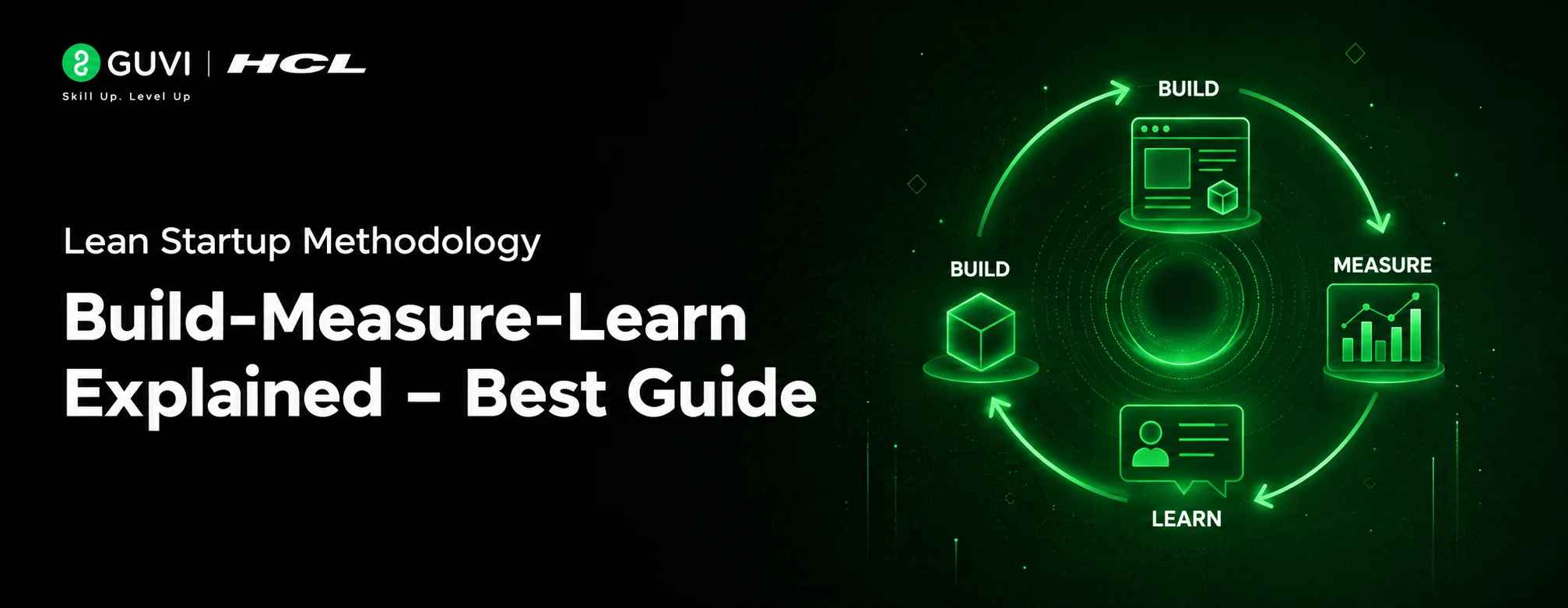
The build measure learn loop is the core feedback cycle of the Lean Startup methodology.
It has three stages:
Build → Measure → Learn → Repeat
The official Lean Startup framework describes the fundamental startup activity as turning ideas into products, measuring customer response, and learning whether to pivot or persevere.
| Stage | Main Question | Output |
| Build | What is the smallest experiment we can create? | MVP or test |
| Measure | How did customers actually respond? | Behavioural evidence |
| Learn | What does the evidence tell us? | Pivot, persevere, or test again |
The important word here is loop.
You do not complete the process once.
Each round should lead to another, better-informed experiment.
How Does Build–Measure–Learn Work in Practice?
Consider a founder who believes college students would pay for AI-generated interview preparation plans.
Assumption
Students want personalized interview preparation.
Build
Create a basic landing page describing the service and allow students to request a personalized plan.
Measure
Track:
- Landing-page visits
- Sign-ups
- Completed requests
- Willingness to pay
- Feedback from users
Learn
Suppose many students register but very few will pay.
The founder has learned something important.
Perhaps students want interview preparation, but the value proposition, pricing, or target segment needs improvement.
The next experiment can test one of those assumptions.
That is much more useful than spending six months developing a complete application before discovering the same issue.
What Does “Build” Mean in Lean Startup?
“Build” is often misunderstood.
It does not automatically mean building a working software product.
The purpose of Build is to create the fastest reliable experiment that helps answer an important business question.
Strategyzer warns against interpreting the Build stage too literally. Early experiments can often test customer interest without developing the final product at all.
What Is an MVP?
An MVP, or Minimum Viable Product, is the smallest version or experiment that allows a startup to test a critical assumption and learn from real users.
An MVP might be:
- Landing page
- Clickable prototype
- Demo video
- Manual service
- Pre-order page
- Simple spreadsheet-based solution
- Basic app with one core feature
- Concierge service
The objective is learning, not launching an incomplete version of the final product.
AI prototyping can help teams create early product concepts and test user flows before investing in full development.
Example of an MVP
Suppose you want to create an AI platform that recommends personalised learning paths for engineering students.
Instead of immediately building:
- AI recommendation engine
- Student dashboard
- Course marketplace
- Progress analytics
- Mobile application
you could begin with:
- A form asking students about their goals.
- A manually created learning recommendation.
- A payment or sign-up option.
- Follow-up questions about usefulness.
If students find the recommendations valuable, you have evidence supporting further investment.
If they do not, you can change the idea cheaply.
What Makes a Good MVP?
A good MVP should answer a specific question.
For example:
Weak objective:
“Let’s launch a basic version of our app.”
Better objective:
“Let’s test whether working professionals will pay ₹299 per month for automated expense reminders.”
The second objective is measurable.
A useful MVP should therefore be:
- Fast to create
- Focused on one major assumption
- Usable by real customers
- Measurable
- Cheap enough to modify or discard
This keeps the Lean Startup process focused on evidence rather than feature development.
The official Lean Startup framework treats validated learning,not the number of features built,as the real measure of progress for a startup operating under uncertainty. Experiments are used to test whether the assumptions behind a business can actually support a sustainable model
What Should You Measure in the Lean Startup Process?
Once you have built an MVP or experiment, the next step in the Lean Startup process is Measure.
Measurement tells you whether customers are behaving the way you expected. Instead of relying only on positive comments or opinions, you look at evidence that relates directly to the assumption you are testing.
The metrics you choose depend on your business model and experiment.
For example, you might measure:
- Sign-up rate
- Activation rate
- Repeat usage
- Conversion rate
- Customer retention
- Trial-to-paid conversion
- Revenue per customer
- Feature usage
- Customer acquisition cost
- Number of pre-orders
The important part is choosing metrics before running the experiment. Otherwise, it becomes easy to focus only on numbers that make the idea look successful.
As the product grows, product analytics can help teams track feature usage, activation, retention, and other behavioural signals across repeated experiments.
Business analytics can also help founders interpret experiment results and connect customer behaviour with broader business outcomes.
When testing acquisition assumptions, a focused digital marketing strategy for startups can help compare which channels attract the most relevant users.
Which Metrics Actually Matter?
Not every number represents meaningful progress.
Imagine your startup’s Instagram reel receives 50,000 views and drives 5,000 visitors to your product page. That sounds impressive.
But if almost nobody signs up, purchases, or returns, those views may tell you very little about whether customers value the product.
A better approach is to connect each metric with a specific assumption.
| Startup Assumption | Useful Metric |
| People are interested in the solution | Landing-page conversion |
| Users understand the product | Activation rate |
| Customers find ongoing value | Retention |
| Customers will pay | Paid conversion |
| A feature solves the intended problem | Feature usage |
| Customers recommend the product | Referrals |
| The business can acquire customers efficiently | Customer acquisition cost |
This keeps the Lean Startup experiment focused on evidence that can influence your next decision.
Avoid Vanity Metrics
Vanity metrics are numbers that may look impressive but provide limited insight into whether your startup is actually progressing.
Examples can include total app downloads, page views, social media followers, or registered accounts when those numbers are viewed without engagement, retention, conversion, or revenue context.
For instance:
10,000 app downloads sounds encouraging.
But if only 200 people use the app again after the first week, retention may reveal a much more important problem.
Measurement should help you answer a business question, not simply produce a bigger number.
What Does “Learn” Mean in the Build–Measure–Learn Loop?
The Learn stage is where the evidence collected during an experiment becomes a decision.
This is the point where founders compare what they expected customers to do with what customers actually did.
The outcome may support the original assumption, challenge it, or reveal a completely different opportunity.
The Lean Startup approach calls this validated learning.
Founders can also use AI-assisted workflows to move from an idea to an early product faster while keeping the first version focused on validation.
Ask Three Questions After Every Experiment
After completing an experiment, ask:
- What did we expect to happen?
- What actually happened?
- What should we change or test next?
Suppose you believe customers will pay ₹499 per month for your productivity tool.
You launch a basic version to 100 potential users.
Twenty people start a free trial, but only two choose the paid plan.
Simply saying “customers liked the product” would not be enough.
You now need to investigate why paid conversion was low.
Was ₹499 too expensive?
Was the value unclear?
Did customers need a different feature?
Was the wrong audience targeted?
Those questions become inputs for the next build-measure-learn cycle.
When Should a Startup Pivot or Persevere?
One of the most important decisions in Lean Startup is whether to pivot or persevere.
Persevere means the evidence supports your current direction strongly enough to continue testing and improving it.
Pivot means changing an important part of the strategy because the evidence does not sufficiently support the original assumption.
A pivot does not necessarily mean abandoning the startup.
You might change:
- Target customer
- Core problem
- Product feature
- Pricing model
- Distribution channel
- Revenue model
- Positioning
- Technology approach
Understanding the difference between product strategy and a product roadmap also helps teams decide whether to change direction or simply adjust execution.
Example of Pivoting
Imagine you build an attendance management tool for college students.
Students try it but rarely return.
During customer interviews, however, several faculty members show strong interest because they struggle with manually tracking attendance.
Instead of abandoning the product, you could test a new assumption:
Colleges and faculty may be a better target customer than individual students.
You could then build another small experiment specifically for faculty.
That is a pivot based on learning rather than guesswork.
When Should You Persevere?
Suppose customers:
- Continue using the product
- Complete the intended action
- Return regularly
- Recommend it to others
- Show willingness to pay
These signals may justify continuing in the same direction.
However, Lean Startup does not mean blindly persevering because one experiment performed well. The evidence should become stronger across multiple experiments.
Lean Startup vs Traditional Startup Approach
Both approaches can involve planning, product development, and customer research. The major difference is when assumptions are tested and how much is invested before receiving customer evidence.
| Factor | Lean Startup | Traditional Approach |
| Starting point | Hypotheses and assumptions | Detailed business plan |
| Product development | Small experiments and MVPs | Larger planned releases |
| Customer feedback | Collected early and repeatedly | Often stronger after development or launch |
| Decision-making | Evidence-driven | More plan-driven |
| Changes | Expected when evidence changes | Can be harder after major investment |
| Primary objective early on | Validated learning | Executing the planned product |
| Development cycle | Iterative | Often longer and more sequential |
This does not mean planning is unnecessary.
A startup still needs goals, financial thinking, customer understanding, and a business strategy. The difference is that assumptions within those plans are continuously tested against real customer behaviour.
This experimentation mindset also aligns closely with growth marketing, where teams continuously test channels, messaging, and conversion opportunities.
How to Apply Lean Startup Step by Step
You do not need a large company or sophisticated analytics system to use the Lean Startup methodology.
You can begin with one uncertain assumption.
Step 1: Identify the Problem
Start with the customer’s problem rather than your product idea.
Ask:
- Who experiences the problem?
- When does it occur?
- How serious is it?
- How do people solve it today?
- What is frustrating about existing alternatives?
Customer interviews and observation can help you understand whether the problem is real before you design a solution.
Understanding the voice of the customer helps founders identify real pain points instead of building around assumptions.
Step 2: Write Down Your Riskiest Assumptions
Every startup idea contains assumptions.
Suppose you want to launch an online platform connecting college students with industry mentors.
Your assumptions might include:
- Students struggle to find relevant mentors.
- Students want one-to-one mentoring.
- Professionals are willing to become mentors.
- Students will pay for sessions.
- Mentors will accept the proposed payment.
Do not test everything simultaneously.
Start with the assumption that could invalidate the idea if it proves false.

Step 3: Define What Evidence You Need
Before building anything, decide what result would support or challenge your assumption.
For example:
Assumption: Students will pay ₹299 for a 30-minute career mentoring session.
Experiment: Offer the session to a small group of relevant students.
Evidence: Number of students who actually book and pay.
This makes your Lean Startup experiment much clearer.
Step 4: Build the Smallest Useful Experiment
Now create the simplest experiment capable of generating that evidence.
Depending on the idea, your MVP could be:
- Landing page
- Prototype
- Demo
- Pre-order page
- WhatsApp-based service
- Manual concierge service
- One-feature application
Avoid building features that do not help test the assumption.
Step 5: Measure Real Customer Behaviour
Launch the experiment with the intended users.
Observe what people actually do.
Do they:
- Register?
- Complete onboarding?
- Use the feature?
- Return?
- Pay?
- Recommend it?
Customer interviews can explain why people behaved a certain way, while behavioural metrics show what they actually did.
Using both gives you a clearer picture.
Step 6: Learn From the Results
Compare your hypothesis with the outcome.
If the evidence supports your assumption, you may continue developing the idea.
If it challenges your assumption, investigate what needs to change.
The objective is not to prove that your original idea was correct.
The objective is to discover what customers actually value.
Step 7: Pivot, Persevere, or Run Another Experiment
Finally, choose your next action.
Persevere: Continue in the same direction when evidence supports the hypothesis.
Pivot: Change an important assumption when evidence consistently points elsewhere.
Experiment again: Gather more evidence when the results are inconclusive.
Then begin another Build–Measure–Learn loop.
This repeated cycle turns startup development into a continuous learning process rather than a single large bet.
Once repeated experiments validate the core idea, a clearer product development strategy can help turn those learnings into a structured roadmap.
Practical Lean Startup Example
Consider a founder planning an AI-powered resume review platform for Indian freshers.
The original idea is to build a complete platform containing resume scoring, ATS analysis, job recommendations, interview preparation, and AI-generated improvements.
Using Lean Startup, the founder would not necessarily build everything first.
Hypothesis
Fresh graduates are willing to pay for personalized resume feedback before applying for jobs.
Build
Create a simple landing page where users upload their resumes. Instead of developing a complete AI platform immediately, the first reviews could combine basic automation with manual expert feedback.
Measure
Track:
- Landing-page conversion
- Resume uploads
- Paid reviews
- Repeat usage
- Most requested improvements
Learn
Suppose users value ATS feedback but show little interest in job recommendations.
The founder now has evidence about which problem appears more valuable.
The next MVP can focus primarily on ATS analysis instead of spending development resources on several features customers may not need.
This is the Lean Startup process in practice: each product decision becomes more informed as evidence accumulates.
When Is Lean Startup Most Useful?
The approach is particularly useful when significant uncertainty exists around the customer, problem, solution, or business model.
It can work well for:
- Early-stage startups
- New digital products
- SaaS businesses
- Consumer applications
- Marketplace ideas
- New services
- Internal innovation projects
- New features within existing businesses
But the methodology should not be interpreted as “never plan” or “always launch unfinished products.”
Lean Startup is primarily about identifying uncertainty and designing efficient ways to reduce it.
The less you know about an assumption, the stronger the reason to test it before making a large investment.
Common Lean Startup Mistakes to Avoid
The Lean Startup approach sounds simple, but it is easy to apply it incorrectly. The goal is not simply to build faster. It is to learn faster while avoiding unnecessary investment in assumptions that have not been validated.
Here are some common mistakes founders should avoid.
1. Building Too Much Before Testing
One of the biggest mistakes is treating an MVP like the first complete version of the product.
If you spend months developing multiple features before speaking to customers, you may discover that the market values only a small part of what you built.
Start with the smallest experiment that can answer your most important question.
2. Measuring the Wrong Numbers
High traffic, downloads, followers, or registrations can look promising without proving that customers genuinely value the product.
Connect every important metric to a hypothesis. Retention, conversion, repeat usage, and willingness to pay often provide more actionable information than surface-level popularity.
3. Asking Customers Only What They Want
Customer feedback is useful, but stated preferences and actual behaviour are not always the same.
Instead of relying entirely on questions such as “Would you use this?”, create opportunities for customers to demonstrate interest through actions such as registering, trying, returning, booking, or paying.
4. Ignoring Negative Evidence
Founders naturally become attached to their ideas. This can make it tempting to explain away disappointing results.
The Lean Startup mindset treats negative evidence as useful information. A failed experiment can prevent months of unnecessary development if it reveals that an important assumption is wrong.
5. Pivoting After Every Small Setback
Being flexible does not mean changing direction every time an experiment performs poorly.
First understand why the experiment failed. The problem may be the audience, pricing, messaging, experiment design, or product itself.
Look for patterns across evidence before making a major strategic change.
Best Practices for Using the Lean Startup Methodology
A few practical habits can make the methodology much more useful.
Test the riskiest assumption first: Find the assumption that could seriously weaken your idea if it proves false.
Define success before experimenting: Decide what evidence would support or challenge your hypothesis before looking at the results.
Keep experiments focused: One experiment should ideally answer one important question.
Combine numbers with conversations: Analytics tells you what customers did. Interviews and feedback can help explain why.
Document what you learn: Maintain a simple record of hypotheses, experiments, results, and decisions.
Keep the loop short: Smaller experiments generally allow you to incorporate useful learning sooner.
Most importantly, do not treat Lean Startup as a rigid checklist. Adapt the process to the type of business, customer, product, and risk you are dealing with.
A clear product vision statement helps the team stay focused on the long-term customer problem even while individual experiments change.
Is Lean Startup Still Relevant in 2026?
Yes. The core idea remains highly relevant in 2026 because startups still face the same fundamental challenge: uncertainty.
A founder may have access to AI coding assistants, no-code platforms, analytics tools, cloud infrastructure, and rapid prototyping tools that make building easier. But faster development does not automatically mean customers want the resulting product.
In fact, easier product creation makes validation even more important.
The Lean Startup approach helps founders separate two questions:
Can we build this?
and
Should we build this?
Modern tools can help answer the first question faster. Customer experiments, usage data, interviews, and real market behaviour are still necessary to answer the second.
For founders in India, this can be particularly useful when testing products across different customer segments, price points, languages, cities, or business models before committing to wider expansion.
Lean Startup and AI: What Changes in 2026?
AI has shortened the time required to create prototypes, landing pages, basic applications, marketing assets, research summaries, and early product concepts.
That can accelerate the Build stage.
But AI should not replace the Measure and Learn stages.
A startup can now build the wrong solution faster than before if it skips customer validation.
A more useful approach is:
Hypothesis → AI-assisted prototype → Real users → Behavioural data → Customer feedback → Learning → Next experiment
For example, instead of spending months developing an AI learning platform, a founder could create a small prototype around one learning problem, test it with a specific group of students, observe usage, and expand only after finding evidence of value.
Technology can shorten the experiment. It cannot validate the assumption on behalf of the customer.
The wider use of Generative AI in business is making it easier for founders to prototype, summarise research, test concepts, and automate parts of early experimentation.
Lean Startup Checklist for Beginners
Before completing your first build-measure-learn cycle, check whether you can answer these questions:
- Who exactly is the customer?
- What problem are you trying to solve?
- Which assumption are you testing?
- What is the smallest experiment you can run?
- What does your MVP need to include?
- Which metric will indicate success or failure?
- What did customers actually do?
- What did you learn?
- Should you pivot, persevere, or test again?
- What is the next assumption to validate?
If you cannot answer one of these clearly, that is usually where your next discussion or experiment should begin.
Practising with real entrepreneurship projects can also help you apply customer validation, MVP thinking, and Build–Measure–Learn in realistic scenarios.
The Lean Startup methodology was shaped by Eric Ries’s experience building technology startups and drew heavily from ideas such as lean manufacturing, customer development, rapid experimentation, and validated learning.
One of its most important principles is that startup progress should not be judged only by how much has been built. Progress also comes from learning whether the assumptions behind a business can actually work.
Build Stronger Entrepreneurship Skills With HCL GUVI
Understanding Lean Startup gives you a framework for testing ideas, but building a successful venture requires several connected skills.
You need to understand customers, evaluate opportunities, develop a workable business model, make strategic decisions, communicate ideas, and use evidence to improve them.
HCL GUVI’s Entrepreneurship Program can help learners develop these practical foundations through structured learning and real-world business concepts.
If you are exploring entrepreneurship or planning your own venture, learning how business ideas move from assumptions to validated opportunities can help you make more informed decisions instead of relying entirely on intuition.
Final Thoughts
The Lean Startup methodology gives founders a practical way to deal with uncertainty. Instead of spending months perfecting an idea behind closed doors, you identify assumptions, create small experiments, measure customer behaviour, and use the evidence to decide what happens next.
The Build–Measure–Learn loop is therefore less about building quickly and more about learning efficiently. Your first idea does not need to be perfect. What matters is whether each experiment improves your understanding of the customer and the business opportunity.
Used correctly, Lean Startup turns product development into a continuous process of testing, learning, and improving.
FAQs
1. What is the Lean Startup methodology?
The Lean Startup methodology is an approach to developing businesses and products through rapid experiments, customer feedback, and validated learning. Instead of building a complete product based mainly on assumptions, startups test important ideas early and improve their direction using evidence.
2. What are the three stages of Lean Startup?
The three stages are Build, Measure, and Learn. You build an experiment or MVP, measure how customers respond, learn from the results, and use those insights to decide what to test next.
3. What is Build–Measure–Learn?
Build measure learning is a continuous feedback loop. A startup converts an assumption into an experiment, observes customer behaviour, analyses the evidence, and uses what it learns to guide the next decision.
4. What is an MVP in Lean Startup?
An MVP, or Minimum Viable Product, is the simplest version of an experiment that allows a startup to test an important assumption with real customers. It does not necessarily need to be a miniature version of the final product.
5. What is the main goal of Lean Startup?
The main goal is validated learning. Startups try to discover whether important assumptions about customers, problems, solutions, pricing, or business models are supported by real evidence before making larger investments.
6. What is the difference between an MVP and a prototype?
A prototype primarily demonstrates how an idea could work, while an MVP is designed to test a meaningful assumption with users. Depending on the experiment, an MVP may itself contain a prototype.
7. What does pivot mean in Lean Startup?
A pivot is a meaningful change in strategy based on what a startup has learned. It could involve changing the target customer, problem, pricing, product feature, distribution model, or another important assumption while retaining useful learning from earlier experiments.
8. Can Lean Startup be used outside technology startups?
Yes. Its principles can be applied to services, consumer businesses, internal innovation projects, educational products, marketplaces, and other situations where important customer or business assumptions need to be tested.
Success Stories

About the Author
Reemsha Khan
Always been a storyteller at heart. Now, I turn complex topics into simple, easy-to-understand stories through content. Hope you find it helpful.
View all posts by Reemsha Khan
Connect with me @








Did you enjoy this article?