


Entrepreneurship Articles
How to Raise Seed Funding for Your Startup: A Complete Guide for Founders
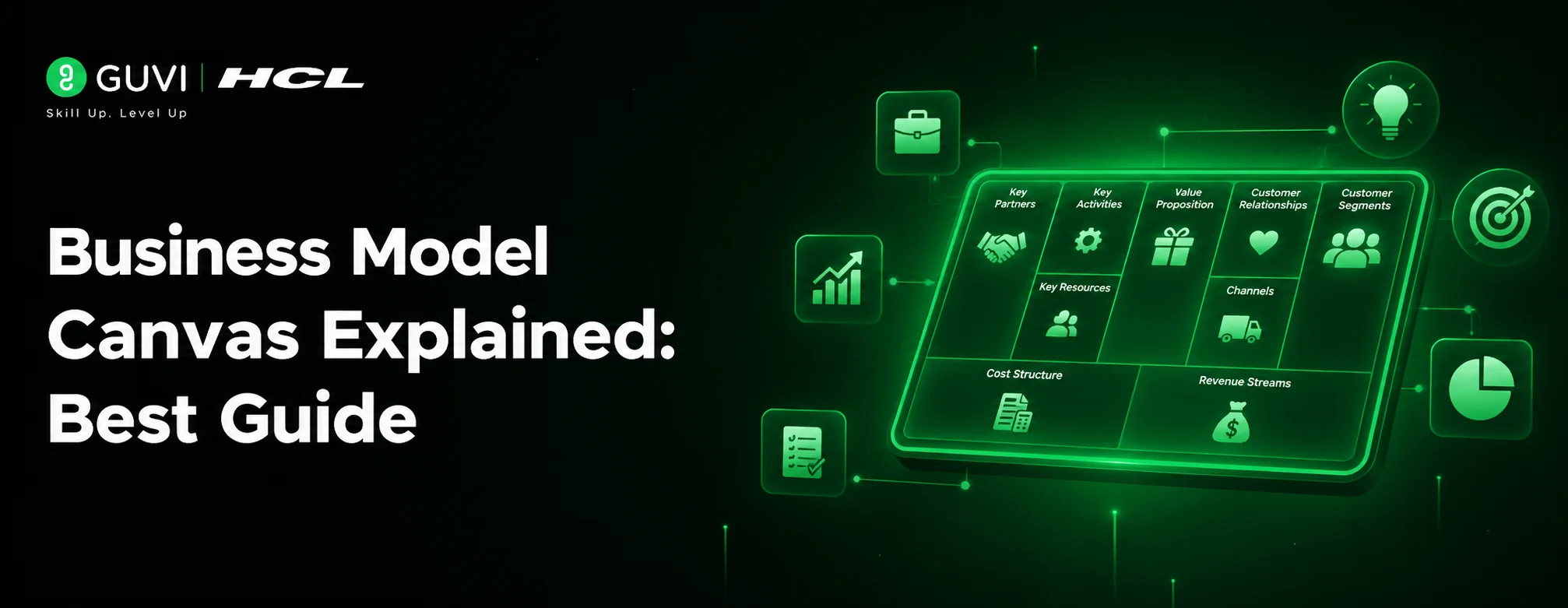
Business Model Canvas Explained: Best Guide (2026)
What Is Social Entrepreneurship? Building Businesses That Create Social Impact (2026 Guide)
Product Market Fit: How to Know You’ve Found It - Best Guide


Get In Touch For Details! Request More Information
Value Proposition Canvas: How to Define Your Startup’s Edge
Aug 07, 2026 6 Min Read 33 Views
(Last Updated)
Table of contents
- TL;DR
- Introduction
- Understanding the Value Proposition Canvas
- What Is a Value Proposition Canvas?
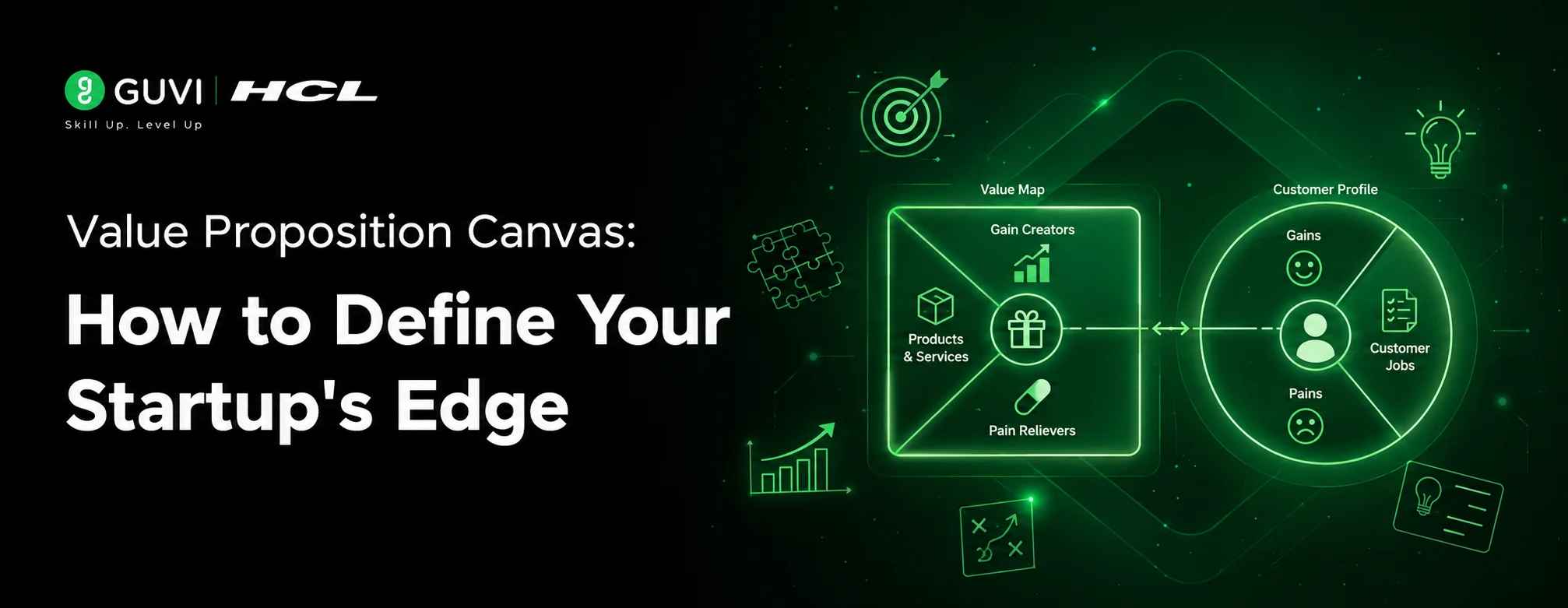
- The Two Main Parts of the Value Proposition Canvas
- Customer Profile
- Creating Your Value Map
- How to Build Your Own Value Proposition Canvas?
- Best practices for effective canvas building:
- Value Proposition Canvas vs. Business Model Canvas
- Real-World Examples of Value Proposition Canvas
- Netflix Transformation Case Study
- Slack Communication Solution
- Common Mistakes to Avoid When Doing Value Proposition Canvas
- Assuming You Know Customer Needs
- Focusing on Features Over Outcomes
- Ignoring Emotional and Social Jobs
- Creating Generic Pain Relievers
- Skipping Validation
- Enhance Your Entrepreneurial Skills with HCL GUVI
- Wrapping Up
- Frequently Asked Questions
- What's the difference between a value proposition and a value proposition canvas?
- Who should use the Value Proposition Canvas?
- How detailed should my value proposition canvas be?
- Can I use the value proposition canvas for existing products?
- How often should I update my value proposition canvas?
- Is the canvas only for digital products?
- What if my customer profile shows conflicting needs?
- Can I have multiple value proposition canvases for different customer segments?
- How do I validate my value proposition canvas?
- Should I complete the customer profile before the value map?
TL;DR
- The Value Proposition Canvas is a strategic tool that helps startups align their offerings with real customer needs.
- It consists of two main parts: Customer Profile (jobs, pains, gains) and Value Map (products/services, pain relievers, gain creators).
- This framework enables entrepreneurs to validate product ideas before full development, reducing market fit risks by up to 90%.
- Companies using this approach effectively differentiate themselves by addressing specific customer needs competitors overlook.
- Successful implementations can be seen at companies like Netflix and Slack, which used similar customer-centric methodologies to disrupt their respective industries.
Introduction
Did you know that 90% of startups fail within their first few years? While funding shortages and market timing often get blamed, the real culprit is something more fundamental: lack of product-market fit. Startups pour millions into development only to discover that nobody actually wants their product.
Here’s what separates the 10% that succeed: they understand their customers deeply before building anything. The Value Proposition Canvas is the secret weapon these successful startups use to guarantee they’re solving real problems that people are willing to pay for.
This isn’t just theoretical; research from CB Insights shows that 42% of failed startups point to “no market need” as their primary reason for failure.
The Value Proposition Canvas directly addresses this by ensuring your solution maps precisely to customer demands. In fact, startups that clearly define their startup value proposition using structured frameworks like this are 90% more likely to achieve sustainable product-market fit.
This guide will show you how to use the Value Proposition Canvas to eliminate guesswork and build offerings customers actually want.
Understanding the Value Proposition Canvas
What Is a Value Proposition Canvas?
The Value Proposition Canvas is a visual tool that helps businesses design products and services customers truly want.
Created by Alex Osterwalder, it focuses specifically on the value proposition aspect of your business model, separating it from other operational considerations.
Think of it as a magnifying glass that zooms in on the relationship between your offering and customer needs.
Unlike comprehensive frameworks that cover all aspects of a business, the Value Proposition Canvas homes in on one critical question: “Are we creating value that customers actually want?” This focus makes it particularly valuable for startups looking to validate their ideas quickly and efficiently.
A Value Proposition Canvas works best when combined with a strong business model. Once you’ve validated customer needs, the next step is to design a sustainable business strategy by understanding the fundamentals of entrepreneurship.
The Value Proposition Canvas was originally designed as a one-page tool that can be completed in under 20 minutes, making it one of the fastest strategy frameworks for validating business ideas.
The Two Main Parts of the Value Proposition Canvas
The canvas is divided into two distinct sections that work together:
- Customer Profile: Understanding who you’re serving
- Value Map: Defining what you’re offering
These sections must align perfectly for a successful value proposition. Misalignment leads to products that technically work but don’t solve real customer problems.
Customer Profile
The customer profile focuses entirely on understanding your target customers. It’s broken down into three components:
- Customer Jobs: What Customers Are Trying to Get Done
Customer jobs represent the fundamental tasks, activities, or problems your target audience is trying to solve. These aren’t just product features but the underlying objectives customers want to achieve in their lives or work.
Understanding jobs at this deeper level is crucial for creating meaningful solutions.
There are several types of customer jobs:
- Functional Jobs: Tasks related to getting something done (e.g., commuting to work, preparing meals)
- Emotional Jobs: Fulfilling emotional needs (e.g., feeling secure, gaining confidence)
- Social Jobs: Achieving social goals (e.g., fitting in with peers, gaining status)
To identify customer jobs effectively:
- Observe customers in their natural environment
- Conduct in-depth interviews focusing on daily challenges
- Analyze customer support tickets and complaints
- Study competitor reviews to understand unmet needs
For instance, when considering a fitness app, the functional job might be “getting fit,” but the emotional job could be “feeling confident,” and the social job might be “fitting in with health-conscious friends.”
- Pains: Obstacles and Challenges
Pains are the frustrations, obstacles, and risks customers experience while trying to complete their jobs. These represent the problems your startup can potentially solve.
Identifying pains requires looking beyond obvious complaints to uncover hidden frustrations.
Types of customer pains include:
- Undesired Costs: Time, money, or effort spent unnecessarily
- Difficulties: Complex processes or confusing interfaces
- Negative Emotions: Stress, anxiety, or disappointment
- Risks: Financial loss, security concerns, or safety issues
- Barriers: Constraints preventing job completion
Effective pain identification methods:
- Journey mapping to spot friction points
- Complaint analysis to surface recurring issues
- Competitor research to find gaps in solutions
- Direct observation of customer behavior
For a food delivery service, pains might include long wait times, inaccurate orders, expensive delivery fees, and unreliable delivery estimates.
- Gains: Desired Outcomes and Benefits
Gains represent the positive outcomes, benefits, and expectations customers hope to achieve. These are what motivate customers to seek solutions in the first place.
Understanding gains allows you to design features that exceed expectations rather than just meeting basic requirements.
Types of customer gains:
- Required Gains: Essential benefits customers expect
- Expected Gains: Standard improvements over current solutions
- Desired Gains: Additional benefits that delight customers
Methods for discovering customer gains:
- Outcome-driven interviews focusing on desired results
- Wishlist analysis from customer communications
- Review analysis of positive feedback
- Benchmarking against best-in-class solutions
Continuing with our food delivery example, gains might include convenience, variety of options, fast delivery, quality assurance, and cost savings compared to dining out.

Creating Your Value Map
Value Map details your solution offering:
- Products & Services: Your Solution Offering
This shows your actual offerings, the tangible products or intangible services you provide. List everything your startup brings to the table, from core features to supplementary services.
The key is connecting these directly to customer jobs identified in your customer profile.
When documenting your products and services:
- Focus on capabilities rather than features
- Explain how each element serves specific customer needs
- Include both current offerings and planned developments
- Consider both physical and digital components
Don’t just list features; explain how each element serves a specific customer need. This connection forms the foundation of your value proposition.
For example, instead of listing “mobile app,” describe “on-demand ordering through intuitive mobile interface that eliminates phone calls and reduces ordering time by 75%.”
- Pain Relievers: How You Address Customer Struggles
For each significant customer pain, identify how your offering alleviates it. Effective pain relievers go beyond basic problem-solving to eliminate or significantly reduce the root causes of frustration.
Characteristics of effective pain relievers:
- Target specific, documented customer pains
- Provide measurable relief from identified problems
- Offer advantages over existing alternatives
- Are clearly communicated to customers
Creating compelling pain relievers requires:
- Direct correlation between identified pains and relief mechanisms
- Measurable outcomes that demonstrate effectiveness
- Clear communication of benefits to customers
For a project management software targeting freelancers, pain relievers might include automated invoicing (reducing administrative time), client portal integration (eliminating communication chaos), and time tracking (ensuring accurate billing).
- Gain Creators: How You Deliver Desired Outcomes
Describe how your offering creates customer gains. This goes beyond basic functionality to include unexpected benefits that delight customers and create loyalty.
Effective gain creators:
- Deliver measurable improvements over alternatives
- Exceed customer expectations in meaningful ways
- Provide emotional or social benefits alongside functional ones
- Are clearly differentiated from competitor offerings
When developing gain creators:
- Map each desired gain to specific solution elements
- Design unexpected benefits that surprise and delight
- Ensure gains are easily recognizable to customers
- Measure and communicate the value delivered
For an e-learning platform, gain creators might include personalized learning paths (increased efficiency), gamification elements (enhanced engagement), community features (social connection), and certification upon completion (professional advancement).
Companies that use visual canvases like the Value Proposition Canvas are 3 times more likely to achieve alignment between their product teams and customer needs, according to McKinsey research.
How to Build Your Own Value Proposition Canvas?
Creating your canvas involves four key steps that require iterative refinement and validation:
- Research Your Customers: Conduct interviews, surveys, and observations to understand real jobs, pains, and gains. Aim for at least 10-15 customer interviews to identify patterns.
- Map the Customer Profile: Fill in the left side based on your research findings. Be specific rather than general; “saving 2 hours weekly” is more actionable than “saving time.”
- Design Your Value Map: Develop offerings that directly correspond to customer needs. Each element should have a clear connection to your customer profile.
- Validate Alignment: Test if your value map adequately addresses the customer profile. Show your canvas to real customers and observe their reactions.
Before investing months into product development, validate your idea using Lean Startup principles. Learn how to test your business idea faster with our Minimum Viable Product (MVP) Guide.
Best practices for effective canvas building:
- Involve cross-functional teams in the process
- Update regularly based on customer feedback
- Create separate canvases for different customer segments
- Use sticky notes for easy iteration during workshops
- Validate assumptions with real customer interactions
Alex Osterwalder’s Value Proposition Canvas has been translated into 25+ languages and is taught in over 500 universities worldwide, making it one of the most widely adopted business frameworks of the 21st century.
Value Proposition Canvas vs. Business Model Canvas
While both tools complement each other, they serve different purposes:
| Aspect | Value Proposition Canvas | Business Model Canvas |
| Focus | Customer value alignment | Complete business model |
| Scope | Product-market fit | Revenue streams, channels, partners |
| Purpose | Validate customer needs | Plan entire business strategy |
| Components | 6 elements (3+3) | 9 building blocks |
| Detail Level | Deep dive on value creation | High-level business overview |
Think of the Value Proposition Canvas as the engine of your business model; without proper value creation, other business elements won’t succeed.
The Business Model Canvas provides the broader context for how you’ll deliver and capture value, while the Value Proposition Canvas ensures that value resonates with customers. Most successful startups use both tools iteratively, refining their value proposition as they develop their overall business model.
Real-World Examples of Value Proposition Canvas
Netflix Transformation Case Study
Netflix brilliantly used value proposition principles even before the Value Proposition Canvas existed:
Customer Profile:
- Job: Entertainment consumption without scheduling constraints
- Pains: Late fees, limited selection, store visits, missed returns
- Gains: Unlimited viewing, convenience, variety, personalization
Value Map:
- Service: Streaming platform with vast content library
- Pain Relievers: No late fees, instant access, personalized recommendations, offline viewing
- Gain Creators: Original content, multiple device support, binge-watching capability
This alignment helped Netflix disrupt traditional video rental businesses completely.
Slack Communication Solution
Slack identified workplace communication pain points and created a compelling value proposition:
Customer Profile:
- Job: Real-time team collaboration and information sharing
- Pains: Email overload, disconnected communication tools, information silos
- Gains: Streamlined communication, improved productivity, organized knowledge base
Value Map:
- Service: Integrated messaging and file sharing platform
- Pain Relievers: Channel-based organization, integration with existing tools, searchable history
- Gain Creators: Real-time collaboration, reduced email volume, centralized information
Slack’s clear value proposition alignment led to rapid adoption across industries.
Want to build products people actually love? Learn the fundamentals of Design Thinking and customer-centric innovation.
| Startup | Value Proposition |
| Uber | Ride anywhere in minutes with transparent pricing. |
| Airbnb | Book unique accommodations directly from local hosts. |
| Spotify | Access millions of songs instantly on any device. |
| Canva | Create professional designs without design skills. |
| Notion | Manage notes, tasks, docs, and projects in one workspace. |
Common Mistakes to Avoid When Doing Value Proposition Canvas
1. Assuming You Know Customer Needs
Without research, you risk solving problems that don’t exist. Even experienced entrepreneurs fall into this trap, relying on assumptions rather than validated insights.
Always conduct primary research with real potential customers before finalizing your canvas.
2. Focusing on Features Over Outcomes
Customers care about results, not technical specifications. Describing your product’s technical capabilities won’t resonate if you don’t connect those features to meaningful outcomes.
Focus on what customers can accomplish rather than what your product can do.
3. Ignoring Emotional and Social Jobs
Functional benefits alone rarely create loyal customers. People buy products that make them feel better or help them achieve social goals.
Neglecting emotional and social dimensions limits your value proposition’s appeal.
4. Creating Generic Pain Relievers
Vague promises like “better service” don’t differentiate your startup. Effective pain relievers are specific, measurable, and clearly superior to existing alternatives. Generic statements won’t convince customers to switch from their current solutions.
5. Skipping Validation
Assuming alignment without testing with real customers leads to costly pivots. Validation doesn’t require launching a full product – prototypes, mockups, and even detailed descriptions can test your value proposition before major investments.
Enhance Your Entrepreneurial Skills with HCL GUVI
Ready to master startup strategy tools like the Value Proposition Canvas? Our Entrepreneurship Course provides hands-on training in business modeling, customer validation, and growth strategies.
Learn from industry experts and build real projects that prepare you for startup success.
Explore our Entrepreneurship Course and take your startup from idea to execution with confidence.
Our program covers:
- Advanced value proposition techniques
- Customer discovery methodologies
- Business model innovation frameworks
- Pitch preparation and investor readiness
- Real-world case studies from successful startups
Connect with mentors who’ve built and scaled startups, access exclusive resources, and join a community of aspiring entrepreneurs.
Wrapping Up
The Value Proposition Canvas is more than a business tool; it’s your startup’s roadmap to creating genuine customer value.
By systematically understanding customer jobs, pains, and gains, then aligning your offerings accordingly, you dramatically increase your chances of building a successful venture.
Remember that the best value propositions don’t just solve problems, they transform customer experiences. Regularly revisiting and refining your canvas ensures your startup continues to meet evolving customer needs as you grow.
Make the Value Proposition Canvas a living document that evolves with your business and customers.
Frequently Asked Questions
1. What’s the difference between a value proposition and a value proposition canvas?
A value proposition is a statement describing how your product solves customer problems. The Value Proposition Canvas is a visual tool for designing and validating that proposition.
2. Who should use the Value Proposition Canvas?
Any entrepreneur, product manager, or innovation team looking to ensure their offering aligns with customer needs.
3. How detailed should my value proposition canvas be?
Start simple and add complexity as you learn more. A few well-researched elements beat many assumptions.
4. Can I use the value proposition canvas for existing products?
Absolutely. It’s excellent for identifying improvement opportunities and new use cases for current offerings.
5. How often should I update my value proposition canvas?
Regularly, especially after customer feedback sessions, market changes, or product updates.
6. Is the canvas only for digital products?
No, it applies to any product or service where understanding customer needs matters.
7. What if my customer profile shows conflicting needs?
This is common. Prioritize based on market size, willingness to pay, or strategic fit with your startup’s capabilities.
8. Can I have multiple value proposition canvases for different customer segments?
Yes, sophisticated startups often maintain separate canvases for distinct customer groups.
9. How do I validate my value proposition canvas?
Test with real customers through interviews, surveys, prototypes, and minimum viable products. Look for clear resonance and willingness to engage.
10. Should I complete the customer profile before the value map?
Generally yes, understanding customer needs first prevents building solutions in a vacuum. However, some teams work on both simultaneously during collaborative sessions.
Success Stories

About the Author
Hashmithaa
Hi, I’m Hashmithaa — a content writer with a love for words. Writing isn’t just what I do; it’s how I connect, communicate, and create meaning in a noisy digital world. And if my words help someone make a better decision, learn something new, or feel more confident, then I’ve done my job well.
View all posts by Hashmithaa
Connect with me @








Did you enjoy this article?