


Entrepreneurship Articles
Employment Law Basics for Startup Founders: Hiring Compliance Guide for India
Data Privacy Compliance for Startups: A Practical & Best Guide for Founders
GST for Startups: A Beginner's Best Guide to Registration, Tax & Compliance
Founder Agreement and Equity Vesting: What You Need to Know in 2026


Get In Touch For Details! Request More Information
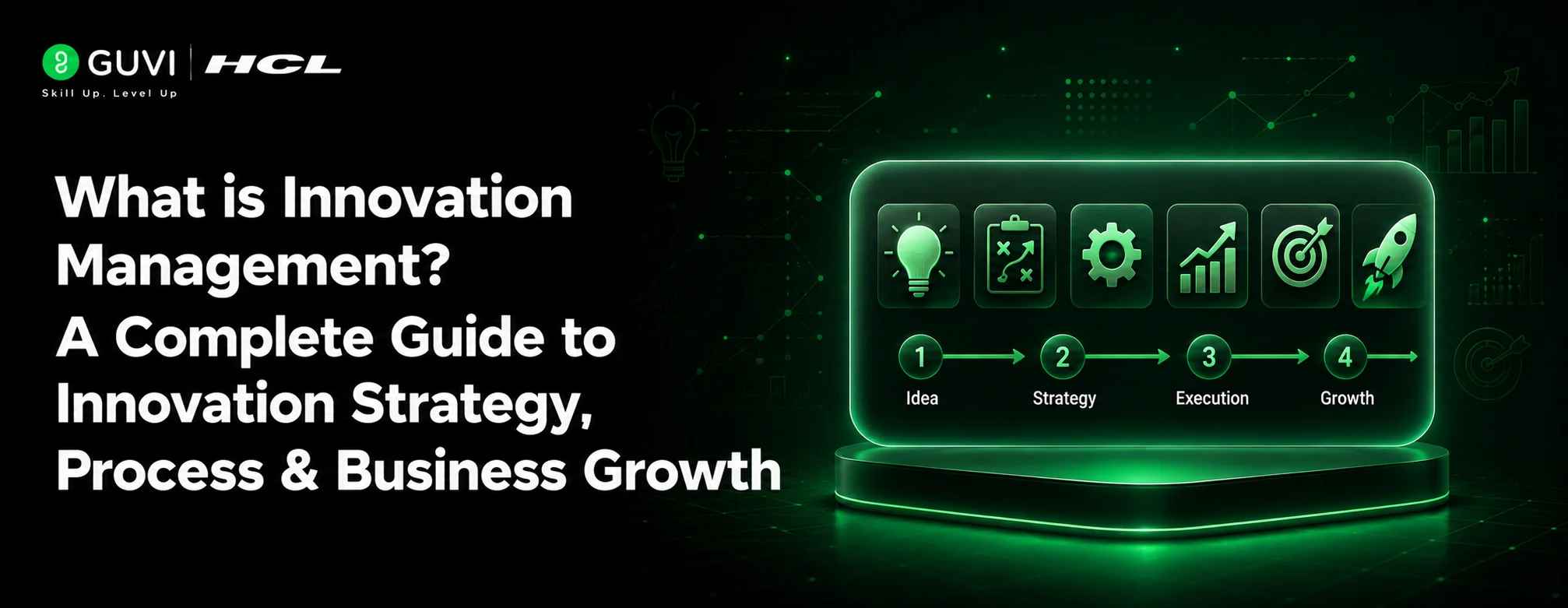
What is Innovation Management? A Complete Guide to Innovation Strategy, Process & Business Growth (2026)
Jul 22, 2026 8 Min Read 276 Views
(Last Updated)
Table of contents
- TL;DR
- Introduction
- What is Innovation Management?
- Innovation Management Goes Beyond Product Innovation
- Innovation Management vs. Regular Business Management
- Why is Innovation Management Important?
- Business Benefits of Innovation Management
- Key Statistics That Show Why Innovation Matters
- How Does the Innovation Process Work?
- Stage 1: Identify Opportunities
- Stage 2: Generate Ideas
- Stage 3: Evaluate and Prioritize Ideas
- Stage 4: Develop and Prototype
- Stage 5: Test and Improve
- Stage 6: Launch and Scale
- Innovation Process at a Glance
- What is an Innovation Framework?
- Popular Innovation Frameworks
- Types of Innovation
- Product Innovation
- Process Innovation
- Business Model Innovation
- Service Innovation
- Marketing Innovation
- Popular Innovation Management Frameworks
- Stage-Gate Model
- Design Thinking
- Lean Startup
- Agile Innovation
- How to Measure Innovation Management Success?
- Input Metrics
- Process Metrics
- Output Metrics
- Innovation Strategy vs Innovation Management
- Real-World Examples of Innovation Management
- Apple
- Amazon
- Tesla
- Challenges of Innovation Management
- Skills for a Career in Innovation Management
- Common Mistakes to Avoid in Innovation Management
- Focusing on Ideas Instead of Customer Problems
- Treating Innovation as a One-Time Project
- Ignoring Employee Contributions
- Skipping Validation
- Measuring Only Financial Results
- How to Build Innovation Management Skills?
- Career Opportunities in Innovation Management
- Innovation Management Salary Insights
- Ready to Turn Innovative Ideas into Successful Businesses?
- Final Words
- Frequently Asked Questions
- What is innovation management in simple words?
- What is the innovation process?
- What is the difference between innovation management and R&D?
- Which framework is best for innovation management?
- Why do most innovation efforts fail?
- What skills do I need for a career in innovation management?
- Is innovation management only for large companies?
TL;DR
- Innovation Management is the systematic process of generating, evaluating, developing, and implementing new ideas that create value for customers and businesses.
- It combines an effective innovation strategy, a structured innovation process, and the right innovation framework to transform ideas into successful products, services, or business models.
- Organizations that manage innovation effectively adapt faster to market changes, improve customer experiences, and build long-term competitive advantages.
Introduction
If you have ever wondered how companies like Amazon or Tata Motors keep launching new products while staying profitable, the answer usually comes down to one thing: innovation management.
It is not about waiting for a lightning-bolt idea. Innovation management is a structured way of finding, testing, and scaling ideas so they consistently create value instead of staying stuck as a whiteboard sketch.
In this guide, you’ll learn what Innovation Management is, why it matters, how the innovation process works, the role of an effective innovation strategy, and how businesses use proven innovation frameworks to build successful products and sustainable growth.
What is Innovation Management?
Innovation Management is the structured practice of generating, evaluating, developing, and implementing new ideas that create value for an organization.
It combines people, processes, technology, and strategy to improve products, services, operations, or business models while supporting long-term business growth.
Unlike random brainstorming sessions, Innovation Management creates a repeatable system that helps organizations identify opportunities, prioritize ideas, allocate resources effectively, and measure outcomes.
At its core, Innovation Management answers three important questions:
- What opportunities should we pursue?
- How can we turn ideas into valuable solutions?
- How do we continuously improve and stay competitive?
A successful Innovation Management system brings together multiple business functions, including product development, marketing, operations, customer experience, and leadership, to foster a culture where innovation becomes part of everyday decision-making.
Innovation Management Goes Beyond Product Innovation
Many people associate innovation solely with creating new products. While product innovation is a major component, Innovation Management encompasses much more.
It can include:
- Developing new business models
- Improving internal processes
- Enhancing customer experiences
- Adopting emerging technologies
- Creating new revenue streams
- Entering new markets
For example, Netflix didn’t just innovate by producing original content. It transformed its entire business model from DVD rentals to on-demand streaming, demonstrating how business innovation can redefine an industry.
Innovation Management vs. Regular Business Management
- Regular business management focuses on optimising what already exists, improving efficiency, cutting costs, and hitting quarterly targets.
- Innovation management focuses on what does not exist yet. It deals with uncertainty, so it needs different tools: hypothesis testing, rapid prototyping, and staged funding instead of fixed annual budgets.
India climbed from 81st position in 2015 to 38th position in the Global Innovation Index (GII) 2025, and has been recognised as an “innovation overperformer” for 15 consecutive years, according to the World Intellectual Property Organization (WIPO).
Why is Innovation Management Important?
Markets evolve faster than ever. Customer expectations shift rapidly, new technologies emerge continuously, and competitors can disrupt industries almost overnight. Without a structured innovation strategy, businesses risk becoming outdated.
An effective Innovation Management approach enables organizations to:
- Identify market opportunities early
- Encourage continuous improvement
- Reduce the risk of failed initiatives
- Improve collaboration across teams
- Accelerate product development
- Increase customer satisfaction
- Build sustainable competitive advantages
Rather than reacting to change, innovative organizations anticipate it and position themselves as industry leaders.
Business Benefits of Innovation Management
| Benefit | Business Impact |
| Faster Product Development | Reduces time-to-market for new ideas |
| Better Decision Making | Prioritizes high-value opportunities |
| Increased Revenue | Opens new markets and revenue streams |
| Higher Customer Satisfaction | Solves real customer problems |
| Stronger Competitive Advantage | Keeps businesses ahead of competitors |
| Improved Employee Engagement | Encourages creativity and collaboration |
Key Statistics That Show Why Innovation Matters
Research consistently shows that organizations investing in structured innovation outperform those that don’t.
| Statistic | Source |
| Companies ranking in the top quartile for innovation generate significantly higher revenue growth than peers. | McKinsey & Company |
| Organizations with strong innovation capabilities are more likely to outperform competitors during periods of market disruption. | Boston Consulting Group (BCG) |
| More than 75% of executives consider innovation among their organization’s top three priorities. | PwC Global Investor Survey |
These findings reinforce a simple truth: Innovation is no longer optional—it’s a strategic necessity.
3M allows employees to dedicate a portion of their work time to pursuing innovative ideas outside their core responsibilities. This innovation-driven culture has led to breakthrough products like INNOVATIVE WINDOW FILMS, proving that structured experimentation can create billion-dollar businesses.
How Does the Innovation Process Work?
An effective innovation process provides a structured roadmap for transforming ideas into valuable outcomes. Instead of relying on occasional inspiration, businesses follow a repeatable cycle that encourages experimentation, learning, and continuous improvement.
While organizations may customize the process, most successful innovation programs follow these six stages.
Stage 1: Identify Opportunities
Every innovation begins with recognizing a problem, unmet customer need, or market opportunity.
Businesses gather insights through:
- Customer feedback
- Market research
- Industry trends
- Emerging technologies
- Competitor analysis
- Employee suggestions
For example, a food delivery platform may notice that users abandon orders because checkout takes too long. This insight becomes the starting point for innovation.
Stage 2: Generate Ideas
Once an opportunity is identified, teams brainstorm multiple possible solutions.
Common ideation techniques include:
- Brainstorming sessions
- Design Thinking workshops
- Mind mapping
- SCAMPER method
- Customer co-creation
- Hackathons
The objective is quantity before quality. Teams generate a wide range of ideas before narrowing them down.
Stage 3: Evaluate and Prioritize Ideas
Not every idea deserves investment. Organizations evaluate ideas based on factors such as:
- Customer value
- Business impact
- Technical feasibility
- Cost
- Time to market
- Strategic alignment
Many businesses use scoring models or innovation matrices to identify high-potential projects.
Stage 4: Develop and Prototype
Promising ideas move into development.
Instead of building a complete solution immediately, organizations often create:
- Minimum Viable Products (MVPs)
- Wireframes
- Prototypes
- Pilot programs
Early prototypes allow businesses to validate assumptions while minimizing risk.
Stage 5: Test and Improve
Innovation is rarely perfect on the first attempt.
Organizations collect feedback from:
- Customers
- Employees
- Beta users
- Stakeholders
The product or solution is refined through multiple iterations until it effectively solves the target problem.
Stage 6: Launch and Scale
After successful validation, the innovation is launched to the market.
Teams continue monitoring:
- Customer adoption
- Revenue
- Customer satisfaction
- Operational performance
- Return on investment (ROI)
Innovation doesn’t stop after launch; it continues through ongoing improvements and feature updates.
Innovation Process at a Glance
| Stage | Objective | Example |
| Identify Opportunity | Find customer problems | Long checkout time |
| Generate Ideas | Brainstorm solutions | One-click checkout |
| Evaluate | Select best ideas | ROI and feasibility analysis |
| Develop | Build MVP or prototype | Beta mobile app |
| Test | Gather user feedback | Pilot with 1,000 users |
| Launch | Scale successful solution | Nationwide rollout |
What is an Innovation Framework?
An innovation framework is a structured model that helps organizations manage innovation consistently. It provides clear guidelines, decision-making processes, and tools that support idea generation, evaluation, execution, and continuous improvement.
Without a framework, innovation often becomes reactive and inconsistent. With one, organizations can innovate systematically while aligning efforts with business goals.
Popular Innovation Frameworks
1. Design Thinking
A human-centered approach focused on understanding user needs before creating solutions.
Key stages include:
- Empathize
- Define
- Ideate
- Prototype
- Test
Best suited for: Product development, UI/UX design, and customer experience improvement.
2. Stage-Gate Framework
Projects move through predefined stages separated by review checkpoints (“gates”).
Typical stages:
- Discovery
- Scoping
- Business Case
- Development
- Testing
- Launch
Best suited for: Manufacturing, pharmaceuticals, and large-scale product development.
3. Lean Startup Framework
Popular among startups, this framework emphasizes rapid experimentation.
Cycle:
Build → Measure → Learn
Businesses launch an MVP, collect customer feedback, and improve continuously instead of investing heavily upfront.
4. Open Innovation Framework
Instead of relying solely on internal teams, organizations collaborate with:
- Universities
- Startups
- Customers
- Suppliers
- Research institutions
Companies such as Procter & Gamble have successfully adopted open innovation to accelerate product development.
Types of Innovation
Not every innovation is revolutionary. Businesses innovate in different ways depending on their goals.
1. Product Innovation
Developing new or improved products that better serve customer needs.
Example: Apple’s transition from the iPod to the iPhone fundamentally changed the smartphone industry.
2. Process Innovation
Improving internal operations to increase efficiency, reduce costs, or enhance quality.
Example: Amazon’s warehouse automation enables faster order fulfillment with fewer manual processes.
3. Business Model Innovation
Changing how a company creates, delivers, or captures value.
Example: Netflix shifted from DVD rentals to a subscription-based streaming platform, transforming the entertainment industry.
4. Service Innovation
Enhancing customer experiences through improved services or delivery methods.
Example: Banks introducing AI-powered chatbots and instant digital account opening.
5. Marketing Innovation
Using creative marketing strategies to attract and retain customers.
Example: Spotify Wrapped turns user listening data into personalized, shareable experiences that drive engagement.
Popular Innovation Management Frameworks
An innovation framework gives structure to the innovation process so ideas do not get lost between departments. Here are four widely used models.
Stage-Gate Model
The Stage-Gate model breaks development into stages separated by decision gates. At each gate, leadership reviews progress and decides whether to continue, pause, or stop funding the idea. It works well for capital-intensive product development where large investments are involved.
Design Thinking
Design Thinking centres the entire process around the user, moving through empathising, defining the problem, ideating, prototyping, and testing. It is especially useful when the core challenge is understanding an unclear customer need.
Lean Startup
Popularised for new ventures, the Lean Startup approach uses a build-measure-learn loop, launching a minimum viable product quickly and adjusting based on real user data instead of assumptions.
Agile Innovation
Borrowed from software development, Agile innovation breaks work into short sprints with frequent reviews, allowing teams to adapt the innovation strategy as new information comes in.
How to Measure Innovation Management Success?
A common mistake is treating innovation as a creative activity with no measurable outcome.
In practice, mature innovation management programs track a mix of input, process, and output metrics so leadership can see whether the effort is actually working.
Input Metrics
These track how much a company invests in innovation, including R&D spend as a percentage of revenue, number of employees involved in innovation projects, and the size of the idea pipeline at any given time.

Process Metrics
Process metrics look at how efficiently ideas move through the innovation process, such as average time from concept to prototype, the percentage of ideas that pass each gate, and how long a pilot runs before a scale-up decision is made.
Output Metrics
Output metrics measure results: revenue from products launched in the last three years, cost savings from process innovation, patents filed, and customer adoption rates for newly launched offerings.
Many large organisations set a target, for example, that a fixed percentage of annual revenue must come from products introduced within a recent time window to keep the innovation pipeline active rather than one-off.
India now ranks 6th globally in patent applications, and Indian universities lead among lower-middle-income economies in industry engagement, reflecting stronger commercialisation of research output, according to the WIPO Global Innovation Index 2025.
Innovation Strategy vs Innovation Management
Although these terms are often used interchangeably, they serve different purposes.
| Aspect | Innovation Strategy | Innovation Management |
| Purpose | Defines innovation goals | Executes innovation initiatives |
| Focus | Long-term direction | Daily execution and governance |
| Questions Answered | What should we innovate? | How do we innovate effectively? |
| Time Horizon | Strategic | Operational |
| Ownership | Leadership | Cross-functional teams |
| Outcome | Business priorities | Successful implementation |
An innovation strategy establishes the vision, while Innovation Management ensures that vision becomes reality through structured execution.
Real-World Examples of Innovation Management
Apple
Apple consistently demonstrates effective Innovation Management by combining product innovation, user-centric design, and ecosystem integration.
Rather than launching products frequently, Apple focuses on refining user experiences and creating seamless connections across devices.
Amazon
Amazon encourages experimentation through its “Day One” philosophy.
From one-click purchasing to Amazon Prime and AWS, the company continuously improves customer experiences while exploring entirely new business opportunities.
Google promotes innovation through cross-functional collaboration, rapid experimentation, and data-driven decision-making.
Products such as Gmail, Google Maps, and Google Photos evolved through continuous testing and user feedback.
Tesla
Tesla combines technological innovation with business innovation.
Beyond electric vehicles, it transformed battery technology, software updates, charging infrastructure, and direct-to-consumer sales, creating an entirely new automotive ecosystem.
Google encourages employees to spend time exploring experimental ideas outside their core responsibilities. Several successful products, including Gmail and Google News, originated from internal innovation initiatives, demonstrating how a culture of experimentation can lead to breakthrough products.
Challenges of Innovation Management
While the benefits are significant, implementing Innovation Management comes with its own set of challenges. Recognizing these obstacles early can help businesses develop more effective innovation strategies.
Some common challenges include:
- Resistance to organizational change
- Limited budgets or resources
- Lack of leadership support
- Fear of failure among employees
- Poor collaboration between departments
- Difficulty measuring innovation outcomes
- Balancing short-term goals with long-term innovation initiatives
Overcoming these challenges requires a supportive culture, clear leadership, and structured processes that encourage experimentation and continuous learning.
Skills for a Career in Innovation Management
Innovation management is increasingly its own career path, not just a side responsibility for product managers. If you are exploring roles in innovation, strategy, or entrepreneurship, these skills matter most:
- Strategic thinking: Connecting new ideas to long-term business goals.
- Market and customer research: Validating whether a problem is worth solving.
- Design thinking and prototyping: Turning abstract ideas into testable concepts quickly.
- Data analysis: Reading pilot results and customer feedback to decide what to scale.
- Project and stakeholder management: Coordinating cross-functional teams through uncertainty.
- Business model design: Understanding how value is created, delivered, and captured.
These are exactly the skills covered in structured, project-based learning paths that combine business fundamentals with hands-on venture building.
Common Mistakes to Avoid in Innovation Management
Many organizations invest heavily in innovation but fail to achieve meaningful results because of avoidable mistakes.
1. Focusing on Ideas Instead of Customer Problems
Innovation should begin with understanding customer needs, not simply generating creative ideas.
Tip: Conduct customer interviews, surveys, and market research before developing solutions.
2. Treating Innovation as a One-Time Project
Innovation isn’t something businesses do once a year during brainstorming sessions.
Successful organizations integrate innovation into everyday decision-making and continuously improve products and processes.
3. Ignoring Employee Contributions
Employees across departments often have valuable insights into operational challenges and customer pain points.
Creating channels for idea sharing encourages participation and uncovers innovative solutions.
4. Skipping Validation
Launching a product without testing assumptions can lead to costly failures.
Develop prototypes, gather user feedback, and iterate before full-scale implementation.
5. Measuring Only Financial Results
Innovation success isn’t always immediate.
Businesses should also track metrics such as:
- Customer satisfaction
- Adoption rates
- Employee engagement
- Time-to-market
- Learning outcomes
These indicators provide a more complete picture of innovation performance.
How to Build Innovation Management Skills?
Developing innovation skills requires both knowledge and practical experience. Here’s a structured roadmap you can follow.
| Stage | What to Learn |
| Step 1 | Understand innovation fundamentals and business strategy |
| Step 2 | Learn customer research and problem validation techniques |
| Step 3 | Explore Design Thinking and Lean Startup methodologies |
| Step 4 | Practice idea generation and innovation frameworks |
| Step 5 | Build MVPs and prototype solutions |
| Step 6 | Learn business model innovation and product management |
| Step 7 | Analyze real-world innovation case studies |
| Step 8 | Launch projects, collect feedback, and iterate continuously |
The best way to master Innovation Management is by applying these concepts to real business problems. Even small side projects can help you build critical problem-solving, leadership, and entrepreneurial skills.
Career Opportunities in Innovation Management
As organizations increasingly prioritize digital transformation and business growth, professionals with innovation expertise are in demand across industries.
Popular career roles include:
- Innovation Manager
- Product Manager
- Business Consultant
- Strategy Consultant
- Corporate Innovation Lead
- Entrepreneur
- Startup Founder
- Product Owner
- Business Development Manager
- Design Thinking Facilitator
Industries hiring innovation professionals include:
- Technology
- Healthcare
- Manufacturing
- Banking & Financial Services
- Retail & E-commerce
- Education
- Automotive
- Consulting
- Government and Public Services
Innovation Management Salary Insights
While salaries vary depending on industry, experience, and location, professionals specializing in innovation and product strategy often earn competitive compensation.
| Role | Average Salary (India) |
| Product Manager | ₹21-25 LPA |
| Innovation Manager | ₹21.7-24.6 LPA |
| Strategy Consultant | ₹24.9-27.5 LPA |
| Business Consultant | ₹16-17.7 LPA |
| Startup Founder | Varies based on business success |
Professionals who combine innovation skills with business strategy, technology, and leadership often enjoy faster career progression and broader opportunities.
Ready to Turn Innovative Ideas into Successful Businesses?
Learning Innovation Management is most valuable when you apply it to solving real-world problems.
If you’re interested in validating ideas, building sustainable business models, and launching ventures with expert mentorship, explore the HCL GUVI Entrepreneurship Program through the Zen Class Featured Programs.
The program emphasizes hands-on learning, practical execution, and entrepreneurial thinking, helping you move from concept to market with greater confidence.
Final Words
Innovation Management is much more than generating creative ideas, it’s a disciplined approach to identifying opportunities, solving meaningful problems, and creating lasting value.
By combining a clear innovation strategy, a structured innovation process, and the right innovation framework, organizations can transform ideas into impactful products, services, and business models.
Start by understanding customer needs, experimenting with small ideas, and continuously learning from feedback because innovation is a journey of constant improvement.
Frequently Asked Questions
1. What is innovation management in simple words?
Innovation management is the structured process of generating, evaluating, and implementing new ideas so a business can create products, processes, or business models that add real value to customers.
2. What is the innovation process?
The innovation process is a step-by-step approach that typically includes identifying opportunities, developing concepts, testing and validating ideas, launching solutions, and monitoring results to improve them further.
3. What is the difference between innovation management and R&D?
R&D focuses mainly on technical research and product development, while innovation management is broader, covering strategy, culture, resource allocation, and commercialisation across the entire organisation.
4. Which framework is best for innovation management?
There is no single best framework. Stage-Gate suits capital-intensive product development, Design Thinking suits customer-centric problem solving, and Lean Startup suits fast, low-cost experimentation for new ventures.
5. Why do most innovation efforts fail?
Most innovation efforts fail because of unclear strategy, weak customer validation, poor cross-functional collaboration, and a rush to scale ideas before they have been properly tested in the market.
6. What skills do I need for a career in innovation management?
A career in innovation management benefits from skills in strategic thinking, market research, design thinking, project management, data analysis, and the ability to lead cross-functional teams through change.
7. Is innovation management only for large companies?
No. Startups and small businesses also need innovation management to prioritise limited resources, validate ideas quickly, and avoid building products nobody wants, often using leaner versions of the same frameworks.
Success Stories

About the Author
Hashmithaa
Hi, I’m Hashmithaa — a content writer with a love for words. Writing isn’t just what I do; it’s how I connect, communicate, and create meaning in a noisy digital world. And if my words help someone make a better decision, learn something new, or feel more confident, then I’ve done my job well.
View all posts by Hashmithaa
Connect with me @







Did you enjoy this article?