


Entrepreneurship Articles
Employment Law Basics for Startup Founders: Hiring Compliance Guide for India
Data Privacy Compliance for Startups: A Practical & Best Guide for Founders
GST for Startups: A Beginner's Best Guide to Registration, Tax & Compliance
Founder Agreement and Equity Vesting: What You Need to Know in 2026


Get In Touch For Details! Request More Information
Advantages and Disadvantages of Entrepreneurship You Should Know
Sep 10, 2026 5 Min Read 5670 Views
(Last Updated)
Are you confused about whether entrepreneurship is right for you? Not sure about the advantages and disadvantages of entrepreneurship? We got you covered!
In this blog, we’ll explore an entrepreneur’s responsibilities and the advantages and disadvantages of entrepreneurship. Understanding both the advantages and disadvantages of entrepreneurship can help you decide if entrepreneurship is the right path for you. Let’s get started!
Table of contents
- TL;DR: Summary
- What is Entrepreneurship?
- Who is an Entrepreneur?
- Getting Started with HCL Guvi
- Key Advantages of Entrepreneurship at a Glance
- Disadvantages of Entrepreneurship No One Talks About
- Constant Pressure and Responsibility
- Unpredictable Income
- Work-Life Balance Is Harder Than Expected
- Risk of Business Failure
- Decision Fatigue
- Entrepreneurship in India: Advantages and Challenges
- Advantages
- Challenges
- Entrepreneurship vs Job: Which Is Better for Indian Tech Graduates?
- Who Should Choose What
- Is Entrepreneurship Right for You? A Self-Assessment Checklist
- Conclusion
- FAQs
- Q1. Who can become an entrepreneur?
- Q2. What are the key qualities of a successful entrepreneur?
- Q3. How do entrepreneurs make money?
- Q4. What is the biggest challenge in entrepreneurship?
TL;DR: Summary
- Entrepreneurship offers independence, unlimited income potential, and the freedom to innovate — but it also comes with financial risk and unpredictable income.
- Top advantages include control over decision-making, flexible schedules, and personal growth through real-world problem-solving.
- Key disadvantages include constant pressure, work-life imbalance, and high risk of business failure.
- In India, entrepreneurs benefit from a massive domestic market and strong government support but face regulatory complexity and funding gaps outside metro cities.
- Success depends less on talent and more on financial readiness, risk tolerance, and long-term motivation.
Around 90% of startups fail globally, yet many of the ones that succeed pivot from their original idea. A famous example is Instagram, which started as a check-in app called Burbn before evolving into the photo-sharing platform used by billions today.
What is Entrepreneurship?
Entrepreneurship is the process of creating and running a new business to make a profit. It involves the entire process of identifying a business opportunity, taking financial risks, organising resources, and building it to create and grow the business. It includes innovation, risk-taking, resource management, leadership, and value creation.
Who is an Entrepreneur?
An entrepreneur identifies a business opportunity, creates and grows a business, and takes significant financial risk in the hope of making a profit. The responsibilities of an entrepreneur include:
- They create a business plan that outlines the vision, goals, and financial strategy.
- They raise capital funding from investors, banks, or from personal savings.
- They design and refine the product based on the market needs.
- They recruit the right people and create a productive work environment.
- They promote the business and drive revenue through different marketing tragedies.
- In the early-stage startup, they manage the budgets, accounting to ensure profitability.
- They build strong relationships with customers, partners, and stakeholders.
Getting Started with HCL Guvi
If you are interested in starting your entrepreneurial journey, consider enrolling in HCL Guvi’s Entrepreneurship course. It provides a detailed roadmap towards your entrepreneurship journey under 7 hours. By taking this course, you can launch your own business within a few months.
Key Advantages of Entrepreneurship at a Glance
The table below highlights the key advantages of entrepreneurship, why they matter, real founder examples, and the potential risks associated with each benefit:
| Advantage | Why It Matters | Real Founder Example | Risk Factor |
|---|---|---|---|
| Independence and Control | Entrepreneurs make key business decisions without relying on an employer, allowing them to shape the company’s vision and operations. | Sara Blakely – Spanx: Built the company independently and retained significant control over its brand and products. | Full responsibility for business decisions means mistakes can directly affect profits and growth. |
| Unlimited Income Potential | Business owners can increase their earnings by scaling operations, launching new products, or entering new markets. | Jeff Bezos – Amazon: Started as an online bookstore and scaled it into one of the world’s largest companies. | Income is unpredictable, especially during the early stages, and financial losses are possible. |
| Freedom to Innovate | Entrepreneurs can introduce new ideas, solve customer problems, and create products without corporate restrictions. | Brian Chesky – Airbnb: Created a new way for people to book accommodations by connecting hosts with travelers. | New ideas may fail if customers don’t adopt them or if entrepreneurs overestimate market demand. |
| Flexible Work Schedule | Entrepreneurs can decide when and where they work, helping them manage business and personal priorities. | Pat Flynn – Smart Passive Income: Built an online business that offered greater flexibility than a traditional job. | In reality, many entrepreneurs work long hours, especially during the startup phase. |
| Personal and Professional Growth | Running a business develops leadership, problem-solving, financial management, and communication skills. | Melanie Perkins – Canva: Grew from a startup into a global design platform while developing strong leadership and business skills. | Constant learning and high-pressure decision-making can lead to stress and burnout. |
Also Read: Mastering the Fundamentals of Entrepreneurship
Disadvantages of Entrepreneurship No One Talks About
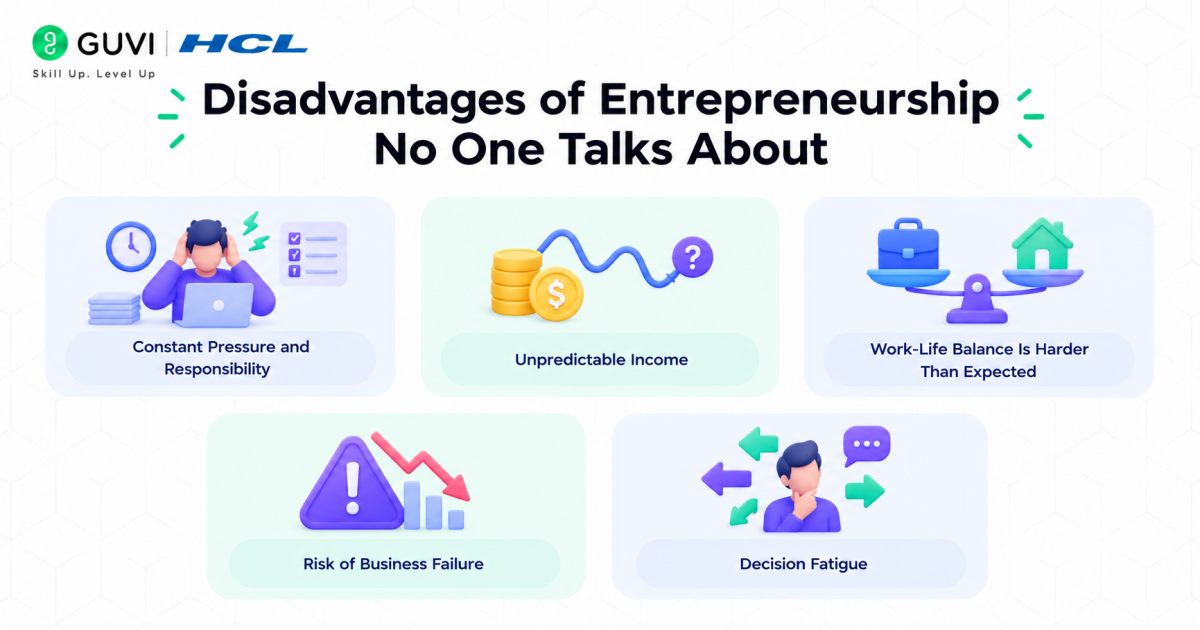
Entrepreneurship offers many rewards, but it also comes with hidden challenges that many people don’t discuss. Understanding these disadvantages can help you set realistic expectations, avoid common mistakes, and prepare for the realities of running a business.
1. Constant Pressure and Responsibility
One of the biggest disadvantages of entrepreneurship is the constant responsibility. Every important decision—from managing finances to handling customers and employees—falls to you.
Unlike a regular job, work doesn’t always end after office hours. If sales drop or problems arise, you have to find a solution.
Over time, this pressure can affect your focus, sleep, and overall well-being if you don’t manage it properly.
2. Unpredictable Income
Entrepreneurs don’t receive a fixed monthly salary. Your income depends on sales, customer demand, and business performance.
Some months may be highly profitable, while others may barely cover expenses. This makes financial planning harder, especially in the early stages of a business.
3. Work-Life Balance Is Harder Than Expected
Many people start a business expecting more freedom, but the reality is often different. In the beginning, entrepreneurs usually spend long hours managing operations, marketing, finances, and customer support.
Although you control your schedule, achieving a healthy work-life balance often takes time and a well-established business.
4. Risk of Business Failure
Every business carries a certain level of financial and operational risk. Market changes, intense competition, or poor planning can affect business growth.
Even successful entrepreneurs have experienced failures before building successful companies. Understanding these risks helps you make better decisions and prepare for unexpected challenges.
5. Decision Fatigue
Entrepreneurs make important decisions every day, from pricing products to hiring employees and planning business strategies.
Making too many decisions can lead to decision fatigue, reducing your ability to think clearly and make sound judgments. Delegating tasks and creating efficient systems can help reduce this mental burden.
Entrepreneurship in India: Advantages and Challenges
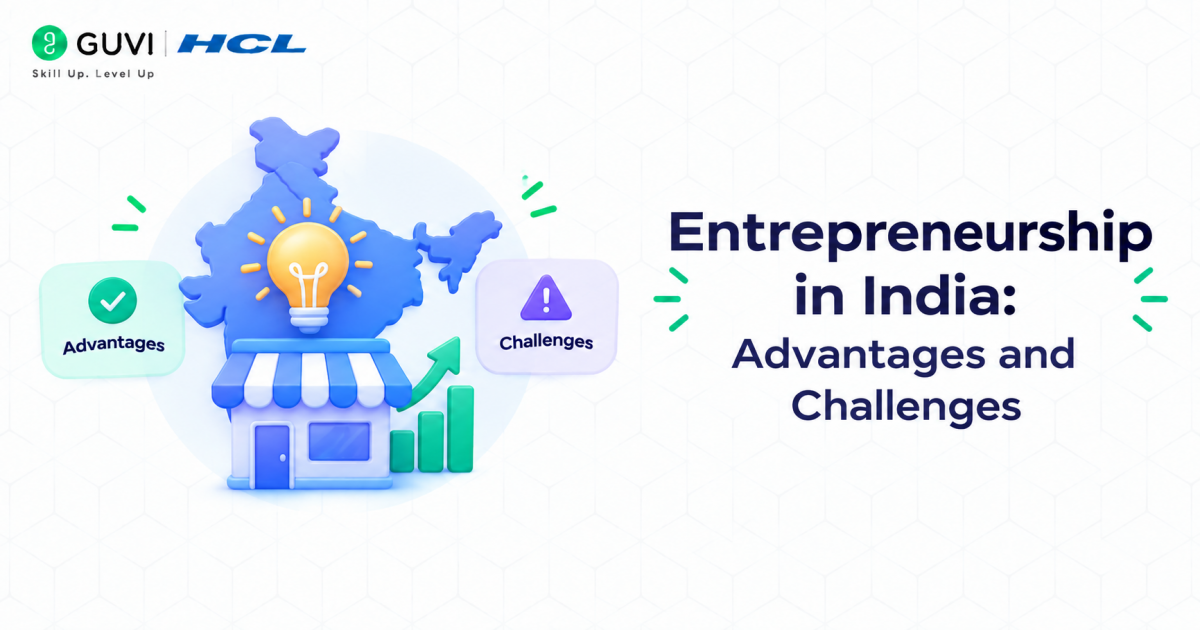
India has become one of the world’s most active startup ecosystems — as of mid-2026, it ranks third globally in total unicorns created, trailing only the US and China, with China at 248 unicorns and the United States at 1,219. But building a business here means navigating real opportunity and real friction. Here’s an honest breakdown. (Source: Tracxn )

Advantages
1. Massive Domestic Market
With over 1.4 billion people and a fast-growing middle class, India offers entrepreneurs a huge, diverse customer base right at home.
2. Government Support
Initiatives like Startup India, Make in India, and Digital India offer tax benefits, easier compliance, and access to funding for early-stage ventures.
3. Low Operational Costs
Talent, infrastructure, and production costs remain significantly lower than in Western markets, helping startups stretch capital further.
4. Booming Digital Infrastructure
UPI, affordable internet, and widespread smartphone adoption have made it easier than ever to launch and scale digital-first businesses. Case in point: Meesho built a billion-dollar reselling platform by leveraging WhatsApp and social commerce instead of expensive ad spend—proving how far digital infrastructure alone can take a lean startup in India.
5. Access to Skilled Talent
India produces a large pool of engineers, developers, and business graduates every year, fueling tech and service-based startups.
6. Growing Investor Interest
India ranks among the top countries globally for startup funding, with active VC, angel investor, and incubator networks driving continued momentum.
Challenges
1. Regulatory Complexity
Despite reforms, entrepreneurs still face bureaucratic delays, multiple compliance layers, and inconsistent state-level regulations.
2. Access to Capital (Beyond Metro Cities)
Funding is heavily concentrated in metro hubs — Bengaluru alone accounts for the largest share of India’s unicorns — while Tier 2/3 founders often struggle to attract investors.
3. Infrastructure Gaps
Logistics, power reliability, and connectivity issues persist outside major urban centers, raising operational costs.
4. High Competition
Low entry barriers in many sectors mean markets get crowded fast, squeezing margins for new entrants.
5. Talent Retention
Startups often compete with larger companies and MNCs offering better pay and stability, making it hard to retain skilled employees.
6. Cultural Risk Aversion
In many families, entrepreneurship is still seen as riskier than a stable job, which can limit access to early support and funding.
Find out: What is the Scope of Entrepreneurship in 2026?
Here’s the section, drafted per that plan:
Entrepreneurship vs Job: Which Is Better for Indian Tech Graduates?
There’s no universal answer — it depends on what you’re optimizing for. Here’s a quick comparison:
| Factor | Job | Entrepreneurship |
|---|---|---|
| Initial Income | Stable, predictable — average tech fresher salary in 2026 ranges from ₹3.5–6 LPA at IT services firms to ₹6–12 LPA at product-based companies | Uncertain, often ₹0 for months; income tied to traction |
| Job Security | High — fixed salary, defined role | Low — depends entirely on runway and market fit |
| Learning Curve | Structured, role-specific | Broad — forces you to learn sales, finance, ops fast |
| Work-Life Balance | More predictable hours | Often blurred; especially in early stages |
| Long-Term Upside | Capped by hikes/promotions | Uncapped, but high failure risk |
Who Should Choose What
Choose a job if: you value financial stability early on, are still building core skills, or have family/loan obligations that need predictable income.
Choose entrepreneurship if: you have a validated idea, some financial cushion (savings or family support), and can tolerate 12–18 months of income uncertainty while building traction.
For most graduates, the smartest path is often a hybrid: work for 2–3 years to build skills, savings, and a network — then take the leap with a stronger safety net.
Is Entrepreneurship Right for You? A Self-Assessment Checklist
Before you take the leap, be honest with yourself about these 8 questions. The more “yes” answers you have, the more ready you likely are.
- Can you survive 6-12 months with little to no income?
Financial cushion matters more than passion in the early days. - Are you comfortable making decisions with incomplete information?
Entrepreneurship rarely offers clear right answers — just calculated bets. - Do you have at least one skill you can monetize immediately (coding, sales, design, content)?
This becomes your fallback and your MVP-building tool. - Can you handle rejection repeatedly — from customers, investors, or partners — without it derailing you?
- Do you have a support system (family, mentor, peer group) that won’t pressure you to quit at the first setback?
- Have you validated your idea with real users, not just friends and family?
- Are you solving a problem you’d stay motivated by even after 2-3 tough years, not just chasing a trend?
- Are you okay with your title, income, and social status being unclear for a while?
Conclusion
Entrepreneurship can be a rewarding path filled with independence, innovation, and personal growth. However, it also involves financial risks, long hours, and high levels of responsibility. If you are prepared to face uncertainty and handle pressure, the rewards can be great. By understanding the advantages and disadvantages of entrepreneurship, you can make informed decisions and increase your chances of building a successful business.
FAQs
Q1. Who can become an entrepreneur?
Anyone with a business idea, a passion, and a willingness to take risks and learn can become an entrepreneur, regardless of age, background, or education.
Q2. What are the key qualities of a successful entrepreneur?
Key qualities include creativity, resilience, leadership, risk tolerance, adaptability, and strong problem-solving skills.
Q3. How do entrepreneurs make money?
Entrepreneurs earn money by selling products or services that solve problems or meet market needs, generating revenue and profit over time.
Q4. What is the biggest challenge in entrepreneurship?
The biggest challenge is managing risk and uncertainty especially in funding, competition, and building a customer base.
Success Stories







Did you enjoy this article?