


Entrepreneurship Articles
Bootstrapping a Startup: Pros, Cons, and How to Do It
Venture Capital vs Angel Investors: Which Funding Source Is Right for Your Startup?
Startup Leadership Styles: What Works at Different Stages? - Best Guide
Lean Startup Methodology: Build-Measure-Learn Explained - Best Guide


Get In Touch For Details! Request More Information
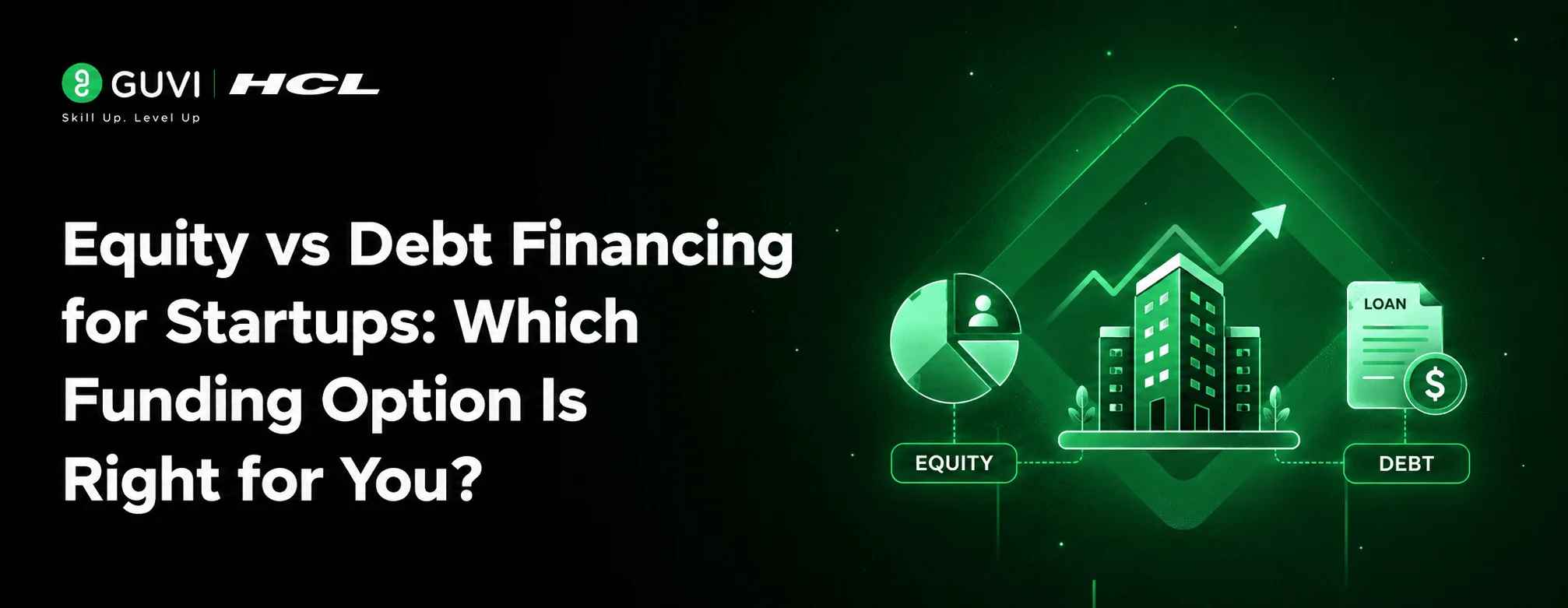
Equity vs Debt Financing for Startups: Which Funding Option Is Right for You?
Aug 13, 2026 9 Min Read 114 Views
(Last Updated)
Table of contents
- TL;DR
- Quick Answer: Equity vs Debt Financing
- What Is Equity vs Debt Financing?
- Equity vs Debt Financing at a Glance
- What Is Equity Financing for Startups?
- Common Sources of Equity Funding
- How Equity Funding Works
- Example of Equity Funding
- What Is Debt Financing for Startups?
- How Debt Funding Works
- Startup Debt in India
- Equity vs Debt Financing: Key Differences
- Ownership and Control
- Repayment and Cash Flow
- Risk
- Cost of Capital
- Equity Funding: Advantages and Disadvantages
- Advantages of Equity Funding
- Disadvantages of Equity Funding
- Debt Funding: Advantages and Disadvantages
- Advantages of Debt Funding
- Disadvantages of Debt Funding
- When Should a Startup Choose Equity Financing?
- Equity Is Often Better for High-Uncertainty Growth
- When Should a Startup Choose Debt Financing?
- Debt Works Better When Revenue Is Predictable
- Equity vs Debt Financing: Which Should You Choose?
- Can Startups Use Both Equity and Debt Financing?
- A Hybrid Financing Strategy
- How to Choose Between Equity and Debt Financing?
- How predictable is your revenue?
- How much ownership are you willing to give up?
- Can you comfortably repay the debt?
- What will the funding accomplish?
- What does your long-term financing plan look like?
- Equity vs Debt Financing Example
- Startup Financing Options in India
- Equity-Based Options
- Debt-Based Options
- Government-Backed Startup Support
- Equity vs Debt Financing by Startup Stage
- 7 Questions to Ask Before Choosing Startup Financing
- Real-World Example: Startup India and Debt Support
- Common Mistakes Startups Make When Choosing Funding
- Choosing Funding Based Only on Ownership
- Taking Debt Without a Cash-Flow Plan
- Giving Away Too Much Equity Too Early
- Ignoring the Total Cost of Capital
- Raising More Money Than the Business Can Deploy
- Learn Startup Finance and Fundraising with HCL GUVI
- Wrapping Up
- FAQs
- What is the difference between equity and debt financing?
- Is equity or debt funding better for startups?
- Does debt financing dilute startup ownership?
- What are the main advantages of equity funding?
- What are the disadvantages of debt funding?
- When should a startup use debt funding?
- Can a startup have both equity and debt?
- What is startup finance?
- What is the biggest risk of equity financing?
- What is the biggest risk of debt financing?
TL;DR
- Choosing equity vs debt financing is one of the most critical decisions startup founders make.
- Equity financing involves selling shares in your company to investors in exchange for capital, offering access to expertise and networks but resulting in ownership dilution.
- Debt financing means borrowing money that must be repaid with interest, allowing you to retain full ownership but requiring consistent cash flow to meet repayment obligations.
- Equity can suit startups that prioritize rapid growth, experimentation, and long-term scalability.
- Debt can work well for businesses with predictable revenue and enough cash flow to service repayments.
- Many startups eventually use a mix of equity and debt, depending on their stage, cash flow, growth plans, and risk tolerance.
- The right choice in equity vs debt financing depends less on which option is “better” and more on what your startup can realistically afford.
By August 2026, the global startup ecosystem has witnessed a significant shift in financing preferences. While traditional venture capital dominated the landscape just a few years ago, recent economic conditions have led to a 40% increase in startup founders choosing debt financing. This pivotal change reflects a new generation of founders who prioritize maintaining control over rapid scaling.
Yet despite this trend, founders still acknowledge they initially chose the wrong financing structure for their company’s stage. This decision affects everything from daily cash flow management to long-term exit strategies, potentially determining whether your startup thrives or merely survives.
The question isn’t simply “How do I get money?” but rather “What will my company look like after I secure funding?” Understanding equity vs debt financing is essential for making informed decisions that align with your startup’s growth trajectory.
Whether you’re launching a tech venture, opening a restaurant, or developing a revolutionary product, choosing the right financing method( equity vs debt financing) will significantly influence your company’s future. Let’s break down both options to help you make the best choice for your unique situation.
Quick Answer: Equity vs Debt Financing
- Equity financing is generally better for startups with high growth potential, uncertain revenue, or significant upfront investment needs because it does not create conventional repayment obligations.
- Debt financing can be better for startups with predictable revenue and strong cash flow because founders retain ownership but must repay the borrowed capital, usually with interest.
What Is Equity vs Debt Financing?
Equity financing means raising money by selling a percentage of ownership in your company to investors. The investor receives an ownership stake and may also receive certain rights depending on the investment agreement.
Debt financing means borrowing money that your startup agrees to repay according to defined terms. The repayment may include principal, interest, fees, or other financing costs.
In simple terms:
Equity = Give up some ownership to receive capital.
Debt = Keep ownership but take on an obligation to repay capital.
The difference becomes especially important as your startup grows.
With equity, the financial burden is generally connected to ownership and future value creation. With debt, the obligation exists regardless of whether your startup reaches its growth targets.
Equity vs Debt Financing at a Glance
| Factor | Equity Financing | Debt Financing |
| Basic structure | Capital for ownership | Borrowed capital |
| Ownership dilution | Yes | Generally no |
| Repayment | Usually no scheduled repayment of invested capital | Yes |
| Interest | Usually no traditional loan interest | Usually applicable |
| Investor/lender involvement | Can be significant | Usually limited to financing terms |
| Cash-flow pressure | Lower repayment pressure | Higher repayment pressure |
| Founder control | Can decrease | Usually preserved |
| Suitable for | High-growth or uncertain-revenue startups | Revenue-generating businesses |
| Main risk | Ownership dilution | Repayment/default risk |
| Common sources | Angels, VCs, strategic investors | Banks, NBFCs, venture debt funds, government-backed schemes |
| Collateral | Usually not applicable | May be required |
| Upside shared with | Investors | Founders/shareholders |
| Typical stage | Pre-seed to growth | Usually revenue-generating/growth |
| Investor/lender involvement | Potentially high | Usually contractual |
What Is Equity Financing for Startups?
Equity financing is a form of startup finance where investors provide capital in exchange for ownership in the business.
Suppose you own 100% of a startup and raise money by selling 15% of the company to an investor. After the transaction, you may own approximately 85%, subject to the exact deal structure and any existing shareholders or option pools.
The important point is that you are exchanging part of your future ownership for capital today.
Common Sources of Equity Funding
Startups can raise equity funding from:
- Angel investors
- Venture capital firms
- Strategic investors
- Family offices
- Incubators and accelerators
- Crowdfunding platforms, where legally applicable
- Friends and family
- Other private investors
Equity funding is often associated with startups that have significant growth potential but may not yet have the predictable cash flows required for conventional lending.
How Equity Funding Works
A simplified equity fundraising process looks like this:
- The founder identifies the amount of capital required.
- The startup estimates its valuation.
- Investors evaluate the business, market, team, traction, and financials.
- Both sides negotiate the investment terms.
- Legal documentation is completed.
- The investor provides capital.
- The investor receives shares or another agreed ownership instrument.
The actual process can be considerably more complex, particularly when preferred shares, liquidation preferences, voting rights, board rights, convertible instruments, or multiple funding rounds are involved.
Example of Equity Funding
Imagine a startup valued at ₹4 crore before investment.
An investor agrees to invest ₹1 crore.
If the transaction is structured as a simple priced equity round:
- Pre-money valuation = ₹4 crore
- New investment = ₹1 crore
- Post-money valuation = ₹5 crore
- Investor ownership = approximately 20%
The exact ownership outcome depends on the final deal structure and capitalization table.
Key takeaway: Equity funding reduces the founder’s ownership percentage, but it does not create the same scheduled repayment obligation as a conventional loan.
What Is Debt Financing for Startups?
Debt financing provides capital that a startup must repay according to agreed terms.
Depending on the arrangement, the startup may make regular principal and interest payments or follow another repayment structure.
Common forms include:
- Business loans
- Working-capital loans
- Venture debt
- Equipment financing
- Invoice financing
- Lines of credit
- Government-backed startup or MSME financing
- Convertible debt and debt-linked instruments
Debt funding can be attractive when founders want to raise capital without immediately diluting ownership.
However, retaining ownership does not mean the financing is free.
Interest, fees, covenants, security requirements, repayment schedules, and potential default consequences all need to be considered before borrowing.
How Debt Funding Works
A typical debt financing process involves:
- Determining the amount required.
- Assessing repayment capacity.
- Selecting a lender or financing provider.
- Providing financial and business information.
- Negotiating loan terms.
- Completing documentation.
- Receiving the capital.
- Making repayments according to the agreement.
Lenders generally focus heavily on repayment capacity, financial performance, creditworthiness, collateral or guarantees where applicable, and the overall risk of the business.
Startup Debt in India
India also has government-supported mechanisms designed to improve startup access to debt.
For example, the Startup India Credit Guarantee Scheme for Startups (CGSS) provides guarantee coverage for eligible loans extended to DPIIT-recognized startups by specified financial institutions, including scheduled commercial banks, NBFCs, and venture debt funds.
The maximum amount of debt eligible for guarantee cover has been revised to ₹20 crore per borrower under the current framework.
This does not mean every startup can automatically borrow ₹20 crore. Eligibility, lender assessment, scheme conditions, and the startup’s financial position still matter.
Equity vs Debt Financing: Key Differences
The biggest difference between equity and debt is what the startup gives up in return for capital.
Equity generally involves ownership dilution, while debt generally involves repayment obligations.
Ownership and Control
With equity funding, investors become shareholders or receive an instrument that can convert into or represent an ownership interest.
Depending on the investment agreement, investors may also receive voting, information, board, or other rights.
Debt lenders, on the other hand, generally do not become owners simply because they lend money.
If maintaining founder ownership is your top priority, debt may appear more attractive. If minimizing repayment pressure is more important, equity may be preferable.
Repayment and Cash Flow
Debt creates an obligation to repay.
This means a startup needs sufficient cash flow to meet its repayment commitments even when sales temporarily decline.
Equity does not normally work like a conventional loan. Investors instead expect the value of their ownership to increase over time.
Debt creates greater repayment pressure and requires cash flows to support interest payments, while equity reduces repayment pressure but can increase investor involvement and growth expectations.
Risk
Debt can increase financial risk because repayments continue according to the agreement.
Equity transfers more financial risk to investors because they participate in the company’s upside and downside through their ownership.
However, equity is not risk-free for founders. Dilution can become expensive if the startup later becomes highly valuable.
Cost of Capital
Debt has an identifiable financing cost, usually including interest and fees.
Equity may not require periodic cash payments, but giving up 10%, 15%, or 20% of a company that eventually becomes extremely valuable can represent a substantial economic cost.
That is why founders should not compare only the immediate cost of capital.
They should also consider the long-term cost of ownership dilution.
Equity Funding: Advantages and Disadvantages
Advantages of Equity Funding
Equity funding can be useful when:
- The startup has limited or unpredictable revenue.
- The company needs significant capital to scale.
- The business model requires a long development period.
- The founders want investors who can provide networks and expertise.
- Repayment obligations could restrict growth.
- The company has strong potential but limited assets for conventional lending.
Disadvantages of Equity Funding
The main drawbacks include:
- Founder ownership dilution
- Potential loss of some decision-making control
- Investor reporting requirements
- Pressure to achieve growth targets
- More complex fundraising negotiations
- Potential conflicts between founders and investors
Equity investors may also have different expectations from founders about growth, hiring, profitability, expansion, and exit timelines.
Debt Funding: Advantages and Disadvantages
Advantages of Debt Funding
Debt funding can help startups:
- Preserve founder ownership.
- Avoid immediate equity dilution.
- Finance inventory or equipment.
- Fund working capital.
- Extend runway without selling additional shares.
- Take advantage of predictable future cash flows.
For a startup with stable revenue, debt can be particularly useful when the expected return from using the borrowed capital is greater than the total cost of borrowing.
Disadvantages of Debt Funding
Debt can also create significant pressure.
Potential disadvantages include:
- Regular repayments
- Interest and financing costs
- Cash-flow pressure
- Potential collateral or guarantees
- Financial covenants
- Default risk
- Reduced flexibility during downturns
This is why debt funding should not be viewed simply as “free ownership-preserving capital.”
When Should a Startup Choose Equity Financing?
Equity financing may be more appropriate when your startup is still proving its business model.
Consider equity if:
- You are pre-revenue or have unpredictable revenue.
- Product development requires substantial investment.
- You are entering a large market quickly.
- You need strategic investors.
- You cannot comfortably service debt.
- Your business has limited collateral.
- You expect significant growth but uncertain near-term cash flow.
Equity Is Often Better for High-Uncertainty Growth
Imagine a health-tech startup developing a new software platform.
The founders need ₹3 crore for product development, regulatory work, hiring, and market validation. Revenue may remain limited for the next 18 months.
Taking a large loan could create repayment pressure before the company has meaningful cash flow.
In this scenario, equity funding may provide more breathing room.
A startup does not have to choose between equity and debt forever. Many companies change their financing mix as they move from product development to predictable revenue and growth.
When Should a Startup Choose Debt Financing?
Debt financing can make more sense when your startup has predictable cash flows and a clear use for borrowed capital.
Consider debt if:
- Your startup generates consistent revenue.
- Your gross margins are healthy.
- You can forecast cash flow with reasonable confidence.
- You have a clear repayment plan.
- You want to avoid additional dilution.
- The borrowed capital will generate measurable returns.
- Your business has suitable assets or other credit support, where required.
Debt Works Better When Revenue Is Predictable
Suppose an established D2C startup generates ₹50 lakh in monthly revenue and needs ₹2 crore to purchase inventory ahead of a major seasonal period.

If historical sales provide reasonable confidence that the inventory will convert into cash, debt may be a practical option.
The founder can retain ownership while using borrowed capital to support a specific revenue-generating activity.
The numbers still need to work after considering interest, fees, taxes, inventory risk, and slower-than-expected sales.
Equity vs Debt Financing: Which Should You Choose?
| If your startup… | Consider |
| Is pre-revenue | Equity |
| Has unpredictable revenue | Equity |
| Needs years to reach profitability | Equity |
| Needs strategic investor support | Equity |
| Has predictable monthly revenue | Debt |
| Has strong cash flow | Debt |
| Needs inventory financing | Debt |
| Needs equipment financing | Debt |
| Wants to avoid dilution | Debt |
| Has both growth and predictable cash flows | Hybrid |
Can Startups Use Both Equity and Debt Financing?
Yes. A startup does not always have to choose one financing method permanently. Many businesses use different types of capital at different stages.
For example:
Stage 1: Founder savings or grants
↓
Stage 2: Angel or seed equity
↓
Stage 3: Venture capital & venture debt
↓
Stage 4: Revenue-based or working-capital debt
↓
Stage 5: Larger institutional financing or public-market capital
The optimal combination depends on the startup’s maturity and financial profile.
Multiple funding sources across startup stages and note that venture debt funds can invest alongside angel or VC rounds.
A Hybrid Financing Strategy
A startup could use:
- Equity for long-term product development and market expansion.
- Debt for short-term working capital.
- Grants for eligible research or innovation activities.
- Revenue to fund recurring operating expenses.
This approach can help founders match each financing source to the purpose for which the money is needed.
How to Choose Between Equity and Debt Financing?
Instead of asking, “Which financing is better?” ask five practical questions.
1. How predictable is your revenue?
- If revenue is uncertain, equity may provide more flexibility.
- If revenue is predictable, debt becomes easier to evaluate.
2. How much ownership are you willing to give up?
If you are unwilling to dilute ownership, debt or bootstrapping may be more attractive.
However, refusing equity at all costs can also restrict a startup that needs substantial capital to scale.
3. Can you comfortably repay the debt?
Create a conservative cash-flow forecast.
Ask:
- What happens if revenue falls 20%?
- What happens if customers pay late?
- What happens if expenses rise?
- Can the startup still make repayments?
If the answer is no, debt may introduce excessive risk.
4. What will the funding accomplish?
Capital should have a clear purpose.
Good examples include:
- Building a product
- Hiring essential employees
- Purchasing inventory
- Expanding into a validated market
- Increasing production capacity
- Funding customer acquisition with measurable returns
Avoid borrowing or selling equity simply because “more cash” feels safer.
5. What does your long-term financing plan look like?
Think beyond the immediate round. A funding decision affects your next financing round, ownership structure, cash flow, valuation, and strategic flexibility.
Equity vs Debt Financing Example
Consider two hypothetical startups.
| Factor | Startup A: SaaS | Startup B: D2C |
| Stage | Early stage | Growth stage |
| Revenue | Unpredictable | Consistent |
| Funding need | Product development | Inventory |
| Cash flow | Negative | Positive |
| Main concern | Runway | Working capital |
| Potential option | Equity | Debt |
| Why? | Repayment could restrict growth | Predictable cash flow supports repayment |
Startup A may prioritize equity because it needs time to develop and validate its product.
Startup B may consider debt because it has predictable cash flows and a defined short-term use for the capital.
Neither decision is automatically correct. The right financing method depends on the numbers behind the business.
Startup Financing Options in India
Indian founders have several potential funding routes, depending on eligibility and business stage.
Equity-Based Options
Common equity routes include:
- Angel investors
- Venture capital
- Strategic investors
- Incubators and accelerators
- Family offices
- Eligible crowdfunding structures
Debt-Based Options
Potential debt routes include:
- Bank loans
- NBFC financing
- Venture debt
- Working-capital facilities
- Equipment financing
- Invoice financing
- Government-supported financing programs
Government-Backed Startup Support
The Startup India Seed Fund Scheme provides eligible startups with up to ₹20 lakh as a grant for proof of concept, prototype development, or product trials, and up to ₹50 lakh for market entry, commercialization, or scaling through convertible debentures, debt, or debt-linked instruments, subject to the scheme’s eligibility and conditions.
The scheme also states that debt or convertible-debt support can have a tenure of up to 60 months, with a possible moratorium of up to 12 months, subject to the applicable terms.
These programs can be useful reference points, but founders should verify the latest eligibility criteria and terms before making funding decisions.
External fundraising can be time-consuming and may take more than six months to convert in some cases. This is one reason founders should plan their runway well before they actually run out of cash.
Raise capital before your cash position becomes desperate.
A founder negotiating from a position of urgency may have fewer financing choices and less negotiating power.
Equity vs Debt Financing by Startup Stage
| Startup Stage | Commonly Considered Funding |
| Idea / Pre-revenue | Bootstrapping, grants, angel equity |
| Pre-seed | Founder capital, angels, seed equity |
| Seed | Angels, VC, equity, selected debt |
| Series A/B | VC + possible venture debt |
| Growth stage | Debt, venture debt, equity |
| Mature business | Bank debt, institutional capital, equity |
The earlier the startup, the more difficult conventional debt financing can be because lenders generally need evidence that the business can repay the borrowing.
7 Questions to Ask Before Choosing Startup Financing
- Is my startup generating predictable revenue?
- Can I comfortably make monthly repayments?
- How much ownership am I willing to dilute?
- Do I need investor expertise or connections?
- What exactly will the capital fund?
- What happens if revenue falls by 20–30%?
- Will this financing make my next funding round easier or harder?
Real-World Example: Startup India and Debt Support
Government-backed startup programs show that startup debt does not always look like a traditional secured bank loan.
Under the Startup India Credit Guarantee Scheme for Startups, eligible DPIIT-recognized startups can receive credit guarantee coverage for qualifying debt facilities provided by eligible financial institutions.
The scheme covers instruments such as venture debt, working capital, subordinated or mezzanine debt, debentures, and optionally convertible debt, subject to its framework.
This illustrates why founders should look beyond the simple “loan vs investor” distinction.
Modern startup finance can involve several instruments, each with different ownership, repayment, risk, and conversion characteristics.
Common Mistakes Startups Make When Choosing Funding
1. Choosing Funding Based Only on Ownership
Keeping 100% ownership is not automatically better if the business cannot grow because it lacks capital.
Founders should compare ownership retained with the potential value created using the funding.
2. Taking Debt Without a Cash-Flow Plan
A loan can become dangerous when repayment assumptions depend on optimistic sales projections.
Build a downside scenario before borrowing.
3. Giving Away Too Much Equity Too Early
Early-stage founders sometimes accept significant dilution because they urgently need capital.
Understand your valuation, capitalization table, investor rights, and future fundraising requirements before signing.
4. Ignoring the Total Cost of Capital
Interest is not the only cost of debt. Likewise, dilution is not the only cost of equity.
Consider fees, investor rights, control, repayment obligations, opportunity cost, and the potential future value of the ownership being transferred.
5. Raising More Money Than the Business Can Deploy
More capital is not always better. Excess capital can encourage unnecessary hiring, excessive marketing spend, and inefficient operations.
Your financing plan should match your business plan.
Learn Startup Finance and Fundraising with HCL GUVI
Understanding equity vs debt financing is only one part of becoming a capable entrepreneur.
If you want to learn how startup funding decisions connect with market sizing, financial projections, fundraising, valuation, investor pitch decks, and negotiation, consider HCL GUVI’s Entrepreneurship – Bootstrap vs Fundraising course.
The course includes modules on startup financing, funding needs, market sizing, bootstrapping, angel and VC fundraising, investor pitch decks, valuation, term sheets, and financing decision-making.
Explore HCL GUVI’s Entrepreneurship Course
You can also strengthen your broader entrepreneurship foundation through our practical guides on how to start entrepreneurship as a career and factors influencing entrepreneurship.
Wrapping Up
Choosing between equity vs debt financing is ultimately a question of matching capital with your startup’s financial reality.
Equity funding can provide flexibility and growth capital without conventional repayment pressure, but it reduces ownership and may bring additional investor involvement. Debt funding can help founders preserve ownership, but it creates repayment obligations that can strain cash flow.
Before choosing, evaluate your revenue predictability, cash flow, growth plans, funding purpose, ownership goals, and ability to handle downside scenarios.
For many startups, the best answer is not equity or debt. It is a carefully planned combination of financing sources used at the right stage.
FAQs
1. What is the difference between equity and debt financing?
Equity financing provides capital in exchange for ownership in a startup, while debt financing provides borrowed capital that must generally be repaid with interest.
2. Is equity or debt funding better for startups?
Neither is universally better. Equity can suit startups with high growth potential and uncertain cash flow, while debt may suit businesses with predictable revenue and sufficient repayment capacity.
3. Does debt financing dilute startup ownership?
Generally, traditional debt financing does not give the lender ownership of the company. However, some instruments, such as convertible debt, may convert into equity under specified conditions.
4. What are the main advantages of equity funding?
Equity funding can reduce immediate repayment pressure, provide growth capital, and potentially bring investors with useful expertise, networks, and strategic support.
5. What are the disadvantages of debt funding?
Debt funding creates repayment obligations and may involve interest, fees, collateral, guarantees, covenants, or other conditions. These obligations can create cash-flow pressure.
6. When should a startup use debt funding?
Debt may be suitable when a startup has predictable cash flow, a clear use for the capital, and sufficient capacity to make repayments even under conservative scenarios.
7. Can a startup have both equity and debt?
Yes. A startup can combine equity and debt to finance different needs, such as using equity for long-term growth and debt for working capital or inventory.
8. What is startup finance?
Startup finance refers to the money and financial resources used to launch, operate, validate, and grow a startup. Sources can include founder capital, equity funding, debt funding, grants, and revenue.
9. What is the biggest risk of equity financing?
The main founder-level risk is dilution. Selling equity means giving investors a share of future ownership and potentially some control or decision-making rights.
10. What is the biggest risk of debt financing?
The main risk is repayment pressure. If revenue falls or cash flow becomes tight, the startup may still need to meet its contractual debt obligations.
Success Stories

About the Author
Hashmithaa
Hi, I’m Hashmithaa — a content writer with a love for words. Writing isn’t just what I do; it’s how I connect, communicate, and create meaning in a noisy digital world. And if my words help someone make a better decision, learn something new, or feel more confident, then I’ve done my job well.
View all posts by Hashmithaa
Connect with me @















Did you enjoy this article?