


Career Articles
Top Highest-Paying EV Careers in 2026: Skills, Salaries & Jobs Hiring Right Now
How Do You Choose the Right Electric Vehicle Course & Certification in 2026? The Only Guide You Need
Android Development Roadmap :10-Step Guide to Become an Android Developer


Get In Touch For Details! Request More Information

Your Ultimate Guide: 10 Leadership Interview Questions With Samples That Work
Feb 17, 2026 6 Min Read 1020 Views
(Last Updated)
Are you planning to build your career in a leadership role, but every polite “We’ll get back to you” leaves you frustrated? You’re not the only one. Many deserving candidates feel rejected even though they possess the necessary skills.
Leadership roles are no longer about “command and control”. That approach is outdated. Today, organizations look for people who can inspire teams, communicate clearly, and resolve issues with confidence.
This is where proper preparation matters. Most interviews expect clear communication as a core leadership skill. To help you showcase your strengths during interviews, here are the key questions you should prepare for.
Here, in this blog, we will uncover leadership interview questions with effective sample answers. With this guide, you will learn how to impress hiring managers. Each answer framework is designed to help you demonstrate your leadership skills excellently.
How do I get my first leadership role?
Quick Answer: Focus on doing your best in your current role, take initiative, and solve problems. Seek guidance, build strong connections, and show interest in leading.
Start small by managing a project or team. Leadership skills grow with experience and practice.
Table of contents
- What Are Leadership Interview Questions?
- Core Competencies Tested
- How to Prepare for Leadership Interview Questions
- Research Company
- Identify Your Leadership Style
- Use Framework
- STAR Method (Situation, Task, Action, Result)
- CAR Method (Challenge, Action, Result)
- SOAR Method (Situation, Obstacle, Action, Result)
- Top 10 Leadership Interview Questions (With Sample Answers)
- What is your leadership style?
- Tell me about a time you led a team through a challenge.
- How do you motivate your team?
- How do you handle conflict within your team?
- Describe a difficult decision you made as a leader.
- How do you delegate tasks?
- What do you do when your team misses a deadline?
- How do you develop future leaders?
- How do you give constructive feedback?
- How do you handle underperforming employees?
- Other Common Leadership Interview Questions:
- Entry-Level Leadership Questions
- Experienced Leadership Questions
- C-Suite / Executive (CCO, CEO, COO) Leadership Questions
- Wrapping Up
- Frequently Asked Questions
- 1. How do I get my first leadership role?
- What skills do hiring managers look for in a leadership interview?
- What makes a strong answer in a leadership interview?
What Are Leadership Interview Questions?
In a recent interview, Mr. Sundar Pichai, the CEO of Google, said, “The job of a CEO is one of the easier things AI could replace.”
What does this imply? The leadership landscape in the era of AI is shifting dramatically, and companies no longer expect leaders to be just strategic or simply smart.
The future of leadership is about being visionary, empathetic, and aligned with the organization’s culture.
To achieve this, here is a list of core competencies that hiring managers will try to assess.
Before we dive in, you can also explore HCL GUVI’s interview preparation course. In this course, you will learn the most effective concepts from resume writing, handling common interview challenges, and even managing success confidently.
By completing this course, you’ll earn a globally recognized certificate and gain the practical skills needed to navigate the job market effectively, apply proven tips and tricks to land your dream job.
Core Competencies Tested
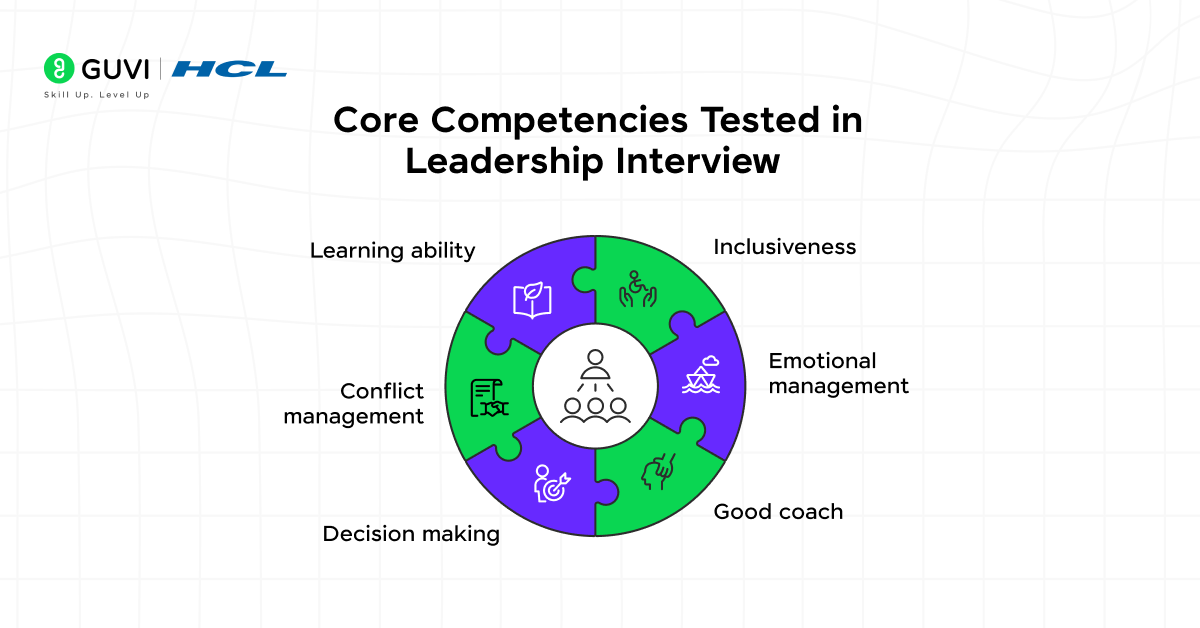
Inclusiveness: Leading a diverse group of individuals with much respect, fairness, and openness. It requires strong communication, ensuring that every voice is heard and valued.
Emotional Management: Ability to stay calm, composed, and aware of your emotions. Being skillful in responding thoughtfully in stressful situations rather than reacting impulsively.
Good Coach: Guiding team numbers with patience and supporting them. Giving people constructive feedback and helping them grow to their full potential.
Decision Making: Decision making is the skill of evaluating information, considering alternatives, and choosing the best course of action with confidence.
Conflict Management: Conflict management is the ability to address disagreements in a healthy, solution-oriented way.
Learning Ability: Learning ability refers to a leader’s openness to new ideas, willingness to acquire new skills, and capacity to adapt quickly.
How to Prepare for Leadership Interview Questions
Here is a simple preparation list for your leadership interview. Learn effective ways to prepare.
These structured storytelling methods will help you answer clearly and show your leadership skills with confidence.
Research Company
Research the company’s mission, vision, and core values.

Identify Your Leadership Style
Prepare a leadership philosophy to help you communicate authentically and consistently throughout the interview.
Use Framework
Here is a simple preparation list for your leadership interview. Know how to prepare for a leadership interview. These structured storytelling methods will help you answer better and show your leadership skills clearly.
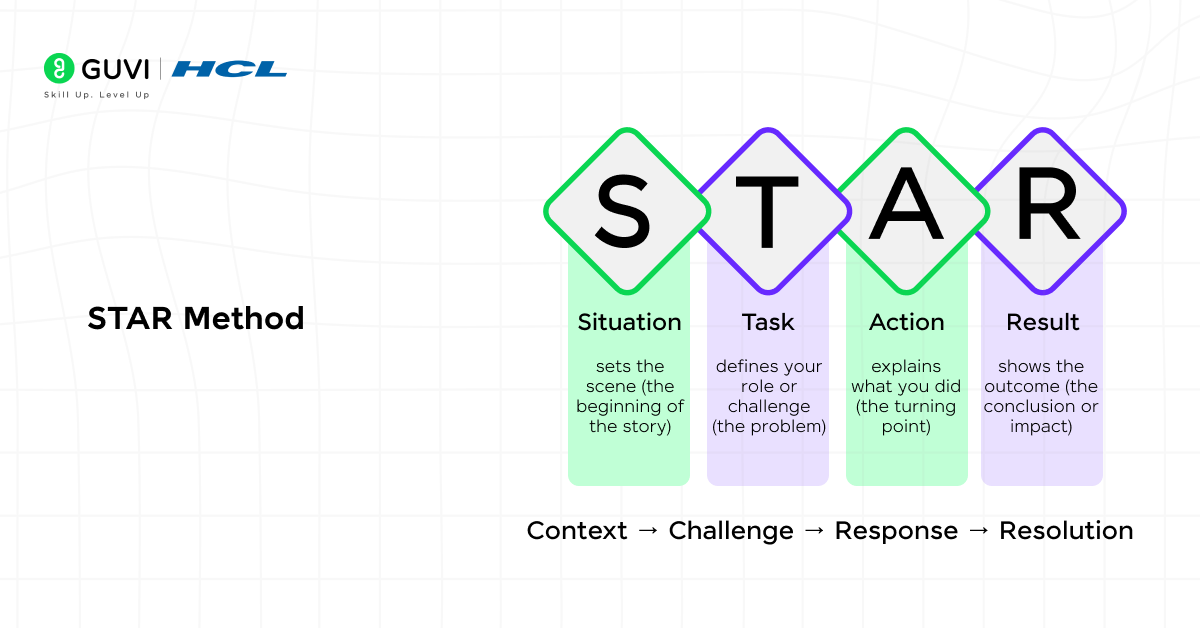
STAR Method (Situation, Task, Action, Result)
| Situation | Briefly set the context—what was happening? |
| Task | What were you responsible for? |
| Action | What specific steps did you take? |
| Result | What happened? Use metrics when possible (e.g., boosted retention by 25%, delivered ahead of schedule). |
CAR Method (Challenge, Action, Result)
A streamlined version of STAR. Combine the situation + task into the challenge, then explain your actions and the outcomes.
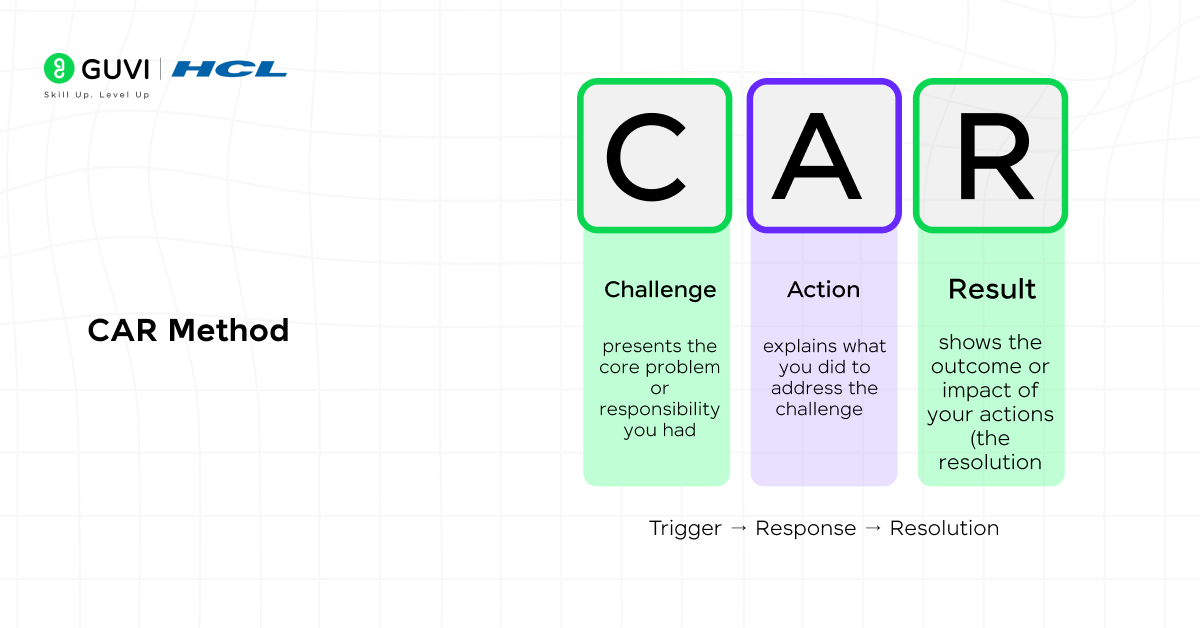
| Challenge | Briefly describe the main problem or obstacle you faced. |
| Action | Explain the specific steps you took to handle the challenge. |
| Result | Share the outcome. Use numbers or measurable impact when possible (e.g., reduced errors by 30%, improved delivery speed by 20%). |
SOAR Method (Situation, Obstacle, Action, Result)
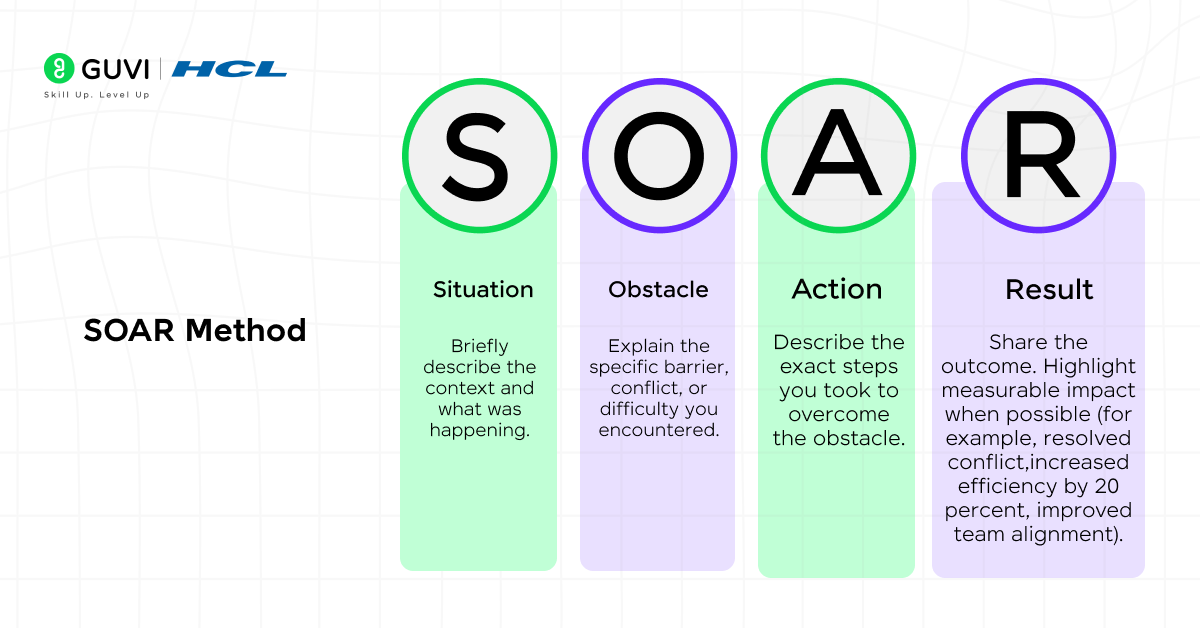
| Situation | Briefly describe the context and what was happening. |
| Obstacle | Explain the specific barrier, conflict, or difficulty you encountered. |
| Action | Describe the exact steps you took to overcome the obstacle. |
| Result | Share the outcome. Highlight measurable impact when possible (for example, resolved conflict, increased efficiency by 20 percent, improved team alignment). |
If you’re planning to step up your career as a leader, consider enrolling in HCL GUVI’s Problem-Solving & Resourcefulness course. This course is ideal for aspiring leaders. You’ll learn how to make effective decisions and develop strong organizational skills.
Top 10 Leadership Interview Questions (With Sample Answers)
Below are the top leadership questions and answers to help you prepare for your upcoming leadership interview.
1. What is your leadership style?
Why this question: To understand how you manage a team, and check whether your style aligns with the organization’s culture.
How to structure your answer: Start with a clear, concise definition of your leadership style. Provide a specific example that demonstrates this style and connect to the result.
Sample Answer: I am a collaborative leader who believes in empowering people to own their work. I set clear expectations and strategic direction, but I give my team autonomy in how they achieve goals.
2. Tell me about a time you led a team through a challenge.
Why this question: To assess your leadership strategy and how you support your team.
How to structure your answer: Focus on the challenge and its impact, highlight the strategies you used to support your team, and clearly explain the steps you took to guide them through the situation.
Sample answer: My team was stressed because the project scope changed suddenly. I explained the new priorities, divided the work clearly, and held short daily check-ins to help everyone stay on track. With clear guidance and support, the team worked smoothly again and finished the project on time.
3. How do you motivate your team?
Why this question: Interviewers want to understand what drives people. And to know whether you create an environment that encourages people to be committed and engaged.
How to structure your answer: Explain how you understand your team, give tasks that match their strengths, provide growth opportunities, and recognize achievements.
Sample Answer: I motivate my team by understanding what drives each person, giving matching tasks, offering growth chances, and celebrating wins together.
4. How do you handle conflict within your team?
Why this question: To check if you can handle people’s problems calmly, and to see how you address an issue constructively. It also shows whether you create psychological safety and handle disagreements respectfully.
How to structure your answer: This is the right place to show your listening skills. Focus on collaboration and demonstrate fairness in how you handle the situation.
Sample answer: I handle conflict by listening first and staying neutral. I talk to each person privately to understand their side, then bring them together to find common ground.
5. Describe a difficult decision you made as a leader.
Why this question: To understand your decision-making process and your ability to make tough calls.
How to structure your answer: Be real! Describe a difficult situation, explain the reason behind your decision, and highlight the positive outcome or what you learned from it.
Sample Answer: I once had to lay off a long-time team member after months of no improvement. It was difficult, but I handled it with care and learned that tough decisions need kindness.
6. How do you delegate tasks?
Why they ask this question: The interviewer wants to know if you help your team grow and learn, or if you just take over and make all the decisions yourself.
How to answer: Tell the truth! Explain what you believe about giving tasks to others, share a real example of how you did it, and show how it helped someone on your team become better at their job.
Sample answer: I give people tasks that are a little harder than they’ve done before to help them grow. I’m clear about what success looks like, but let them own the work.
7. What do you do when your team misses a deadline?
Why they ask this: They want to see how you handle tough situations. Do you blame others, or do you focus on fixing the problem and learning from it?
How to answer: Figure out what went wrong before pointing fingers. Show that you take responsibility, too. Explain how you would fix things now and make sure it doesn’t happen again. Show that you stay positive and keep moving forward.
Sample Answer: Find out why we missed the deadline instead of blaming anyone. Then, I help the team get back on track and make sure it doesn’t happen again.
For example, when a project got delayed by two weeks because it was harder than expected, we changed priorities, planned better, and learned to speak up early if something seemed off.
8. How do you develop future leaders?
Why they ask this: They want to see if you invest in people, think about the organization’s future, and build a strong team that can step up when needed.
How to answer: Show that you care about developing people. Explain specific ways you help them grow. Give an example of someone you’ve helped develop. Show how this helps the team and organization in the long run.
Sample answer: I give people challenging projects, mentor them, and involve them in bigger decisions so they can grow. For example, I helped a team member step into a lead role, coached her, and she later became a manager. I also encourage a culture where people can try new things and learn from mistakes.
9. How do you give constructive feedback?
Why they ask this: Interviewers want to see if you can give honest feedback in a respectful way and help people improve instead of just criticizing them.
How to answer: Show that you treat feedback as a helpful way of improvement. Explain how you give it, like timing, a private setting, and clear examples. Share a real example and show follow-up.
Sample answer: I see feedback to help people grow, so I give it carefully. I give it soon after the situation, privately, and focus on specific behaviors, not the person.
For example, an engineer was dominating meetings and blocking juniors from speaking. I said, “Yesterday, you answered most questions before others could. Was that intentional?” He didn’t realize it and agreed to pause more. His change made meetings much better, and I followed up to thank him.
10. How do you handle underperforming employees?
Why they ask this: They want to see if you handle performance issues fairly and effectively instead of letting them hurt the team.
How to answer: Understand why someone is underperforming. Support them with clear expectations and a plan. Show care while keeping standards, and document progress.
Sample answer: I start by understanding why someone is struggling. It could be unclear instructions, skills gaps, or personal issues. Then I make a clear plan with goals and check in regularly. For example, a team member’s work dropped because she was struggling with a new process. I paired her with a mentor and provided extra training, and her performance improved in six weeks. If someone still can’t meet expectations, I have honest conversations about next steps and help them transition fairly.
Other Common Leadership Interview Questions:
Describe a time you had to influence without authority.
What qualities make an effective leader?
How do you promote diversity and inclusion?
Tell me about a leadership failure and what you learned.
Why should we choose you for a leadership role?
1. Entry-Level Leadership Questions
- What is your leadership style?
- How do you motivate a small team?
- Tell me about a time you resolved a conflict in a group project.
- How do you handle missing deadlines or setbacks?
- How do you give constructive feedback to peers?
- How do you prioritize tasks for yourself and your team?
- How do you encourage collaboration among team members?
2. Experienced Leadership Questions
- Tell me about a time you led a team through a challenge.
- How do you develop future leaders on your team?
- Describe a difficult decision you made as a leader.
- How do you handle underperforming employees?
- How do you manage team morale during stressful projects?
- How do you balance short-term goals with long-term strategy?
- How do you influence others without formal authority?
3. C-Suite / Executive (CCO, CEO, COO) Leadership Questions
- What is your vision for the company/department over the next 3–5 years?
- How do you drive organizational culture and employee engagement?
- How do you manage large-scale change or transformation?
- How do you ensure alignment between different teams or departments?
- How do you balance stakeholder expectations with team needs?
- How do you promote diversity, equity, and inclusion at the top level?
Wrapping Up
The leadership interview may seem daunting, but proper preparation will help you confidently present your skills, experience, and potential. Be sure to understand the key competencies that hiring managers look for in their employees, structure your answers using frameworks like STAR, CAR, and SOAR, and support them with real-life examples.
Whether you’re getting ready to step into your first leadership role or are aiming for a C-suite position, practicing these questions and thinking about your leadership style will set you apart. Leadership is not commanding anymore; it is to inspire your team, be thoughtful in solving problems, and grow people. Prepare well, be authentic, and let your leadership shine.
Frequently Asked Questions
1. How do I get my first leadership role?
Do your best at your current job, help out with extra tasks, and solve problems. Ask for guidance, make good connections, and show you want to lead. Start small by leading a project or team. Leadership grows with practice and experience.
2. What skills do hiring managers look for in a leadership interview?
Hiring managers look for emotional intelligence, decision-making, communication skills, conflict management, team motivation, and the ability to handle pressure.
They also check if you can coach others, think strategically, and adapt quickly to change.
3. What makes a strong answer in a leadership interview?
A strong answer clearly explains the situation, your role, the actions you took, and the outcome.
Use metrics when possible, highlight your leadership behaviors, and connect your example to what the company needs. Authenticity and self-awareness make your answer stand out.
Success Stories

About the Author
Salini Balasubramaniam
A curious, information-savvy writer loves to turn deep insights into authentic and engaging content that connects. With experience in writing for brands and driving audience engagement, I believe that words can make a powerful difference.
View all posts by Salini Balasubramaniam
Connect with me @














Did you enjoy this article?