


Artificial Intelligence and Machine Learning Articles
Getting Started with LangChain Prompt Templates in 2026
Cursor 2.0: Trending AI Model Explained In-Depth
Creating Custom Swag Merchandise Using Generative AI
Create a Recipe with ChatGPT: A Guide to AI-Assisted Cooking


Get In Touch For Details! Request More Information

K-means Clustering Algorithm in Machine Learning: A Complete Beginner’s Guide
Aug 29, 2025 7 Min Read 3856 Views
(Last Updated)
Global market research indicates that nearly 80 percent of today’s leading organizations rely on data-driven strategies for informed decision-making. The interesting part is that the proficiency to organize unlabeled data often sets businesses apart. People often encounter vast and unlabeled datasets and find that organizing them manually requires considerable time and effort.
Anyone who wants to turn chaos into order in fields like marketing or image analysis can find a powerful tool in clustering algorithms. Read on, because this complete guide will walk you through the K-means clustering algorithm. It will provide you with a deep and practical look at how you can use it in real-world scenarios.
Table of contents
- What is K-means Clustering?
- How does the K-means clustering algorithm work?
- Evaluation Metrics for K-means Clustering Algorithm: How to Measure Cluster Quality and Compare Results
- Comparing K-means Clustering with Alternative Clustering Algorithms
- K-Means Algorithm Tutorial: Step-by-Step for Beginners
- Step 1: Prepare Your Data
- Step 2: Choose the Number of Clusters (k)
- Step 3: Initialize Centroids
- Step 4: Assign Data Points to the Closest Centroid
- Step 5: Update Centroids
- Step 6: Repeat
- Step 7: Use and Evaluate the Clusters
- K-Means Python Example: A Simple Walkthrough
- Advantages of K-means clustering algorithm
- Disadvantages and challenges of K-means clustering
- Applications and Use Cases of K-means Clustering Algorithm in Machine Learning
- Conclusion
- FAQs
What is K-means Clustering?
The K-means clustering algorithm belongs to centroid-based clustering and functions as an unsupervised learning algorithm that operates without preassigned labels. Here, k refers to the specific number of clusters the user wants the algorithm to form within the dataset.
How does the K-means clustering algorithm work?
The K-means clustering process in machine learning starts by choosing a value for k that matches the number of clusters desired. This step is guided by either intuition or statistical techniques.
With K-means++ initialization, centroids are strategically placed to be far apart. This step reduces the chance of poor clustering results. Each data point is then assigned to the nearest cluster centroid using Euclidean distance. It forms the initial clusters that will be refined through the algorithm’s main cycle.
Next, the algorithm updates each centroid’s position by computing the mean of all points currently belonging to that cluster. This two-step process repeats until cluster memberships stop changing or a predetermined maximum number of iterations is reached. The spherical K-means variant is usually selected when working with high-dimensional or textual data. It normalizes each vector and uses cosine similarity instead of Euclidean distance.
The entire process that drives K-means clustering is known as Lloyd’s algorithm. Whenever someone talks about “running K-means,” this is the underlying routine they are describing, a repeatable series of steps that gradually organize your data into k groups by moving centroids and regrouping points until each cluster is as tight as possible.
Think of it this way:
If you were sorting marbles into k bowls, you’d first put the bowls anywhere. Then, you’d place each marble in the bowl it’s closest to. Next, you’d move each bowl to the average spot of all its marbles. By repeating this process, you’d quickly see all marbles sorted into groups. Lloyd’s algorithm does exactly this, but with your dataset.
Don’t just read about clustering, apply it! Join thousands of learners mastering AI and ML with real-world datasets in the Artificial Intelligence and Machine Learning course (with Intel Certification). Earn a globally recognized credential and accelerate your future in machine learning, start your journey today!
Evaluation Metrics for K-means Clustering Algorithm: How to Measure Cluster Quality and Compare Results
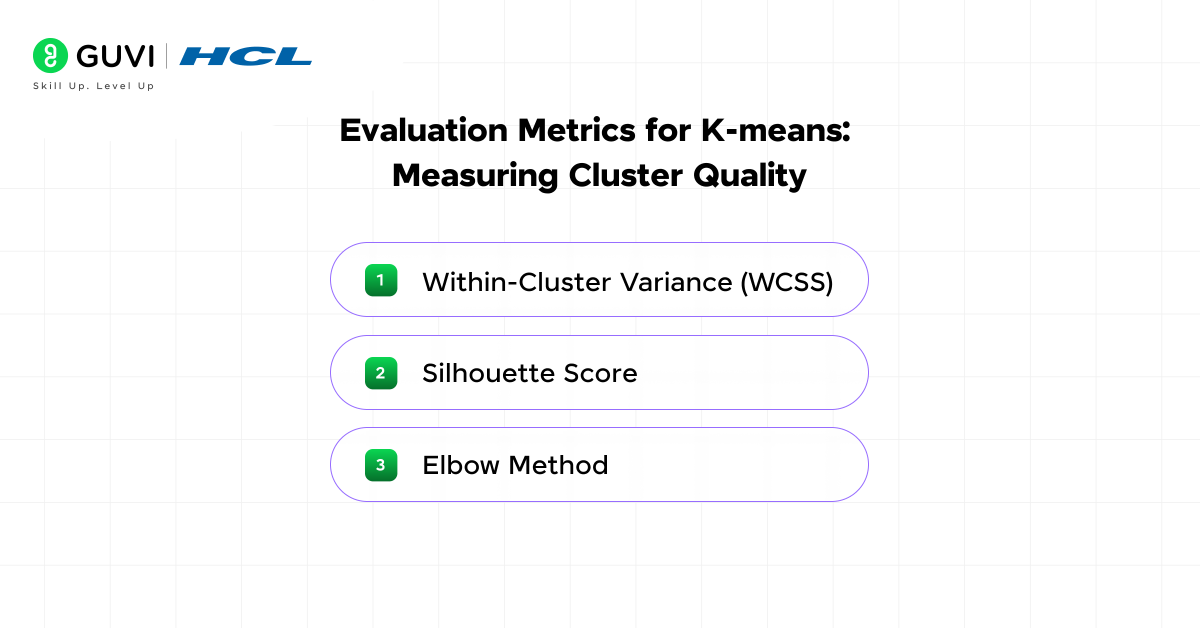
- Within-Cluster Variance (WCSS)
Within-cluster variance (WCSS) is sometimes called inertia. It measures the sum of squared distances between every data point and its assigned cluster centroid. Lower WCSS values indicate that data points are tightly grouped around centroids, which results in compact and well-separated clusters.
This metric is directly optimized during each iteration of the K-means clustering algorithm through Lloyd’s algorithm. Monitoring WCSS at each step is crucial for evaluating both model fit and the impact of changing k.
2. Silhouette Score
The Silhouette score is a powerful external metric for validating K-means clustering results. This score takes into account both how similar an object is to its cluster (cohesion) and how different it is from other clusters (separation).
Scores range from -1 to +1; higher values mean that clusters are both compact and well separated, while scores near zero or negative values point to ambiguous or misclassified samples. Using the Silhouette score across different values of k can guide you in determining optimal k in K-means and spotting poor or overlapping clustering.
3. Elbow Method for K-means
The elbow method K-means technique helps data scientists and analysts visually choose the right number of clusters. After running K-means for a range of k values and plotting the WCSS for each, you look for the point where further increases in k produce only marginal improvements.
The curve “bends” at this point, forming an elbow. This k offers a practical balance between minimizing within-cluster variance and avoiding unnecessary model complexity. The elbow method is indeed one of the most searched and reliable approaches for determining optimal k in K-means.

Comparing K-means Clustering with Alternative Clustering Algorithms
Benchmarking the K-means clustering algorithm against alternative methods like the Gaussian mixture model, k-medians, and k-medoids is essential for modern machine learning projects. While K-means excels with large and evenly sized clusters, its performance can degrade with non-globular shapes or datasets prone to outliers.
The Gaussian mixture model offers more flexible and probabilistic cluster boundaries and excels with overlapping or elliptical data distributions. Meanwhile, k-medians and k-medoids provide resilience against outliers and irregular structures by relying on medians or representative data points, which makes them ideal for data with non-Euclidean or noisy characteristics.
| Algorithm | Cluster Shape Assumption | Handles Outliers Well | Cluster Assignment | Evaluation Metrics | Best Use Cases | Weaknesses |
| K-means Clustering | Spherical, equal size | No | Hard (nearest centroid) | WCSS, Silhouette score | Large, uniform datasets, customer segmentation | Sensitive to outliers, struggles with irregular shapes |
| Gaussian Mixture Model | Elliptical, overlapping | Somewhat | Probabilistic | Log-likelihood, BIC, Silhouette score | Overlapping clusters, mixed density data | More complex, needs more computation |
| K-Medians | Arbitrary | Yes | Hard (nearest median) | WCSS (using medians), Silhouette score | Data with outliers, non-Euclidean spaces | Slower than K-means, less interpretable centroids |
| K-Medoids | Arbitrary | Yes | Hard (nearest medoid) | Total dissimilarity, Silhouette score | Noisy data, categorical or mixed data types | Computationally intensive, sensitive to initialization |
K-Means Algorithm Tutorial: Step-by-Step for Beginners
K-means clustering is an easy-to-understand machine learning method that automatically sorts data into groups, called clusters. If you follow these steps, you’ll be able to organize any unlabeled dataset into meaningful segments.
Step 1: Prepare Your Data
Start with your raw data, which could be customer spending, website activity, sensor readings, or even colors in an image. Make sure your data is numeric, since K-means works by measuring distances.
Step 2: Choose the Number of Clusters (k)
Decide how many groups (k) you want to find. Sometimes you know this from business goals; other times, you can use the elbow method or Silhouette score to help you decide. Remember, k is a number you set for the algorithm.
Step 3: Initialize Centroids
K-means begins by picking k points as the starting centers, called centroids. With K-means++ initialization, these first centers are chosen to be far apart from each other, which helps the algorithm work better.
Step 4: Assign Data Points to the Closest Centroid
For every data point, the algorithm finds which centroid is closest. That point joins the cluster represented by that centroid. You can picture this as every customer, pixel, or document joining the nearest team.
Step 5: Update Centroids
Now, for each cluster, calculate the average of all its points. Move the centroid to this new average position. Each centroid always represents the “center” of its group.
Step 6: Repeat
Keep repeating Steps 4 and 5:
- Reassign points to the nearest centroid
- Recalculate the centroids
The process stops when points don’t switch clusters anymore, or after a set number of repetitions. At this point, your clusters are ready.
Step 7: Use and Evaluate the Clusters
Now you can use your clusters for marketing segments, anomaly detection, data visualization, or any business task. Check if the clusters make sense and use evaluation metrics (like WCSS or Silhouette score) to measure how well your clusters fit the data.
K-Means Python Example: A Simple Walkthrough
Let’s walk through a real beginner example using Python’s popular scikit-learn library. This example shows how to group customers based on two features: annual spending and number of visits.
# Step 1: Import libraries
from sklearn.cluster import KMeans
import numpy as np
import matplotlib.pyplot as plt
# Step 2: Example data (annual spending, visits per year)
data = np.array([
[300, 4],
[320, 5],
[340, 6],
[1000, 40],
[1050, 42],
[1080, 39],
[60, 1],
[80, 2],
[75, 1]
])
# Step 3: Choose k (let’s try 3 clusters)
k = 3
kmeans = KMeans(n_clusters=k, init=’k-means++’, random_state=0)
# Step 4: Fit the model and predict cluster
labels = kmeans.fit_predict(data)
# Step 5: Get cluster centroids
centroids = kmeans.cluster_centers_
# Step 6: Visualize the clusters
plt.scatter(data[:, 0], data[:, 1], c=labels, cmap=’viridis’, label=’Customers’)
plt.scatter(centroids[:, 0], centroids[:, 1], marker=’X’, s=200, c=’red’, label=’Centroids’)
plt.xlabel(‘Annual Spending’)
plt.ylabel(‘Visits per Year’)
plt.title(‘K-Means Clustering Example (Python)’)
plt.legend()
plt.show()
What happens in this code:
- The customers are grouped into 3 clusters based on spending and visits.
- Each cluster has a centroid that represents the “average” customer in that segment.
- The scatter plot helps you see how customers are grouped and where the centroids are.
Advantages of K-means clustering algorithm
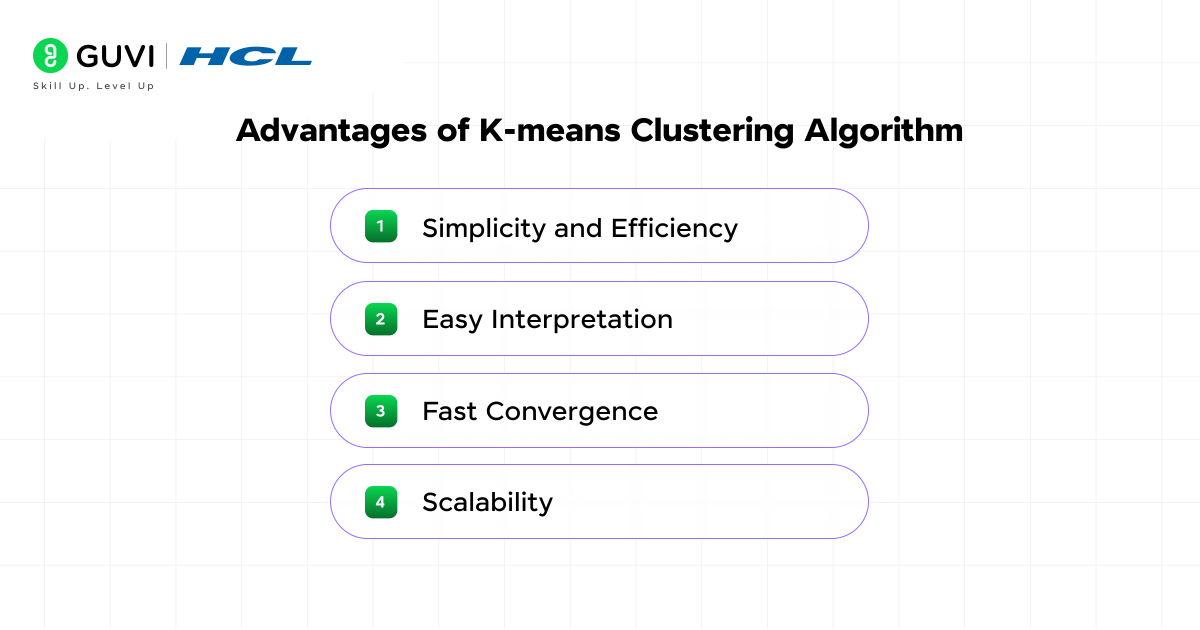
Here are the leading pros of the K-means clustering algorithm:
- Simplicity and Efficiency
The K-means clustering algorithm is straightforward to implement. It relies on basic mathematics, just distance calculations, and mean updates. Even beginners can use it effectively, and its efficiency is especially clear when using mini-batch K-means. It further enables clustering of extremely large datasets by processing small and random samples at a time without sacrificing too much accuracy.
- Easy Interpretation
Each resulting cluster comes with a centroid that summarizes the “average” characteristics of the data points it contains, which makes results easy to understand and communicate. This transparency enables both technical and non-technical stakeholders to see how data is grouped and why particular points belong together, based simply on proximity to the cluster centroid.
- Fast Convergence
K-means stands out for its capacity to reach stable clusters rapidly. K-means++ initialization makes this process even more reliable by starting with a smart spread of centroids. It does this by avoiding the slowdowns and errors that come from poor initial placement.
- Scalability
The algorithm scales nearly linearly with both the number of data points and the number of features, which is rare among clustering methods. Techniques like mini-batch K-means allow practitioners to apply K-means to massive datasets, millions of rows are routinely clustered on ordinary hardware, therefore making it a favorite for both research and business analytics.
Disadvantages and challenges of K-means clustering
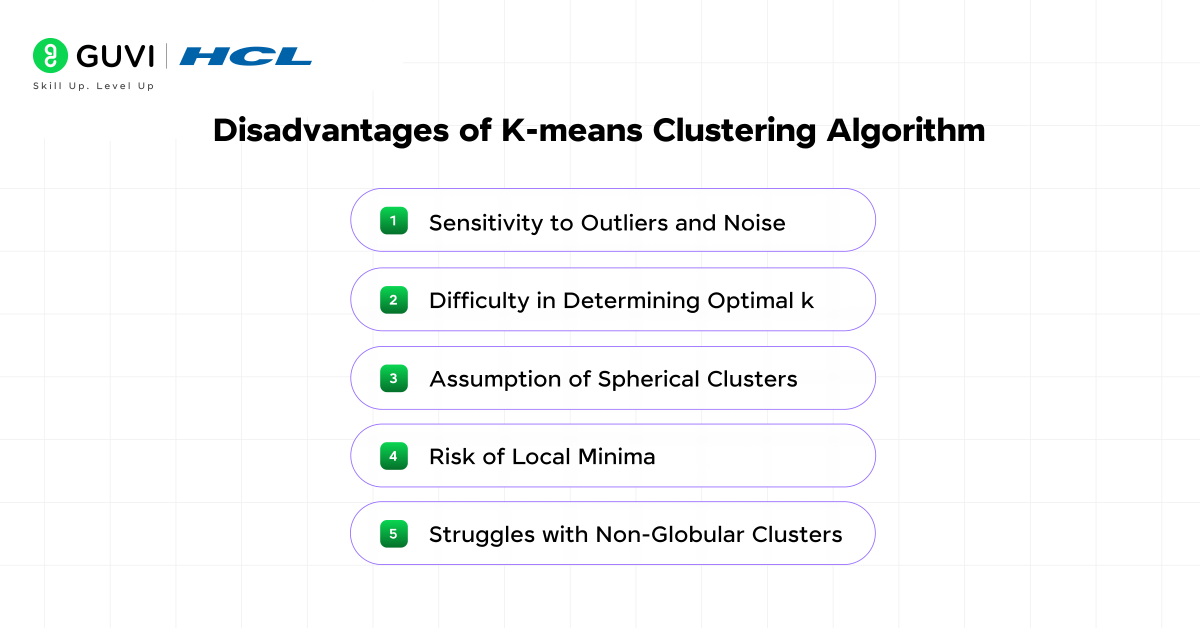
- Sensitivity to Outliers and Noise
K-means clustering is highly sensitive to outliers and noisy data. A single extreme value can significantly shift the cluster centroid. Careful preprocessing or outlier filtering is constantly necessary to maintain clustering quality.
- Difficulty in Determining Optimal k
Choosing the most appropriate k remains a persistent challenge. Relying on domain expertise and quantitative metrics such as the silhouette score is quite necessary. Incorrect selection can result in clusters that are too broad or overly fragmented, which reduces the utility of the analysis.
- Assumption of Spherical Clusters
K-means inherently assumes that all clusters are roughly spherical and of similar size. K-means may fail to identify meaningful groupings when data contains elongated or variably dense clusters. It often results in splitting or merging clusters inappropriately.
- Risk of Local Minima
The algorithm can become trapped in local minima, particularly if initial centroids are poorly chosen. K-means++ initialization and running the algorithm multiple times with different seeds can help reduce this risk, but cannot guarantee finding the absolute best solution.
- Struggles with Non-Globular Clusters
K-means often produces misleading or artificial results when the true structure of the data involves non-globular shapes or widely varying densities. In such situations, approaches like the Gaussian mixture model or robust alternatives such as k-medians and k-medoids can deliver more faithful and accurate clustering.
Applications and Use Cases of K-means Clustering Algorithm in Machine Learning
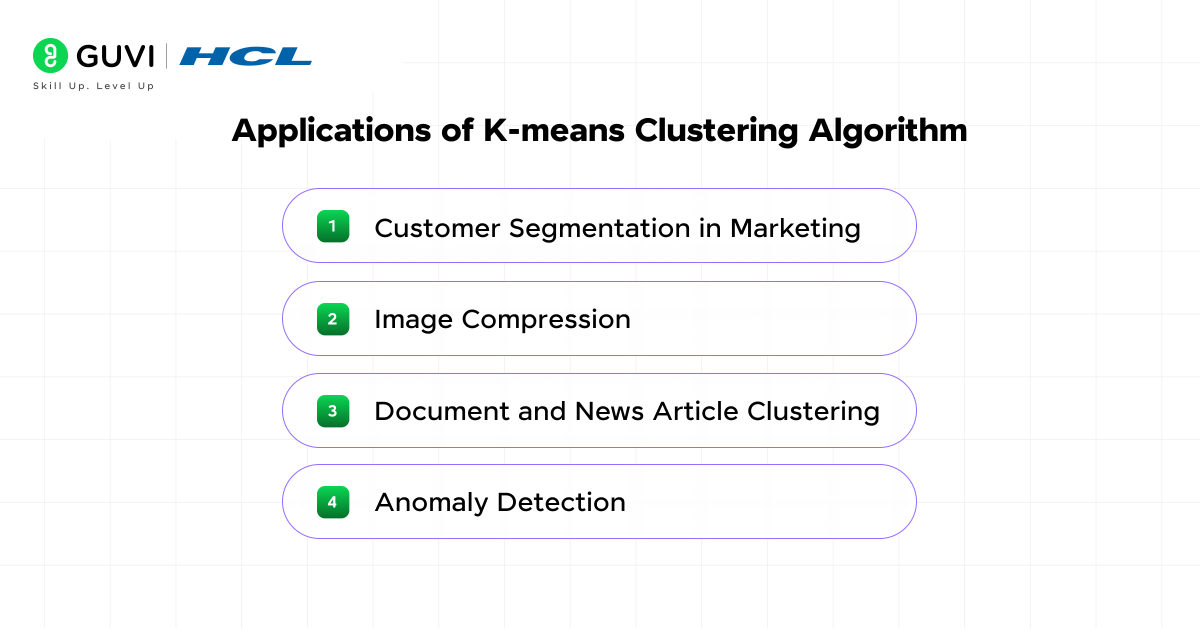
- Customer Segmentation in Marketing
One of the most popular and effective applications of the K-means clustering algorithm is customer segmentation in marketing analytics. Retailers and service providers often have large and unlabeled datasets containing transaction history and engagement metrics.
Businesses can automatically group customers into segments based on shared purchasing habits or frequency of interaction by applying K-means. Each cluster centroid summarizes the typical profile of that segment, which makes it straightforward to design targeted marketing campaigns and allocate resources to the most profitable groups. This approach helps companies understand their customer base at a granular level and increase revenue.
- Image Compression
K-means clustering is a cornerstone of fast image compression in computer vision and digital graphics. The algorithm clusters all pixel colors in an image into k groups. Each pixel is then replaced with the color of its nearest cluster centroid. It drastically reduces the number of unique colors while preserving the main visual content.
This results in much smaller image file sizes, which is pretty essential for optimizing web performance or transmitting images in bandwidth-constrained environments. Because K-means is both efficient and easy to implement, it remains a go-to solution for quick color quantization in both research and industry applications.
- Document and News Article Clustering
Organizing and analyzing massive collections of text, such as news articles or support tickets, is streamlined by K-means clustering. Documents are first represented as high-dimensional feature vectors (for example, using TF-IDF weights). The K-means clustering algorithm or spherical K-means for text data using cosine similarity, then groups documents into clusters where each one corresponds to a specific topic or news category.
This makes it easier for organizations to build topic-based recommendation systems and improve search relevance. K-means helps reduce information overload by enabling automated and scalable document categorization.
- Anomaly Detection
Anomaly detection in fields such as finance and manufacturing benefits greatly from K-means clustering. The core idea is that normal data points will belong to dense clusters, while outliers or rare events will be far from any cluster centroid or in sparse and fringe clusters.
The K-means clustering algorithm can flag potential fraud in financial transactions or detect faulty machinery in industrial sensor data by measuring the distance between each observation and its centroid. Its efficiency allows analysts to run large-scale anomaly detection in real time or near-real time.
Conclusion
The K-means clustering algorithm remains a foundational tool in the machine learning toolkit due to its simplicity and versatility. While it shines for data that fits its assumptions, knowing when to use alternatives like the Gaussian mixture model or k-medians / k-medoids confirms long-term robust results. Mastering its workflow and interpretation encourages efficient discovery of patterns and structure in diverse and unlabeled datasets.
FAQs
1. What industries benefit the most from K-means clustering in real-world machine learning projects?
K-means clustering benefits a wide range of industries, including e-commerce, healthcare, finance, and cybersecurity. In e-commerce, it’s used for personalized marketing and product recommendation systems. In healthcare, it helps cluster patient symptoms or genetic profiles for targeted treatments. Financial analysts apply it to detect spending patterns and group risk profiles, while cybersecurity teams use it for clustering potential threats in network traffic analysis.
2. Can K-means clustering be used in unsupervised feature engineering for machine learning models?
Yes, K-means clustering is commonly used in unsupervised feature engineering. It helps supervised models (like decision trees or logistic regression) capture latent patterns in raw data by creating cluster labels as new categorical features.
3. How does K-means clustering help in time-series data segmentation and analysis?
K-means can segment time-series data by treating windowed segments or statistical summaries (like rolling averages) as input vectors. It allows the algorithm to identify recurring behaviors or seasonal trends.
4. What are the computational limitations of K-means clustering in high-dimensional datasets?
K-means clustering can suffer from the curse of dimensionality, where distance measures become less meaningful. Data points tend to appear equally distant from centroids as dimensions increase, which further degrade clustering quality. Techniques like dimensionality reduction (e.g., PCA or t-SNE) are required before applying K-means to guarantee meaningful and computationally efficient clustering.
5. How does K-means clustering support recommender systems and personalization engines?
K-means helps recommender systems by clustering users or items based on shared behaviors or features. For example, users can be grouped by browsing patterns or product ratings, and each group receives tailored content or product recommendations. This technique improves personalization accuracy.
Success Stories

About the Author
Vaishali
I'm a seasoned writer with four years of experience across technical, non-technical, and just about every genre or niche you can imagine. Adaptable and curious, I enjoy exploring new topics and making information engaging and easy to understand. Fueled by a steady stream of tea, I approach each project with creativity, reliability, and genuine enthusiasm for storytelling.
View all posts by Vaishali
Connect with me @














Did you enjoy this article?